×

Namibia🇳🇦 | best hikesYour Guide to the 5 Best hikes in Namibia

Hiking in Namibia means walking through space: pale gravel plains that tick as they heat up, red dunes that squeak underfoot, and granite that smells of dust and dry thyme after a rare shower. Trails are few and far apart, and most are self-guided, so independent travelers do well here. The south offers canyon and desert routes with permits and fixed overnight stops. The Namib coast and central highlands have day walks near lodges and campsites. The north and northwest are quieter, rougher and often need a 4x4 to reach. Crowds are thin, but distances and heat are real.

By Johan Kruseman 🇳🇱 | Updated October 23, 2026
Explore the best beaches in Namibia

Why go?Understanding Their Importance

Namibia is the least densely populated country in Africa south of the Sahara, with roughly 3 million people across more than 800,000 square kilometers. That emptiness shapes every hike. Horizons run to the edge of the world, nights are loud with stars and almost silent otherwise, and the air is bone dry, so sweat evaporates before you feel it. Geology does the showing off: ancient rock, escarpments and some of the oldest desert on Earth, with colors that shift from rust to violet at dawn and dusk.

Before choosing Namibia, understand the infrastructure. Roads are good tarmac between towns and gravel everywhere else, and public transport rarely reaches trailheads, so most hikers rent a car. Many trails sit inside national parks or private reserves that require permits or fees, and some limit … read more 👉
Namibia is the least densely populated country in Africa south of the Sahara, with roughly 3 million people across more than 800,000 square kilometers. That emptiness shapes every hike. Horizons run to the edge of the world, nights are loud with stars and almost silent otherwise, and the air is bone dry, so sweat evaporates before you feel it. Geology does the showing off: ancient rock, escarpments and some of the oldest desert on Earth, with colors that shift from rust to violet at dawn and dusk.

Before choosing Namibia, understand the infrastructure. Roads are good tarmac between towns and gravel everywhere else, and public transport rarely reaches trailheads, so most hikers rent a car. Many trails sit inside national parks or private reserves that require permits or fees, and some limit group size or require booking ahead. Water is scarce, and you carry nearly all of it, often 3 to 5 liters per person per day. Shade is rare, and midday sun on rock can burn through boot soles. Mobile coverage drops out fast. Come prepared for self-reliance, and the country gives you solitude few places can match.
Evaluating the Top Choices
The list of best hikes in Namibia is created based on scenery, challenge, trail quality, landmarks, and overall enjoyment. If you feel a hike is missing in this list, please let us know.

When to go?Best Time to Visit Namibia for hikes

Best months and weather: The best months for hiking in Namibia are May to September, the dry winter, when days reach 20 to 28°C (68 to 82°F) and rain is almost absent. Mornings can be cold, dropping near freezing in the desert and highlands, and the low light turns rock gold and long-shadowed. Air is crisp, and dust hangs less heavily than later in the year.

Shoulder seasons and heat: April and October are good shoulders, with warm days and fewer visitors. From November to March, the inland south and the Namib regularly pass 38°C (100°F), and midday hiking becomes risky. Rain falls mostly between December and March, especially in the north and east, with annual totals under 100 mm in the desert and 400 to 600 mm in the north. Storms can turn dry riverbeds into flash floods and make gravel … read more 👉
Best months and weather: The best months for hiking in Namibia are May to September, the dry winter, when days reach 20 to 28°C (68 to 82°F) and rain is almost absent. Mornings can be cold, dropping near freezing in the desert and highlands, and the low light turns rock gold and long-shadowed. Air is crisp, and dust hangs less heavily than later in the year.

Shoulder seasons and heat: April and October are good shoulders, with warm days and fewer visitors. From November to March, the inland south and the Namib regularly pass 38°C (100°F), and midday hiking becomes risky. Rain falls mostly between December and March, especially in the north and east, with annual totals under 100 mm in the desert and 400 to 600 mm in the north. Storms can turn dry riverbeds into flash floods and make gravel roads slick. The coast stays cooler, around 15 to 22°C, with fog rolling in on summer mornings.

Crowds and prices: July to October is peak season. Lodges and campsites in popular areas fill, so book weeks ahead, and rates can run 20 to 40 percent higher than in the green season. Permit-controlled trails often have limited departure dates, which also sell out in winter.

hike hoppingTips for Visiting Multiple Destinations

How long you need: A trip combining several hikes in Namibia needs 12 to 21 days, because the driving between regions is long and the walking itself is the short part. Plan on 4 to 7 hours behind the wheel on many transfer days, much of it on gravel with a shimmering heat haze after midday.

Regions and direction: The country clusters naturally into south, central Namib and coast, and north or northwest. Starting in Windhoek, where most flights land and car rentals are easiest, travelers usually head south first, then swing northwest through the desert toward the coast, and finish in the north or loop back. Windhoek to the far south takes about 8 to 9 hours, central Namib to the coast around 4 to 5, and the coast to the northwest roughly 6 to 8. Allow 2 to 3 nights at each base so you can … read more 👉
How long you need: A trip combining several hikes in Namibia needs 12 to 21 days, because the driving between regions is long and the walking itself is the short part. Plan on 4 to 7 hours behind the wheel on many transfer days, much of it on gravel with a shimmering heat haze after midday.

Regions and direction: The country clusters naturally into south, central Namib and coast, and north or northwest. Starting in Windhoek, where most flights land and car rentals are easiest, travelers usually head south first, then swing northwest through the desert toward the coast, and finish in the north or loop back. Windhoek to the far south takes about 8 to 9 hours, central Namib to the coast around 4 to 5, and the coast to the northwest roughly 6 to 8. Allow 2 to 3 nights at each base so you can hike early and rest through the midday heat.

Planning mistakes: The classic error is cramming too many regions into too few days, which leaves you driving at dusk, when kudu, oryx and cattle wander onto roads. Set off by mid-morning and arrive before 5 p.m. Another is trusting a map distance, since gravel cuts average speed to 50 to 70 km/h. Add buffer days, refuel at every town, and carry a full-size spare tire.

The ListHighly Recommended hikes of Namibia

1 Fish River Canyon

Permit-only canyon trek, sandbank camps, scree descent, Ai-Ais hot springs

Descend from the Hobas rim into a 550-meter-deep gorge, then wade and walk the riverbed for days before soaking in hot springs.

Namibia - Fish River Canyon

2 Namib Naukluft Trail

Eight-day hut circuit, dolomite plateau, tufa pools, chain sections

Carry your own food up a shadeless escarpment, haul over chained rock steps, and cool off in cold pools beneath mineral overhangs.

3 Tok Tokkie Trail

Guided three-day walk, fog beetles, fairy circles, Nubib views

Walk 10 to 14 kilometers a day with a tracker through NamibRand dunes and gravel plains, sleeping in open camps under dark skies.

namibia-hike-tok-tokkie-trail
© Google |

4 Olive Trail

Self-guided loop, quiver trees, granite boulders, hyrax rocks

Follow a few hours of stony track across the Khomas Hochland, passing quiver trees and boulder fields with open views toward the Namib plains.

namibia-hike-olive-trail
© Google |

5 Spitzkoppe

Granite domes, rock arch, San paintings, unmarked scrambles

Scramble polished slabs to a natural arch and a painted overhang, then camp between boulders under a dark, wide sky.

Loading the map 🌍

Expert viewExpert Commentary on hikes

How many hikes to plan: Three to five hikes is the number I would advise for one trip. Distances between trailheads are huge, and each hike needs a rest day and a driving day around it, so a longer list becomes a car tour with sore feet. Fewer hikes also leave room for the heat, which forces you to walk at dawn and stop by late morning.

Choosing the kind of hike: First-timers and short-trip travelers do best with day walks near lodges and campsites: marked, shaded in places, and easy to bail out of. Experienced hikers who want solitude should choose a multi-day, permit-controlled trail, where you carry food, sleep in basic huts or in the open, and see few other people. Budget travelers can skip pricey guided desert excursions and pick self-guided trails, which cost less and run at your own … read more 👉
How many hikes to plan: Three to five hikes is the number I would advise for one trip. Distances between trailheads are huge, and each hike needs a rest day and a driving day around it, so a longer list becomes a car tour with sore feet. Fewer hikes also leave room for the heat, which forces you to walk at dawn and stop by late morning.

Choosing the kind of hike: First-timers and short-trip travelers do best with day walks near lodges and campsites: marked, shaded in places, and easy to bail out of. Experienced hikers who want solitude should choose a multi-day, permit-controlled trail, where you carry food, sleep in basic huts or in the open, and see few other people. Budget travelers can skip pricey guided desert excursions and pick self-guided trails, which cost less and run at your own pace. Wildlife enthusiasts are better off in the north, where animal encounters are part of the walk and a guide matters.

What it costs: Expect roughly US$60 to 120 a day for an independent hiker: car rental shared between two or three people (US$40 to 70 a day plus fuel), campsite fees of N$150 to 400 (US$8 to 22) per person, and food from supermarkets. Park entry usually runs N$80 to 150 (US$4 to 8) a person plus a vehicle fee. Permits for the classic multi-day trails cost around US$20 to 50 per person per night. Local guides add US$30 to 80 a day. Cooking your own meals saves a lot, since restaurant dinners in remote lodges are expensive.

Safety and cultural points: Namibia is generally safe, and the biggest danger is dehydration. Water sources are unreliable, so carry more than you think you need and leave your plan with your lodge. Heat illness arrives quietly, often as a headache and a dry mouth, so start early and rest in shade. Cell coverage vanishes, so a satellite messenger or offline maps are worth bringing. Avoid dry riverbeds when clouds build in the distance, as flash floods arrive without warning.

On communal land, ask before camping or crossing fences and pay any local fee. Greet people, since a handshake and a short hello matter, and ask permission before photographing individuals, especially in Himba and Herero communities. Take all rubbish out, as nothing breaks down in the desert.

✈️ The backpacker research shortcutNamibia Travel Guide

An offline-friendly backpacking guide with optimized travel routes, ranked highlights, transport advice, and the best areas to stay.
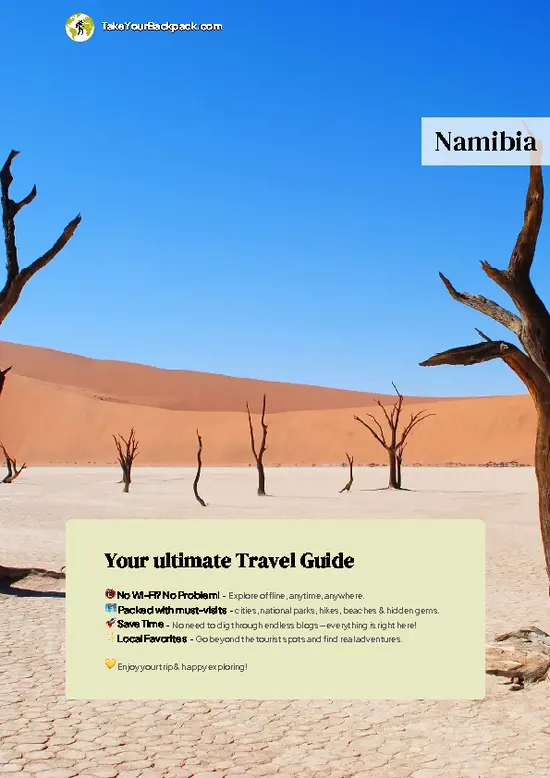
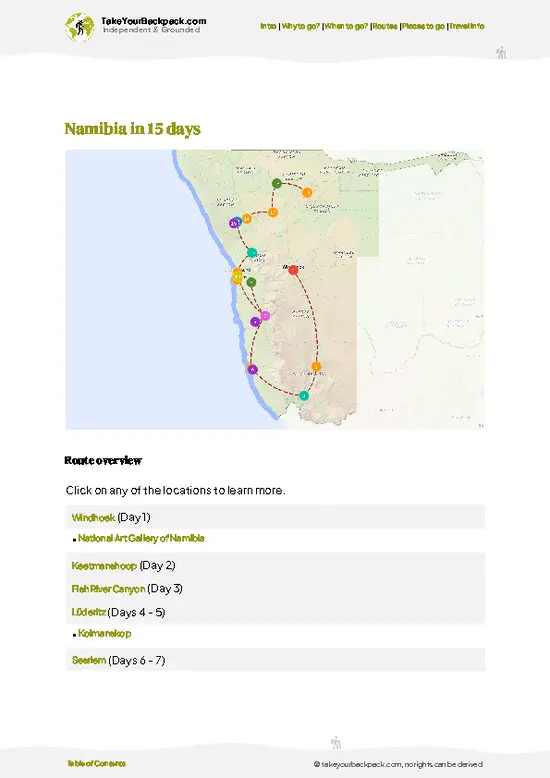
example page 0 from our offline Travel Guide for Namibia
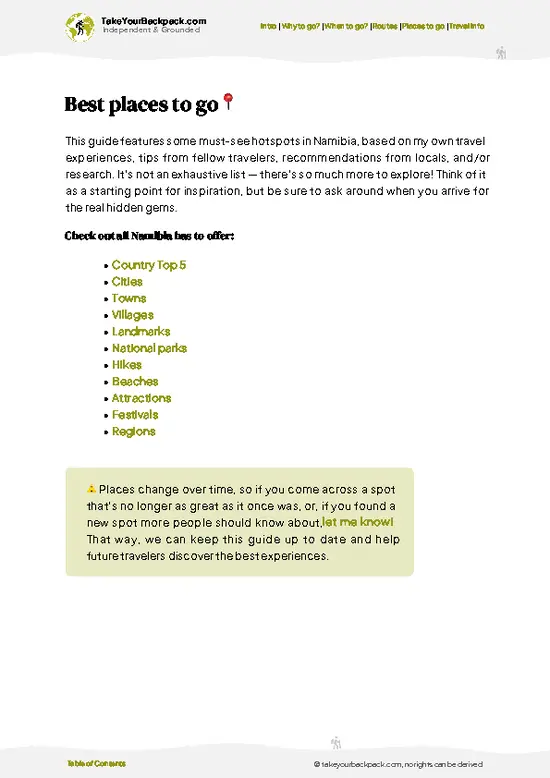
example page 1 from our offline Travel Guide for Namibia
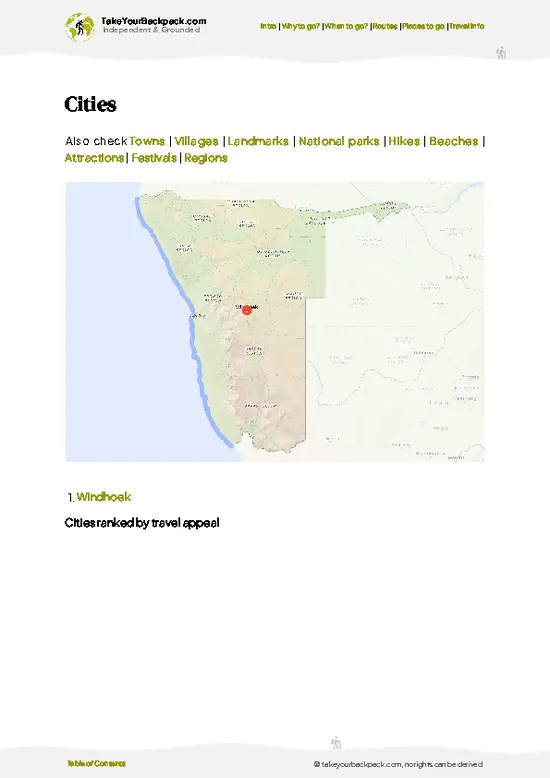
example page 2 from our offline Travel Guide for Namibia
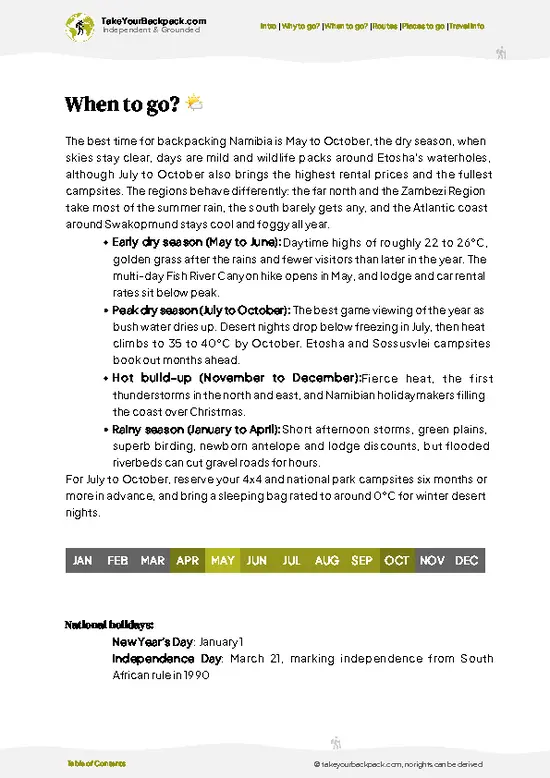
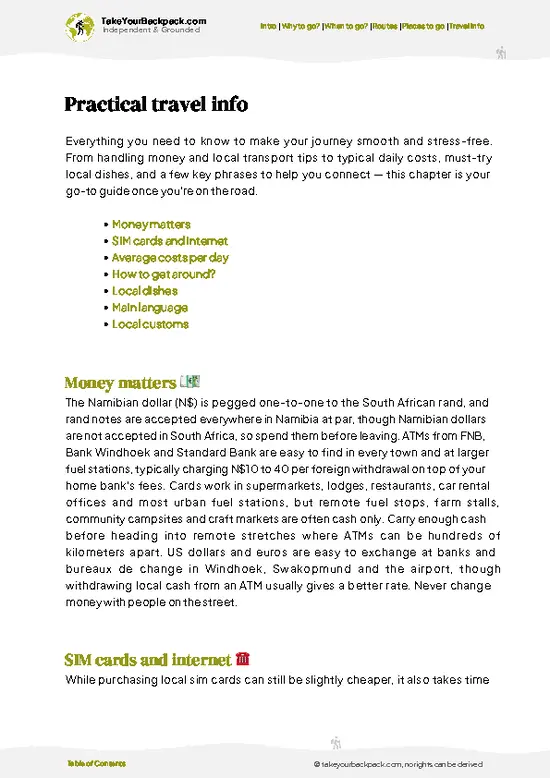
example page 3 from our offline Travel Guide for Namibia
example page 4 from our offline Travel Guide for Namibia
example page 5 from our offline Travel Guide for Namibia
example page 6 from our offline Travel Guide for Namibia
example page 7 from our offline Travel Guide for Namibia
The digital guide (294 pages) contains:
✅ 71 highlights, ranked by travel appeal
✅ Optimized 5, 10 & 15-day travel routes
✅ Cities, national parks, landmarks, beaches
✅ How to get around
✅ Offline-friendly for travel without Wi-Fi
👉 Click to see all 30+ guide features

📅 Plan smarter in minutes, not weeks
✅ Month by month travel advice
✅ Festivals & national holidays
✅ Budget expectations

🗺️ Go to the right places, skip the overrated ones
✅ Honest pros & cons of destinations
✅ Top hikes, parks & viewpoints
✅ Lesser-known places most travelers miss
✅ Clear “worth it vs skip it” guidance

🛏️ Travel smoothly without rookie mistakes
✅ Best areas to stay
✅ Transport systems explained simply
✅ Common scams & safety advice
✅ SIM cards, money & practical tips

🌍 Understand the country, not just visit it
✅ Culture & traditions
✅ 52 Essential phrases & customs
✅ Festivals worth planning around
✅ Traveler-friendly historical context
✅ Insights that make places more meaningful

📱 Built for real travel conditions
✅ Fully downloadable PDF
✅ Works completely offline
✅ Optimized for phone use
✅ Useful in remote areas & buses
✅ Everything in one place
Stop searching, start planning
Get instant access to your full guide. 30‑day money-back guarantee.
+ Add another guide for just

By proceeding you agree to our terms.
Sent to your inbox immediately after payment • 100% Secure Checkout
Best Backpacking Travel Advisor 2025 tourism awardBest Backpacking
Travel Advisor
2025
What others say about Take Your Backpack Guides:
⭐⭐⭐⭐⭐
Fantastic, amazing amount of information!
⭐⭐⭐⭐⭐
My goodness this is amazing, it's what I've been looking for hats off too you!
⭐⭐⭐⭐⭐
I think this is absolutely BRILLIANT
⭐⭐⭐⭐
Very complete and informative. It's still missing places, but I gotta to commend you
⭐⭐⭐⭐⭐
This is truly amazing, thank you, can't wait to explore it with my kids!
⭐⭐⭐⭐⭐
Awesome resource, thank you!
⭐⭐⭐⭐⭐
This is amazing! Can't wait to explore the ones I haven't seen
⭐⭐⭐⭐
I love this! Well done, great idea.
⭐⭐⭐⭐⭐
Thanks for taking the time to make this gem!
⭐⭐⭐⭐⭐
This might be the best website I've ever seen.
⭐⭐⭐⭐⭐
Congratulations, and thank you so much for your work; it's incredibly valuable.
⭐⭐⭐⭐
In all seriousness I think you did a great job pointing out the important spots
⭐⭐⭐⭐⭐
10/10 very good
⭐⭐⭐⭐⭐
As someone who's only just starting to visit regularly this is awesome, thank you.
⭐⭐⭐⭐
Thank you very much! I'm going to visit my dad, it's going to be very useful!
⭐⭐⭐⭐⭐
This is really cool! We'll be travelling for the first time and this definitely come in handy.
⭐⭐⭐⭐⭐
You are now our minister of culture, congratulations 👨‍💼
⭐⭐⭐⭐⭐
Just wanted to tell you that this is a pearl! Going to follow your recommendations.
⭐⭐⭐⭐⭐
This is so cool. I'll definitely be using the resource for my travels soon.
⭐⭐⭐⭐⭐
This is very impressive! Good work.
⭐⭐⭐⭐⭐
This is an amazing and informative site. Very well done!

🛏️ Where to stay?Accommodation Highlights

Namibia has a solid spread of hostels, backpacker lodges and campsites, with dorm beds typically around N$250 to 400 (US$14 to 22) and private rooms from about N$600 (US$33), and nearly every national park and rest stop has a campsite if you are traveling with a tent or rooftop rig. In Windhoek, Windhoek West has the most budget beds within walking distance of the center’s restaurants and bars, which is handy for your first night, though you should take a taxi after dark, while leafy Klein Windhoek is quieter and feels safer but leaves you more dependent on cabs. On the coast, the Swakopmund town center puts you near the beachfront, cafés and adventure-tour pickups with a mellow evening scene, … read more 👉
Namibia has a solid spread of hostels, backpacker lodges and campsites, with dorm beds typically around N$250 to 400 (US$14 to 22) and private rooms from about N$600 (US$33), and nearly every national park and rest stop has a campsite if you are traveling with a tent or rooftop rig. In Windhoek, Windhoek West has the most budget beds within walking distance of the center’s restaurants and bars, which is handy for your first night, though you should take a taxi after dark, while leafy Klein Windhoek is quieter and feels safer but leaves you more dependent on cabs. On the coast, the Swakopmund town center puts you near the beachfront, cafés and adventure-tour pickups with a mellow evening scene, and the more residential Vineta area to the north trades that convenience for calm streets and sea air.

If you enjoy meeting fellow travelers, consider choosing hostels with high ratings for atmosphere. On the other hand, if you prefer having your own space, a hotel might be a better option.

NamibiaSee More of Namibia

👋 Meet the founderWho’s Behind Take Your Backpack?

Johan, backpacker and founder of TakeYourBackpackHi, I’m Johan (Netherlands 🇳🇱), the creator of TakeYourBackpack. Over the past 3 decades, I’ve backpacked through 90+ countries across six continents, gaining extensive experience with independent travel, long-term trips, and overland routes.

This site is built on a combination of firsthand travel experience and carefully curated insights from other backpackers. Many guides are based on places I’ve personally visited, while others bring together tips, observations, and practical advice shared by trusted travelers I’ve met along the way.

The goal is to provide realistic, experience-driven guidance — not generic itineraries — so you can explore destinations with better context, clearer expectations, and more confidence.