×

Namibia🇳🇦 | best townsYour Guide to the 10 Best towns in Namibia

Towns in Namibia are small, far apart and shaped by what surrounds them. Most sit on a single main street of wide, sun-bleached tarmac, with a supermarket, a fuel station and a bakery smelling of fresh bread and diesel. The coast brings cold fog, German-era facades and the highest prices. The south is dry, quiet and cheap, with hours of empty gravel between stops. The north is warmer, greener and more crowded, with open-air markets and cattle on the verges. For independent travel, distance and transport matter more than the sights.

By Johan Kruseman 🇳🇱 | Updated October 23, 2026
Explore the best villages in Namibia

Why go?Understanding Their Importance

Namibia has about 2.5 million people spread across a country larger than France and Germany combined, so towns are the only places where services concentrate. Fuel, cash machines, groceries, mechanics and a bed all cluster in a few settlements, separated by 100 to 300 km of gravel, scrub and dust. That emptiness makes each stop feel like a reset: the hiss of a tire pump, the smell of braai smoke, a cold drink sweating in a fridge.

History left a layered map. German colonial architecture survives along the coast and in the center, while the former townships and the northern settlements reflect the very different Owambo, Kavango and Herero communities. South African rule shaped the street grids and the language mix of English, Afrikaans, German and local languages.

Before choosing Namibia … read more 👉
Namibia has about 2.5 million people spread across a country larger than France and Germany combined, so towns are the only places where services concentrate. Fuel, cash machines, groceries, mechanics and a bed all cluster in a few settlements, separated by 100 to 300 km of gravel, scrub and dust. That emptiness makes each stop feel like a reset: the hiss of a tire pump, the smell of braai smoke, a cold drink sweating in a fridge.

History left a layered map. German colonial architecture survives along the coast and in the center, while the former townships and the northern settlements reflect the very different Owambo, Kavango and Herero communities. South African rule shaped the street grids and the language mix of English, Afrikaans, German and local languages.

Before choosing Namibia for its towns, know that they are a base, not the main attraction. The big experiences, dunes, salt pans and wildlife reserves, lie outside them, and most need a vehicle. Public transport is thin, with a few long-distance bus lines and shared minibuses. Roads are mostly good tar between hubs, but gravel dominates beyond. Climate matters too: the Atlantic coast is cold and foggy while the interior can hit 35°C, and the dry air sharpens everything, from sunlight to thirst.
Why These Made the Cut
The list of best towns in Namibia is created based on charm, local culture, atmosphere, hidden gems, and visitor appeal. If you feel a town is missing in this list, please let us know.

When to go?Best Time to Visit Namibia for towns

Best months: The best months for Namibian towns are May to September, when skies are clear, days are warm and dry, and gravel roads are firm. Rain is almost absent, so dust is the main hazard, hanging gold in the late light behind every passing vehicle.

Weather by region: In the interior, winter days reach 20 to 25°C but nights drop to 0 to 5°C, so a proper sleeping bag matters in unheated rooms and campsites. The coast stays between 14 and 22°C all year, with morning fog that burns off by midday or sits all day, and almost no rain. The north is wetter and hotter. Summer rains fall from roughly November to April, peaking January to March, with 400 to 600 mm in the northeast. Storms turn dirt roads to slick red mud, and temperatures of 33 to 40°C are common in the south and west.

Shoulder … read more 👉
Best months: The best months for Namibian towns are May to September, when skies are clear, days are warm and dry, and gravel roads are firm. Rain is almost absent, so dust is the main hazard, hanging gold in the late light behind every passing vehicle.

Weather by region: In the interior, winter days reach 20 to 25°C but nights drop to 0 to 5°C, so a proper sleeping bag matters in unheated rooms and campsites. The coast stays between 14 and 22°C all year, with morning fog that burns off by midday or sits all day, and almost no rain. The north is wetter and hotter. Summer rains fall from roughly November to April, peaking January to March, with 400 to 600 mm in the northeast. Storms turn dirt roads to slick red mud, and temperatures of 33 to 40°C are common in the south and west.

Shoulder and peak periods: October and April to May are shoulder months. October is hot but dry, with fewer travelers, and April still has green landscapes and cooler nights. December and January are peak for South African and Namibian holidaymakers, especially on the coast, and accommodation fills early with rates commonly 20 to 40 percent higher. July and August are the busiest international months. Midsummer inland is quieter and cheaper, but the heat and thunderstorms narrow your driving hours.

town hoppingTips for Visiting Multiple Destinations

Time and direction: A trip combining several Namibian towns needs 10 to 14 days, and 7 days is the minimum for a short loop. Windhoek, with its international airport 45 km east of the city, is the natural hub, since roads fan out from it toward the coast, the south and the north.

Grouping regions: The coast pairs naturally with the central highlands, about 4 hours of tar from Windhoek. The south clusters together, with 5 to 6 hours between Windhoek and Keetmanshoop and a further 3 to 4 hours of desert road to the coast at Lüderitz. The north is its own trip: 5 hours to Tsumeb and around 7 hours to Rundu. A sensible direction is a loop out of Windhoek to the coast first, while energy is high, then inland and south or north, finishing with the long drive back. Allow 2 to 3 nights per stop.
… read more 👉
Time and direction: A trip combining several Namibian towns needs 10 to 14 days, and 7 days is the minimum for a short loop. Windhoek, with its international airport 45 km east of the city, is the natural hub, since roads fan out from it toward the coast, the south and the north.

Grouping regions: The coast pairs naturally with the central highlands, about 4 hours of tar from Windhoek. The south clusters together, with 5 to 6 hours between Windhoek and Keetmanshoop and a further 3 to 4 hours of desert road to the coast at Lüderitz. The north is its own trip: 5 hours to Tsumeb and around 7 hours to Rundu. A sensible direction is a loop out of Windhoek to the coast first, while energy is high, then inland and south or north, finishing with the long drive back. Allow 2 to 3 nights per stop.

Common planning mistakes: Travelers read distances on a map and forget that 300 km can take 4 hours on tar and 6 on gravel. Build in one buffer day per week. Driving after dusk is another error: kudu, donkeys and cattle step onto the road without warning, so plan to arrive by 5 pm. Fuel stations can be 150 km or more apart, so fill up at every chance. Without a car, rely on Intercape buses along the main corridors, shared minibuses on busy routes, and pre-booked shuttles, and expect departures to be fixed and few.

The ListHighly Recommended towns of Namibia

1 Swakopmund

Fog coast, jetty, adrenaline sports, German facades

Walk the 1911 jetty into the sea mist, browse the museum and crystal gallery, then book sandboarding or quad biking over the dunes.

2 Walvis Bay

Flamingo lagoon, seal colony, salt ponds, Dune 7

Kayak out to the Pelican Point seals, watch waders along the lagoon, and climb Dune 7 once the morning sand is still cool.

3 Lüderitz

Diamond ghost town, Art Nouveau, Atlantic wind

Tour sand-filled Kolmanskop houses, climb to the Felsenkirche above the harbor, and finish with fresh oysters and windswept views at Diaz Point.

4 Opuwo

Himba country, otjize, Kunene supply town

Arrange a guided homestead visit to learn how Himba families live with cattle, then watch the main strip fill with traders at the supermarkets.

5 Tsumeb

Copper mining, sinkhole lake, jacaranda avenues

Peer into deep green Lake Otjikoto, trace the mining story at the museum, and walk jacaranda-lined streets before pushing on toward Etosha.

6 Otjiwarongo

Cheetah research, crocodile farm, bronze mascot

Watch cheetahs being fed at the conservation center, then catch the afternoon feeding at the crocodile ranch before stocking up on supplies.

7 Outjo

German bakery, colonial fort museum, Etosha approach

Order filter coffee and strudel in a shaded garden, then pass through the 1899 fort museum and browse the main street’s carvings.

namibia-city-outjo
© Google |

8 Omaruru

Shaded river bed, galleries, desert wine

Stroll a tree-lined dry riverbed, browse small art studios, and taste wine and olive oil produced right at the edge of town.

9 Henties Bay

Surf angling, fog coast, river mouth

Join anglers casting for kob on a wide gray beach, then walk the seafront and look for birds at the Omaruru river mouth.

10 Rundu

Kavango River, mekoro canoes, woodcarvers

Glide in a poled dugout or sunset boat past reedy banks and Angola’s shore, then watch carvers turn local hardwood into giraffes.

namibia-city-rundu
© Google |

11 Okahandja

Woodcarvers’ market, Herero graves, biltong stalls

Watch carvers shape wooden animals along the roadside, pay respects at the Herero chiefs’ graves, and snack on biltong before driving on.

12 Keetmanshoop

Quiver trees, dolerite blocks, rail-town stop

Time a visit to the kokerboom forest and its balanced rock heaps for dusk, then wander colonial stone buildings and the 1908 station.

13 Gobabis

Cattle auctions, Herero dress, Trans-Kalahari stop

Watch farmers and buyers trade livestock at the stockyards, then grill fresh local beef at your guesthouse after a morning on the main street.

14 Ondangwa

Owambo markets, old fort, northern supply stop

Browse grilled meat and mahangu at the open market, visit the old military fort, and see how families lay out mopane-pole homesteads.

15 Oshakati

Main market, braai counters, Owambo heritage

Pick your cut at smoky meat stalls, wander the crowded market, and learn about Owambo history at the heritage centre downtown.

16 Oranjemund

Diamond company town, river mouth, cold surf

Scan reed beds and sandbanks at the Orange River mouth for flamingos and pelicans, then walk the empty kelp-strewn shoreline.

17 Mariental

Hardap Dam, Kalahari dunes, B1 halt

Look for pelicans and fish eagles around the reservoir, then drive east at dusk to red dunes where the Kalahari sand begins.

18 Khorixas

Damaraland gateway, petrified trunks, fuel and supplies

Refuel and stock up before heading west to ancient fossilized logs, living Welwitschia plants, and a community-run museum of Damara crafts.

19 Usakos

Spitzkoppe turnoff, railway workshops, granite plains

Catch the granite peaks glowing orange on the horizon, then spend an hour among rusting locomotives and a bakery stop in town.

20 Karasburg

Sandstone German buildings, spring-fed greenery, lamb chops

Walk wide quiet streets lined with early 1900s sandstone, step into the district museum, and finish with grilled lamb as the nearby hills redden.

21 Aranos

Kalahari farm town, red-sand tracks, camelthorn braai

Drive gravel farm roads past dune-edged pasture, then share a camelthorn-coal braai with local farmers at a guesthouse as the stars come out.

Think you know Namibia?

Prove you’re a true local — uncover 11 lesser-known towns in Namibia that locals tend to keep to themselves.
Loading the map 🌍

Expert viewExpert Commentary on towns

How many towns: Visit four to six towns on a two-week trip. Distances are long, and each hub needs at least two nights to rest, restock and recover from hours of glare and vibration on dirt roads. Squeezing in more means you spend the trip looking at a windshield, with the dust in your teeth and the low sun in your eyes, instead of walking a market or finding a braai at sunset.

Choosing the kind of town: Pick by travel style. For adventure and comfort, choose a coastal hub: sandboarding, quad biking and kayaking are bookable on the spot, and cafés serve real coffee. For solitude and low cost, choose southern and central desert towns, where evenings are silent apart from wind. For culture and the least-crowded experience, choose the north, where markets sell dried mopane worms, grilled meat … read more 👉
How many towns: Visit four to six towns on a two-week trip. Distances are long, and each hub needs at least two nights to rest, restock and recover from hours of glare and vibration on dirt roads. Squeezing in more means you spend the trip looking at a windshield, with the dust in your teeth and the low sun in your eyes, instead of walking a market or finding a braai at sunset.

Choosing the kind of town: Pick by travel style. For adventure and comfort, choose a coastal hub: sandboarding, quad biking and kayaking are bookable on the spot, and cafés serve real coffee. For solitude and low cost, choose southern and central desert towns, where evenings are silent apart from wind. For culture and the least-crowded experience, choose the north, where markets sell dried mopane worms, grilled meat and fabric by the meter. Most travelers mix one of each. The coast is pricier because it caters to package tourists and South African holidaymakers, so the smarter move is to treat it as a short splurge between cheaper stops.

What it costs: Budget US$35 to 60 a day (about N$650 to 1,100) for camping or dorm beds and self-catering, and US$80 to 130 if you rent a car and stay in guesthouses. Campsites run N$150 to 300 (US$8 to 17) per person, dorm beds N$250 to 400 (US$14 to 22), and a restaurant meal N$100 to 200 (US$6 to 11). Fuel is around N$23 to 26 a liter, and a basic rental car costs US$40 to 70 a day. Group activities such as sandboarding or a dolphin cruise run US$40 to 70 each. Namibia has few cheap shortcuts, so the smarter approach is to cook in supermarkets, which are well stocked and fairly priced, and to share rental costs among three or four travelers.

Safety and etiquette: Namibia is among Africa’s safer destinations, but petty theft occurs around bus stops, markets and parked cars. Never leave luggage visible in a vehicle, and avoid walking after dark in larger towns, taking taxis instead. Tap water is generally drinkable in towns, but the sun is severe, so carry 3 liters per person and wear a hat. The north carries malaria risk in the wet season, while the south and coast do not, so check with a travel clinic before you go.

Greet people before asking anything. A handshake and a few words are expected, and skipping them reads as rude. Ask before photographing residents, especially in rural communities, and expect to pay or be refused. Cash is useful because small stores and fuel stations in remote areas may not take cards. Tip about 10 percent in restaurants and a few dollars to the fuel attendants who check your tires and clean your windshield.

✈️ The backpacker research shortcutNamibia Travel Guide

An offline-friendly backpacking guide with optimized travel routes, ranked highlights, transport advice, and the best areas to stay.
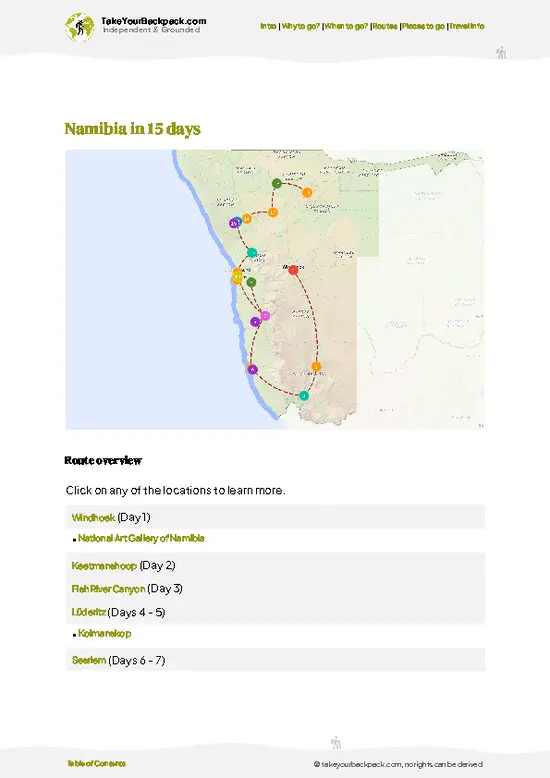
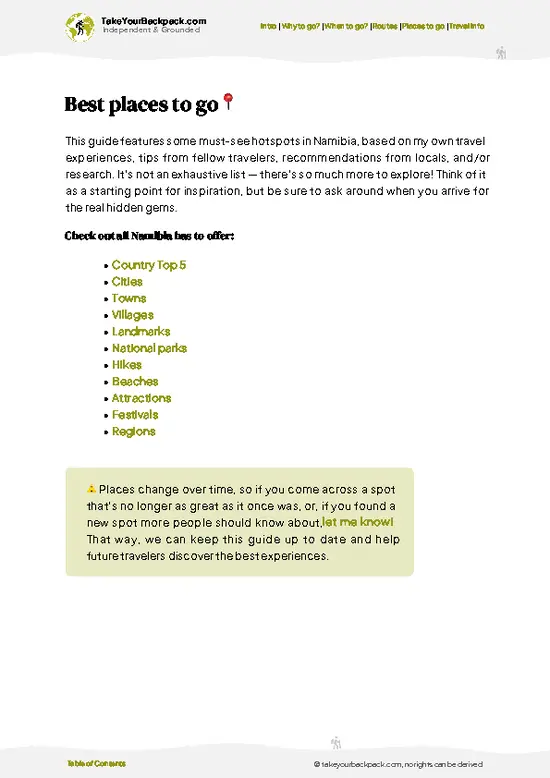
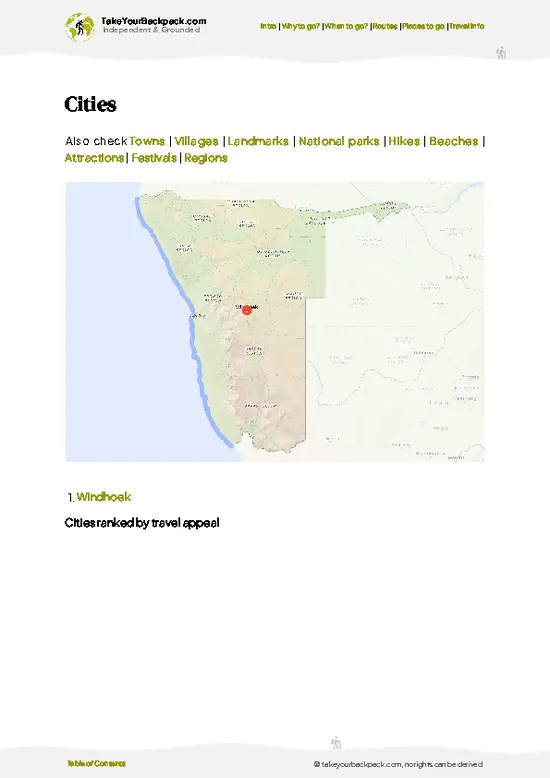
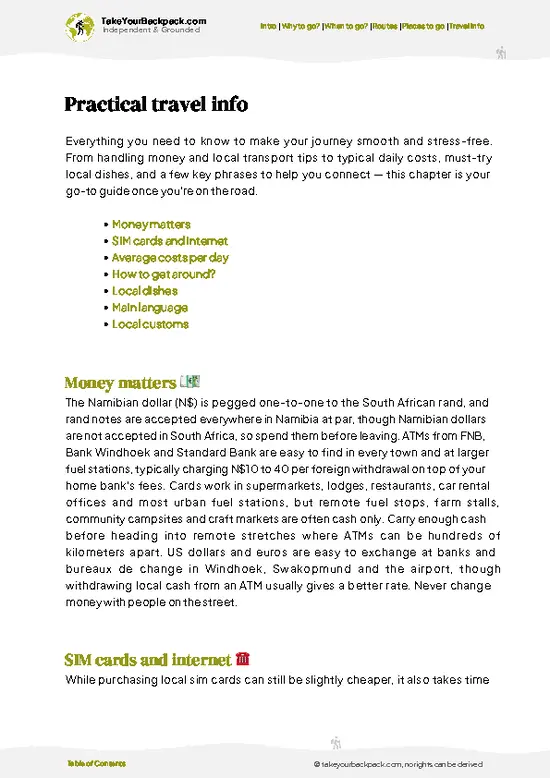
example page 0 from our offline Travel Guide for Namibia
example page 1 from our offline Travel Guide for Namibia
example page 2 from our offline Travel Guide for Namibia
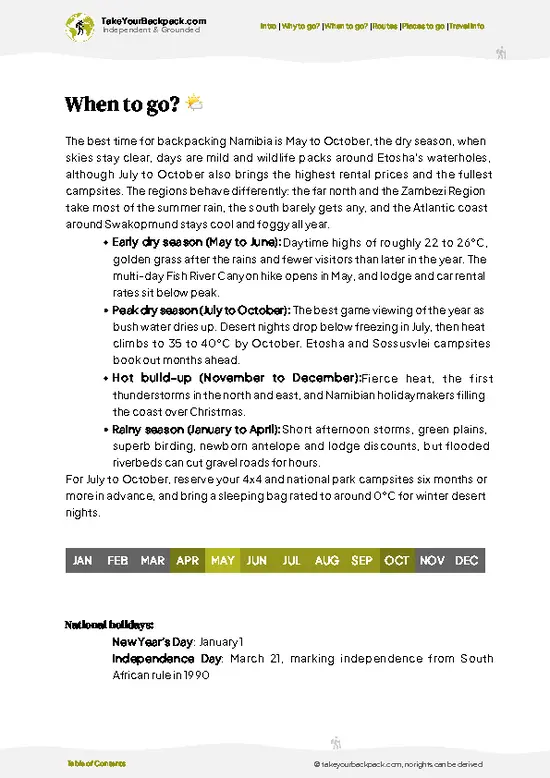
example page 3 from our offline Travel Guide for Namibia
example page 4 from our offline Travel Guide for Namibia
example page 5 from our offline Travel Guide for Namibia
example page 6 from our offline Travel Guide for Namibia
example page 7 from our offline Travel Guide for Namibia
The digital guide (294 pages) contains:
✅ 71 highlights, ranked by travel appeal
✅ Optimized 5, 10 & 15-day travel routes
✅ Cities, national parks, landmarks, beaches
✅ How to get around
✅ Offline-friendly for travel without Wi-Fi
👉 Click to see all 30+ guide features

📅 Plan smarter in minutes, not weeks
✅ Month by month travel advice
✅ Festivals & national holidays
✅ Budget expectations

🗺️ Go to the right places, skip the overrated ones
✅ Honest pros & cons of destinations
✅ Top hikes, parks & viewpoints
✅ Lesser-known places most travelers miss
✅ Clear “worth it vs skip it” guidance

🛏️ Travel smoothly without rookie mistakes
✅ Best areas to stay
✅ Transport systems explained simply
✅ Common scams & safety advice
✅ SIM cards, money & practical tips

🌍 Understand the country, not just visit it
✅ Culture & traditions
✅ 52 Essential phrases & customs
✅ Festivals worth planning around
✅ Traveler-friendly historical context
✅ Insights that make places more meaningful

📱 Built for real travel conditions
✅ Fully downloadable PDF
✅ Works completely offline
✅ Optimized for phone use
✅ Useful in remote areas & buses
✅ Everything in one place
Stop searching, start planning
Get instant access to your full guide. 30‑day money-back guarantee.
+ Add another guide for just

By proceeding you agree to our terms.
Sent to your inbox immediately after payment • 100% Secure Checkout
Best Backpacking Travel Advisor 2025 tourism awardBest Backpacking
Travel Advisor
2025
What others say about Take Your Backpack Guides:
⭐⭐⭐⭐⭐
Fantastic, amazing amount of information!
⭐⭐⭐⭐⭐
My goodness this is amazing, it's what I've been looking for hats off too you!
⭐⭐⭐⭐⭐
I think this is absolutely BRILLIANT
⭐⭐⭐⭐
Very complete and informative. It's still missing places, but I gotta to commend you
⭐⭐⭐⭐⭐
This is truly amazing, thank you, can't wait to explore it with my kids!
⭐⭐⭐⭐⭐
Awesome resource, thank you!
⭐⭐⭐⭐⭐
This is amazing! Can't wait to explore the ones I haven't seen
⭐⭐⭐⭐
I love this! Well done, great idea.
⭐⭐⭐⭐⭐
Thanks for taking the time to make this gem!
⭐⭐⭐⭐⭐
This might be the best website I've ever seen.
⭐⭐⭐⭐⭐
Congratulations, and thank you so much for your work; it's incredibly valuable.
⭐⭐⭐⭐
In all seriousness I think you did a great job pointing out the important spots
⭐⭐⭐⭐⭐
10/10 very good
⭐⭐⭐⭐⭐
As someone who's only just starting to visit regularly this is awesome, thank you.
⭐⭐⭐⭐
Thank you very much! I'm going to visit my dad, it's going to be very useful!
⭐⭐⭐⭐⭐
This is really cool! We'll be travelling for the first time and this definitely come in handy.
⭐⭐⭐⭐⭐
You are now our minister of culture, congratulations 👨‍💼
⭐⭐⭐⭐⭐
Just wanted to tell you that this is a pearl! Going to follow your recommendations.
⭐⭐⭐⭐⭐
This is so cool. I'll definitely be using the resource for my travels soon.
⭐⭐⭐⭐⭐
This is very impressive! Good work.
⭐⭐⭐⭐⭐
This is an amazing and informative site. Very well done!

🛏️ Where to stay?Accommodation Highlights

Namibia has a solid spread of hostels, backpacker lodges and campsites, with dorm beds typically around N$250 to 400 (US$14 to 22) and private rooms from about N$600 (US$33), and nearly every national park and rest stop has a campsite if you are traveling with a tent or rooftop rig. In Windhoek, Windhoek West has the most budget beds within walking distance of the center’s restaurants and bars, which is handy for your first night, though you should take a taxi after dark, while leafy Klein Windhoek is quieter and feels safer but leaves you more dependent on cabs. On the coast, the Swakopmund town center puts you near the beachfront, cafés and adventure-tour pickups with a mellow evening scene, … read more 👉
Namibia has a solid spread of hostels, backpacker lodges and campsites, with dorm beds typically around N$250 to 400 (US$14 to 22) and private rooms from about N$600 (US$33), and nearly every national park and rest stop has a campsite if you are traveling with a tent or rooftop rig. In Windhoek, Windhoek West has the most budget beds within walking distance of the center’s restaurants and bars, which is handy for your first night, though you should take a taxi after dark, while leafy Klein Windhoek is quieter and feels safer but leaves you more dependent on cabs. On the coast, the Swakopmund town center puts you near the beachfront, cafés and adventure-tour pickups with a mellow evening scene, and the more residential Vineta area to the north trades that convenience for calm streets and sea air.

If you enjoy meeting fellow travelers, consider choosing hostels with high ratings for atmosphere. On the other hand, if you prefer having your own space, a hotel might be a better option.

NamibiaSee More of Namibia

👋 Meet the founderWho’s Behind Take Your Backpack?

Johan, backpacker and founder of TakeYourBackpackHi, I’m Johan (Netherlands 🇳🇱), the creator of TakeYourBackpack. Over the past 3 decades, I’ve backpacked through 90+ countries across six continents, gaining extensive experience with independent travel, long-term trips, and overland routes.

This site is built on a combination of firsthand travel experience and carefully curated insights from other backpackers. Many guides are based on places I’ve personally visited, while others bring together tips, observations, and practical advice shared by trusted travelers I’ve met along the way.

The goal is to provide realistic, experience-driven guidance — not generic itineraries — so you can explore destinations with better context, clearer expectations, and more confidence.