×

Norway🇳🇴 | best beachesDiscover the 7 Best beaches Across Norway

Beaches in Norway come with fjord walls, not palm trees. In the south, the Sørlandet coast has pale sand, warm shallows by Norwegian standards and summer car parks that fill by 11 a.m. Farther north, the Lofoten and Vesterålen islands put white quartz sand beside granite peaks, with turquoise water that stays around 10 to 14°C and a wind that smells of salt and drying cod. The west is a patchwork of rocky coves and a few long dune strands. Access ranges from a bus stop to a muddy trail. Backpackers and other independent travelers get empty sand in the north, but pay Norwegian prices for every meal.

By Johan Kruseman 🇳🇱 | Updated October 18, 2026
Explore the best attractions in Norway

Why go?Why Travelers Love These Spots

Norway is a country of cold-water beaches, and that is the whole point. The Gulf Stream keeps the coast ice-free and surprisingly mild for its latitude, so you can stand on pale sand under a sky that stays light past midnight in June while the Arctic sits only a few hundred kilometers away. Sea temperatures rarely pass 20°C even in the south, and in the north a swim is a brisk, lung-tightening dip that most people keep to a few minutes. Wetsuits and quick-dry towels are normal gear.

The country's geography shapes everything. A coastline carved by glaciers means steep mountains drop straight into the sea, so sand is scattered rather than continuous, and many beaches sit at the end of a single narrow road or a short hike. The allemannsretten, the right to roam, lets you walk, swim and camp … read more 👉
Norway is a country of cold-water beaches, and that is the whole point. The Gulf Stream keeps the coast ice-free and surprisingly mild for its latitude, so you can stand on pale sand under a sky that stays light past midnight in June while the Arctic sits only a few hundred kilometers away. Sea temperatures rarely pass 20°C even in the south, and in the north a swim is a brisk, lung-tightening dip that most people keep to a few minutes. Wetsuits and quick-dry towels are normal gear.

The country's geography shapes everything. A coastline carved by glaciers means steep mountains drop straight into the sea, so sand is scattered rather than continuous, and many beaches sit at the end of a single narrow road or a short hike. The allemannsretten, the right to roam, lets you walk, swim and camp briefly near most shores for free, which makes independent travel far easier than in countries with private resort strips. Facilities are tidy but thin: expect clean toilets at popular spots, few beach bars and almost no sunbed rental.

Before choosing Norway for beaches, accept the high costs of food and transport, changeable weather and mosquitoes or midges in still evenings. The reward is quiet sand, clear water and dramatic scale.
How the List Was Created
The list of best beaches in Norway is created based on beauty, vibe, water quality, activities, and surrounding scenery. If you feel a beach is missing in this list, please let us know.

When to go?When to Plan Your Trip

Best months for Norway's beaches: The best months for beaches in Norway are June to August, when daytime air temperatures reach 18 to 25°C in the south and sea temperatures climb to about 16 to 20°C. In the Arctic north, the midnight sun runs from roughly late May to late July, giving endless golden light, though water there stays near 10 to 14°C.

Shoulder seasons and rain: May and September work if you accept cooler air of 8 to 15°C and sea water around 8 to 12°C. Crowds thin out, car parks empty and accommodation can cost 15 to 30 percent less than in July. Western Norway, around Bergen, is among Europe's wettest areas, with well over 2,000 mm of rain a year, so pack waterproofs even in summer. The south and east, around Kristiansand and Oslo, are drier and sunnier, and that is where beach … read more 👉
Best months for Norway's beaches: The best months for beaches in Norway are June to August, when daytime air temperatures reach 18 to 25°C in the south and sea temperatures climb to about 16 to 20°C. In the Arctic north, the midnight sun runs from roughly late May to late July, giving endless golden light, though water there stays near 10 to 14°C.

Shoulder seasons and rain: May and September work if you accept cooler air of 8 to 15°C and sea water around 8 to 12°C. Crowds thin out, car parks empty and accommodation can cost 15 to 30 percent less than in July. Western Norway, around Bergen, is among Europe's wettest areas, with well over 2,000 mm of rain a year, so pack waterproofs even in summer. The south and east, around Kristiansand and Oslo, are drier and sunnier, and that is where beach days are most reliable.

Peak periods and closures: Late June to early August is peak season, especially around the Norwegian summer holidays (the main vacation falls in July). Southern coastal towns fill up, and campsites and cabins should be booked weeks ahead. Many seasonal kiosks, ferries and campsites close between mid-August and early September. Winter beach visits are possible, but they involve snow, storms and very short days, so they suit only experienced, well-equipped travelers.

beach hoppingSuggested Travel Strategies

How many days to plan: A trip combining several beaches in Norway needs 10 to 14 days, because distances are long and roads are slow. Norway's coast is cut by fjords, so a point that looks close on a map can mean a two-hour drive plus a ferry.

Which regions group well: The most natural clusters are the south coast (Kristiansand to Stavanger area), the west coast around Bergen, and the Arctic north in Lofoten. Kristiansand to Stavanger takes about 3.5 to 4.5 hours by road, and Stavanger to Bergen about 4.5 to 5.5 hours with ferries or the coastal express routes. Bergen or Oslo to Bodø or Harstad usually means a flight of 1.5 to 2 hours, and the Lofoten islands then take another ferry or flight link. Travel from south to north keeps the warmest water first and finishes with the midnight sun, … read more 👉
How many days to plan: A trip combining several beaches in Norway needs 10 to 14 days, because distances are long and roads are slow. Norway's coast is cut by fjords, so a point that looks close on a map can mean a two-hour drive plus a ferry.

Which regions group well: The most natural clusters are the south coast (Kristiansand to Stavanger area), the west coast around Bergen, and the Arctic north in Lofoten. Kristiansand to Stavanger takes about 3.5 to 4.5 hours by road, and Stavanger to Bergen about 4.5 to 5.5 hours with ferries or the coastal express routes. Bergen or Oslo to Bodø or Harstad usually means a flight of 1.5 to 2 hours, and the Lofoten islands then take another ferry or flight link. Travel from south to north keeps the warmest water first and finishes with the midnight sun, which suits late June or July.

Time per stop and common mistakes: Allow 2 to 3 nights per region and a half-day to a full day for each beach, longer if you hike in. The classic mistake is trying to cover the whole coast by road in one week. Another is forgetting ferry timetables, which run less often in the shoulder season and can leave you waiting 1 to 3 hours. Instead, choose two regions, add buffer time for weather and book key ferries and rental cars early.

The ListTop beaches of Norway

1 Haukland Beach

turquoise shallows, gentle curve, mountain amphitheater

Swim in clear water framed by steep ridges, or follow coastal trails that reveal new perspectives on this sheltered bay.

norway-beach-haukland-beach
© Google | Karin Thaler

2 Kvalvika Beach

cliff-ringed cove, wild camping, hiking access

Reach a remote shore by footpath, where tents dot the grass and the sound of waves echoes off towering cliffs.

norway-beach-kvalvika-beach
© Google | Vladimír Černý

3 Uttakleiv

rocky headlands, midnight sun, mountain backdrop

Watch the sky change color above dramatic peaks, with smooth stones underfoot and open views north toward the Arctic horizon.

norway-beach-uttakleiv
© Google |

4 Ramberg Beach

white sand arc, fishing village, roadside access

Pause at a broad sweep of sand just steps from local homes, with easy parking and views of distant islands across clear water.

norway-beach-ramberg-beach
© Google | G. R.

5 Hoddevik

remote valley, grassy slopes, consistent surf

Arrive at a secluded bay surrounded by steep hills, where surfers and campers share a quiet stretch of Atlantic-facing sand.

6 Sola Beach

airport proximity, wide sands, kiteboarding zone

Land minutes from a broad, open beach popular for wind sports, family outings, and watching planes cross the sky overhead.

norway-beach-sola-beach
© Google | Lukasz Rosinski

7 Paradisbukta

urban forest edge, sheltered cove, Oslofjord views

Relax on a sandy inlet where city dwellers swim, picnic, and watch ferries pass, all within walking distance of Oslo’s green spaces.

norway-beach-paradisbukta
© Google |
Loading the map 🌍

Expert viewExpert Commentary on beaches

How many beaches to visit: I advise visiting four to six beaches in total, spread across two regions, because Norway’s distances turn each extra stop into half a day. More than that and you spend the trip in a rental car or on ferry decks, with the Atlantic wind in your face and sandwiches costing US$10 to 15.

Which kind to prioritize: Southern beaches suit first-timers and families. They are the warmest, easiest to reach by bus or short drive and often have kiosks, toilets and lifeguards in July. Lofoten and the Arctic coast suit hikers and photographers, who accept cold water, rough roads and fewer services in exchange for solitude and mountain views. Western Norway is the middle option, with smaller coves tucked under steep hills. For most backpackers, the north gives the most, as the … read more 👉
How many beaches to visit: I advise visiting four to six beaches in total, spread across two regions, because Norway’s distances turn each extra stop into half a day. More than that and you spend the trip in a rental car or on ferry decks, with the Atlantic wind in your face and sandwiches costing US$10 to 15.

Which kind to prioritize: Southern beaches suit first-timers and families. They are the warmest, easiest to reach by bus or short drive and often have kiosks, toilets and lifeguards in July. Lofoten and the Arctic coast suit hikers and photographers, who accept cold water, rough roads and fewer services in exchange for solitude and mountain views. Western Norway is the middle option, with smaller coves tucked under steep hills. For most backpackers, the north gives the most, as the sand is free, the space is generous and the light is extraordinary, though it takes more time and money to reach. If your trip is short, pick the south.

What it costs: Most beaches are free to enter, and the right to roam keeps campers on the shore at no cost in most places. A realistic budget is US$90 to 150 a day for a backpacker using hostels, supermarket meals and public transport, or US$150 to 220 if you add a rental car. A dorm bed runs US$40 to 70, a basic campsite pitch US$20 to 35. Parking at popular beaches can cost 100 to 200 NOK (about US$10 to 20) a day, and some ferries cost 150 to 400 NOK (about US$14 to 38) per vehicle. Buy food at Rema 1000 or Kiwi and carry a stove to keep daily spending down.

Safety and etiquette: Cold water is the main danger. Even in July, cold-water shock can cause cramps in minutes, so enter slowly, stay close to shore and avoid swimming alone. Currents can be strong near fjord mouths and channels, and Atlantic beaches can have sudden surf. Sandy shores can be exposed to wind, so tie down gear. Lifeguards are rare outside the main southern beaches. Respect private land and keep at least 150 meters from houses when camping. Leave no trace, take your trash with you and don’t light fires between mid-April and mid-September, when open fires are banned near forests and shorelines. Nudity is generally tolerated, but families expect swimwear at busy beaches.

Gear that earns its weight: A thin wetsuit or neoprene shoes, a windproof shell and insect repellent make the biggest difference. A towel that dries fast beats a thick one every time.

✈️ The backpacker research shortcutNorway Travel Guide

An offline-friendly backpacking guide with optimized travel routes, ranked highlights, transport advice, and the best areas to stay.
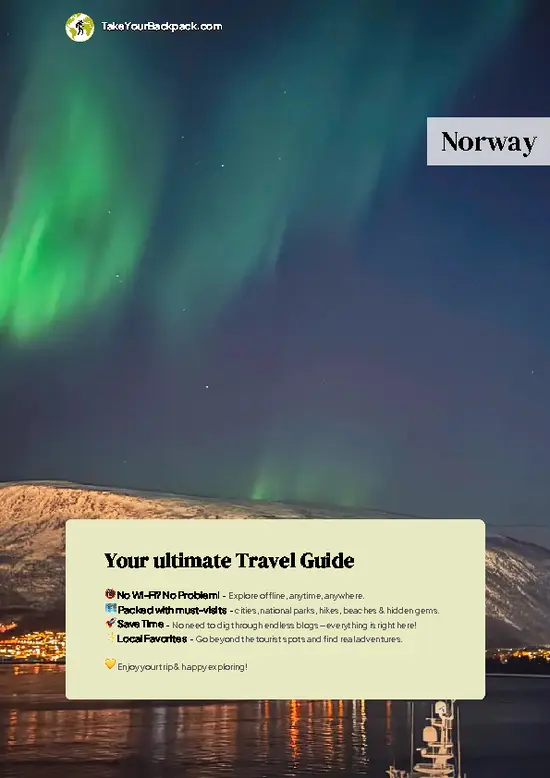
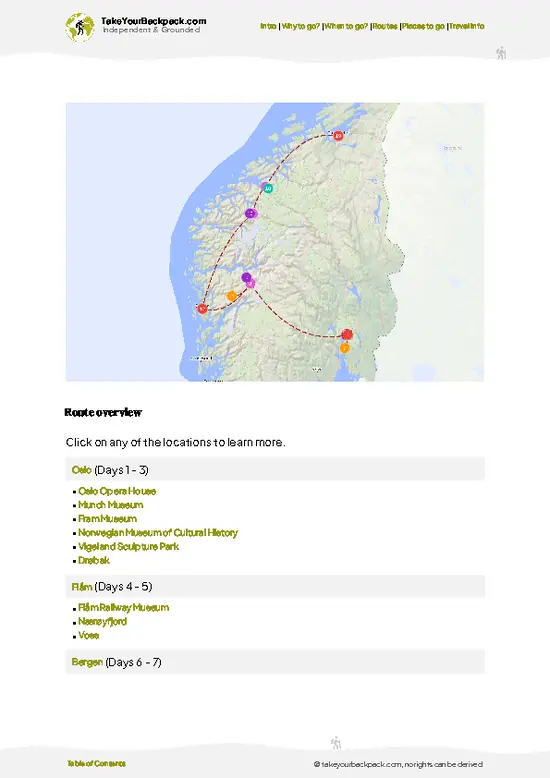
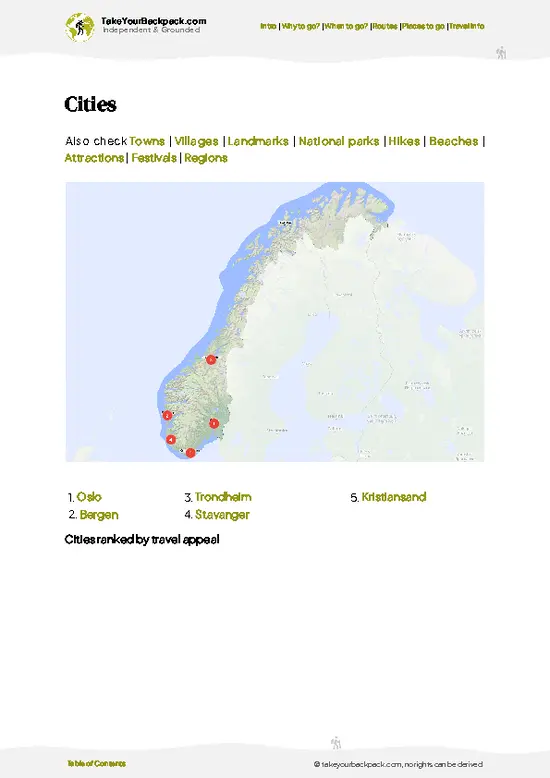
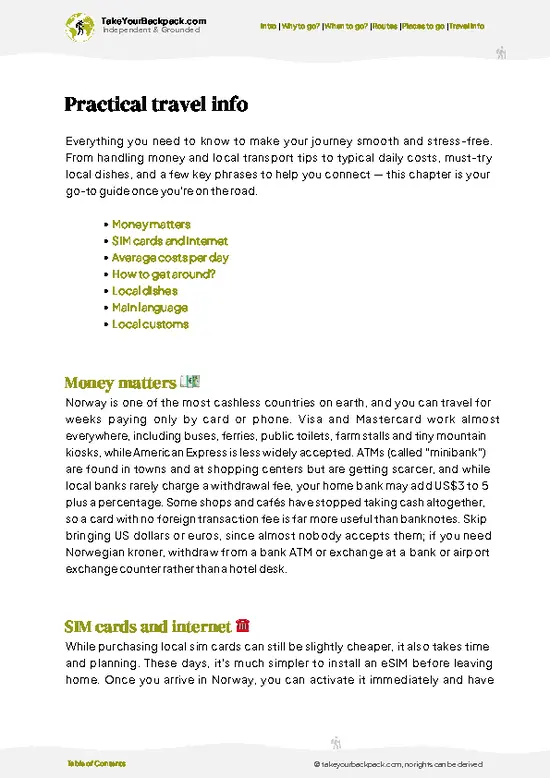
example page 0 from our offline Travel Guide for Norway
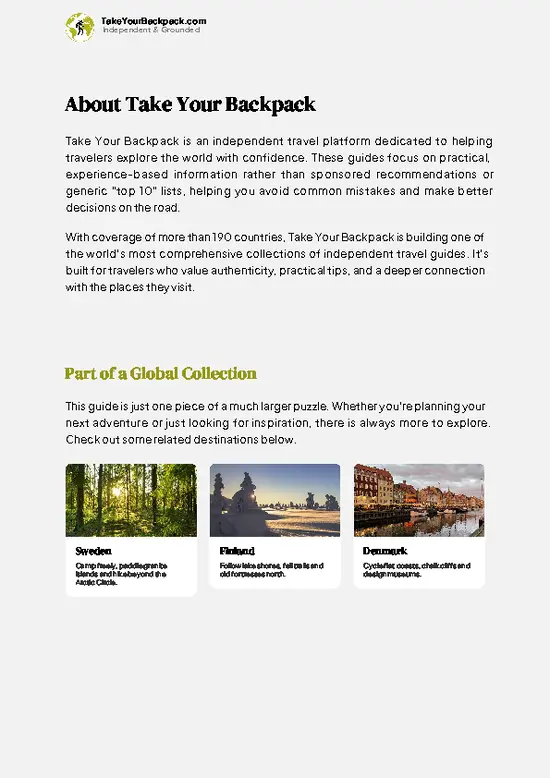
example page 1 from our offline Travel Guide for Norway
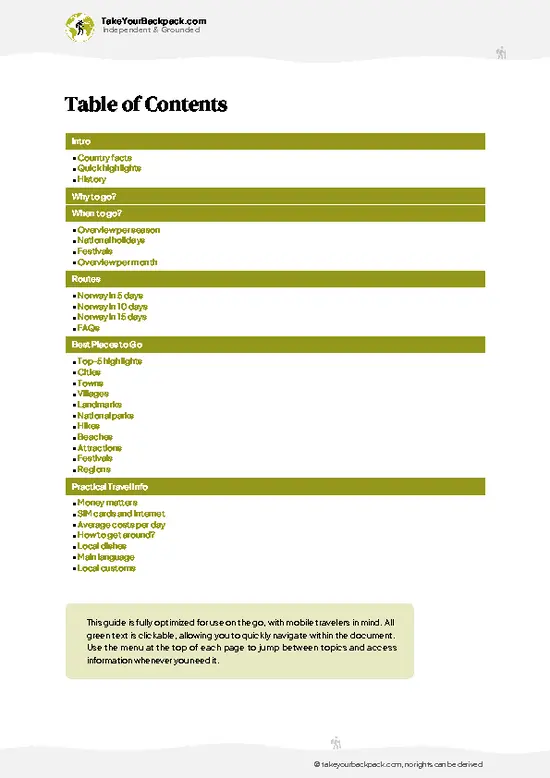
example page 2 from our offline Travel Guide for Norway
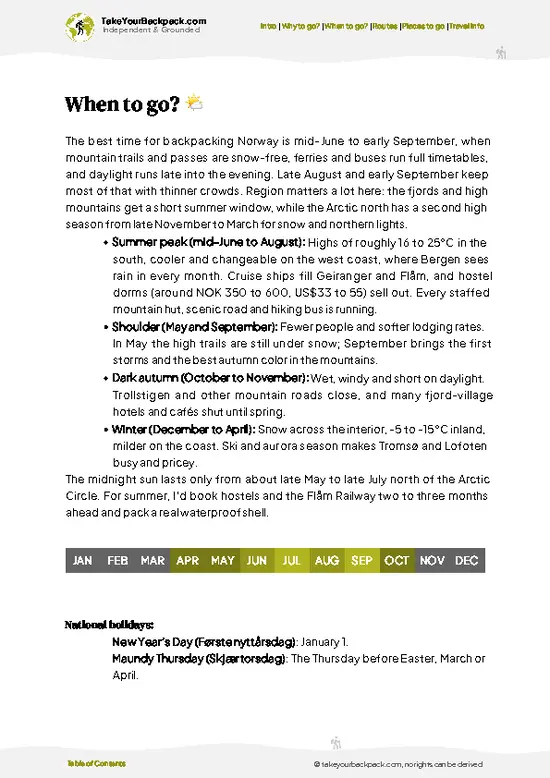
example page 3 from our offline Travel Guide for Norway
example page 4 from our offline Travel Guide for Norway
example page 5 from our offline Travel Guide for Norway
example page 6 from our offline Travel Guide for Norway
example page 7 from our offline Travel Guide for Norway
The digital guide (377 pages) contains:
✅ 101 highlights, ranked by travel appeal
✅ Optimized 5, 10 & 15-day travel routes
✅ Cities, national parks, landmarks, beaches
✅ How to get around
✅ Offline-friendly for travel without Wi-Fi
👉 Click to see all 30+ guide features

📅 Plan smarter in minutes, not weeks
✅ Month by month travel advice
✅ Festivals & national holidays
✅ Budget expectations

🗺️ Go to the right places, skip the overrated ones
✅ Honest pros & cons of destinations
✅ Top hikes, parks & viewpoints
✅ Lesser-known places most travelers miss
✅ Clear “worth it vs skip it” guidance

🛏️ Travel smoothly without rookie mistakes
✅ Best areas to stay
✅ Transport systems explained simply
✅ Common scams & safety advice
✅ SIM cards, money & practical tips

🌍 Understand the country, not just visit it
✅ Culture & traditions
✅ 52 Essential phrases & customs
✅ Festivals worth planning around
✅ Traveler-friendly historical context
✅ Insights that make places more meaningful

📱 Built for real travel conditions
✅ Fully downloadable PDF
✅ Works completely offline
✅ Optimized for phone use
✅ Useful in remote areas & buses
✅ Everything in one place
Stop searching, start planning
Get instant access to your full guide. 30‑day money-back guarantee.
+ Add another guide for just

By proceeding you agree to our terms.
Sent to your inbox immediately after payment • 100% Secure Checkout
Best Backpacking Travel Advisor 2025 tourism awardBest Backpacking
Travel Advisor
2025
What others say about Take Your Backpack Guides:
⭐⭐⭐⭐⭐
Fantastic, amazing amount of information!
⭐⭐⭐⭐⭐
My goodness this is amazing, it's what I've been looking for hats off too you!
⭐⭐⭐⭐⭐
I think this is absolutely BRILLIANT
⭐⭐⭐⭐
Very complete and informative. It's still missing places, but I gotta to commend you
⭐⭐⭐⭐⭐
This is truly amazing, thank you, can't wait to explore it with my kids!
⭐⭐⭐⭐⭐
Awesome resource, thank you!
⭐⭐⭐⭐⭐
This is amazing! Can't wait to explore the ones I haven't seen
⭐⭐⭐⭐
I love this! Well done, great idea.
⭐⭐⭐⭐⭐
Thanks for taking the time to make this gem!
⭐⭐⭐⭐⭐
This might be the best website I've ever seen.
⭐⭐⭐⭐⭐
Congratulations, and thank you so much for your work; it's incredibly valuable.
⭐⭐⭐⭐
In all seriousness I think you did a great job pointing out the important spots
⭐⭐⭐⭐⭐
10/10 very good
⭐⭐⭐⭐⭐
As someone who's only just starting to visit regularly this is awesome, thank you.
⭐⭐⭐⭐
Thank you very much! I'm going to visit my dad, it's going to be very useful!
⭐⭐⭐⭐⭐
This is really cool! We'll be travelling for the first time and this definitely come in handy.
⭐⭐⭐⭐⭐
You are now our minister of culture, congratulations 👨‍💼
⭐⭐⭐⭐⭐
Just wanted to tell you that this is a pearl! Going to follow your recommendations.
⭐⭐⭐⭐⭐
This is so cool. I'll definitely be using the resource for my travels soon.
⭐⭐⭐⭐⭐
This is very impressive! Good work.
⭐⭐⭐⭐⭐
This is an amazing and informative site. Very well done!

🛏️ Where to stay?Where to Stay: Norway Edition

Norway has hostels and budget beds in every major city, with dorms typically running NOK 350 to 600 (about US$33 to 56) a night, plus cheap cabins at campsites along the main touring routes. In Oslo, Sentrum around the central station puts you closest to the waterfront, museums and transport links but gets rowdy and a little rough late at night, while Grünerløkka has the best bars and cafés and a younger crowd, with a 15 to 20 minute walk to the center. In Bergen, the area around Bryggen and the fish market keeps every sight within walking distance but books out early in summer, and in Tromsø the compact city center is small and safe, with most budget beds a short walk from the harbor and the … read more 👉
Norway has hostels and budget beds in every major city, with dorms typically running NOK 350 to 600 (about US$33 to 56) a night, plus cheap cabins at campsites along the main touring routes. In Oslo, Sentrum around the central station puts you closest to the waterfront, museums and transport links but gets rowdy and a little rough late at night, while Grünerløkka has the best bars and cafés and a younger crowd, with a 15 to 20 minute walk to the center. In Bergen, the area around Bryggen and the fish market keeps every sight within walking distance but books out early in summer, and in Tromsø the compact city center is small and safe, with most budget beds a short walk from the harbor and the late-opening pubs.

If you enjoy meeting fellow travelers, consider choosing hostels with high ratings for atmosphere. On the other hand, if you prefer having your own space, a hotel might be a better option.

NorwayExplore Beyond This Category

👋 Meet the founderWho’s Behind Take Your Backpack?

Johan, backpacker and founder of TakeYourBackpackHi, I’m Johan (Netherlands 🇳🇱), the creator of TakeYourBackpack. Over the past 3 decades, I’ve backpacked through 90+ countries across six continents, gaining extensive experience with independent travel, long-term trips, and overland routes.

This site is built on a combination of firsthand travel experience and carefully curated insights from other backpackers. Many guides are based on places I’ve personally visited, while others bring together tips, observations, and practical advice shared by trusted travelers I’ve met along the way.

The goal is to provide realistic, experience-driven guidance — not generic itineraries — so you can explore destinations with better context, clearer expectations, and more confidence.