×

Norway🇳🇴 | best national parksDiscover the 10 Best national parks Across Norway

Norway’s national parks are mostly free to enter, unfenced and ungated, so no ticket booth stands between you and the trail. In the south, Hardangervidda and Jotunheimen mean wind-scoured plateaus, the smell of wet lichen and a network of staffed and self-service huts, which makes them the easiest ground for independent travel and the busiest in July. Along the coast and in the north, fjord walls and Arctic ridges bring longer transfers, ferries, and lower crowds. The far north adds midnight sun, mosquitoes and prices that climb with every boat ride. Pick by how much logistics you can stomach.

By Johan Kruseman 🇳🇱 | Updated October 18, 2026
Explore the best hikes in Norway

Why go?Why Travelers Love These Spots

Norway suits national parks because of allemannsretten, the public right of access that lets anyone walk, camp and pick berries on uncultivated land for free. Parks here protect landscapes rather than sell them, so you will find few entrance gates, a few visitor centers, and trails marked with red painted T’s on rock. That openness comes from a rural culture that treats the outdoors as a shared birthright, and from the Norwegian Trekking Association (DNT), whose cabins, bridges and cairns knit the mountains together.

Geography shapes everything else. Glaciers carved deep fjords and high plateaus, so you get sharp elevation changes, cold lakes and sudden weather: rain, hail and sun can arrive within an hour, and fog can swallow a cairn at ten meters. Distances look short on the map but road … read more 👉
Norway suits national parks because of allemannsretten, the public right of access that lets anyone walk, camp and pick berries on uncultivated land for free. Parks here protect landscapes rather than sell them, so you will find few entrance gates, a few visitor centers, and trails marked with red painted T’s on rock. That openness comes from a rural culture that treats the outdoors as a shared birthright, and from the Norwegian Trekking Association (DNT), whose cabins, bridges and cairns knit the mountains together.

Geography shapes everything else. Glaciers carved deep fjords and high plateaus, so you get sharp elevation changes, cold lakes and sudden weather: rain, hail and sun can arrive within an hour, and fog can swallow a cairn at ten meters. Distances look short on the map but road tunnels, ferries and single-lane mountain roads stretch the journey.

Before choosing Norway, know that it is expensive. Food, fuel and ferries cost far more than in most of Europe, a cabin bed runs roughly NOK 400 to 700 (US$40 to 65) for members, and alcohol is heavily taxed. Carry cash-free payment, since cards work nearly everywhere, and bring waterproof gear. The trade is silence, drinkable stream water and wide space.
Our Approach to Ranking
The list of best national parks in Norway is created based on landscapes, wildlife, adventure opportunities, facilities, and overall experience. If you feel a national park is missing in this list, please let us know.

When to go?When to Plan Your Trip

Best months and conditions: The best months for Norway’s national parks are late June to early September, when snow has left most trails, cabins are staffed and daylight lasts 18 to 24 hours in the north. Valley temperatures sit around 12 to 22°C, while high plateaus and ridges often drop to 0 to 8°C at night, even in July. Rain is common, especially in the west, where Bergen-area fjords can see 2,000 mm a year or more, so expect wet boots, steaming drying rooms and the smell of damp wool.
Shoulder seasons and regions: In June and September, crowds thin, lodging prices ease and autumn turns the dwarf birch on the plateaus red and gold. The catch: high routes in southern Norway can hold snowfields into early July, and many DNT cabins close or go self-service in mid-September. In Arctic Norway, … read more 👉
Best months and conditions: The best months for Norway’s national parks are late June to early September, when snow has left most trails, cabins are staffed and daylight lasts 18 to 24 hours in the north. Valley temperatures sit around 12 to 22°C, while high plateaus and ridges often drop to 0 to 8°C at night, even in July. Rain is common, especially in the west, where Bergen-area fjords can see 2,000 mm a year or more, so expect wet boots, steaming drying rooms and the smell of damp wool.
Shoulder seasons and regions: In June and September, crowds thin, lodging prices ease and autumn turns the dwarf birch on the plateaus red and gold. The catch: high routes in southern Norway can hold snowfields into early July, and many DNT cabins close or go self-service in mid-September. In Arctic Norway, the season is shorter, roughly July to early September, with mosquitoes strongest in July and the first frosts by late August.
Peak periods and winter: The Norwegian holiday weeks in July bring the busiest trails and full cabins, so reserve beds early. Between October and April, the parks turn to snow, ski touring and short days, with northern lights in the Arctic. Winter travel needs avalanche awareness and proper gear.

national park hoppingSuggested Travel Strategies

How long a multi-park trip needs: A trip linking several national parks in Norway needs 10 to 16 days, because the distances are bigger than they look. The south groups well: Oslo, the Hardangervidda plateau and the Jotunheimen mountains share road and rail links. Bergen works as the western hub, with the Bergen to Oslo railway crossing the high plateau in about 6.5 hours. The north forms a separate cluster around Tromsø and Narvik, so reaching it adds a flight of 1.5 to 2 hours from Oslo.
Direction and pacing: Travel south to north, or the reverse by flight, and keep the Arctic for the end of the season so you catch the late-summer light. Allow 2 to 4 days per stop, which gives one day of hiking and a buffer for fog or rain. Transfers between regions take 4 to 8 hours by bus, with ferries … read more 👉
How long a multi-park trip needs: A trip linking several national parks in Norway needs 10 to 16 days, because the distances are bigger than they look. The south groups well: Oslo, the Hardangervidda plateau and the Jotunheimen mountains share road and rail links. Bergen works as the western hub, with the Bergen to Oslo railway crossing the high plateau in about 6.5 hours. The north forms a separate cluster around Tromsø and Narvik, so reaching it adds a flight of 1.5 to 2 hours from Oslo.
Direction and pacing: Travel south to north, or the reverse by flight, and keep the Arctic for the end of the season so you catch the late-summer light. Allow 2 to 4 days per stop, which gives one day of hiking and a buffer for fog or rain. Transfers between regions take 4 to 8 hours by bus, with ferries or tunnels adding delays. Rental cars make mountain roads and fjord crossings easier, though they cost more than buses.
Planning mistakes: The most common error is cramming one park a day, which leaves you in a car with gray windows and no time on foot. Another is trusting a map distance: a 100 km mountain road can take three hours. Check ferry timetables, book huts early for July, and leave one spare day for weather.

The ListTop national parks of Norway

1 Jotunheimen National Park

highest peaks, alpine lakes, scree slopes, glacier crossings

Ascend Norway’s tallest summits, crossing rocky slopes and glacier tongues with panoramic views across a dramatic alpine landscape.

2 Lofotodden National Park

coastal cliffs, white sand beaches, seabird colonies, Arctic fjords

Follow rugged trails along the sea, passing windswept beaches and towering cliffs alive with seabirds, all beneath shifting northern skies.

norway-national-park-lofotodden-national-park
© Google |

3 Jostedalsbreen

ice fields, crevasses, glacial rivers, blue ice caves

Walk along the edge of Norway’s largest glacier, exploring crevasses and rivers that reveal the raw power of moving ice.

norway-national-park-jostedalsbreen
© Google | Sandra Smolná

4 Hardangervidda

vast plateau, trout lakes, stone shelters, open moorland

Cross open moors and fish in cold lakes, using stone shelters as you traverse one of Europe’s largest mountain plateaus.

norway-national-park-hardangervidda
© Google | Irene Vik

5 Rondane National Park

rounded peaks, lichen fields, wild reindeer, open valleys

Roam among gentle mountains and wide valleys, where lichen carpets the ground and wild reindeer graze in the distance.

6 Dovrefjell-Sunndalsfjella National Park

musk oxen, alpine plateaus, wildflower meadows, reindeer

Hike through open uplands where musk oxen graze, crossing ancient mountain passes and quiet valleys shaped by centuries of natural forces.

norway-national-park-dovrefjell-sunndalsfjella-national-park
© Google |

7 Folgefonna National Park

blue glacier, meltwater lakes, birch forest, ice caves

Traverse glacier tongues and shimmering lakes, then descend into lush woodlands where the landscape shifts dramatically with each season.

norway-national-park-folgefonna-national-park
© Google |

8 Børgefjell National Park

bare peaks, wild rivers, Arctic fox, scree slopes

Navigate a landscape of stark mountains and fast-flowing rivers, where wildlife sightings reward those willing to travel off-trail.

norway-national-park-borgefjell-national-park
© Google |

9 Breheimen National Park

glacier valleys, mountain farms, wild rivers, high passes

Climb through steep valleys and past old summer farms, with rivers and glaciers shaping the high country’s ever-changing terrain.

norway-national-park-breheimen-national-park
© Google |

10 Saltfjellet-Svartisen National Park

ice cap, deep valleys, Arctic Circle, Sami heritage

Cross the Arctic Circle on foot, exploring deep valleys and glacier tongues while encountering traces of traditional Sami culture.

norway-national-park-saltfjellet-svartisen-national-park
© Google |

11 Femundsmarka National Park

pine forest, canoe routes, ancient rocks, border wilderness

Paddle across quiet lakes and trek through pine woods, where the landscape feels untouched and the borderlands stretch into Sweden.

norway-national-park-femundsmarka-national-park
© Google |

12 Reisa National Park

deep canyon, waterfalls, birch woodland, salmon river

Follow the Reisaelva river through a dramatic gorge, passing waterfalls and quiet woods rich in birdlife and salmon runs.

13 Blåfjella-Skjækerfjella National Park

rolling hills, remote cabins, old-growth forest, reindeer migration

Venture into vast forests and gentle mountains, where solitude reigns and reindeer herds move quietly through ancient woodlands.

norway-national-park-blafjella-skjaekerfjella-national-park
© Google |

14 Rago National Park

granite ridges, hanging lakes, twisted pine, remote trails

Trek over rugged granite and past isolated lakes, where the terrain is challenging and the sense of isolation is profound.

15 Ånderdalen National Park

coastal pine, peat bogs, island wildlife, Sami traces

Walk through coastal forests and bogs on Senja, where the interplay of land and sea creates a unique habitat for rare species.

16 Seiland National Park

fjord arms, glacier tongues, arctic tundra, sea eagles

Travel by boat and foot across a landscape where glaciers meet the sea, and tundra gives way to dramatic coastal cliffs.

Think you know Norway?

Prove you’re a true local — uncover 6 lesser-known national parks in Norway that locals tend to keep to themselves.
Loading the map 🌍

Expert viewExpert Commentary on national parks

How many parks to visit: Two or three national parks is the right number for most backpackers, even on a three-week trip. Each one takes several days to walk properly, and the transfers between regions eat half a day or more. A rushed list of six gives you six car windows and wet shoes in a hostel. Two parks with real hiking time cost less in transport and leave you with something better than a checklist.
Choosing a kind of park: For a first trip, the southern mountain parks give the most for the least. Trails are marked, huts sit a day apart, and you can reach trailheads by bus or train from Oslo or Bergen. You pay in crowds in July, but you save in logistics. The fjord-coast parks offer steep climbs and better views but need ferries and shuttle buses, so they cost more in time and money. … read more 👉
How many parks to visit: Two or three national parks is the right number for most backpackers, even on a three-week trip. Each one takes several days to walk properly, and the transfers between regions eat half a day or more. A rushed list of six gives you six car windows and wet shoes in a hostel. Two parks with real hiking time cost less in transport and leave you with something better than a checklist.
Choosing a kind of park: For a first trip, the southern mountain parks give the most for the least. Trails are marked, huts sit a day apart, and you can reach trailheads by bus or train from Oslo or Bergen. You pay in crowds in July, but you save in logistics. The fjord-coast parks offer steep climbs and better views but need ferries and shuttle buses, so they cost more in time and money. The Arctic parks suit experienced hikers with a tent and a stove: they are quieter and more demanding, with fewer huts, river crossings and weather that shifts quickly.
Budget: Entry to the parks is free, so the cost lies elsewhere. Camping in the wild and cooking your own food keeps a day to about NOK 350 to 600 (US$32 to 55), including supermarket food. Sleeping in DNT huts raises that to NOK 900 to 1,500 (US$85 to 140) a day with dinner. Hut beds for members run roughly NOK 400 to 700, with non-members paying more. Bus and ferry transfers to trailheads add NOK 100 to 500 (US$10 to 45) per visit, and a guided glacier walk costs NOK 700 to 1,500 (US$65 to 140). Joining DNT before the trip pays for itself in about two nights.
Safety and etiquette: The main dangers are weather and navigation. Fog and rain can erase a trail, so carry a paper map, compass and a waterproof layer even on day hikes. Streams can run high after rain or snowmelt, so cross early in the day and unclip your hip belt. Glacier travel needs a certified guide. Emergency number 112 works where there is signal, and many valleys have none, so tell the cabin staff your route.

Follow allemannsretten rules: camp at least 150 m from houses, stay no more than two nights in one spot in the lowlands, and leave no trace. Open fires are banned from mid-April to mid-September. Respect Sámi reindeer herds in the north by keeping dogs leashed and not chasing animals. Take every scrap of rubbish out with you, since bins are rare on the plateaus.

✈️ The backpacker research shortcutNorway Travel Guide

An offline-friendly backpacking guide with optimized travel routes, ranked highlights, transport advice, and the best areas to stay.
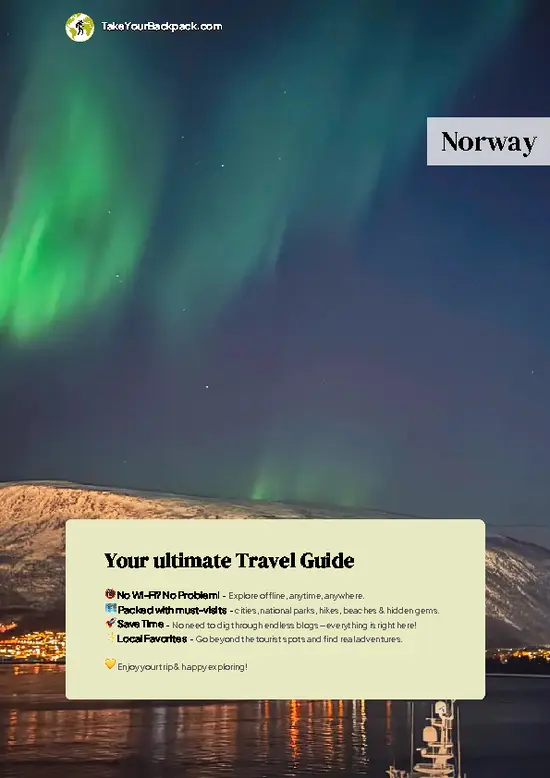
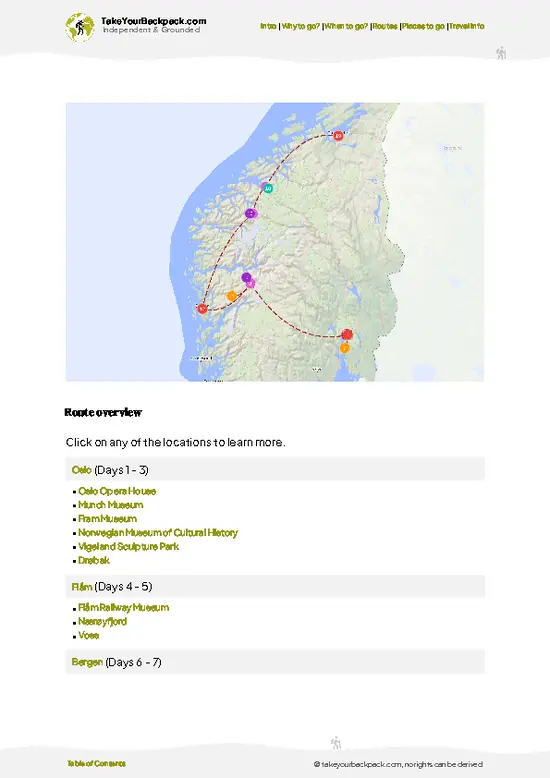
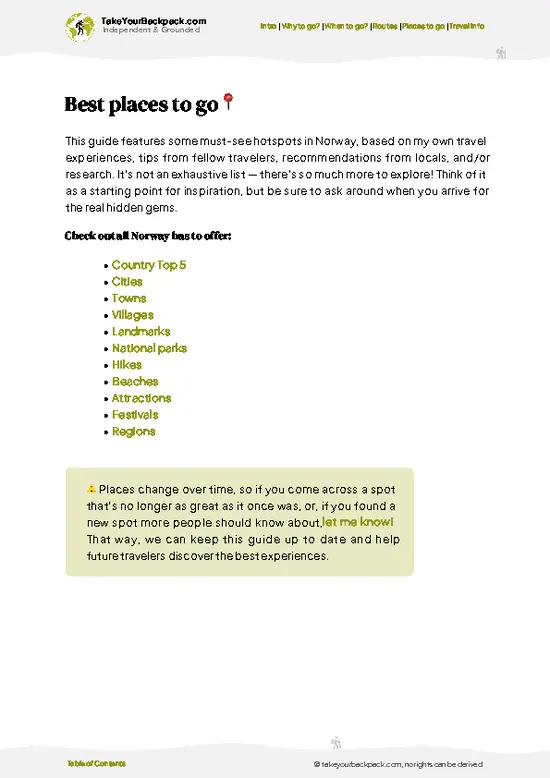
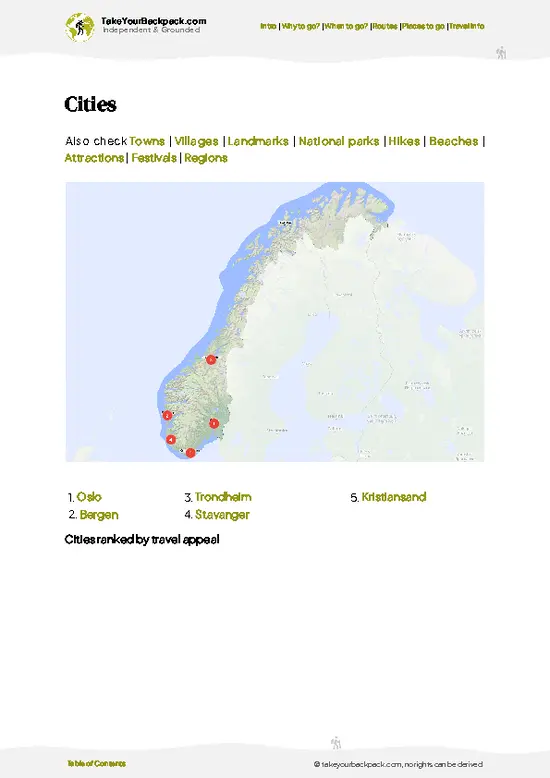
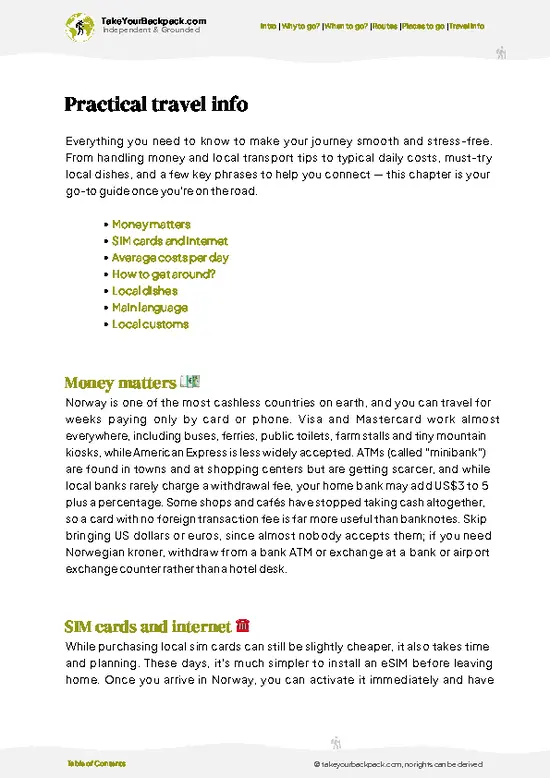
example page 0 from our offline Travel Guide for Norway
example page 1 from our offline Travel Guide for Norway
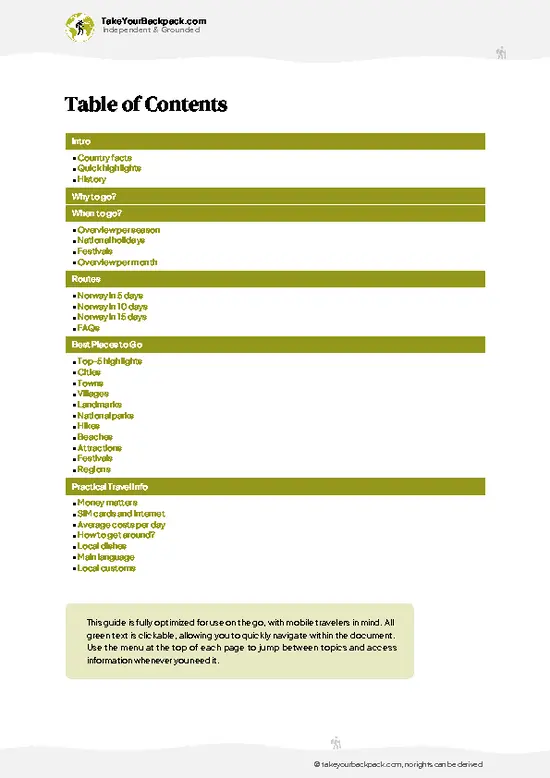
example page 2 from our offline Travel Guide for Norway
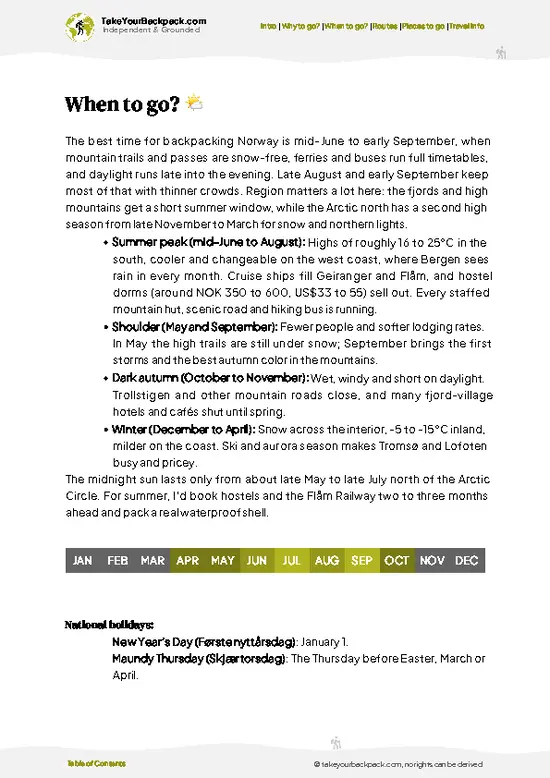
example page 3 from our offline Travel Guide for Norway
example page 4 from our offline Travel Guide for Norway
example page 5 from our offline Travel Guide for Norway
example page 6 from our offline Travel Guide for Norway
example page 7 from our offline Travel Guide for Norway
The digital guide (377 pages) contains:
✅ 101 highlights, ranked by travel appeal
✅ Optimized 5, 10 & 15-day travel routes
✅ Cities, national parks, landmarks, beaches
✅ How to get around
✅ Offline-friendly for travel without Wi-Fi
👉 Click to see all 30+ guide features

📅 Plan smarter in minutes, not weeks
✅ Month by month travel advice
✅ Festivals & national holidays
✅ Budget expectations

🗺️ Go to the right places, skip the overrated ones
✅ Honest pros & cons of destinations
✅ Top hikes, parks & viewpoints
✅ Lesser-known places most travelers miss
✅ Clear “worth it vs skip it” guidance

🛏️ Travel smoothly without rookie mistakes
✅ Best areas to stay
✅ Transport systems explained simply
✅ Common scams & safety advice
✅ SIM cards, money & practical tips

🌍 Understand the country, not just visit it
✅ Culture & traditions
✅ 52 Essential phrases & customs
✅ Festivals worth planning around
✅ Traveler-friendly historical context
✅ Insights that make places more meaningful

📱 Built for real travel conditions
✅ Fully downloadable PDF
✅ Works completely offline
✅ Optimized for phone use
✅ Useful in remote areas & buses
✅ Everything in one place
Stop searching, start planning
Get instant access to your full guide. 30‑day money-back guarantee.
+ Add another guide for just

By proceeding you agree to our terms.
Sent to your inbox immediately after payment • 100% Secure Checkout
Best Backpacking Travel Advisor 2025 tourism awardBest Backpacking
Travel Advisor
2025
What others say about Take Your Backpack Guides:
⭐⭐⭐⭐⭐
Fantastic, amazing amount of information!
⭐⭐⭐⭐⭐
My goodness this is amazing, it's what I've been looking for hats off too you!
⭐⭐⭐⭐⭐
I think this is absolutely BRILLIANT
⭐⭐⭐⭐
Very complete and informative. It's still missing places, but I gotta to commend you
⭐⭐⭐⭐⭐
This is truly amazing, thank you, can't wait to explore it with my kids!
⭐⭐⭐⭐⭐
Awesome resource, thank you!
⭐⭐⭐⭐⭐
This is amazing! Can't wait to explore the ones I haven't seen
⭐⭐⭐⭐
I love this! Well done, great idea.
⭐⭐⭐⭐⭐
Thanks for taking the time to make this gem!
⭐⭐⭐⭐⭐
This might be the best website I've ever seen.
⭐⭐⭐⭐⭐
Congratulations, and thank you so much for your work; it's incredibly valuable.
⭐⭐⭐⭐
In all seriousness I think you did a great job pointing out the important spots
⭐⭐⭐⭐⭐
10/10 very good
⭐⭐⭐⭐⭐
As someone who's only just starting to visit regularly this is awesome, thank you.
⭐⭐⭐⭐
Thank you very much! I'm going to visit my dad, it's going to be very useful!
⭐⭐⭐⭐⭐
This is really cool! We'll be travelling for the first time and this definitely come in handy.
⭐⭐⭐⭐⭐
You are now our minister of culture, congratulations 👨‍💼
⭐⭐⭐⭐⭐
Just wanted to tell you that this is a pearl! Going to follow your recommendations.
⭐⭐⭐⭐⭐
This is so cool. I'll definitely be using the resource for my travels soon.
⭐⭐⭐⭐⭐
This is very impressive! Good work.
⭐⭐⭐⭐⭐
This is an amazing and informative site. Very well done!

🛏️ Where to stay?Top Areas to Stay

Norway has hostels and budget beds in every major city, with dorms typically running NOK 350 to 600 (about US$33 to 56) a night, plus cheap cabins at campsites along the main touring routes. In Oslo, Sentrum around the central station puts you closest to the waterfront, museums and transport links but gets rowdy and a little rough late at night, while Grünerløkka has the best bars and cafés and a younger crowd, with a 15 to 20 minute walk to the center. In Bergen, the area around Bryggen and the fish market keeps every sight within walking distance but books out early in summer, and in Tromsø the compact city center is small and safe, with most budget beds a short walk from the harbor and the … read more 👉
Norway has hostels and budget beds in every major city, with dorms typically running NOK 350 to 600 (about US$33 to 56) a night, plus cheap cabins at campsites along the main touring routes. In Oslo, Sentrum around the central station puts you closest to the waterfront, museums and transport links but gets rowdy and a little rough late at night, while Grünerløkka has the best bars and cafés and a younger crowd, with a 15 to 20 minute walk to the center. In Bergen, the area around Bryggen and the fish market keeps every sight within walking distance but books out early in summer, and in Tromsø the compact city center is small and safe, with most budget beds a short walk from the harbor and the late-opening pubs.

If you enjoy meeting fellow travelers, consider choosing hostels with high ratings for atmosphere. On the other hand, if you prefer having your own space, a hotel might be a better option.

NorwayDiscover the Country

👋 Meet the founderWho’s Behind Take Your Backpack?

Johan, backpacker and founder of TakeYourBackpackHi, I’m Johan (Netherlands 🇳🇱), the creator of TakeYourBackpack. Over the past 3 decades, I’ve backpacked through 90+ countries across six continents, gaining extensive experience with independent travel, long-term trips, and overland routes.

This site is built on a combination of firsthand travel experience and carefully curated insights from other backpackers. Many guides are based on places I’ve personally visited, while others bring together tips, observations, and practical advice shared by trusted travelers I’ve met along the way.

The goal is to provide realistic, experience-driven guidance — not generic itineraries — so you can explore destinations with better context, clearer expectations, and more confidence.