×

Norway🇳🇴 | best landmarksDiscover the 5 Best landmarks Across Norway

Norwegian landmarks are mostly landscapes rather than buildings: fjords that smell of cold salt and wet stone, plateaus where wind flattens the heather, and cliffs reached by a muddy, rooty trail. The west coast pulls the crowds and the ferry queues, with cruise-ship surges in summer. The north is quieter and more expensive to reach, with long drives, arctic light and few services. The south and east hold stave churches, Viking-era ships and city museums that are easy to reach by train. For backpacking or independent travel, the choice comes down to whether you want hiking boots, a rail pass or a rental car.

By Johan Kruseman 🇳🇱 | Updated October 18, 2026
Explore the best national parks in Norway

Why go?Why Travelers Love These Spots

Norway’s landmarks exist because of ice. Glaciers carved valleys deep enough that the sea now fills them, leaving walls that rise 1,000 meters or more from still, green-black water. Under your feet, that same rock is slick with spray and moss, and the air near a waterfall is cold enough to make you zip up in July. The country also kept its wooden heritage alive in damp, cold valleys, so a few medieval buildings survive that rotted away elsewhere in Europe, and they smell of tar and old pine.

Before choosing Norway, know that the distances are large and the roads wind. Ferries, tunnels and mountain passes set your pace, and a map distance of 100 kilometers can take three hours. Many natural sites have no ticket booth at all, thanks to the right to roam (allemannsretten), which means free access … read more 👉
Norway’s landmarks exist because of ice. Glaciers carved valleys deep enough that the sea now fills them, leaving walls that rise 1,000 meters or more from still, green-black water. Under your feet, that same rock is slick with spray and moss, and the air near a waterfall is cold enough to make you zip up in July. The country also kept its wooden heritage alive in damp, cold valleys, so a few medieval buildings survive that rotted away elsewhere in Europe, and they smell of tar and old pine.

Before choosing Norway, know that the distances are large and the roads wind. Ferries, tunnels and mountain passes set your pace, and a map distance of 100 kilometers can take three hours. Many natural sites have no ticket booth at all, thanks to the right to roam (allemannsretten), which means free access but also no handrails or rescue signs on some trails. Prices are among the highest in Europe, with a restaurant meal often costing NOK 200 to 350 (about US$19 to 33). Weather changes within an hour, so waterproofs matter more than a camera upgrade. Norway rewards people who accept rain and plan around it.
Evaluating the Top Choices
The list of best unique sites in Norway is created based on history or culture, wow factor, atmosphere, quirks, and memorability. If you feel a unique site is missing in this list, please let us know.

When to go?When to Plan Your Trip

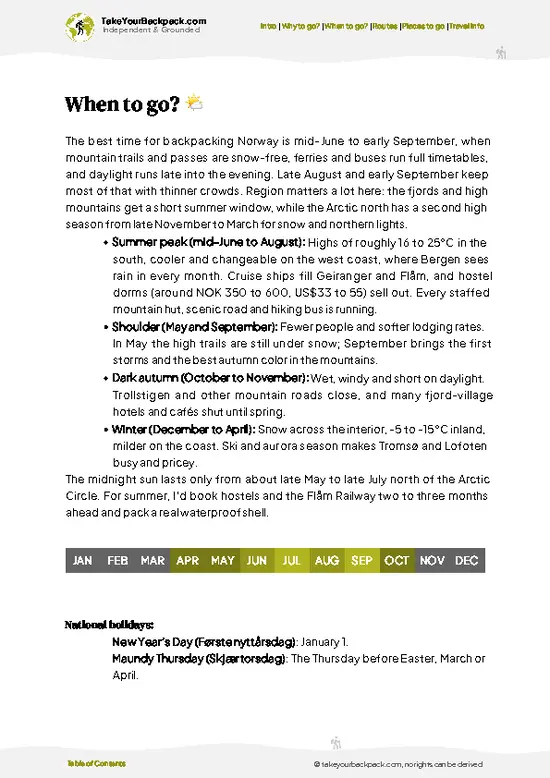
Best months and light: June to August is the best window for most landmarks in Norway, because mountain roads and trails are open, ferries run frequently and daylight lasts 18 to 24 hours in the north. Daytime temperatures along the western fjords sit around 15 to 22°C, and the air carries wet pine and cut grass. Bergen is among the wettest large cities in Europe, with roughly 2,000 to 2,500 millimeters a year, so rain can arrive in any month.

Shoulder seasons: May and September bring lower prices, with hotel rates often 20 to 40 percent below July. Crowds thin, and September has crisp mornings and orange birch and bog. But some high trails still hold snow in May and early June, and several seasonal roads, including the Trollstigen mountain road, open only around May to early June. Ferries … read more 👉
Best months and light: June to August is the best window for most landmarks in Norway, because mountain roads and trails are open, ferries run frequently and daylight lasts 18 to 24 hours in the north. Daytime temperatures along the western fjords sit around 15 to 22°C, and the air carries wet pine and cut grass. Bergen is among the wettest large cities in Europe, with roughly 2,000 to 2,500 millimeters a year, so rain can arrive in any month.

Shoulder seasons: May and September bring lower prices, with hotel rates often 20 to 40 percent below July. Crowds thin, and September has crisp mornings and orange birch and bog. But some high trails still hold snow in May and early June, and several seasonal roads, including the Trollstigen mountain road, open only around May to early June. Ferries and tourist boats also run reduced schedules.

Winter: From November to March, the south has short gray days of 4 to 7 hours of light and temperatures near 0°C. Northern Norway drops to -5 to -15°C and the sun disappears for weeks above the Arctic Circle, though the blue twilight is striking. Many mountain sites are inaccessible, and tourist facilities close. Cities and museums stay open year-round, so they work in any month.

unique site hoppingSuggested Travel Strategies

How long to allow: A trip combining several landmarks in Norway needs 10 to 14 days, and a week works only if you stay in one region. The country is long and the fjords cut deep, so every transfer takes longer than the map suggests.

Regions that group well: The south and east pair easily: Oslo connects to the rest of the country by train and bus, and cities here need only 1 to 2 days each. From there, the Oslo to Bergen railway takes about 6.5 to 7 hours and crosses a snowy plateau. The fjord region around Bergen, Flåm and Geiranger suits 4 to 6 days, since each fjord needs a half day to a full day, and ferries between villages take 1 to 3 hours. Going north from Bergen toward Ålesund and Trondheim, add a half day per leg by bus, and consider a flight from Oslo or Trondheim to Tromsø or the … read more 👉
How long to allow: A trip combining several landmarks in Norway needs 10 to 14 days, and a week works only if you stay in one region. The country is long and the fjords cut deep, so every transfer takes longer than the map suggests.

Regions that group well: The south and east pair easily: Oslo connects to the rest of the country by train and bus, and cities here need only 1 to 2 days each. From there, the Oslo to Bergen railway takes about 6.5 to 7 hours and crosses a snowy plateau. The fjord region around Bergen, Flåm and Geiranger suits 4 to 6 days, since each fjord needs a half day to a full day, and ferries between villages take 1 to 3 hours. Going north from Bergen toward Ålesund and Trondheim, add a half day per leg by bus, and consider a flight from Oslo or Trondheim to Tromsø or the Lofoten Islands, which saves 1 to 2 days of driving.

Direction and mistakes: Travel from Oslo west to Bergen, then north, so the long flights sit at the end of the trip. The common mistake is trying to fit in too much: a day with two fjord ferries, a mountain pass and a hike leaves you looking at the windshield. Plan one major stop per day, keep a buffer day for fog and rain, and book trains and ferries early in summer.

The ListTop landmarks of Norway

1 Geirangerfjord

sheer cliffs, cascading waterfalls, deep blue water, mountain farms

Cruise beneath vertical rock faces and tumbling falls, passing remote farmsteads clinging to slopes above the narrow, winding fjord.

norway-unique-site-geirangerfjord
© Google | Evo

2 Nærøyfjord

UNESCO fjord, slender waterway, steep mountainsides, tiny hamlets

Paddle or boat through a narrow, twisting fjord lined with towering slopes and scattered settlements accessible only by water.

norway-unique-site-naeroyfjord
© Google | Simone Wunderlich

3 Galdhøpiggen

summit glacier, alpine plateau, snowfields, panoramic ridge

Ascend Norway’s highest peak to cross ancient ice, traverse exposed ridges, and take in expansive views of the Jotunheimen wilderness.

norway-unique-site-galdhopiggen
© Google |

4 Lysefjord

Preikestolen, granite walls, narrow inlet, high plateaus

Hike to dramatic overlooks or ferry through a steep-sided fjord where bare rock and dizzying heights define the landscape.

norway-unique-site-lysefjord
© Google | Tzwen

5 Vøringsfossen

plunging waterfall, canyon views, misty spray, footbridge

Stand above a roaring cascade as water drops into a deep gorge, with walkways offering close encounters and sweeping vistas.

Loading the map 🌍

Expert viewExpert Commentary on landmarks

How many to visit: Plan on 5 to 8 landmarks in a 10 to 14 day trip. Norway’s distances and weather eat days, and each major stop deserves a half day to a full day, since a good view can vanish into fog and a second chance matters. More than eight turns the trip into transit. For a backpacker, the best value comes from fewer sites visited longer rather than a fast sweep.

Which kind for which traveler: Hikers should prioritize natural landmarks. They cost nothing to enter, though you pay in sweat, boots and time: a famous cliff hike takes 4 to 8 hours round trip, with wet rock and often a queue of people on the trail. If you have a short trip and limited energy, boat-accessed fjord sights cost more (a cruise or ferry runs about NOK 400 to 900, or US$37 to 85) but need no fitness. Culture-focused … read more 👉
How many to visit: Plan on 5 to 8 landmarks in a 10 to 14 day trip. Norway’s distances and weather eat days, and each major stop deserves a half day to a full day, since a good view can vanish into fog and a second chance matters. More than eight turns the trip into transit. For a backpacker, the best value comes from fewer sites visited longer rather than a fast sweep.

Which kind for which traveler: Hikers should prioritize natural landmarks. They cost nothing to enter, though you pay in sweat, boots and time: a famous cliff hike takes 4 to 8 hours round trip, with wet rock and often a queue of people on the trail. If you have a short trip and limited energy, boat-accessed fjord sights cost more (a cruise or ferry runs about NOK 400 to 900, or US$37 to 85) but need no fitness. Culture-focused travelers get the best return from museums and historic wooden churches, where entry is usually NOK 100 to 200 (about US$9 to 19), you stay dry, and city locations connect easily by train. Anyone watching money should pick two or three paid sites and spend the rest of the time on free trails and viewpoints.

What it costs: A frugal independent traveler spends about NOK 700 to 1,100 (US$65 to 100) a day. A hostel dorm bed runs NOK 350 to 600 (US$33 to 56), a supermarket meal NOK 70 to 120 (US$7 to 11), and a restaurant main course NOK 200 to 350. Self-catering and camping lower this. Regional bus and ferry legs add NOK 100 to 500 per segment, and a rental car costs more once fuel, tolls and ferries are counted. Add roughly NOK 150 to 900 per visit for entry fees, guided tours and boat tickets. Booking in advance often brings lower fares on trains and some ferries.

Safety and etiquette: Mountain weather is the real hazard. Temperatures can swing 10°C within hours, and wet rock turns treacherous, so wear boots with grip, carry a waterproof layer and check the forecast on yr.no before you start. Many popular cliff edges have no fences. Keep back from the drop and do not pose near the edge for photos. Winter roads can close, and tunnels and passes should be checked on the road authority’s site.

Culturally, Norwegians value quiet and personal space. Keep to marked paths, carry out rubbish, and camp at least 150 meters from houses under the right to roam. At churches and heritage buildings, follow posted rules and keep your voice low.

✈️ The backpacker research shortcutNorway Travel Guide

An offline-friendly backpacking guide with optimized travel routes, ranked highlights, transport advice, and the best areas to stay.
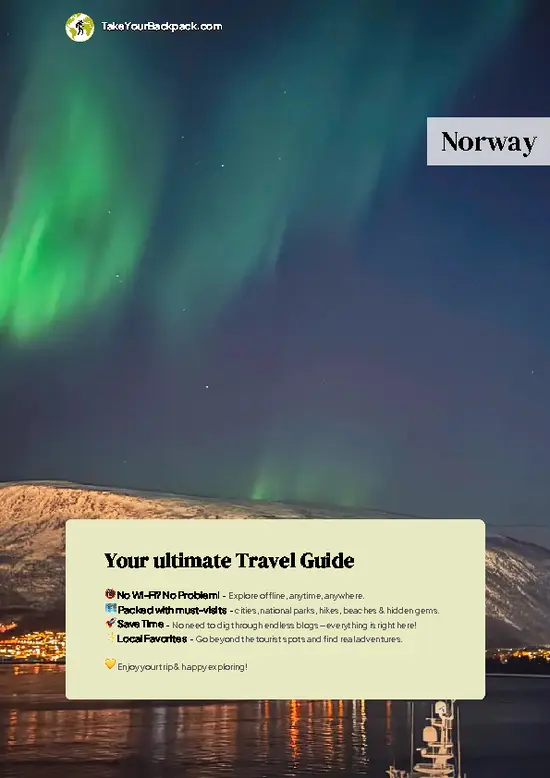
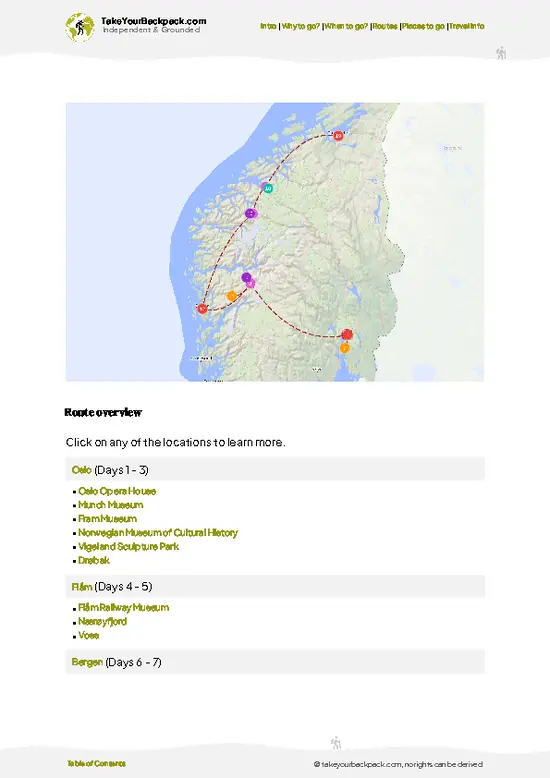
example page 0 from our offline Travel Guide for Norway
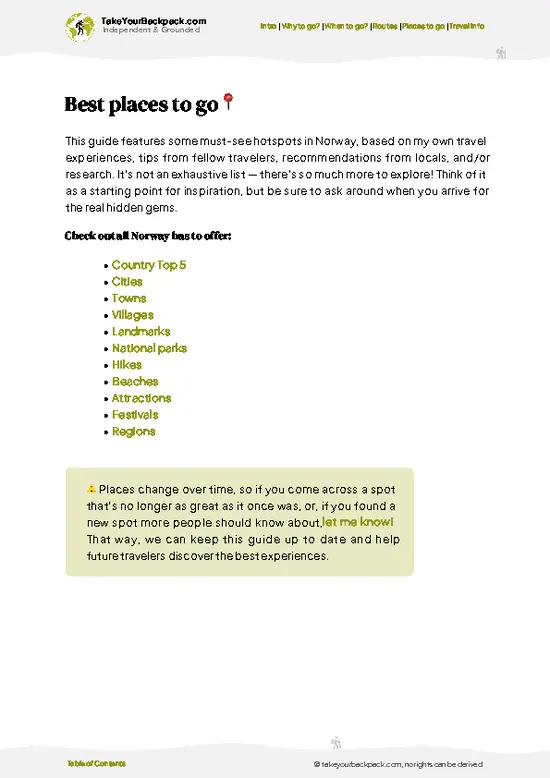
example page 1 from our offline Travel Guide for Norway
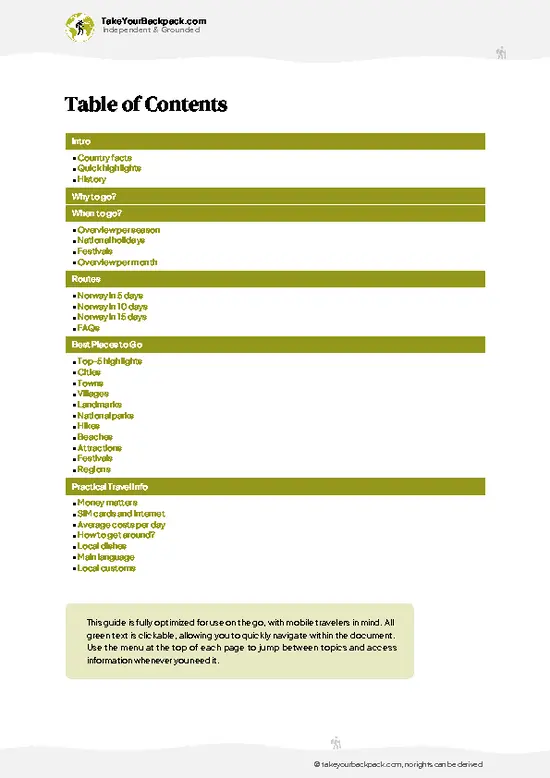
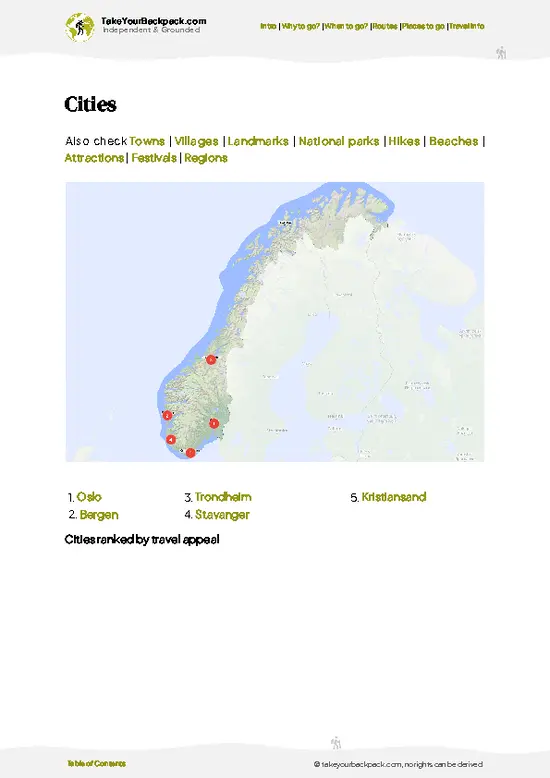
example page 2 from our offline Travel Guide for Norway
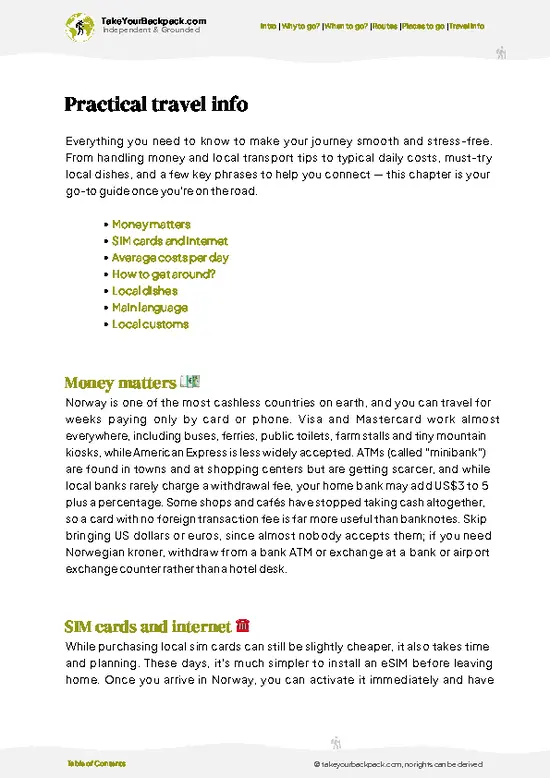
example page 3 from our offline Travel Guide for Norway
example page 4 from our offline Travel Guide for Norway
example page 5 from our offline Travel Guide for Norway
example page 6 from our offline Travel Guide for Norway
example page 7 from our offline Travel Guide for Norway
The digital guide (377 pages) contains:
✅ 101 highlights, ranked by travel appeal
✅ Optimized 5, 10 & 15-day travel routes
✅ Cities, national parks, landmarks, beaches
✅ How to get around
✅ Offline-friendly for travel without Wi-Fi
👉 Click to see all 30+ guide features

📅 Plan smarter in minutes, not weeks
✅ Month by month travel advice
✅ Festivals & national holidays
✅ Budget expectations

🗺️ Go to the right places, skip the overrated ones
✅ Honest pros & cons of destinations
✅ Top hikes, parks & viewpoints
✅ Lesser-known places most travelers miss
✅ Clear “worth it vs skip it” guidance

🛏️ Travel smoothly without rookie mistakes
✅ Best areas to stay
✅ Transport systems explained simply
✅ Common scams & safety advice
✅ SIM cards, money & practical tips

🌍 Understand the country, not just visit it
✅ Culture & traditions
✅ 52 Essential phrases & customs
✅ Festivals worth planning around
✅ Traveler-friendly historical context
✅ Insights that make places more meaningful

📱 Built for real travel conditions
✅ Fully downloadable PDF
✅ Works completely offline
✅ Optimized for phone use
✅ Useful in remote areas & buses
✅ Everything in one place
Stop searching, start planning
Get instant access to your full guide. 30‑day money-back guarantee.
+ Add another guide for just

By proceeding you agree to our terms.
Sent to your inbox immediately after payment • 100% Secure Checkout
Best Backpacking Travel Advisor 2025 tourism awardBest Backpacking
Travel Advisor
2025
What others say about Take Your Backpack Guides:
⭐⭐⭐⭐⭐
Fantastic, amazing amount of information!
⭐⭐⭐⭐⭐
My goodness this is amazing, it's what I've been looking for hats off too you!
⭐⭐⭐⭐⭐
I think this is absolutely BRILLIANT
⭐⭐⭐⭐
Very complete and informative. It's still missing places, but I gotta to commend you
⭐⭐⭐⭐⭐
This is truly amazing, thank you, can't wait to explore it with my kids!
⭐⭐⭐⭐⭐
Awesome resource, thank you!
⭐⭐⭐⭐⭐
This is amazing! Can't wait to explore the ones I haven't seen
⭐⭐⭐⭐
I love this! Well done, great idea.
⭐⭐⭐⭐⭐
Thanks for taking the time to make this gem!
⭐⭐⭐⭐⭐
This might be the best website I've ever seen.
⭐⭐⭐⭐⭐
Congratulations, and thank you so much for your work; it's incredibly valuable.
⭐⭐⭐⭐
In all seriousness I think you did a great job pointing out the important spots
⭐⭐⭐⭐⭐
10/10 very good
⭐⭐⭐⭐⭐
As someone who's only just starting to visit regularly this is awesome, thank you.
⭐⭐⭐⭐
Thank you very much! I'm going to visit my dad, it's going to be very useful!
⭐⭐⭐⭐⭐
This is really cool! We'll be travelling for the first time and this definitely come in handy.
⭐⭐⭐⭐⭐
You are now our minister of culture, congratulations 👨‍💼
⭐⭐⭐⭐⭐
Just wanted to tell you that this is a pearl! Going to follow your recommendations.
⭐⭐⭐⭐⭐
This is so cool. I'll definitely be using the resource for my travels soon.
⭐⭐⭐⭐⭐
This is very impressive! Good work.
⭐⭐⭐⭐⭐
This is an amazing and informative site. Very well done!

🛏️ Where to stay?Top Places to Consider Staying

Norway has hostels and budget beds in every major city, with dorms typically running NOK 350 to 600 (about US$33 to 56) a night, plus cheap cabins at campsites along the main touring routes. In Oslo, Sentrum around the central station puts you closest to the waterfront, museums and transport links but gets rowdy and a little rough late at night, while Grünerløkka has the best bars and cafés and a younger crowd, with a 15 to 20 minute walk to the center. In Bergen, the area around Bryggen and the fish market keeps every sight within walking distance but books out early in summer, and in Tromsø the compact city center is small and safe, with most budget beds a short walk from the harbor and the … read more 👉
Norway has hostels and budget beds in every major city, with dorms typically running NOK 350 to 600 (about US$33 to 56) a night, plus cheap cabins at campsites along the main touring routes. In Oslo, Sentrum around the central station puts you closest to the waterfront, museums and transport links but gets rowdy and a little rough late at night, while Grünerløkka has the best bars and cafés and a younger crowd, with a 15 to 20 minute walk to the center. In Bergen, the area around Bryggen and the fish market keeps every sight within walking distance but books out early in summer, and in Tromsø the compact city center is small and safe, with most budget beds a short walk from the harbor and the late-opening pubs.

If you enjoy meeting fellow travelers, consider choosing hostels with high ratings for atmosphere. On the other hand, if you prefer having your own space, a hotel might be a better option.

NorwayMore Places Across Norway

👋 Meet the founderWho’s Behind Take Your Backpack?

Johan, backpacker and founder of TakeYourBackpackHi, I’m Johan (Netherlands 🇳🇱), the creator of TakeYourBackpack. Over the past 3 decades, I’ve backpacked through 90+ countries across six continents, gaining extensive experience with independent travel, long-term trips, and overland routes.

This site is built on a combination of firsthand travel experience and carefully curated insights from other backpackers. Many guides are based on places I’ve personally visited, while others bring together tips, observations, and practical advice shared by trusted travelers I’ve met along the way.

The goal is to provide realistic, experience-driven guidance — not generic itineraries — so you can explore destinations with better context, clearer expectations, and more confidence.