×

Norway🇳🇴 | best hikesDiscover the 9 Best hikes Across Norway

Hiking in Norway means walking through weather as much as landscape: granite slabs slick with rain, the sharp smell of wet birch and crushed crowberry, glacial meltwater roaring in gullies. The fjord country of the west offers steep stone steps and big vertical gains, with the busiest trailheads near Bergen, Geiranger and Lysefjord. Jotunheimen and the high interior bring boulder fields, snow patches into July and a network of staffed huts. Lofoten and the north trade crowds for sea-level peaks, midnight light and costlier access. Backpackers traveling independently get the most from the marked trails and the right-to-roam, which lets you camp almost anywhere.

By Johan Kruseman 🇳🇱 | Updated October 18, 2026
Explore the best beaches in Norway

Why go?Why Travelers Love These Spots

Norway is built for walking in a way few countries match. The allemannsretten, the right to roam, lets you cross uncultivated land and pitch a tent a reasonable distance from houses, so a trip is not tied to a campground. The Norwegian Trekking Association (DNT) maintains thousands of kilometers of trails marked with red-painted T’s on rocks and cairns, plus a network of staffed, self-service and unstaffed cabins. That infrastructure exists because walking, or friluftsliv, is part of national identity, and you will meet Norwegians in wool and rain shells on the same slopes.

Geography does the rest. Glaciers carved fjords and plateaus, leaving trails that climb hundreds of meters from sea level within a few kilometers, over wet rock, loose scree and spongy bog that soaks boots through. Weather … read more 👉
Norway is built for walking in a way few countries match. The allemannsretten, the right to roam, lets you cross uncultivated land and pitch a tent a reasonable distance from houses, so a trip is not tied to a campground. The Norwegian Trekking Association (DNT) maintains thousands of kilometers of trails marked with red-painted T’s on rocks and cairns, plus a network of staffed, self-service and unstaffed cabins. That infrastructure exists because walking, or friluftsliv, is part of national identity, and you will meet Norwegians in wool and rain shells on the same slopes.

Geography does the rest. Glaciers carved fjords and plateaus, leaving trails that climb hundreds of meters from sea level within a few kilometers, over wet rock, loose scree and spongy bog that soaks boots through. Weather swings quickly: sun, hail and fog can arrive within an hour, and the air smells of cold stone and moss.

Know before you choose it that Norway is expensive: food, cabin beds and ferries add up, and supermarket supplies are far cheaper than cafés. Many routes are short on distance but long on effort, so Norwegian trail times matter more than distance. Daylight also ranges from near 24 hours in summer to a few hours in winter, which shapes what is practical.
Behind the Scenes of Selection
The list of best hikes in Norway is created based on scenery, challenge, trail quality, landmarks, and overall enjoyment. If you feel a hike is missing in this list, please let us know.

When to go?When to Plan Your Trip

Best months: late June to early September: Late June to early September is the window for hiking in Norway, because snow has melted from most trails, huts are staffed and daylight lasts 17 to 24 hours north of the Arctic Circle. Valley temperatures run 12 to 22°C, but high routes in Jotunheimen and the mountains can hover near 0 to 10°C and drop below freezing at night. Rain is frequent, and the west coast around Bergen gets roughly 2,000 mm a year, so waterproofs are not optional.
Shoulder seasons: May to mid-June and mid-September to early October: Lower trails open from May, with meltwater thundering in the valleys, but high routes often stay under snow into late June or July, and many DNT huts and ferries run limited schedules. September brings crisp air, red-gold bogs and fewer people, … read more 👉
Best months: late June to early September: Late June to early September is the window for hiking in Norway, because snow has melted from most trails, huts are staffed and daylight lasts 17 to 24 hours north of the Arctic Circle. Valley temperatures run 12 to 22°C, but high routes in Jotunheimen and the mountains can hover near 0 to 10°C and drop below freezing at night. Rain is frequent, and the west coast around Bergen gets roughly 2,000 mm a year, so waterproofs are not optional.
Shoulder seasons: May to mid-June and mid-September to early October: Lower trails open from May, with meltwater thundering in the valleys, but high routes often stay under snow into late June or July, and many DNT huts and ferries run limited schedules. September brings crisp air, red-gold bogs and fewer people, though days shorten fast and the first snow can dust higher ground. Cabin and lodging prices are typically 20 to 40 percent lower outside July.
Peak crowds and regional differences: July is the busiest and priciest month, especially in the western fjords and Lofoten, where popular trailheads fill early and parking and accommodation need booking. Northern Norway has the midnight sun from roughly late May to late July, while southern areas get long, soft evenings. Winter hiking calls for snowshoes or skis and avalanche awareness, not summer trails.

hike hoppingSuggested Travel Strategies

How many days to plan: A trip combining several hikes in Norway needs 10 to 16 days, which leaves room for weather days, because rain can close a high route or cloud out a view. Cluster the country in three zones: Bergen and the western fjords, the interior mountains around Jotunheimen and Oslo, and the far north including Lofoten and Tromsø. Travel north to south or the reverse as flights allow, and avoid doubling back.
Time per stop and between regions: Allow 2 to 4 days per region so that a rest or weather day fits in. Oslo to Bergen takes about 6.5 to 7 hours by train over the Hardangervidda plateau, and Bergen to Ålesund or Geiranger involves a long drive or bus plus a ferry, typically 6 to 9 hours. Oslo to Tromsø or Lofoten is best flown, around 1.5 to 2 hours to Tromsø or Bodø, then … read more 👉
How many days to plan: A trip combining several hikes in Norway needs 10 to 16 days, which leaves room for weather days, because rain can close a high route or cloud out a view. Cluster the country in three zones: Bergen and the western fjords, the interior mountains around Jotunheimen and Oslo, and the far north including Lofoten and Tromsø. Travel north to south or the reverse as flights allow, and avoid doubling back.
Time per stop and between regions: Allow 2 to 4 days per region so that a rest or weather day fits in. Oslo to Bergen takes about 6.5 to 7 hours by train over the Hardangervidda plateau, and Bergen to Ålesund or Geiranger involves a long drive or bus plus a ferry, typically 6 to 9 hours. Oslo to Tromsø or Lofoten is best flown, around 1.5 to 2 hours to Tromsø or Bodø, then a ferry or bus. Local buses in the west can be infrequent, so check timetables.
Planning mistakes to avoid: The usual error is packing too many regions into too few days and treating Norwegian distances like European ones, when winding fjord roads and ferries stretch every leg. Instead, choose two or three regions and slow down. Another is scheduling a long, high-altitude route on the first day of arrival after a night journey. Build in at least one buffer day per region, and keep spare food, since mountain villages can be sparse and shops close on Sundays.

The ListTop hikes of Norway

1 Trolltunga

jutting rock ledge, glacial valley, remote plateau

Undertake a long, exposed hike to a narrow rock tongue suspended above a vast valley, surrounded by stark wilderness.

Norway - Trolltunga

2 Preikestolen

flat-topped cliff, fjord overlook, stone plateau

Climb through forest and rocky terrain to a broad ledge, where the landscape drops away to the water far below.

norway-hike-preikestolen
© Google | Oleksandr Bashyn

3 Besseggen

knife-edge ridge, turquoise lakes, high plateau

Cross a famous ridge separating two contrasting lakes, with sweeping views over the Jotunheimen highlands and stark rock formations.

norway-hike-besseggen
© Google | Deniss R

4 Romsdalseggen

airy crest, alpine lakes, jagged summits

Follow a narrow ridge with dramatic drops on both sides, passing high lakes and sharp peaks that define the Romsdal landscape.

norway-hike-romsdalseggen
© Google |

5 Kjeragbolten

suspended boulder, vertical drop, Lysefjord views

Reach a boulder wedged above a sheer fjord, navigating exposed sections and open rock before standing above the abyss.

norway-hike-kjeragbolten
© Google | Marina R

6 Dronningruta

coastal ridges, sandy coves, island panoramas

Traverse exposed ridgelines and descend to sheltered beaches, with constant views of the sea and distant mountain silhouettes.

norway-hike-dronningruta
© Google |

7 Molden Mountain

fjord panorama, forested slopes, rounded summit

Ascend through birch woods to a broad summit, where the Sognefjord’s arms and distant peaks fill the horizon.

norway-hike-molden-mountain
© Google |

8 Litlehornet

grassy summit, coastal scenery, gentle ascent

Gain elevation gradually for open views of islands and sea, finishing on a rounded peak with space to linger.

9 Skjomen

fjord cliffs, Arctic valley, granite walls

Ascend through a remote northern valley where steep granite faces and quiet waters create a sense of isolation and scale.

norway-hike-skjomen
© Google |
Loading the map 🌍

Expert viewExpert Commentary on hikes

How many hikes to plan: Plan on 4 to 6 hikes over a two-week trip, which gives you a mix of short day walks and one or two longer efforts without leaving you too tired for the next climb. Norwegian trails are steep, wet and slower than distance suggests, so more than one big day in a row wears on knees and morale. Three or four days of rest, weather delays or travel fill the rest. For a shorter trip, two or three well-chosen hikes beat a rushed checklist.
Which kind suits your style: First-timers and travelers who want views for little gear should choose fjord-side day hikes, which cost almost nothing beyond ferry and bus fares but are crowded in July and need an early start. If you want solitude and are comfortable with navigation, high-mountain routes with DNT huts give the most for the time, … read more 👉
How many hikes to plan: Plan on 4 to 6 hikes over a two-week trip, which gives you a mix of short day walks and one or two longer efforts without leaving you too tired for the next climb. Norwegian trails are steep, wet and slower than distance suggests, so more than one big day in a row wears on knees and morale. Three or four days of rest, weather delays or travel fill the rest. For a shorter trip, two or three well-chosen hikes beat a rushed checklist.
Which kind suits your style: First-timers and travelers who want views for little gear should choose fjord-side day hikes, which cost almost nothing beyond ferry and bus fares but are crowded in July and need an early start. If you want solitude and are comfortable with navigation, high-mountain routes with DNT huts give the most for the time, with real quiet and long light, but need layers, a map and a rain-proof plan. Multi-day hut-to-hut trekking costs the most in money, with beds often NOK 400 to 700 (US$40 to 70) a night for members and more for non-members, so a tent and supermarket food is the best value for a backpacker willing to carry 12 to 18 kg. Remote northern routes cost the most in transport time but give you empty ridgelines and sea-level light.
Budget: A tent-based backpacker can manage about NOK 700 to 1,100 (US$65 to 100) a day with self-catering, buses and the odd ferry. Hut-based walkers should expect NOK 1,200 to 2,000 (US$110 to 185) with meals. Most trails are free, but some parking and road tolls cost NOK 100 to 300 (US$10 to 28) a day, ferries NOK 100 to 300 a crossing, and glacier walks with a guide NOK 800 to 1,500 (US$75 to 140). DNT membership, around NOK 750 (US$70), pays for itself after a few hut nights.
Safety and culture: Weather is the main hazard. Check yr.no and varsom.no before every walk, carry waterproofs, a warm layer, a map and extra food even on short routes, and turn around when cloud drops or rain sets in, because slick rock and swollen streams cause most accidents. Snow can linger on high passes into July, so ask hut staff or check local conditions. The emergency number is 112, and mobile signal drops in valleys. Cultural etiquette is simple: greet people on the trail with a “hei”, leave no trash, camp at least 150 meters from houses and stay no more than two nights in one spot, and never light open fires between mid-April and mid-September. Leave gates closed around grazing sheep, and keep dogs on leads in that season.

✈️ The backpacker research shortcutNorway Travel Guide

An offline-friendly backpacking guide with optimized travel routes, ranked highlights, transport advice, and the best areas to stay.
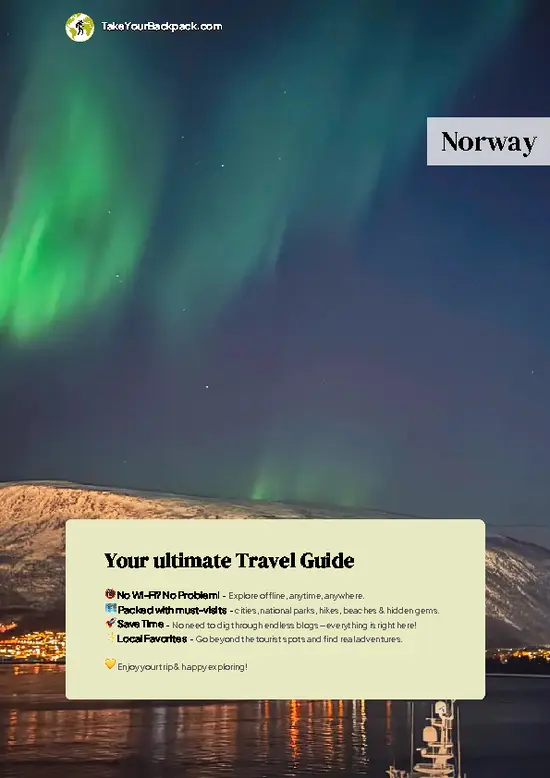
example page 0 from our offline Travel Guide for Norway
example page 1 from our offline Travel Guide for Norway
example page 2 from our offline Travel Guide for Norway
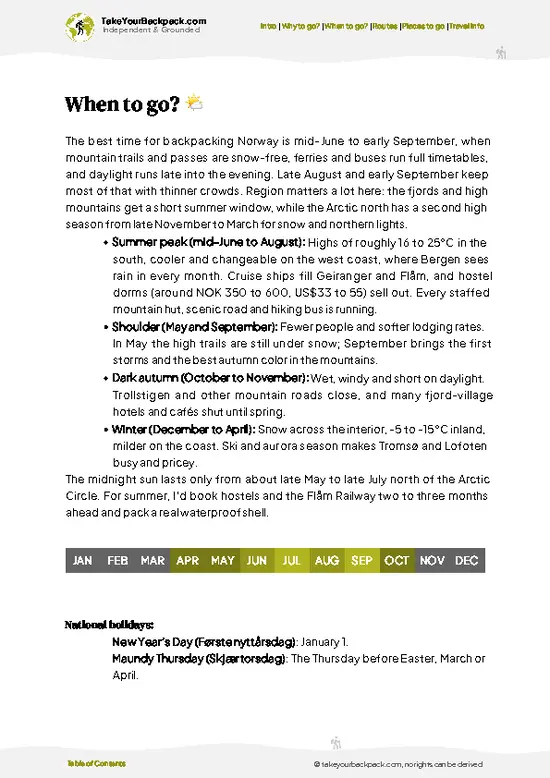
example page 3 from our offline Travel Guide for Norway
example page 4 from our offline Travel Guide for Norway
example page 5 from our offline Travel Guide for Norway
example page 6 from our offline Travel Guide for Norway
example page 7 from our offline Travel Guide for Norway
The digital guide (377 pages) contains:
✅ 101 highlights, ranked by travel appeal
✅ Optimized 5, 10 & 15-day travel routes
✅ Cities, national parks, landmarks, beaches
✅ How to get around
✅ Offline-friendly for travel without Wi-Fi
👉 Click to see all 30+ guide features

📅 Plan smarter in minutes, not weeks
✅ Month by month travel advice
✅ Festivals & national holidays
✅ Budget expectations

🗺️ Go to the right places, skip the overrated ones
✅ Honest pros & cons of destinations
✅ Top hikes, parks & viewpoints
✅ Lesser-known places most travelers miss
✅ Clear “worth it vs skip it” guidance

🛏️ Travel smoothly without rookie mistakes
✅ Best areas to stay
✅ Transport systems explained simply
✅ Common scams & safety advice
✅ SIM cards, money & practical tips

🌍 Understand the country, not just visit it
✅ Culture & traditions
✅ 52 Essential phrases & customs
✅ Festivals worth planning around
✅ Traveler-friendly historical context
✅ Insights that make places more meaningful

📱 Built for real travel conditions
✅ Fully downloadable PDF
✅ Works completely offline
✅ Optimized for phone use
✅ Useful in remote areas & buses
✅ Everything in one place
Stop searching, start planning
Get instant access to your full guide. 30‑day money-back guarantee.
+ Add another guide for just

By proceeding you agree to our terms.
Sent to your inbox immediately after payment • 100% Secure Checkout
Best Backpacking Travel Advisor 2025 tourism awardBest Backpacking
Travel Advisor
2025
What others say about Take Your Backpack Guides:
⭐⭐⭐⭐⭐
Fantastic, amazing amount of information!
⭐⭐⭐⭐⭐
My goodness this is amazing, it's what I've been looking for hats off too you!
⭐⭐⭐⭐⭐
I think this is absolutely BRILLIANT
⭐⭐⭐⭐
Very complete and informative. It's still missing places, but I gotta to commend you
⭐⭐⭐⭐⭐
This is truly amazing, thank you, can't wait to explore it with my kids!
⭐⭐⭐⭐⭐
Awesome resource, thank you!
⭐⭐⭐⭐⭐
This is amazing! Can't wait to explore the ones I haven't seen
⭐⭐⭐⭐
I love this! Well done, great idea.
⭐⭐⭐⭐⭐
Thanks for taking the time to make this gem!
⭐⭐⭐⭐⭐
This might be the best website I've ever seen.
⭐⭐⭐⭐⭐
Congratulations, and thank you so much for your work; it's incredibly valuable.
⭐⭐⭐⭐
In all seriousness I think you did a great job pointing out the important spots
⭐⭐⭐⭐⭐
10/10 very good
⭐⭐⭐⭐⭐
As someone who's only just starting to visit regularly this is awesome, thank you.
⭐⭐⭐⭐
Thank you very much! I'm going to visit my dad, it's going to be very useful!
⭐⭐⭐⭐⭐
This is really cool! We'll be travelling for the first time and this definitely come in handy.
⭐⭐⭐⭐⭐
You are now our minister of culture, congratulations 👨‍💼
⭐⭐⭐⭐⭐
Just wanted to tell you that this is a pearl! Going to follow your recommendations.
⭐⭐⭐⭐⭐
This is so cool. I'll definitely be using the resource for my travels soon.
⭐⭐⭐⭐⭐
This is very impressive! Good work.
⭐⭐⭐⭐⭐
This is an amazing and informative site. Very well done!

🛏️ Where to stay?Where to Stay in Norway

Norway has hostels and budget beds in every major city, with dorms typically running NOK 350 to 600 (about US$33 to 56) a night, plus cheap cabins at campsites along the main touring routes. In Oslo, Sentrum around the central station puts you closest to the waterfront, museums and transport links but gets rowdy and a little rough late at night, while Grünerløkka has the best bars and cafés and a younger crowd, with a 15 to 20 minute walk to the center. In Bergen, the area around Bryggen and the fish market keeps every sight within walking distance but books out early in summer, and in Tromsø the compact city center is small and safe, with most budget beds a short walk from the harbor and the … read more 👉
Norway has hostels and budget beds in every major city, with dorms typically running NOK 350 to 600 (about US$33 to 56) a night, plus cheap cabins at campsites along the main touring routes. In Oslo, Sentrum around the central station puts you closest to the waterfront, museums and transport links but gets rowdy and a little rough late at night, while Grünerløkka has the best bars and cafés and a younger crowd, with a 15 to 20 minute walk to the center. In Bergen, the area around Bryggen and the fish market keeps every sight within walking distance but books out early in summer, and in Tromsø the compact city center is small and safe, with most budget beds a short walk from the harbor and the late-opening pubs.

If you enjoy meeting fellow travelers, consider choosing hostels with high ratings for atmosphere. On the other hand, if you prefer having your own space, a hotel might be a better option.

NorwayMore of Norway

👋 Meet the founderWho’s Behind Take Your Backpack?

Johan, backpacker and founder of TakeYourBackpackHi, I’m Johan (Netherlands 🇳🇱), the creator of TakeYourBackpack. Over the past 3 decades, I’ve backpacked through 90+ countries across six continents, gaining extensive experience with independent travel, long-term trips, and overland routes.

This site is built on a combination of firsthand travel experience and carefully curated insights from other backpackers. Many guides are based on places I’ve personally visited, while others bring together tips, observations, and practical advice shared by trusted travelers I’ve met along the way.

The goal is to provide realistic, experience-driven guidance — not generic itineraries — so you can explore destinations with better context, clearer expectations, and more confidence.