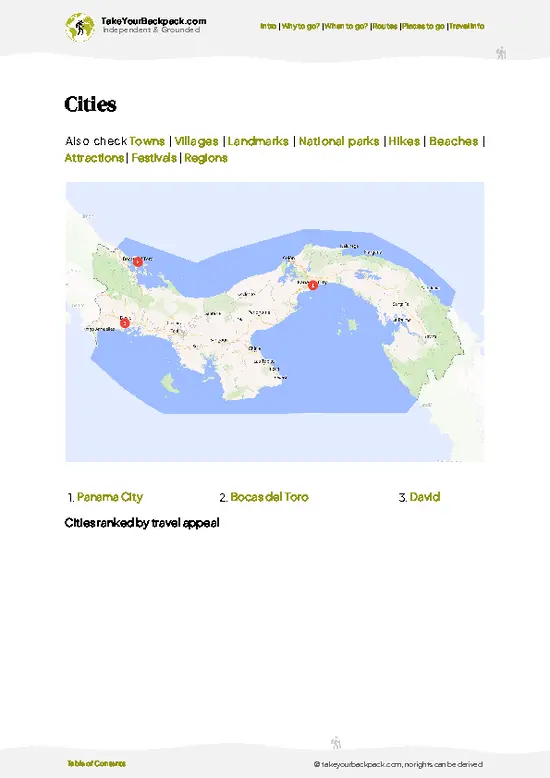
How many cities to visit: I advise
three or four urban stops in a single trip. Panama’s cities are spread by long, hot transfers, and each one needs at least a full day to read properly. Beyond four, you spend more time in buses than on the street, and the differences between places start to blur. If you have under a week, two is plenty.
Choosing between kinds of cities: Match the type to your style. The
capital and its historic quarter suit travelers who want museums, food variety, nightlife and easy onward connections. Smaller
highland towns fit hikers and coffee drinkers, who prefer cooler air and a slower pace.
Caribbean towns suit anyone after local culture, Afro-Caribbean food and a looser schedule, but they cost more in time than in money. Pick one of each rather than three of the …
read more 👉 How many cities to visit: I advise three or four urban stops in a single trip. Panama’s cities are spread by long, hot transfers, and each one needs at least a full day to read properly. Beyond four, you spend more time in buses than on the street, and the differences between places start to blur. If you have under a week, two is plenty.
Choosing between kinds of cities: Match the type to your style. The capital and its historic quarter suit travelers who want museums, food variety, nightlife and easy onward connections. Smaller highland towns fit hikers and coffee drinkers, who prefer cooler air and a slower pace. Caribbean towns suit anyone after local culture, Afro-Caribbean food and a looser schedule, but they cost more in time than in money. Pick one of each rather than three of the same, since the contrast is the point of the country.
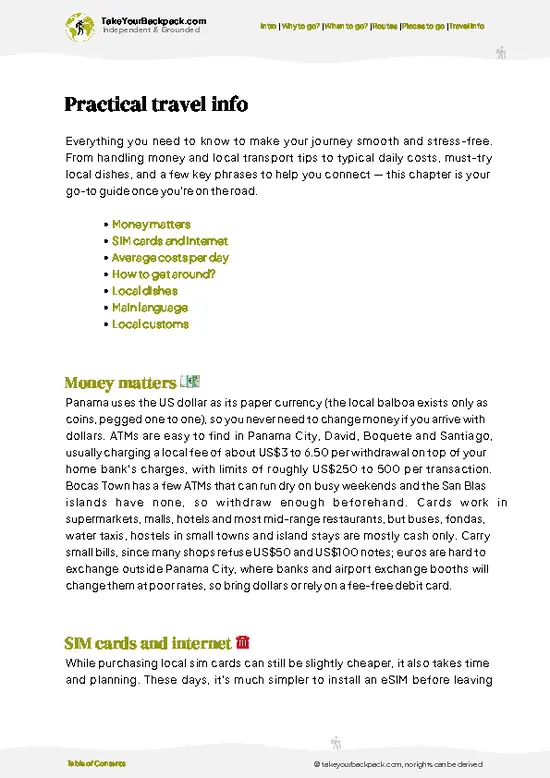
What it costs: Panama is the most expensive country in Central America for a backpacker, because it uses the US dollar and imports much of its food. Budget US$40 to 60 a day: dorm beds US$12 to 20, local lunches (a fixed-price “corredor” plate) US$3 to 6, city buses about US$0.35 to 0.50 per ride with a rechargeable card, and taxis US$4 to 10 for short hops. Museum and site entry typically runs US$2 to 15, and guided walking tours US$15 to 30, with some tip-based ones in the capital. Long-distance buses cost roughly US$10 to 25 per leg. Cash matters outside the capital, since small places may not accept cards, so carry small bills, as many machines and shops struggle with US$50 and US$100 notes.
Safety and cultural points: Panama is among the safer countries in the region, but some neighborhoods at the edge of the capital and in Colón carry real street-crime risk, so ask your hostel which areas to avoid after dark and use ride-hailing or registered taxis at night. Keep phones out of sight on crowded buses.
An experienced traveler also uses the midday heat as a schedule: museums and indoor markets from 11 to 3, walking in the early morning and after 4 pm. Dress modestly for churches, and greet shopkeepers and drivers with “buenas” before asking anything, because directness without greeting reads as rude. Indigenous communities are not attractions: ask before photographing people, and prefer community-run tours where payment goes directly to residents.
Finally, carry a copy of your passport, since police checks happen, and keep the original locked away.
v2.webp)

 Best Backpacking
.jpg) Hi, I’m Johan (Netherlands 🇳🇱), the creator of TakeYourBackpack. Over the past 3 decades, I’ve backpacked through 90+ countries across six continents, gaining extensive experience with independent travel, long-term trips, and overland routes.
Hi, I’m Johan (Netherlands 🇳🇱), the creator of TakeYourBackpack. Over the past 3 decades, I’ve backpacked through 90+ countries across six continents, gaining extensive experience with independent travel, long-term trips, and overland routes.