×

Poland🇵🇱 | best regionsExplore the 2 Best regions in Poland

Poland’s regions differ less by landscape than by history. Three empires divided the country for 123 years, and the borders of that era still show in architecture, dialect, food and pace. For a backpacker or any independent traveler, the useful split is between big historic cities in the south and center, the mountain and forest areas along the southern and eastern edges, and the Baltic coast and lake districts in the north. Cities are well connected by rail and busy in summer. Rural areas are cheaper and quieter, but buses thin out and a car or careful planning helps. Costs drop noticeably away from Kraków, Warsaw and Gdańsk.

By Johan Kruseman 🇳🇱 | Updated October 18, 2026
Explore the best cities in Poland

Why go?Why Travelers Love These Spots

Poland suits regional travel because its history is layered by region. Partition under Prussia, Russia and Austria, followed by border shifts after 1945, left areas with different building styles, religious traditions and local food. A traveler moving between regions meets those differences in towns a few hours apart, which is rare in a country of this size (about 312,000 square kilometers).

Geography is mostly flat to gently rolling, with the Tatra and Sudeten ranges in the south and the Baltic coast in the north. That keeps distances manageable and makes the country easy to cross by train and intercity bus. Rail is affordable, frequent on main lines and bookable online, though some regional branch lines run only a few times a day.

Before choosing Poland, know that the war destroyed much … read more 👉
Poland suits regional travel because its history is layered by region. Partition under Prussia, Russia and Austria, followed by border shifts after 1945, left areas with different building styles, religious traditions and local food. A traveler moving between regions meets those differences in towns a few hours apart, which is rare in a country of this size (about 312,000 square kilometers).

Geography is mostly flat to gently rolling, with the Tatra and Sudeten ranges in the south and the Baltic coast in the north. That keeps distances manageable and makes the country easy to cross by train and intercity bus. Rail is affordable, frequent on main lines and bookable online, though some regional branch lines run only a few times a day.

Before choosing Poland, know that the war destroyed much of the historic fabric in several cities, and many old centers are careful reconstructions rather than original buildings. Memorials and sites of the Second World War are central to the national story and deserve a measured, respectful approach. English is common among younger people in cities and less so in villages. Poland uses the złoty, not the euro, and card payment is widely accepted. Overall it is a good-value country with a sound infrastructure and little tourist pressure outside a few hotspots.
Evaluating the Top Choices
The list of best regions in Poland is created based on landscapes, local culture, attractions, vibes, and overall appeal. If you feel a region is missing in this list, please let us know.

When to go?Best Time to Visit Poland for regions

Best months and seasons: The best months are May to September, when daytime temperatures run about 15 to 25°C, daylight lasts up to 16 hours in midsummer and nearly all trails, ferries, castles and open-air sites operate. June to August is warmest, but also the wettest, with short thunderstorms and monthly rainfall around 60 to 90 mm.

Shoulder seasons: May and September to early October are the best balance of mild weather (10 to 20°C), fewer visitors and lower accommodation prices, often 10 to 25 percent below July and August rates. Autumn brings clear days in the south and colored forests, but nights drop toward freezing by late October. Some seasonal hostels, mountain huts and coastal businesses close after the end of September.

Peak periods and winter: The Baltic coast is crowded and … read more 👉
Best months and seasons: The best months are May to September, when daytime temperatures run about 15 to 25°C, daylight lasts up to 16 hours in midsummer and nearly all trails, ferries, castles and open-air sites operate. June to August is warmest, but also the wettest, with short thunderstorms and monthly rainfall around 60 to 90 mm.

Shoulder seasons: May and September to early October are the best balance of mild weather (10 to 20°C), fewer visitors and lower accommodation prices, often 10 to 25 percent below July and August rates. Autumn brings clear days in the south and colored forests, but nights drop toward freezing by late October. Some seasonal hostels, mountain huts and coastal businesses close after the end of September.

Peak periods and winter: The Baltic coast is crowded and priciest from late June to August, and prices there can rise 30 to 50 percent. The Tatra and Karkonosze mountains are busy in July and August and again during winter ski weeks in January and February. Cities are quieter, though popular ones fill around Christmas markets in December and around Easter and the long May holiday weekend.

Winter, from December to February, brings roughly minus 5 to 3°C, snow in the south and short days of about 8 hours. It suits city breaks and skiing, but not coastal or lake areas, where much is shut. Higher mountain trails may need winter gear from November to April.

region hoppingHow to Combine regions Into One Trip

How many days to plan: A trip combining several regions needs 10 to 16 days; fewer than 10 means rushing between stops. Poland is long enough that travel between distant areas takes real time, even on a good rail network.

Direction and grouping: The practical approach is a loop or a single sweep rather than doubling back. Regions in the south cluster around Kraków, Katowice and Wrocław, with trains of 2 to 3.5 hours between them. The center and north link through Warsaw, Łódź, Toruń, Poznań and Gdańsk. A common direction runs south to north, or the reverse, using Warsaw as the central hub. Warsaw to Kraków takes about 2.5 hours on fast trains, Warsaw to Gdańsk about 3 to 3.5 hours, and Kraków to Gdańsk roughly 5.5 to 7 hours. Mountain and eastern regions have fewer trains, and bus connections … read more 👉
How many days to plan: A trip combining several regions needs 10 to 16 days; fewer than 10 means rushing between stops. Poland is long enough that travel between distant areas takes real time, even on a good rail network.

Direction and grouping: The practical approach is a loop or a single sweep rather than doubling back. Regions in the south cluster around Kraków, Katowice and Wrocław, with trains of 2 to 3.5 hours between them. The center and north link through Warsaw, Łódź, Toruń, Poznań and Gdańsk. A common direction runs south to north, or the reverse, using Warsaw as the central hub. Warsaw to Kraków takes about 2.5 hours on fast trains, Warsaw to Gdańsk about 3 to 3.5 hours, and Kraków to Gdańsk roughly 5.5 to 7 hours. Mountain and eastern regions have fewer trains, and bus connections of 2 to 4 hours from the nearest large city are normal.

Time per stop and common mistakes: Allow 2 to 4 nights in a city region and 2 to 3 nights in a mountain or lake area, which needs a day for access and a day for walking. The most frequent mistake is adding too many stops and spending a third of the trip on transport. Another is booking a mountain stop on a day when the weather window is poor, with no spare day. Travelers also assume rural bus services run daily, when many cut back on Sundays and holidays. Choose a maximum of four or five bases, check timetables the day before, and keep a spare day for weather.

The ListTop regions of Poland

1 Kłodzko Valley

mountain passes, spa towns, fortress ruins, borderland villages

Follow winding roads through a region marked by shifting frontiers, mineral springs, and a landscape shaped by centuries of cross-border exchange.

poland-region-klodzko-valley
© Google | Tom Klíčník

2 Hel Peninsula

windswept dunes, kiteboarding spots, narrow sandbar, Baltic views

Experience shifting sands and open water on both sides, where wind sports thrive and the landscape feels shaped by the elements.

poland-region-hel-peninsula
© Google |
Loading the map 🌍

Expert viewWhat You Should Know

How many regions to visit: I advise three to four regions on a trip of two weeks. Poland’s trains are good, but each change costs half a day once you count station transfers, check-in and settling in. Three or four bases leave time to see the surroundings properly, and that is where most of the character is.

Choosing the kind of region: Pick by travel style. If you want history and food, prioritize the old-town and city regions, which hold most of the museums, memorials and restaurants. If you want walking and quiet, prioritize the mountains and forest areas, which need weather flexibility and sturdier boots. If you want water and slow days, choose the lakes or Baltic coast, which work best from June to early September. A balanced trip pairs one city region with one outdoor region. Anyone … read more 👉
How many regions to visit: I advise three to four regions on a trip of two weeks. Poland’s trains are good, but each change costs half a day once you count station transfers, check-in and settling in. Three or four bases leave time to see the surroundings properly, and that is where most of the character is.

Choosing the kind of region: Pick by travel style. If you want history and food, prioritize the old-town and city regions, which hold most of the museums, memorials and restaurants. If you want walking and quiet, prioritize the mountains and forest areas, which need weather flexibility and sturdier boots. If you want water and slow days, choose the lakes or Baltic coast, which work best from June to early September. A balanced trip pairs one city region with one outdoor region. Anyone short on time should avoid mixing the far north, far south and far east in a single week.

What it costs: Poland is one of Europe’s cheaper countries. A backpacker can manage on about PLN 200 to 300 (US$50 to 75) a day in cities and PLN 150 to 220 (US$38 to 55) in rural areas, covering a dorm bed at PLN 50 to 100 (US$12 to 25), self-catering or milk-bar meals at PLN 25 to 45 (US$6 to 11) and local transport. Mid-range travelers should plan on PLN 350 to 500 (US$88 to 125). Museum entry is usually PLN 15 to 40 (US$4 to 10), with many free days a week. Mountain national park tickets cost around PLN 8 to 15 (US$2 to 4). A guide for a half-day tour runs PLN 250 to 500 (US$63 to 125). Intercity train fares are typically PLN 40 to 120 (US$10 to 30) a leg when booked ahead, and buses are often cheaper. Expect a total per region visit of roughly PLN 600 to 1,200 (US$150 to 300) for three or four days, depending on lodging.

Crowds and cost reality: Kraków, Gdańsk and the Tatra gateway town of Zakopane are crowded and pricier in summer, with rooms costing double the rates elsewhere. Smaller towns and rural areas are far quieter and cheaper, and they are where the best details show up: wooden churches, regional soups, local museums and quiet forests.

Safety and cultural considerations: Poland is generally safe. Watch for pickpockets on crowded trams and at main stations, and use licensed taxis or ride apps rather than street offers. In the mountains, weather turns quickly, so carry a rain layer and leave early. Memorial sites call for quiet and modest dress. Remove shoes if asked in private homes, bring a small gift when invited, and greet people with “dzień dobry”. Most shops close on Sundays, and many close on public holidays, so buy supplies on Saturday. Drinking in public can bring a fine.

✈️ The backpacker research shortcutPoland Travel Guide

An offline-friendly backpacking guide with optimized travel routes, ranked highlights, transport advice, and the best areas to stay.
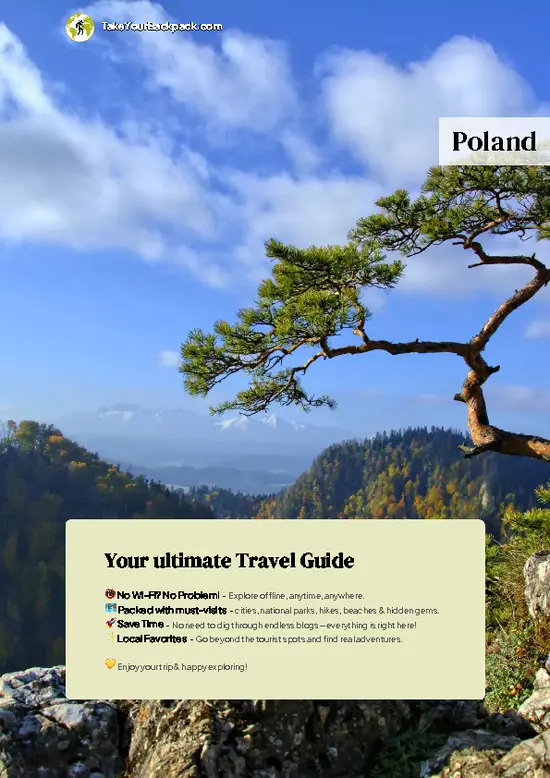
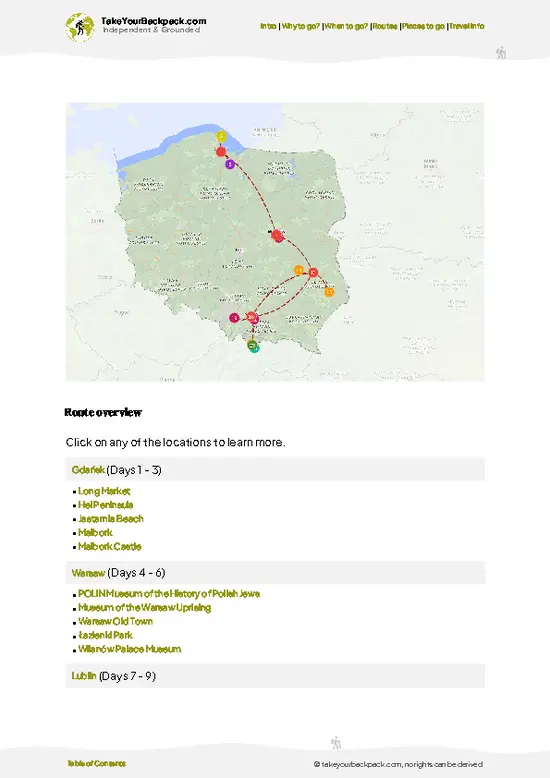
example page 0 from our offline Travel Guide for Poland
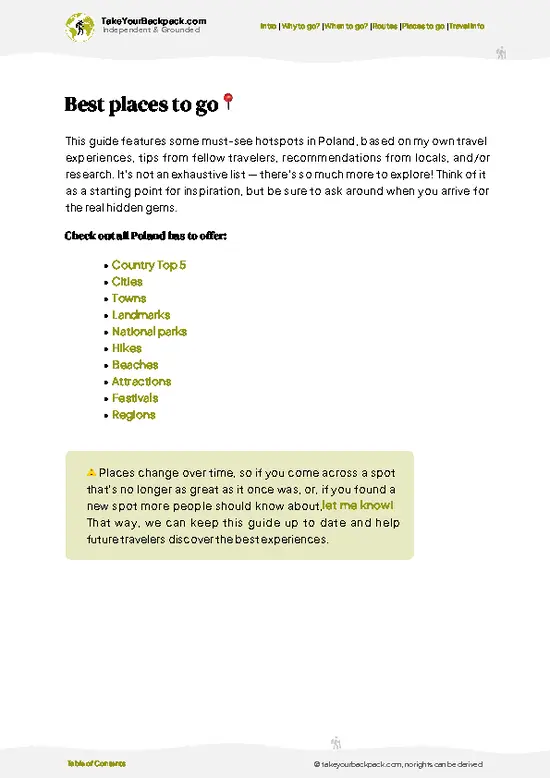
example page 1 from our offline Travel Guide for Poland
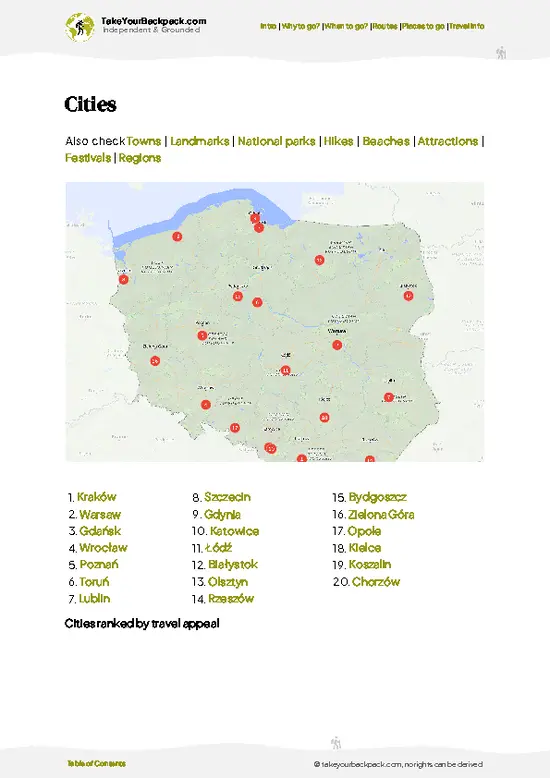
example page 2 from our offline Travel Guide for Poland
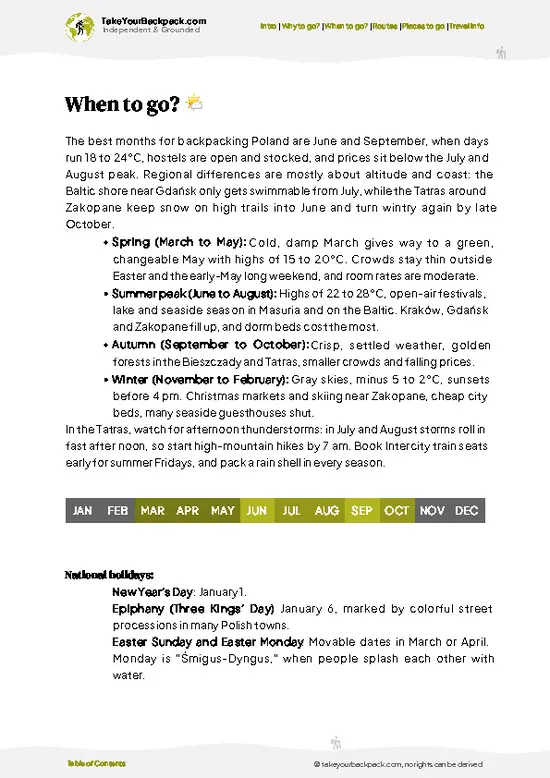
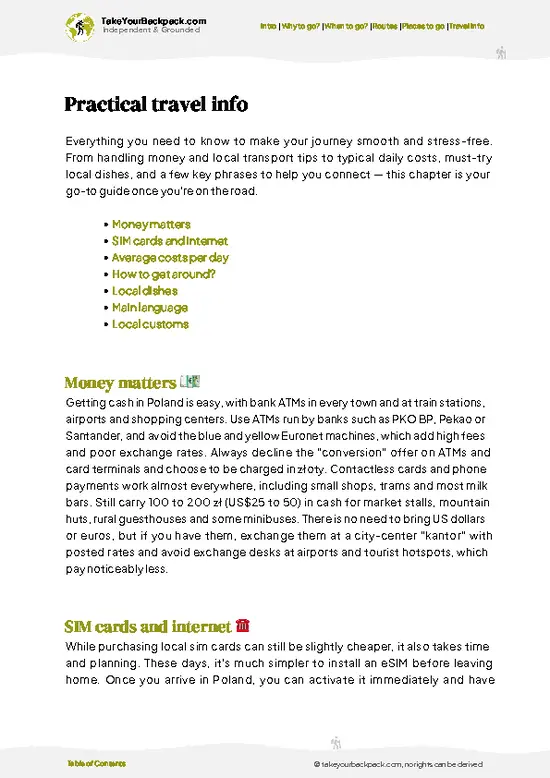
example page 3 from our offline Travel Guide for Poland
example page 4 from our offline Travel Guide for Poland
example page 5 from our offline Travel Guide for Poland
example page 6 from our offline Travel Guide for Poland
example page 7 from our offline Travel Guide for Poland
The digital guide (408 pages) contains:
✅ 110 highlights, ranked by travel appeal
✅ Optimized 5, 10 & 15-day travel routes
✅ Cities, national parks, landmarks, beaches
✅ How to get around
✅ Offline-friendly for travel without Wi-Fi
👉 Click to see all 30+ guide features

📅 Plan smarter in minutes, not weeks
✅ Month by month travel advice
✅ Festivals & national holidays
✅ Budget expectations

🗺️ Go to the right places, skip the overrated ones
✅ Honest pros & cons of destinations
✅ Top hikes, parks & viewpoints
✅ Lesser-known places most travelers miss
✅ Clear “worth it vs skip it” guidance

🛏️ Travel smoothly without rookie mistakes
✅ Best areas to stay
✅ Transport systems explained simply
✅ Common scams & safety advice
✅ SIM cards, money & practical tips

🌍 Understand the country, not just visit it
✅ Culture & traditions
✅ 52 Essential phrases & customs
✅ Festivals worth planning around
✅ Traveler-friendly historical context
✅ Insights that make places more meaningful

📱 Built for real travel conditions
✅ Fully downloadable PDF
✅ Works completely offline
✅ Optimized for phone use
✅ Useful in remote areas & buses
✅ Everything in one place
Stop searching, start planning
Get instant access to your full guide. 30‑day money-back guarantee.
+ Add another guide for just

By proceeding you agree to our terms.
Sent to your inbox immediately after payment • 100% Secure Checkout
Best Backpacking Travel Advisor 2025 tourism awardBest Backpacking
Travel Advisor
2025
What others say about Take Your Backpack Guides:
⭐⭐⭐⭐⭐
Fantastic, amazing amount of information!
⭐⭐⭐⭐⭐
My goodness this is amazing, it's what I've been looking for hats off too you!
⭐⭐⭐⭐⭐
I think this is absolutely BRILLIANT
⭐⭐⭐⭐
Very complete and informative. It's still missing places, but I gotta to commend you
⭐⭐⭐⭐⭐
This is truly amazing, thank you, can't wait to explore it with my kids!
⭐⭐⭐⭐⭐
Awesome resource, thank you!
⭐⭐⭐⭐⭐
This is amazing! Can't wait to explore the ones I haven't seen
⭐⭐⭐⭐
I love this! Well done, great idea.
⭐⭐⭐⭐⭐
Thanks for taking the time to make this gem!
⭐⭐⭐⭐⭐
This might be the best website I've ever seen.
⭐⭐⭐⭐⭐
Congratulations, and thank you so much for your work; it's incredibly valuable.
⭐⭐⭐⭐
In all seriousness I think you did a great job pointing out the important spots
⭐⭐⭐⭐⭐
10/10 very good
⭐⭐⭐⭐⭐
As someone who's only just starting to visit regularly this is awesome, thank you.
⭐⭐⭐⭐
Thank you very much! I'm going to visit my dad, it's going to be very useful!
⭐⭐⭐⭐⭐
This is really cool! We'll be travelling for the first time and this definitely come in handy.
⭐⭐⭐⭐⭐
You are now our minister of culture, congratulations 👨‍💼
⭐⭐⭐⭐⭐
Just wanted to tell you that this is a pearl! Going to follow your recommendations.
⭐⭐⭐⭐⭐
This is so cool. I'll definitely be using the resource for my travels soon.
⭐⭐⭐⭐⭐
This is very impressive! Good work.
⭐⭐⭐⭐⭐
This is an amazing and informative site. Very well done!

🛏️ Where to stay?Top Places to Consider Staying

Hostels are everywhere in Poland, with dorm beds typically running 50 to 110 zł (about €12 to €25) a night in the big cities. In Kraków, Stare Miasto (Old Town) puts you within walking distance of most sights but gets loud on weekend nights, while Kazimierz has the best bar scene and slightly lower prices. In Warsaw, Śródmieście is the most convenient for transport, and Praga is cheaper and grittier with good nightlife across the river. Gdańsk’s Główne Miasto (Main Town) and Wrocław’s Stare Miasto are compact and safe, though rooms book up fast in summer.

If you enjoy meeting fellow travelers, consider choosing hostels with high ratings for atmosphere. On the other hand, if you prefer having your own space, a hotel might be a better option.

PolandMore Places Across Poland

👋 Meet the founderWho’s Behind Take Your Backpack?

Johan, backpacker and founder of TakeYourBackpackHi, I’m Johan (Netherlands 🇳🇱), the creator of TakeYourBackpack. Over the past 3 decades, I’ve backpacked through 90+ countries across six continents, gaining extensive experience with independent travel, long-term trips, and overland routes.

This site is built on a combination of firsthand travel experience and carefully curated insights from other backpackers. Many guides are based on places I’ve personally visited, while others bring together tips, observations, and practical advice shared by trusted travelers I’ve met along the way.

The goal is to provide realistic, experience-driven guidance — not generic itineraries — so you can explore destinations with better context, clearer expectations, and more confidence.