×

Senegal🇸🇳 | best townsBest 10 towns in Senegal

Senegal towns come in distinct flavors, and the coast decides most of it. Dakar and Saint-Louis hum with car horns, fried fish smoke and Atlantic wind that leaves salt on your lips. Down in the Casamance, the air turns thick and green, with palm wine, rice paddies and pirogues sliding through mangroves. Inland and east, dry savanna towns bake under white light, dusty and quiet, with few visitors. Costs climb near Dakar and the beach strips, while the south and east run cheaper but demand longer rides in shared sept-places. For backpacking, pick by pace: coastal for ease, southern for lush calm, eastern for solitude.

By Johan Kruseman 🇳🇱 | Updated October 19, 2026
Explore the best villages in Senegal

Why go?Why These town Stand Out

Senegal suits town travel because its history is written into the streets. French colonial trading posts, Wolof and Serer markets, Mouride and Tijaniyya Sufi brotherhoods and old Atlantic slave-trade ports all left layers you can read in a single afternoon: shuttered balconies, mosque loudspeakers at dawn, handpainted fishing boats, the smell of grilled onions and peanuts at dusk. Geography adds variety. The country is small and mostly flat, yet it moves from Sahelian desert edge in the north through river estuaries and mangrove deltas to the humid forest of the south, so towns feel different within a day's ride.

Before committing, know that infrastructure is uneven. Main highways are decent, but side roads can be broken and transport leaves only when full, so schedules are loose. Power cuts … read more 👉
Senegal suits town travel because its history is written into the streets. French colonial trading posts, Wolof and Serer markets, Mouride and Tijaniyya Sufi brotherhoods and old Atlantic slave-trade ports all left layers you can read in a single afternoon: shuttered balconies, mosque loudspeakers at dawn, handpainted fishing boats, the smell of grilled onions and peanuts at dusk. Geography adds variety. The country is small and mostly flat, yet it moves from Sahelian desert edge in the north through river estuaries and mangrove deltas to the humid forest of the south, so towns feel different within a day's ride.

Before committing, know that infrastructure is uneven. Main highways are decent, but side roads can be broken and transport leaves only when full, so schedules are loose. Power cuts and weak water pressure happen outside major centers. Heat and dust shape every day, and midday is slow for good reason. French is the working language, with Wolof on the street, so a few greetings go a long way. Teranga, the local code of hospitality, is real, but it comes with persistent touts in busy hubs. Expect to bargain, to be invited to tea, and to spend more time waiting than you planned.
How the List Was Created
The list of best towns in Senegal is created based on charm, local culture, atmosphere, hidden gems, and visitor appeal. If you feel a town is missing in this list, please let us know.

When to go?When to Plan Your Trip

Best Months: The best months for towns in Senegal are November to February, when daytime highs sit around 27 to 32°C, humidity drops and virtually no rain falls. Mornings are cool enough for a light layer, and the Harmattan wind can leave a fine haze of dust over the light.
Shoulder Seasons: March to May heats up fast. Inland and eastern areas often pass 40°C, while the coast stays milder at 25 to 30°C thanks to sea breezes, so the Atlantic strip works better then. October and early June are transitional, with sticky air and the odd storm, but fewer travelers and softer prices.
Rainy Season: From July to September rain falls hardest, typically 400 to 600 mm in the north and up to 1,200 mm or more in the Casamance. Dirt roads turn to red mud, some tracks and ferry-linked areas become slow, and … read more 👉
Best Months: The best months for towns in Senegal are November to February, when daytime highs sit around 27 to 32°C, humidity drops and virtually no rain falls. Mornings are cool enough for a light layer, and the Harmattan wind can leave a fine haze of dust over the light.
Shoulder Seasons: March to May heats up fast. Inland and eastern areas often pass 40°C, while the coast stays milder at 25 to 30°C thanks to sea breezes, so the Atlantic strip works better then. October and early June are transitional, with sticky air and the odd storm, but fewer travelers and softer prices.
Rainy Season: From July to September rain falls hardest, typically 400 to 600 mm in the north and up to 1,200 mm or more in the Casamance. Dirt roads turn to red mud, some tracks and ferry-linked areas become slow, and mosquito pressure rises sharply. Southern regions are the most affected, so plan them for the dry months. The landscape is lush green, and rooms can cost 20 to 30 percent less.
Peak Periods: Prices peak in December and January, when guesthouses on the coast fill and rates rise by roughly 20 to 40 percent. Book ahead then. Religious events like the Grand Magal of Touba and Tabaski shift transport and lodging, since sept-places run packed and prices rise.

town hoppingPlanning Your Route Efficiently

How Many Days: A trip combining several towns in Senegal needs 10 to 14 days, because roads are slow and shared vehicles leave only when full. Fewer than eight days turns the trip into a series of dusty bus seats.
Grouping and Direction: Three clusters work well. The north around Saint-Louis, the central coast and Sine-Saloum delta near Dakar and the Petite Côte, and the south in the Casamance. Start in Dakar, the main air and bus hub, then move north first, return through the capital, then head south. Going clockwise saves you from backtracking over the same potholed stretches.
Time and Transfers: Allow 2 to 3 nights per stop, which gives time to settle into the market rhythm and shake off the road. Dakar to Saint-Louis takes about 4 to 5 hours. Dakar to the Sine-Saloum area takes 3 to 4 hours. … read more 👉
How Many Days: A trip combining several towns in Senegal needs 10 to 14 days, because roads are slow and shared vehicles leave only when full. Fewer than eight days turns the trip into a series of dusty bus seats.
Grouping and Direction: Three clusters work well. The north around Saint-Louis, the central coast and Sine-Saloum delta near Dakar and the Petite Côte, and the south in the Casamance. Start in Dakar, the main air and bus hub, then move north first, return through the capital, then head south. Going clockwise saves you from backtracking over the same potholed stretches.
Time and Transfers: Allow 2 to 3 nights per stop, which gives time to settle into the market rhythm and shake off the road. Dakar to Saint-Louis takes about 4 to 5 hours. Dakar to the Sine-Saloum area takes 3 to 4 hours. Dakar to Ziguinchor is about 9 to 12 hours by road through The Gambia, with the Banjul ferry crossing adding long waits. The overnight ferry from Dakar to Ziguinchor, when running, takes around 12 to 14 hours. Domestic flights shorten the south leg to roughly an hour.
Common Mistakes: Travelers often pack in too much and plan same-day connections, forgetting that sept-places wait until full. Leave early, since vehicles fill by morning and afternoon heat drags everything. Build a buffer day before any flight, and never schedule long drives after dark, when livestock and unlit trucks share the road.

The ListThe Best towns of Senegal

1 Joal-Fadiouth

Shell island, wooden bridges, mixed-faith cemeteries

Cross footbridges to a shell-covered island, observe daily life shaped by fishing, and visit unique cemeteries reflecting religious coexistence.

2 Kédougou

Eastern hills, gold mining, trekking base

Start treks into the hills, learn about artisanal gold mining, and use Kédougou as a launch point for exploring remote southeast Senegal.

3 Toubacouta

Delta lodges, birdwatching, eco-tours

Stay in riverside lodges, join guided excursions into the delta, and spot rare birds in a region prized by nature enthusiasts.

4 Bandafassi

Bassari culture, traditional compounds, mountain views

Walk among stone houses, learn about Bassari rituals, and take in panoramic views from the edge of the Senegalese highlands.

5 Podor

Island town, colonial warehouses, river trade

Stroll along the riverfront, see old trading posts, and sense the town’s history as a hub for commerce on the Senegal River.

6 Foundiougne

River ferry, colonial buildings, mangrove forests

Board a ferry across the Saloum, stroll shaded streets lined with old structures, and explore mangroves teeming with birdlife.

7 Bakel

Riverside fort, cliffside views, Soninke heritage

Climb to a colonial fort above the river, explore Soninke traditions, and watch the landscape change from cliffs to riverbanks.

senegal-city-bakel
© Google |

8 Vélingara

Casamance crossroads, cotton fields, ethnic diversity

Pass through a town linking north and south, observe cotton farming, and encounter a mix of cultures in daily street life.

9 Nioro du Rip

Religious center, peanut basin, Sufi shrines

Visit Sufi sites, observe peanut farming, and experience a town where religious gatherings shape the rhythm of local life.

10 Bignona

Casamance gateway, rice paddies, Diola communities

Enter Casamance via a town surrounded by rice fields, meet Diola residents, and use Bignona as a base for exploring the region.

11 Salemata

Fouta Djallon foothills, Bassari villages, weekly market

Venture into hilly terrain, visit Bassari communities, and time your trip for the lively market that draws people from remote hamlets.

12 Linguère

Sahel edge, weekly livestock market, nomadic routes, arid plains

Travel to the Sahel’s edge, where herders gather for trade and the landscape shifts from grassland to desert.

13 Ourossogui

Crossroads town, transport hub, local eateries

Pause in a busy junction for northern routes, sample simple meals, and observe the flow of travelers and traders passing through.

14 Kayar

Atlantic fishing port, colorful pirogues, bustling fish market

Watch hundreds of boats land their catch at dawn, then wander the busy market where the town’s economy pulses with the sea.

15 Mboro

Phosphate mines, sandy coastline, local markets

See mining operations on the town’s edge, walk quiet beaches, and shop for produce in a market serving nearby villages.

16 Goudomp

River port, palm groves, ferry crossing

Board a ferry across the Casamance, walk through palm-dotted neighborhoods, and watch river traffic from the town’s small port.

17 Guinguinéo

Rail junction, peanut warehouses, Wolof heartland

See trains converge at a key junction, pass by peanut storage sites, and explore a town rooted in Wolof culture.

18 Koungheul

Railway stop, millet fields, weekly livestock market

Arrive by train or road, see fields of millet, and time your visit for the market where herders trade cattle and goats.

19 Pout

Fruit orchards, limestone quarries, roadside stalls

Stop for fresh fruit at roadside stands, see limestone extraction on the outskirts, and pass through a town shaped by agriculture and industry.

20 Sinthiou Bamambé

Rural settlement, agricultural fields, local mosques

Pass through a quiet farming area where daily life centers on cultivation, religious practice, and small-scale community gatherings.

Think you know Senegal?

Prove you’re a true local — uncover 10 lesser-known towns in Senegal that locals tend to keep to themselves.
Loading the map 🌍

Expert viewInsights from Locals and Experts

How many towns to visit: Three to five towns is the number I advise for a trip of two to three weeks. Senegal’s roads are workable but slow, and a sept-place (shared seven-seat car) that leaves only when full can eat a morning before the wheels turn. Fewer stops means more time for the part you came for: tea on a sandy courtyard, a pirogue sliding out at dusk, the clatter of a market waking at 7 a.m.
Which kind of town for which traveler: Pick by temperament. Colonial-era coastal towns suit first-timers: tin-roofed fish markets, pastel facades flaking in the salt air, guesthouses with hot water and a rooftop for sunset. River and delta towns suit slower travelers who like boat days, bird-heavy mornings and mud-brick quiet. Interior and southern towns suit veterans, with longer hauls, thinner … read more 👉
How many towns to visit: Three to five towns is the number I advise for a trip of two to three weeks. Senegal’s roads are workable but slow, and a sept-place (shared seven-seat car) that leaves only when full can eat a morning before the wheels turn. Fewer stops means more time for the part you came for: tea on a sandy courtyard, a pirogue sliding out at dusk, the clatter of a market waking at 7 a.m.
Which kind of town for which traveler: Pick by temperament. Colonial-era coastal towns suit first-timers: tin-roofed fish markets, pastel facades flaking in the salt air, guesthouses with hot water and a rooftop for sunset. River and delta towns suit slower travelers who like boat days, bird-heavy mornings and mud-brick quiet. Interior and southern towns suit veterans, with longer hauls, thinner tourist infrastructure and far more conversation per hour. Mix one easy town with one harder one, and you get a rest day built into the plan.
What it costs: Budget US$25 to 45 a day (roughly 15,000 to 27,000 CFA francs). A bed in a basic guesthouse or hostel runs 8,000 to 20,000 CFA francs (US$13 to 33), with air-conditioning pushing it up. A plate of thieboudienne or yassa at a local canteen costs 1,500 to 3,000 CFA francs (US$2.50 to 5), and you eat it from a shared bowl with the afternoon heat pressing in. Intercity sept-place seats typically cost 2,500 to 8,000 CFA francs (US$4 to 13) per leg. Short taxi hops inside a town are 500 to 2,000 CFA francs (US$1 to 3), and you must agree the price before getting in. Pirogue trips, museum entries and local guides usually add 2,000 to 15,000 CFA francs (US$3 to 25) per visit. Carry cash, since cards work only in a few upscale places.
Safety and etiquette on the ground: Senegal is among West Africa’s calmer countries, and town streets are generally relaxed after dark. Petty theft happens in crowded markets and bus stations, so keep your phone in a front pocket. Persistent touts and self-appointed guides are the most common nuisance. A firm, smiling “non, merci” works better than silence, and it usually gets you a handshake instead of a standoff. The southern Casamance region has seen past conflict, so check current advice before heading there.
Cultural manners that pay off: Greetings matter. Start every exchange with “Salaam aleikum” and ask how the family is, and the whole interaction softens. Dress modestly in smaller towns, with shoulders and knees covered, especially during Ramadan, when daytime eating in public is considered impolite. Always ask before photographing people, and expect to be asked for a small payment at times. Eat with your right hand, and accept the offered tea: three rounds, strong, then sweet, then sweeter, and the invitation to sit is the real gift.

✈️ The backpacker research shortcutSenegal Travel Guide

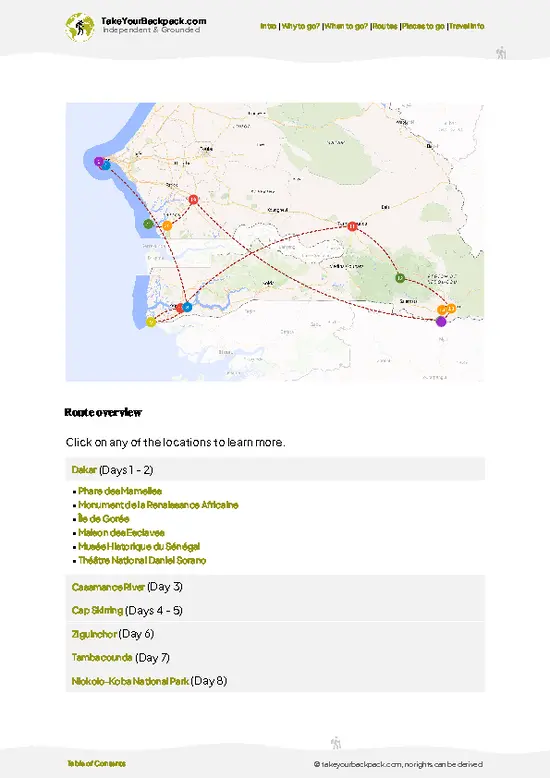
An offline-friendly backpacking guide with optimized travel routes, ranked highlights, transport advice, and the best areas to stay.
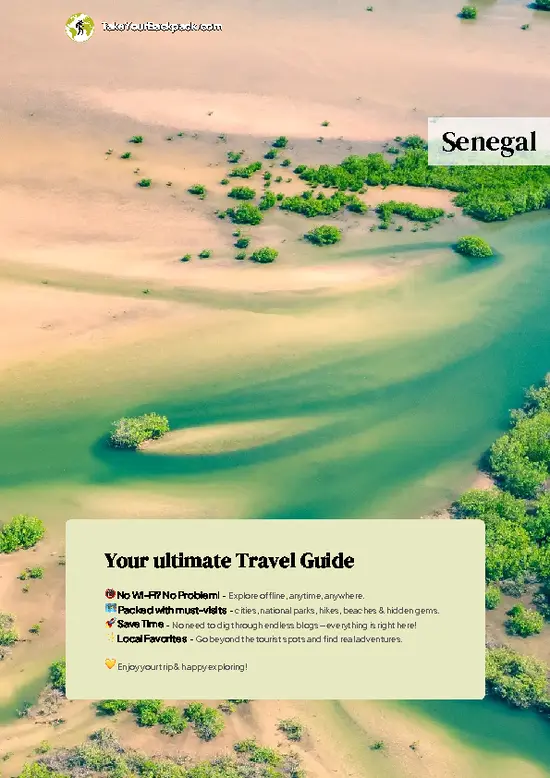
example page 0 from our offline Travel Guide for Senegal
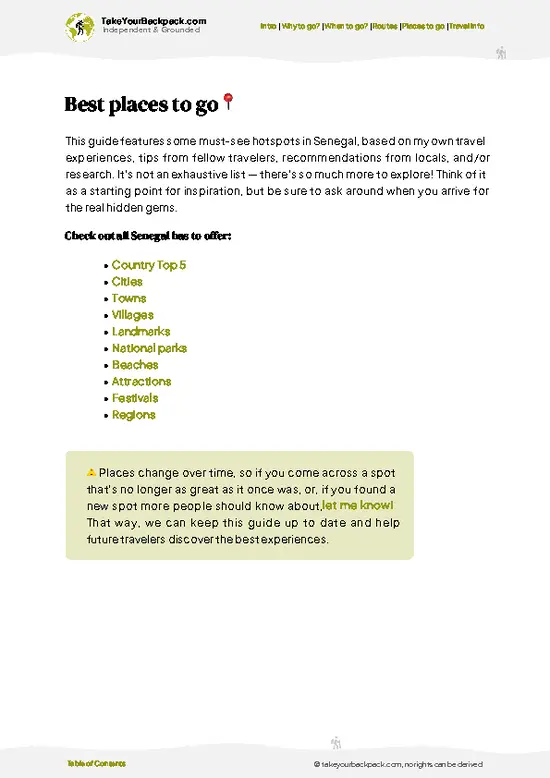
example page 1 from our offline Travel Guide for Senegal
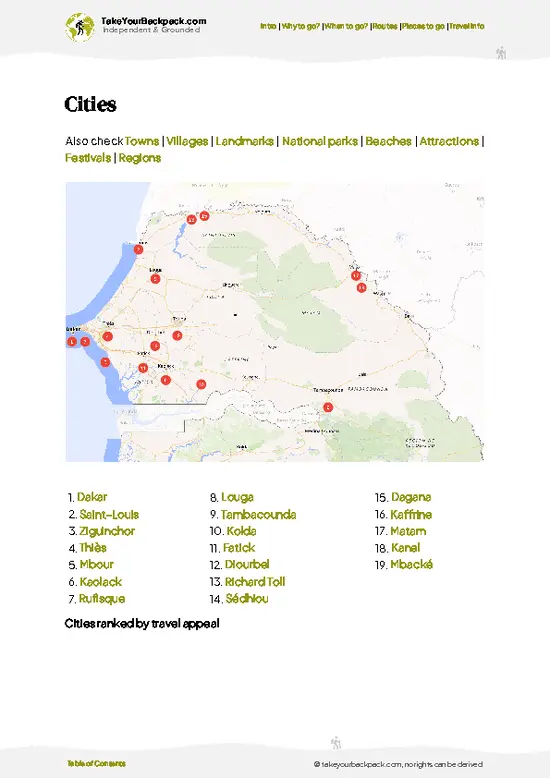
example page 2 from our offline Travel Guide for Senegal
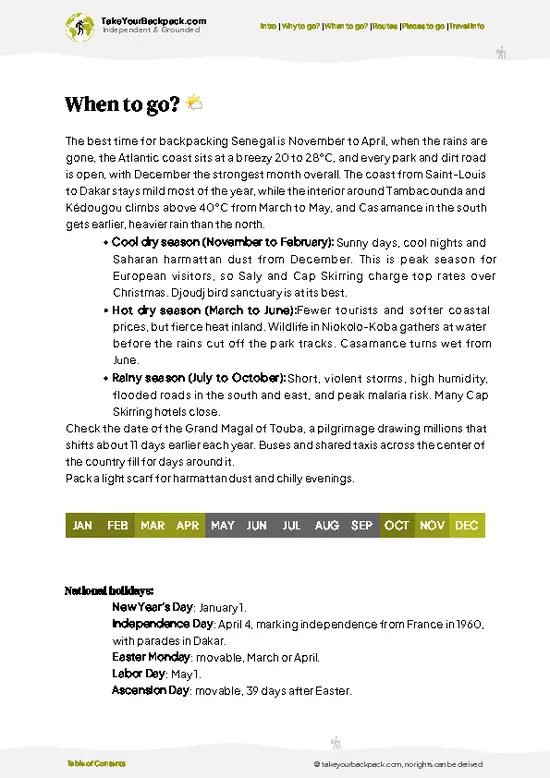
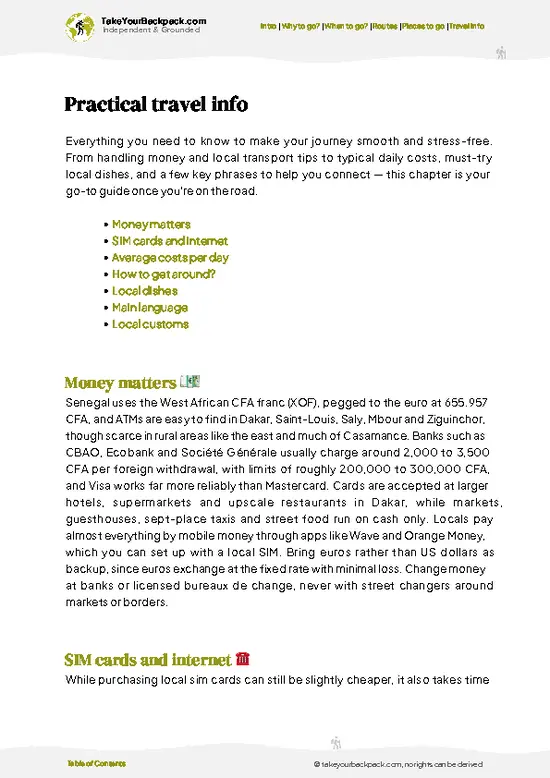
example page 3 from our offline Travel Guide for Senegal
example page 4 from our offline Travel Guide for Senegal
example page 5 from our offline Travel Guide for Senegal
example page 6 from our offline Travel Guide for Senegal
example page 7 from our offline Travel Guide for Senegal
The digital guide (360 pages) contains:
✅ 85 highlights, ranked by travel appeal
✅ Optimized 5, 10 & 15-day travel routes
✅ Cities, national parks, landmarks, beaches
✅ How to get around
✅ Offline-friendly for travel without Wi-Fi
👉 Click to see all 30+ guide features

📅 Plan smarter in minutes, not weeks
✅ Month by month travel advice
✅ Festivals & national holidays
✅ Budget expectations

🗺️ Go to the right places, skip the overrated ones
✅ Honest pros & cons of destinations
✅ Top hikes, parks & viewpoints
✅ Lesser-known places most travelers miss
✅ Clear “worth it vs skip it” guidance

🛏️ Travel smoothly without rookie mistakes
✅ Best areas to stay
✅ Transport systems explained simply
✅ Common scams & safety advice
✅ SIM cards, money & practical tips

🌍 Understand the country, not just visit it
✅ Culture & traditions
✅ 52 Essential phrases & customs
✅ Festivals worth planning around
✅ Traveler-friendly historical context
✅ Insights that make places more meaningful

📱 Built for real travel conditions
✅ Fully downloadable PDF
✅ Works completely offline
✅ Optimized for phone use
✅ Useful in remote areas & buses
✅ Everything in one place
Stop searching, start planning
Get instant access to your full guide. 30‑day money-back guarantee.
+ Add another guide for just

By proceeding you agree to our terms.
Sent to your inbox immediately after payment • 100% Secure Checkout
Best Backpacking Travel Advisor 2025 tourism awardBest Backpacking
Travel Advisor
2025
What others say about Take Your Backpack Guides:
⭐⭐⭐⭐⭐
Fantastic, amazing amount of information!
⭐⭐⭐⭐⭐
My goodness this is amazing, it's what I've been looking for hats off too you!
⭐⭐⭐⭐⭐
I think this is absolutely BRILLIANT
⭐⭐⭐⭐
Very complete and informative. It's still missing places, but I gotta to commend you
⭐⭐⭐⭐⭐
This is truly amazing, thank you, can't wait to explore it with my kids!
⭐⭐⭐⭐⭐
Awesome resource, thank you!
⭐⭐⭐⭐⭐
This is amazing! Can't wait to explore the ones I haven't seen
⭐⭐⭐⭐
I love this! Well done, great idea.
⭐⭐⭐⭐⭐
Thanks for taking the time to make this gem!
⭐⭐⭐⭐⭐
This might be the best website I've ever seen.
⭐⭐⭐⭐⭐
Congratulations, and thank you so much for your work; it's incredibly valuable.
⭐⭐⭐⭐
In all seriousness I think you did a great job pointing out the important spots
⭐⭐⭐⭐⭐
10/10 very good
⭐⭐⭐⭐⭐
As someone who's only just starting to visit regularly this is awesome, thank you.
⭐⭐⭐⭐
Thank you very much! I'm going to visit my dad, it's going to be very useful!
⭐⭐⭐⭐⭐
This is really cool! We'll be travelling for the first time and this definitely come in handy.
⭐⭐⭐⭐⭐
You are now our minister of culture, congratulations 👨‍💼
⭐⭐⭐⭐⭐
Just wanted to tell you that this is a pearl! Going to follow your recommendations.
⭐⭐⭐⭐⭐
This is so cool. I'll definitely be using the resource for my travels soon.
⭐⭐⭐⭐⭐
This is very impressive! Good work.
⭐⭐⭐⭐⭐
This is an amazing and informative site. Very well done!

🛏️ Where to stay?Best Stay Options in Senegal

Senegal has a small but growing hostel scene, with dorm beds at roughly 8,000 to 15,000 CFA (US$13 to 25) and simple guesthouses, called “auberges” or “campements”, filling most of the budget gaps. In Dakar, Ngor and Yoff hold the most backpacker-friendly beds, close to surf breaks, beach bars and Ngor Island, with quieter streets than the center but a 30 to 45 minute ride to the city’s markets. Nearby Almadies has the best nightlife and the highest prices. Plateau puts you within walking distance of Sandaga market and the ferry to Gorée, but it empties out after dark and has more petty theft. Outside the capital, the old island quarter of Saint-Louis and the villages of the Sine-Saloum delta … read more 👉
Senegal has a small but growing hostel scene, with dorm beds at roughly 8,000 to 15,000 CFA (US$13 to 25) and simple guesthouses, called “auberges” or “campements”, filling most of the budget gaps. In Dakar, Ngor and Yoff hold the most backpacker-friendly beds, close to surf breaks, beach bars and Ngor Island, with quieter streets than the center but a 30 to 45 minute ride to the city’s markets. Nearby Almadies has the best nightlife and the highest prices. Plateau puts you within walking distance of Sandaga market and the ferry to Gorée, but it empties out after dark and has more petty theft. Outside the capital, the old island quarter of Saint-Louis and the villages of the Sine-Saloum delta offer good-value guesthouses in a far calmer setting.

If you enjoy meeting fellow travelers, consider choosing hostels with high ratings for atmosphere. On the other hand, if you prefer having your own space, a hotel might be a better option.

SenegalWhere to Go Next

👋 Meet the founderWho’s Behind Take Your Backpack?

Johan, backpacker and founder of TakeYourBackpackHi, I’m Johan (Netherlands 🇳🇱), the creator of TakeYourBackpack. Over the past 3 decades, I’ve backpacked through 90+ countries across six continents, gaining extensive experience with independent travel, long-term trips, and overland routes.

This site is built on a combination of firsthand travel experience and carefully curated insights from other backpackers. Many guides are based on places I’ve personally visited, while others bring together tips, observations, and practical advice shared by trusted travelers I’ve met along the way.

The goal is to provide realistic, experience-driven guidance — not generic itineraries — so you can explore destinations with better context, clearer expectations, and more confidence.