×

Serbia🇷🇸 | best attractionsYour Guide to the 9 Best attractions in Serbia

Attractions in Serbia come in three flavors: Belgrade’s nightlife and fortress-and-river sprawl, the Vojvodina plains with their Habsburg-yellow towns, and the southern and western mountains full of medieval monasteries and gorges. Belgrade is lively, cheap by European standards and crowded on summer weekends. Vojvodina is flat, easy by bus and pleasantly empty. The mountains reward anyone willing to wait for a local bus that runs on its own philosophy of time. For independent travelers and backpackers, entry fees are low, queues are rare outside the capital, and getting somewhere remote is possible but never quick.

By Johan Kruseman 🇳🇱 | Updated October 18, 2026
Explore the best festivals in Serbia

Why go?What Makes Them Special

Serbia sits where the Austro-Hungarian and Ottoman worlds collided, and the Roman Empire got there first. The result is a country where a Roman imperial city, a Habsburg fortress and an Orthodox monastery with 13th-century frescoes can all show up in one week, often without a tour bus in sight. That is the main draw: history without the crowds and without the Western European price tag.

Geography adds range. The Danube cuts through the north and the Iron Gates gorge, while the Dinaric and Balkan ranges in the west, south and east supply national parks, caves and ski slopes. The continental climate means hot summers and properly cold winters, so what you can do depends heavily on the month.

Before choosing Serbia, know that infrastructure is uneven. Belgrade and Novi Sad are easy, with decent … read more 👉
Serbia sits where the Austro-Hungarian and Ottoman worlds collided, and the Roman Empire got there first. The result is a country where a Roman imperial city, a Habsburg fortress and an Orthodox monastery with 13th-century frescoes can all show up in one week, often without a tour bus in sight. That is the main draw: history without the crowds and without the Western European price tag.

Geography adds range. The Danube cuts through the north and the Iron Gates gorge, while the Dinaric and Balkan ranges in the west, south and east supply national parks, caves and ski slopes. The continental climate means hot summers and properly cold winters, so what you can do depends heavily on the month.

Before choosing Serbia, know that infrastructure is uneven. Belgrade and Novi Sad are easy, with decent buses and trains, but rural sites often have sparse signage, irregular timetables and English that thins quickly once you leave the cities. Many monasteries and churches are active places of worship, not museums, so dress and behavior matter. Cash is still useful in small towns. Expect hospitality that borders on aggressive: someone will press coffee, rakija or a second plate on you, and refusing politely takes practice.
How the List Was Created
The list of best attractions in Serbia is created based on cultural significance or entertainment value. If you feel a attraction is missing in this list, please let us know.

When to go?Seasonal Guide to Visiting

Best months for attractions in Serbia: May to June and September to early October are the best months, with daytime highs of roughly 18 to 27°C, long light and open-air sites at full operating hours. Rain is moderate, around 50 to 70 mm a month in late spring, so a light jacket does the job.
Summer: July and August bring heat of 30 to 38°C, especially in Belgrade and the Vojvodina plains, where shade is more of a rumor than a fact. Belgrade’s river clubs and the festival season peak, and accommodation prices in the capital and Novi Sad can run 20 to 40 percent above spring levels. The mountains in the west and south stay cooler, with highs near 22 to 28°C, making them the smarter place to be.
Autumn and winter: Autumn colors the forested gorges and the wine hills of Fruška Gora and brings the … read more 👉
Best months for attractions in Serbia: May to June and September to early October are the best months, with daytime highs of roughly 18 to 27°C, long light and open-air sites at full operating hours. Rain is moderate, around 50 to 70 mm a month in late spring, so a light jacket does the job.
Summer: July and August bring heat of 30 to 38°C, especially in Belgrade and the Vojvodina plains, where shade is more of a rumor than a fact. Belgrade’s river clubs and the festival season peak, and accommodation prices in the capital and Novi Sad can run 20 to 40 percent above spring levels. The mountains in the west and south stay cooler, with highs near 22 to 28°C, making them the smarter place to be.
Autumn and winter: Autumn colors the forested gorges and the wine hills of Fruška Gora and brings the cheapest good-weather rates. From November to February, temperatures hover around -5 to 5°C, fog and gray skies settle over the north, and some rural sites cut hours or close for the season. Ski areas such as Kopaonik run roughly December to March, with prices rising over New Year and Orthodox Christmas on January 7. Spring thaw can leave mountain trails muddy until about May.

attraction hoppingPlanning Your Route Efficiently

How long a multi-stop trip needs: A trip that links several of Serbia’s attractions works best in 8 to 14 days, which allows two or three regional bases without constant packing.
Grouping regions and direction: Start in Belgrade, the transport hub, and give it 2 to 3 days. Vojvodina (Novi Sad and the Danube towns) sits 1.5 to 2 hours north by train or bus and suits 2 days. From there, loop back through Belgrade and head south or west: the western mountains around Zlatibor and Tara take 3 to 4 hours by road, while the southern route toward Niš takes about 2.5 to 3 hours by train or bus and wants 1 to 2 days. The monastery belt in central Serbia pairs with the west, around 2 to 3 hours from the capital.
Mistakes to skip: The classic error is judging distances by the map. Serbia looks small, but … read more 👉
How long a multi-stop trip needs: A trip that links several of Serbia’s attractions works best in 8 to 14 days, which allows two or three regional bases without constant packing.
Grouping regions and direction: Start in Belgrade, the transport hub, and give it 2 to 3 days. Vojvodina (Novi Sad and the Danube towns) sits 1.5 to 2 hours north by train or bus and suits 2 days. From there, loop back through Belgrade and head south or west: the western mountains around Zlatibor and Tara take 3 to 4 hours by road, while the southern route toward Niš takes about 2.5 to 3 hours by train or bus and wants 1 to 2 days. The monastery belt in central Serbia pairs with the west, around 2 to 3 hours from the capital.
Mistakes to skip: The classic error is judging distances by the map. Serbia looks small, but mountain roads and slow regional trains turn 150 km into 3 to 4 hours. Plan one long transfer per day at most. Another is zigzagging between north and south, which burns a full day for nothing. A third is squeezing in rural sites without checking bus timetables, since many routes run only a few times daily and rarely on Sundays. Where public transport thins out, a rented car or shared minibus for a day is the practical fix.

The ListThe Best attractions of Serbia

1 Belgrade Fortress

stone ramparts, panoramic river views, layered ruins

Walk ancient walls overlooking the Sava and Danube, tracing centuries of military history and city life from a commanding vantage.

2 Nikola Tesla Museum

interactive exhibits, original inventions, Tesla’s archive

Engage with hands-on displays and personal items from Tesla’s life, exploring the inventor’s impact on science and technology.

3 National Museum of Serbia

archaeological treasures, Serbian art, numismatic collections

View artifacts spanning prehistory to modern times, with galleries highlighting regional artists and rare coins in a central city setting.

serbia-attraction-national-museum-of-serbia
© Google |

4 Skull Tower

embedded skulls, Ottoman monument, somber memorial

Reflect on a turbulent chapter of resistance, viewing human remains set in stone as a stark reminder of Serbia’s 19th-century struggles.

serbia-attraction-skull-tower
© Google |

5 Knez Mihailova Street

pedestrian boulevard, 19th-century facades, shopping arcades

Stroll a lively corridor lined with ornate architecture, street performers, and shops, connecting key city landmarks on foot.

6 Republic Square

central plaza, equestrian statue, meeting point

Pause at the city’s main gathering spot, framed by cultural institutions and a landmark monument, ideal for orientation and people-watching.

7 Museum of Yugoslavia

Tito’s mausoleum, socialist-era relics, Yugoslav memorabilia

Survey artifacts and personal effects from Yugoslavia’s past, including Tito’s resting place and exhibits on the country’s complex legacy.

8 Zemun

riverbank promenade, Austro-Hungarian houses, hilltop tower

Climb winding streets past pastel facades to Gardos Tower for sweeping views, then linger by the Danube in a distinct neighborhood setting.

9 Skadarlija

colorful facades, contemporary murals, open-air gallery

Admire evolving street art along narrow alleys, where local and international artists transform walls into vibrant visual narratives.

Loading the map 🌍

Expert viewInsights from Locals and Experts

How many to aim for: Plan on one main attraction per day, two at most, which comes to roughly 8 to 12 over a 10-day trip. Serbian distances are short on paper and slow on the ground, and the best moments tend to happen between sights: a lingering lunch, a bus driver pointing out a ruin. Cram in more and you will see mostly car windows.
Choosing by travel style: Culture-minded travelers should lean on monasteries, fortresses and Roman sites, which are quiet and low-priced. Nightlife seekers get the most from Belgrade, where the riverside barges run until sunrise and the payoff is dancing at 4 a.m. with locals who are unreasonably good at it. Outdoor travelers should shift weight to the national parks and gorges in the west and east, where hiking trails are lightly marked and the reward is a … read more 👉
How many to aim for: Plan on one main attraction per day, two at most, which comes to roughly 8 to 12 over a 10-day trip. Serbian distances are short on paper and slow on the ground, and the best moments tend to happen between sights: a lingering lunch, a bus driver pointing out a ruin. Cram in more and you will see mostly car windows.
Choosing by travel style: Culture-minded travelers should lean on monasteries, fortresses and Roman sites, which are quiet and low-priced. Nightlife seekers get the most from Belgrade, where the riverside barges run until sunrise and the payoff is dancing at 4 a.m. with locals who are unreasonably good at it. Outdoor travelers should shift weight to the national parks and gorges in the west and east, where hiking trails are lightly marked and the reward is a viewpoint with nobody else on it.
What it costs: A realistic backpacker budget is US$35 to 60 a day (about 3,500 to 6,500 RSD) including a hostel dorm at US$12 to 20, meals at US$8 to 15 and local transport. Entry fees are modest: fortresses and monasteries often charge nothing to RSD 700 (US$6), museums RSD 300 to 800 (US$3 to 8), national park fees RSD 200 to 600 (US$2 to 6). Local guides run roughly US$25 to 60 for a half day, and are worth it for sites with little signage. Intercity buses cost US$4 to 15 a ride. Carry dinars, since small ticket offices and village cafés often skip cards.
Safety and etiquette: Serbia is generally safe for solo travelers, with petty theft limited to crowded Belgrade areas and the occasional taxi that quotes a creative fare. Use a ride-hailing app or a marked cab. In monasteries, cover shoulders and knees, speak quietly and ask before photographing inside; women may be asked to cover their hair at some. Politics, the 1990s conflicts and Kosovo are sensitive topics, so let locals bring them up, and listen more than you argue. Mountain weather turns quickly, so carry water and a layer even on short walks. Hiking in remote border areas may pass near old minefield zones in a few southern spots, so stay on marked paths.

✈️ The backpacker research shortcutSerbia Travel Guide

An offline-friendly backpacking guide with optimized travel routes, ranked highlights, transport advice, and the best areas to stay.
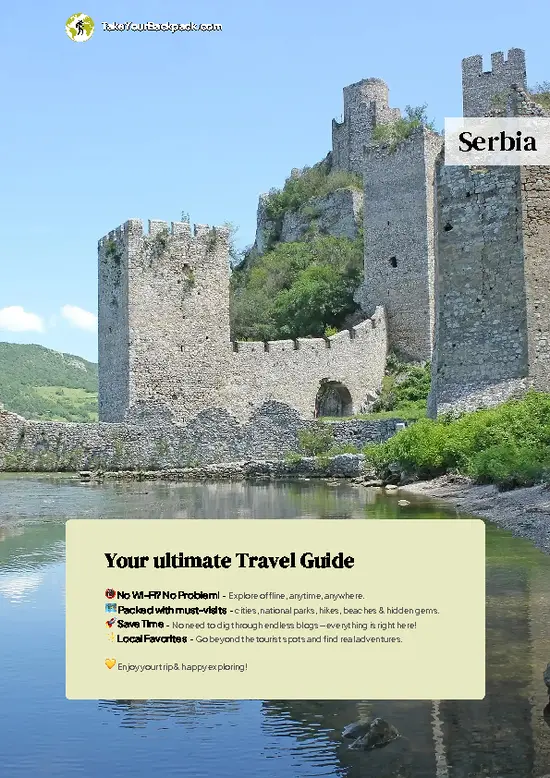
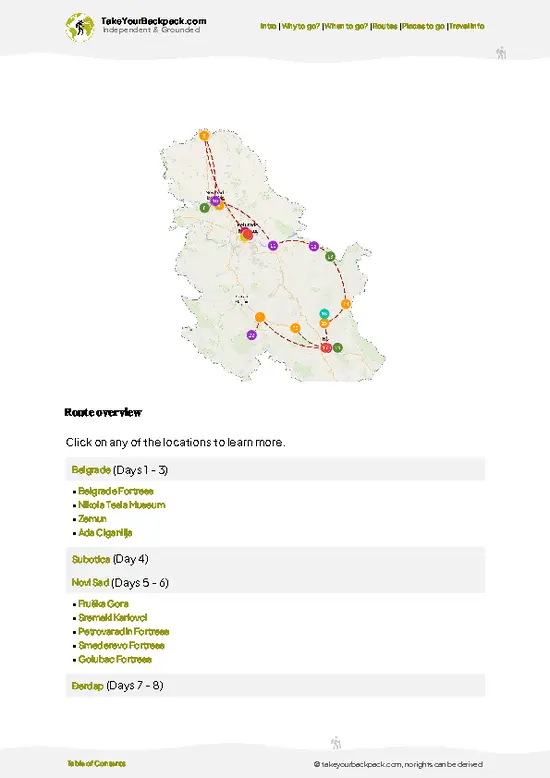
example page 0 from our offline Travel Guide for Serbia
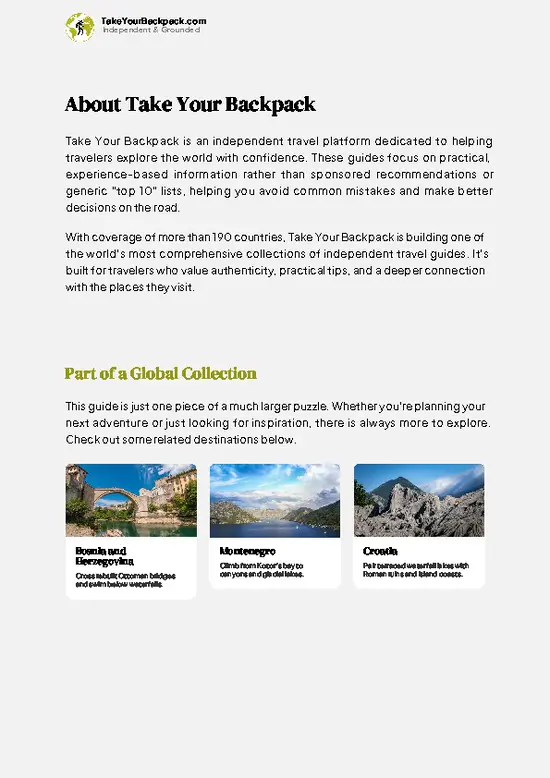
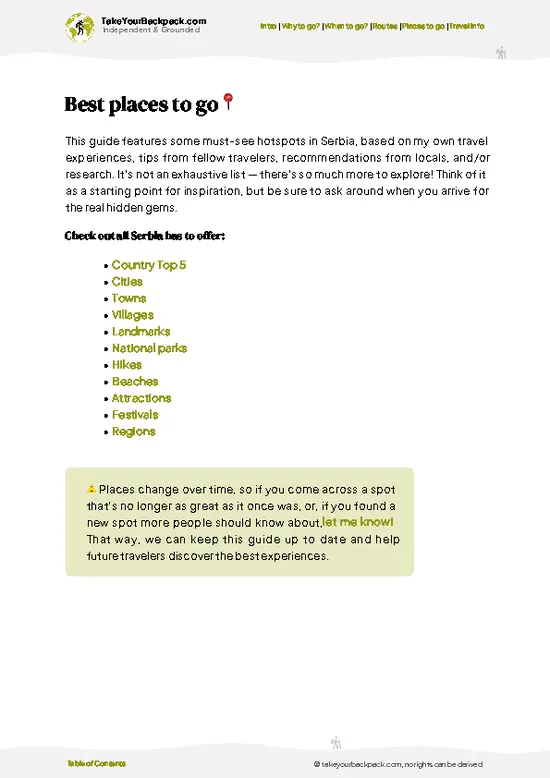
example page 1 from our offline Travel Guide for Serbia
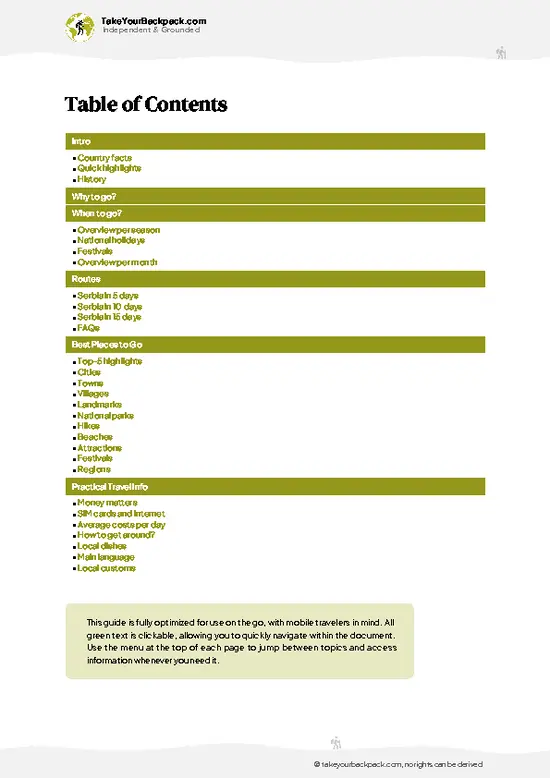
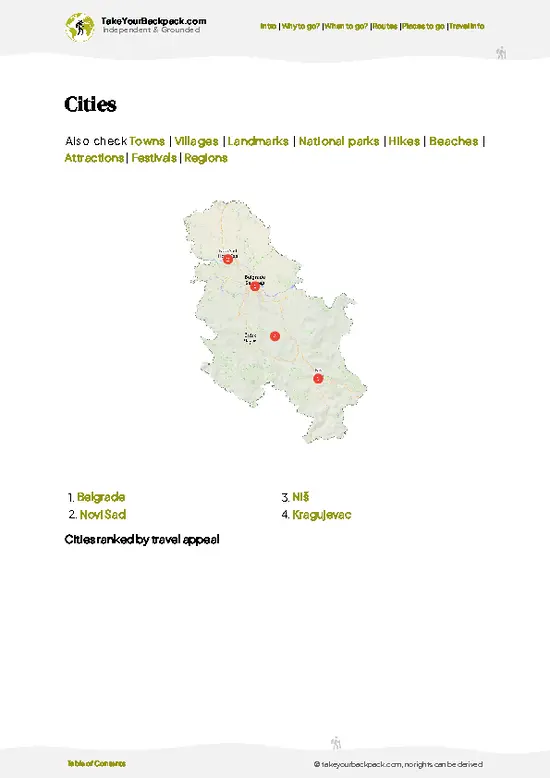
example page 2 from our offline Travel Guide for Serbia
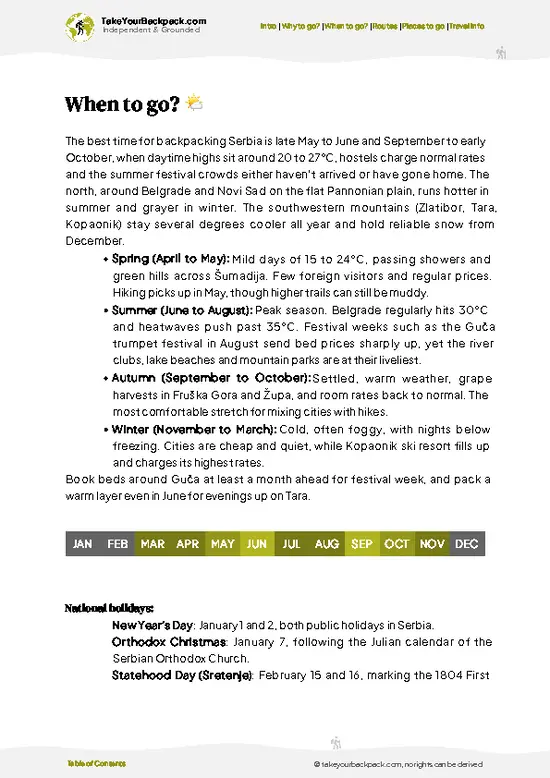
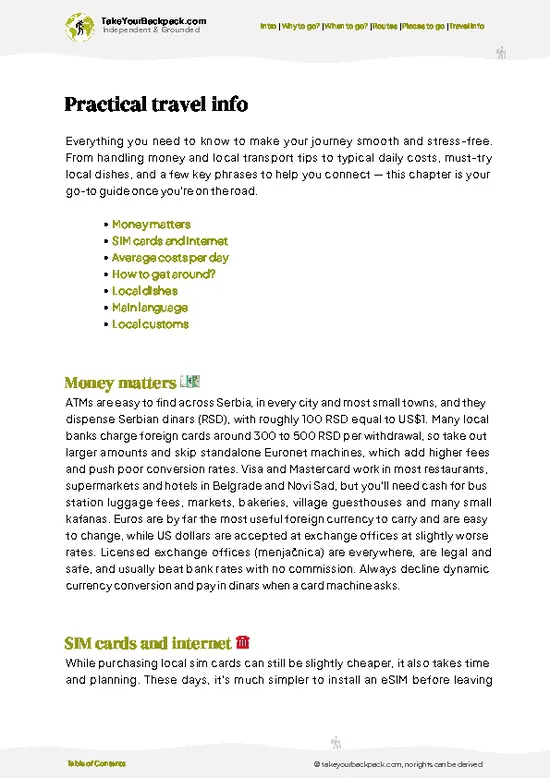
example page 3 from our offline Travel Guide for Serbia
example page 4 from our offline Travel Guide for Serbia
example page 5 from our offline Travel Guide for Serbia
example page 6 from our offline Travel Guide for Serbia
example page 7 from our offline Travel Guide for Serbia
The digital guide (309 pages) contains:
✅ 80 highlights, ranked by travel appeal
✅ Optimized 5, 10 & 15-day travel routes
✅ Cities, national parks, landmarks, beaches
✅ How to get around
✅ Offline-friendly for travel without Wi-Fi
👉 Click to see all 30+ guide features

📅 Plan smarter in minutes, not weeks
✅ Month by month travel advice
✅ Festivals & national holidays
✅ Budget expectations

🗺️ Go to the right places, skip the overrated ones
✅ Honest pros & cons of destinations
✅ Top hikes, parks & viewpoints
✅ Lesser-known places most travelers miss
✅ Clear “worth it vs skip it” guidance

🛏️ Travel smoothly without rookie mistakes
✅ Best areas to stay
✅ Transport systems explained simply
✅ Common scams & safety advice
✅ SIM cards, money & practical tips

🌍 Understand the country, not just visit it
✅ Culture & traditions
✅ 52 Essential phrases & customs
✅ Festivals worth planning around
✅ Traveler-friendly historical context
✅ Insights that make places more meaningful

📱 Built for real travel conditions
✅ Fully downloadable PDF
✅ Works completely offline
✅ Optimized for phone use
✅ Useful in remote areas & buses
✅ Everything in one place
Stop searching, start planning
Get instant access to your full guide. 30‑day money-back guarantee.
+ Add another guide for just

By proceeding you agree to our terms.
Sent to your inbox immediately after payment • 100% Secure Checkout
Best Backpacking Travel Advisor 2025 tourism awardBest Backpacking
Travel Advisor
2025
What others say about Take Your Backpack Guides:
⭐⭐⭐⭐⭐
Fantastic, amazing amount of information!
⭐⭐⭐⭐⭐
My goodness this is amazing, it's what I've been looking for hats off too you!
⭐⭐⭐⭐⭐
I think this is absolutely BRILLIANT
⭐⭐⭐⭐
Very complete and informative. It's still missing places, but I gotta to commend you
⭐⭐⭐⭐⭐
This is truly amazing, thank you, can't wait to explore it with my kids!
⭐⭐⭐⭐⭐
Awesome resource, thank you!
⭐⭐⭐⭐⭐
This is amazing! Can't wait to explore the ones I haven't seen
⭐⭐⭐⭐
I love this! Well done, great idea.
⭐⭐⭐⭐⭐
Thanks for taking the time to make this gem!
⭐⭐⭐⭐⭐
This might be the best website I've ever seen.
⭐⭐⭐⭐⭐
Congratulations, and thank you so much for your work; it's incredibly valuable.
⭐⭐⭐⭐
In all seriousness I think you did a great job pointing out the important spots
⭐⭐⭐⭐⭐
10/10 very good
⭐⭐⭐⭐⭐
As someone who's only just starting to visit regularly this is awesome, thank you.
⭐⭐⭐⭐
Thank you very much! I'm going to visit my dad, it's going to be very useful!
⭐⭐⭐⭐⭐
This is really cool! We'll be travelling for the first time and this definitely come in handy.
⭐⭐⭐⭐⭐
You are now our minister of culture, congratulations 👨‍💼
⭐⭐⭐⭐⭐
Just wanted to tell you that this is a pearl! Going to follow your recommendations.
⭐⭐⭐⭐⭐
This is so cool. I'll definitely be using the resource for my travels soon.
⭐⭐⭐⭐⭐
This is very impressive! Good work.
⭐⭐⭐⭐⭐
This is an amazing and informative site. Very well done!

🛏️ Where to stay?Where to Stay in Serbia

Serbia has plenty of hostels and budget guesthouses, with dorm beds typically running €10 to €18 a night and private rooms in family-run guesthouses from about €25. In Belgrade, Stari Grad and Dorćol put you within walking distance of Kalemegdan and Knez Mihailova, with lively bars and late-night noise to match, while Savamala sits closer to the riverfront clubs and the Sava waterfront but feels rougher around the edges after dark, and Vračar is quieter and leafier yet still a 20-minute walk from the old town. In Novi Sad the pedestrian Old Town around Zmaj Jovina is the easy pick for cafés and safe evening strolls, and in Niš the streets around the fortress and Kopitareva are compact, cheap … read more 👉
Serbia has plenty of hostels and budget guesthouses, with dorm beds typically running €10 to €18 a night and private rooms in family-run guesthouses from about €25. In Belgrade, Stari Grad and Dorćol put you within walking distance of Kalemegdan and Knez Mihailova, with lively bars and late-night noise to match, while Savamala sits closer to the riverfront clubs and the Sava waterfront but feels rougher around the edges after dark, and Vračar is quieter and leafier yet still a 20-minute walk from the old town. In Novi Sad the pedestrian Old Town around Zmaj Jovina is the easy pick for cafés and safe evening strolls, and in Niš the streets around the fortress and Kopitareva are compact, cheap and close to the nightlife.

If you enjoy meeting fellow travelers, consider choosing hostels with high ratings for atmosphere. On the other hand, if you prefer having your own space, a hotel might be a better option.

SerbiaMore of Serbia

👋 Meet the founderWho’s Behind Take Your Backpack?

Johan, backpacker and founder of TakeYourBackpackHi, I’m Johan (Netherlands 🇳🇱), the creator of TakeYourBackpack. Over the past 3 decades, I’ve backpacked through 90+ countries across six continents, gaining extensive experience with independent travel, long-term trips, and overland routes.

This site is built on a combination of firsthand travel experience and carefully curated insights from other backpackers. Many guides are based on places I’ve personally visited, while others bring together tips, observations, and practical advice shared by trusted travelers I’ve met along the way.

The goal is to provide realistic, experience-driven guidance — not generic itineraries — so you can explore destinations with better context, clearer expectations, and more confidence.