×

Serbia🇷🇸 | best hikesYour Guide to the 3 Best hikes in Serbia

Hiking in Serbia mostly means mountains that nobody has turned into a theme park, which is either a relief or a logistical puzzle, depending on your bus app. The west (Tara, Zlatibor) has marked trails, guesthouses and lunch plates piled with kajmak. The southeast (Stara Planina) is emptier, with grazing cows that outnumber hikers and mobile signal that comes and goes. Kopaonik and the Đerdap gorge sit between those extremes. Costs stay low, crowds stay thin outside August, and independent travelers need patience with timetables. Trail signs may be generous or entirely theoretical.

By Johan Kruseman 🇳🇱 | Updated October 18, 2026
Explore the best beaches in Serbia

Why go?What Makes Them Special

Serbia suits hiking because it packs mountain variety into a compact country. The Dinaric ranges in the west are forested, karstic and full of gorges. The Carpathian and Balkan ranges in the east have limestone cliffs, caves and the Danube cutting through the Iron Gates. Add the high, rounded ridges of Stara Planina near the Bulgarian border, and you get several landscapes without crossing a single border. Several of these areas are national parks, so trail networks, ranger posts and small entrance fees exist, and the logic of the place is easy to grasp.

The culture helps too. Village guesthouses and mountain lodges are used to walkers, and meals tend to be large, meaty and cheap. Serbs also love a mountain weekend, so popular areas have a loyal domestic following. What a traveler should … read more 👉
Serbia suits hiking because it packs mountain variety into a compact country. The Dinaric ranges in the west are forested, karstic and full of gorges. The Carpathian and Balkan ranges in the east have limestone cliffs, caves and the Danube cutting through the Iron Gates. Add the high, rounded ridges of Stara Planina near the Bulgarian border, and you get several landscapes without crossing a single border. Several of these areas are national parks, so trail networks, ranger posts and small entrance fees exist, and the logic of the place is easy to grasp.

The culture helps too. Village guesthouses and mountain lodges are used to walkers, and meals tend to be large, meaty and cheap. Serbs also love a mountain weekend, so popular areas have a loyal domestic following. What a traveler should know before choosing Serbia: trail marking varies from excellent to optimistic, English-language information is patchy, and public transport to trailheads is often thin or seasonal. A rental car or a pre-arranged transfer removes most headaches. Summers are warm, the south sees real snow in winter, and mountain weather changes fast. Come for quiet, good food and fair prices, not for polished infrastructure.
How the List Was Created
The list of best hikes in Serbia is created based on scenery, challenge, trail quality, landmarks, and overall enjoyment. If you feel a hike is missing in this list, please let us know.

When to go?Seasonal Guide to Visiting

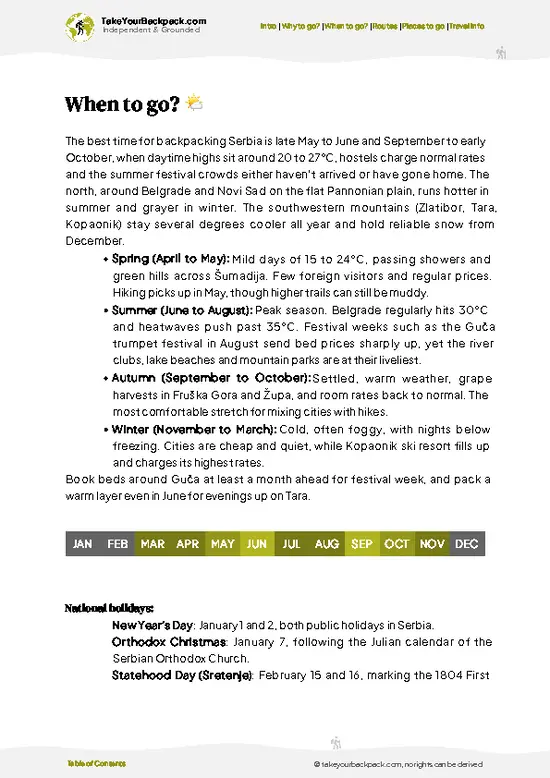
Best months: late spring to early autumn: The best months for hiking in Serbia are June to September, when mountain trails are snow-free and daytime highs in the hills sit around 18 to 28°C. Early June and September are the best choices because meadows are green or golden, afternoons are less punishing, and guesthouses are not full.
Shoulder seasons and the awkward months: May and October work for lower elevations such as Fruška Gora, the Đerdap gorge and forested hills, with days around 12 to 20°C. Higher ranges like Stara Planina and Kopaonik can hold snow into May, and the first dusting can return in October. Spring also brings the most rain, often 60 to 80 mm in May and June, so waterproofs are worth carrying. The mud is very dedicated.
Peak periods and winter: July and August are hottest, … read more 👉
Best months: late spring to early autumn: The best months for hiking in Serbia are June to September, when mountain trails are snow-free and daytime highs in the hills sit around 18 to 28°C. Early June and September are the best choices because meadows are green or golden, afternoons are less punishing, and guesthouses are not full.
Shoulder seasons and the awkward months: May and October work for lower elevations such as Fruška Gora, the Đerdap gorge and forested hills, with days around 12 to 20°C. Higher ranges like Stara Planina and Kopaonik can hold snow into May, and the first dusting can return in October. Spring also brings the most rain, often 60 to 80 mm in May and June, so waterproofs are worth carrying. The mud is very dedicated.
Peak periods and winter: July and August are hottest, with valley temperatures often above 30°C and occasional thunderstorms on exposed ridges. Zlatibor and Tara see the most domestic visitors then, and rooms can cost 20 to 40 percent more than in shoulder months. Winter, roughly December to March, turns the higher mountains into ski and snowshoe terrain, with temperatures well below freezing and some forest roads closed. Serious hiking in that period needs winter gear and experience.

hike hoppingPlanning Your Route Efficiently

How long to allow: A trip combining several hikes in Serbia needs 8 to 12 days, which allows for slow buses, rural roads and at least one weather-driven change of plan.
Which regions cluster well: Start in Belgrade, the main transport hub, and work in a loose arc. The west (Tara, Zlatibor, Zlatar) groups easily, with 3 to 4 hours between Belgrade and the western mountains by bus or car. Moving from there to Kopaonik takes roughly 3 to 4 hours. From the center, the southeast around Stara Planina is the far leg, about 5 to 6 hours from Belgrade, often with a change in Niš or Pirot. The northeast (Đerdap, Đerdap gorge towns) is better tied to Belgrade directly, around 3.5 to 4 hours.
Pacing and common mistakes: Plan 2 to 3 nights per region, enough for one or two proper hiking days after the travel. … read more 👉
How long to allow: A trip combining several hikes in Serbia needs 8 to 12 days, which allows for slow buses, rural roads and at least one weather-driven change of plan.
Which regions cluster well: Start in Belgrade, the main transport hub, and work in a loose arc. The west (Tara, Zlatibor, Zlatar) groups easily, with 3 to 4 hours between Belgrade and the western mountains by bus or car. Moving from there to Kopaonik takes roughly 3 to 4 hours. From the center, the southeast around Stara Planina is the far leg, about 5 to 6 hours from Belgrade, often with a change in Niš or Pirot. The northeast (Đerdap, Đerdap gorge towns) is better tied to Belgrade directly, around 3.5 to 4 hours.
Pacing and common mistakes: Plan 2 to 3 nights per region, enough for one or two proper hiking days after the travel. The classic error is treating the map like a subway diagram. Distances look small, but mountain roads are slow, and some villages have one bus a day or none on Sundays. Instead, build in a buffer day between distant regions and check timetables the day before. Another mistake is cramming a long drive after a full hike. Stay local, eat dinner, and go in the morning.

The ListThe Best hikes of Serbia

1 Rtanj

pyramidal peak, herbal meadows, sudden weather shifts

Ascend a solitary summit known for its geometric profile, crossing open slopes where wild herbs grow and weather can change without warning.

serbia-hike-rtanj
© Google |

2 Homolje Mountains

remote villages, karst springs, forested ridges

Traverse quiet uplands dotted with traditional hamlets, encountering cold springs and dense woods that shelter rare wildlife and local traditions.

serbia-hike-homolje-mountains
© Google |

3 Ovčar-Kablar Gorge

limestone cliffs, monasteries, river bends

Follow winding trails through steep canyons, passing centuries-old religious sites and panoramic overlooks above the Morava’s looping course.

serbia-hike-ovcar-kablar-gorge
© Google |
Loading the map 🌍

Expert viewInsights from Locals and Experts

How many hikes to plan: Aim for four to six hikes across a 10-day trip. That leaves room for transfers that run late, a rain day, and the odd long lunch, none of which are optional in Serbia. More than that and you spend the trip staring through bus windows. On the ground, trails range from wide forest tracks with painted markers to grassy ridgelines where the path is mostly a suggestion, and the payoff is a high meadow with nobody else in sight.
Which kind for which traveler: First-timers and families do best with national park hikes in the west, where waymarks, viewpoints and guesthouses sit close together, and you finish with a hot meal. Experienced hikers who want solitude should favor the Stara Planina ridges, where days are long, cattle are the main traffic, and the reward is wide open … read more 👉
How many hikes to plan: Aim for four to six hikes across a 10-day trip. That leaves room for transfers that run late, a rain day, and the odd long lunch, none of which are optional in Serbia. More than that and you spend the trip staring through bus windows. On the ground, trails range from wide forest tracks with painted markers to grassy ridgelines where the path is mostly a suggestion, and the payoff is a high meadow with nobody else in sight.
Which kind for which traveler: First-timers and families do best with national park hikes in the west, where waymarks, viewpoints and guesthouses sit close together, and you finish with a hot meal. Experienced hikers who want solitude should favor the Stara Planina ridges, where days are long, cattle are the main traffic, and the reward is wide open horizons. Those who like variety should add a gorge or canyon walk along the Danube or in the east, which gives limestone walls and river views without serious elevation. Hikers who care most about cheap logistics should pick one base and do day hikes from it.
What it costs: Expect US$30 to 55 a day (about 3,000 to 5,500 RSD) for a backpacker using guesthouses, local buses and simple restaurants. Dorm beds and basic rooms run roughly US$12 to 30, hearty meals US$6 to 12, and intercity buses US$5 to 15 per leg. National park entry is usually a few dollars per person, and local guides cost roughly US$50 to 120 for a day, worth paying on unmarked ridges. Renting a car adds about US$35 to 60 a day. A typical hiking visit to one area, with two nights, transfers and entry fees, lands around US$100 to 180.
Safety and cultural notes: Weather turns quickly, so carry layers and a rain shell even in July. Download offline maps, because signal drops in valleys. Shepherd dogs guard flocks in the southeast. Stop, speak calmly, and walk around without eyeing them. Ticks are common in grass, so check your legs at night. Emergency number is 112, and Mountain Rescue Service of Serbia can be reached through it. In rural areas, greet people, accept coffee or rakija if offered (a polite sip is fine), and carry some cash in dinars, because small guesthouses often skip cards. Serbs are proud, curious hosts, and a few words of Serbian buy a surprising amount of goodwill, often a second plate of food.

✈️ The backpacker research shortcutSerbia Travel Guide

An offline-friendly backpacking guide with optimized travel routes, ranked highlights, transport advice, and the best areas to stay.
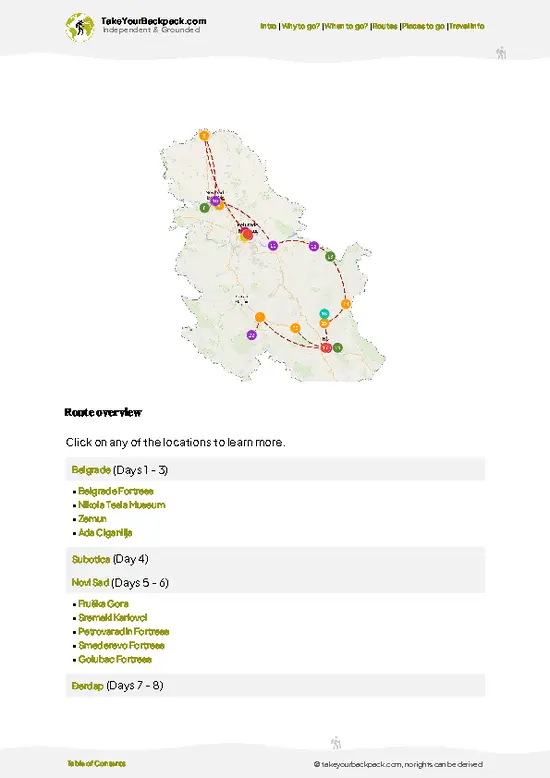
example page 0 from our offline Travel Guide for Serbia
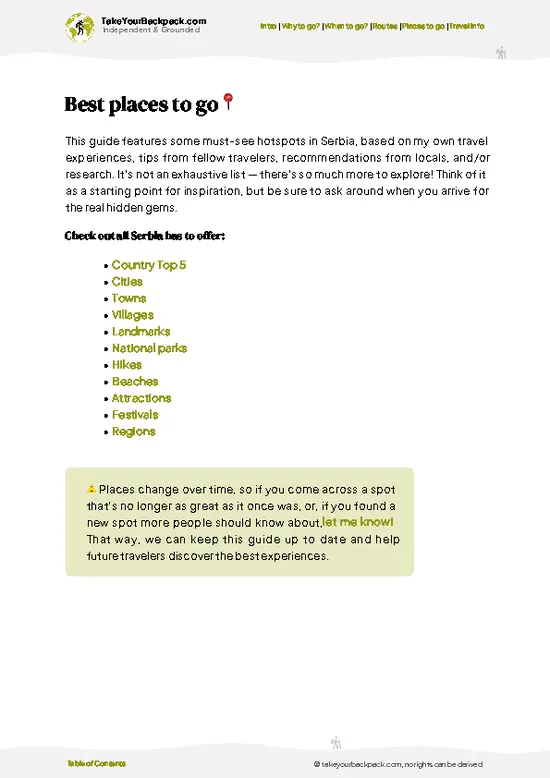
example page 1 from our offline Travel Guide for Serbia
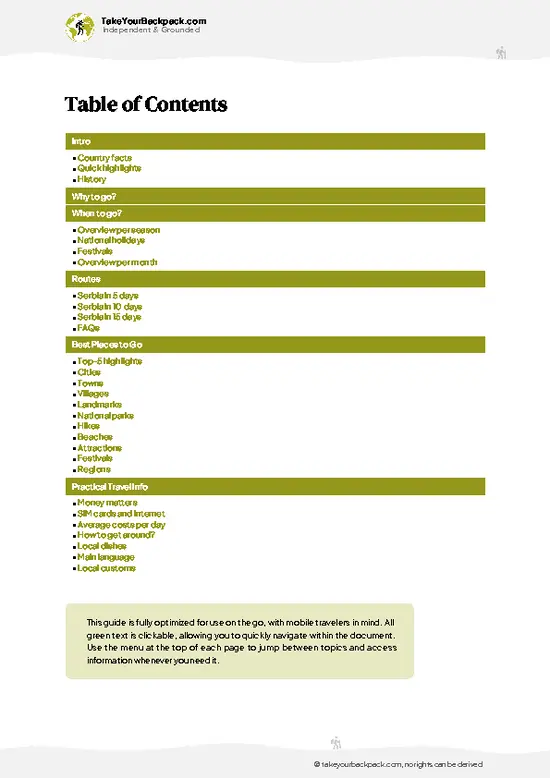
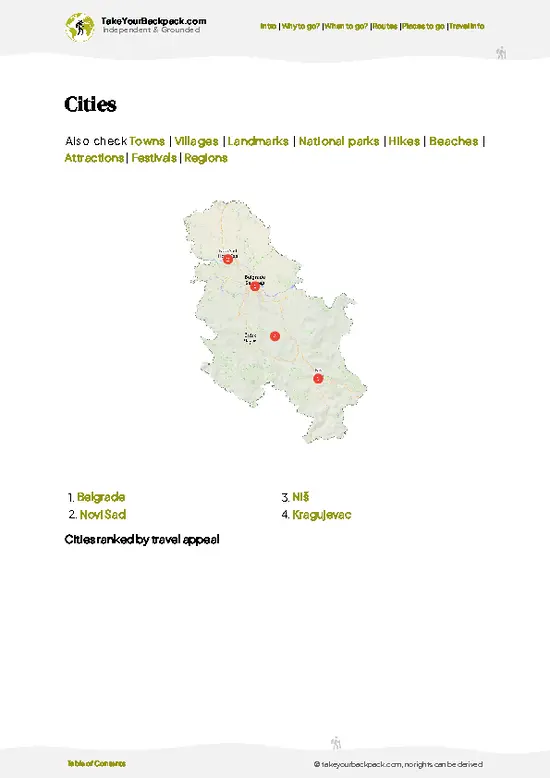
example page 2 from our offline Travel Guide for Serbia
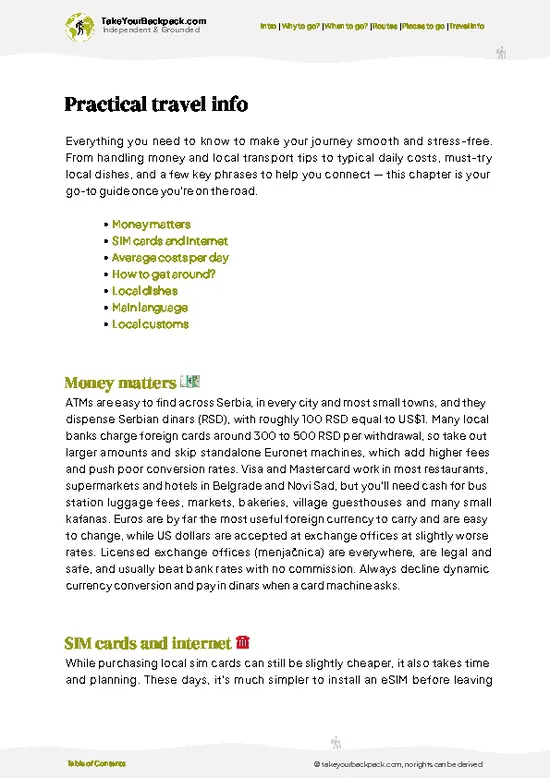
example page 3 from our offline Travel Guide for Serbia
example page 4 from our offline Travel Guide for Serbia
example page 5 from our offline Travel Guide for Serbia
example page 6 from our offline Travel Guide for Serbia
example page 7 from our offline Travel Guide for Serbia
The digital guide (309 pages) contains:
✅ 80 highlights, ranked by travel appeal
✅ Optimized 5, 10 & 15-day travel routes
✅ Cities, national parks, landmarks, beaches
✅ How to get around
✅ Offline-friendly for travel without Wi-Fi
👉 Click to see all 30+ guide features

📅 Plan smarter in minutes, not weeks
✅ Month by month travel advice
✅ Festivals & national holidays
✅ Budget expectations

🗺️ Go to the right places, skip the overrated ones
✅ Honest pros & cons of destinations
✅ Top hikes, parks & viewpoints
✅ Lesser-known places most travelers miss
✅ Clear “worth it vs skip it” guidance

🛏️ Travel smoothly without rookie mistakes
✅ Best areas to stay
✅ Transport systems explained simply
✅ Common scams & safety advice
✅ SIM cards, money & practical tips

🌍 Understand the country, not just visit it
✅ Culture & traditions
✅ 52 Essential phrases & customs
✅ Festivals worth planning around
✅ Traveler-friendly historical context
✅ Insights that make places more meaningful

📱 Built for real travel conditions
✅ Fully downloadable PDF
✅ Works completely offline
✅ Optimized for phone use
✅ Useful in remote areas & buses
✅ Everything in one place
Stop searching, start planning
Get instant access to your full guide. 30‑day money-back guarantee.
+ Add another guide for just

By proceeding you agree to our terms.
Sent to your inbox immediately after payment • 100% Secure Checkout
Best Backpacking Travel Advisor 2025 tourism awardBest Backpacking
Travel Advisor
2025
What others say about Take Your Backpack Guides:
⭐⭐⭐⭐⭐
Fantastic, amazing amount of information!
⭐⭐⭐⭐⭐
My goodness this is amazing, it's what I've been looking for hats off too you!
⭐⭐⭐⭐⭐
I think this is absolutely BRILLIANT
⭐⭐⭐⭐
Very complete and informative. It's still missing places, but I gotta to commend you
⭐⭐⭐⭐⭐
This is truly amazing, thank you, can't wait to explore it with my kids!
⭐⭐⭐⭐⭐
Awesome resource, thank you!
⭐⭐⭐⭐⭐
This is amazing! Can't wait to explore the ones I haven't seen
⭐⭐⭐⭐
I love this! Well done, great idea.
⭐⭐⭐⭐⭐
Thanks for taking the time to make this gem!
⭐⭐⭐⭐⭐
This might be the best website I've ever seen.
⭐⭐⭐⭐⭐
Congratulations, and thank you so much for your work; it's incredibly valuable.
⭐⭐⭐⭐
In all seriousness I think you did a great job pointing out the important spots
⭐⭐⭐⭐⭐
10/10 very good
⭐⭐⭐⭐⭐
As someone who's only just starting to visit regularly this is awesome, thank you.
⭐⭐⭐⭐
Thank you very much! I'm going to visit my dad, it's going to be very useful!
⭐⭐⭐⭐⭐
This is really cool! We'll be travelling for the first time and this definitely come in handy.
⭐⭐⭐⭐⭐
You are now our minister of culture, congratulations 👨‍💼
⭐⭐⭐⭐⭐
Just wanted to tell you that this is a pearl! Going to follow your recommendations.
⭐⭐⭐⭐⭐
This is so cool. I'll definitely be using the resource for my travels soon.
⭐⭐⭐⭐⭐
This is very impressive! Good work.
⭐⭐⭐⭐⭐
This is an amazing and informative site. Very well done!

🛏️ Where to stay?Best Places to Stay in Serbia

Serbia has plenty of hostels and budget guesthouses, with dorm beds typically running €10 to €18 a night and private rooms in family-run guesthouses from about €25. In Belgrade, Stari Grad and Dorćol put you within walking distance of Kalemegdan and Knez Mihailova, with lively bars and late-night noise to match, while Savamala sits closer to the riverfront clubs and the Sava waterfront but feels rougher around the edges after dark, and Vračar is quieter and leafier yet still a 20-minute walk from the old town. In Novi Sad the pedestrian Old Town around Zmaj Jovina is the easy pick for cafés and safe evening strolls, and in Niš the streets around the fortress and Kopitareva are compact, cheap … read more 👉
Serbia has plenty of hostels and budget guesthouses, with dorm beds typically running €10 to €18 a night and private rooms in family-run guesthouses from about €25. In Belgrade, Stari Grad and Dorćol put you within walking distance of Kalemegdan and Knez Mihailova, with lively bars and late-night noise to match, while Savamala sits closer to the riverfront clubs and the Sava waterfront but feels rougher around the edges after dark, and Vračar is quieter and leafier yet still a 20-minute walk from the old town. In Novi Sad the pedestrian Old Town around Zmaj Jovina is the easy pick for cafés and safe evening strolls, and in Niš the streets around the fortress and Kopitareva are compact, cheap and close to the nightlife.

If you enjoy meeting fellow travelers, consider choosing hostels with high ratings for atmosphere. On the other hand, if you prefer having your own space, a hotel might be a better option.

SerbiaExplore Serbia

👋 Meet the founderWho’s Behind Take Your Backpack?

Johan, backpacker and founder of TakeYourBackpackHi, I’m Johan (Netherlands 🇳🇱), the creator of TakeYourBackpack. Over the past 3 decades, I’ve backpacked through 90+ countries across six continents, gaining extensive experience with independent travel, long-term trips, and overland routes.

This site is built on a combination of firsthand travel experience and carefully curated insights from other backpackers. Many guides are based on places I’ve personally visited, while others bring together tips, observations, and practical advice shared by trusted travelers I’ve met along the way.

The goal is to provide realistic, experience-driven guidance — not generic itineraries — so you can explore destinations with better context, clearer expectations, and more confidence.