×

Serbia🇷🇸 | best regionsYour Guide to the 3 Best regions in Serbia

Serbia sorts itself into regions that behave like different countries sharing one currency, the dinar. The north is Vojvodina, flat as a tray, with Habsburg-era towns and cycling paths. The center holds Belgrade and its nightlife, which keeps hours that confuse jet-lagged visitors. The south and east run to mountains, gorges and monasteries, where buses thin out and a car or patience becomes your friend. Costs stay low everywhere, though Belgrade and Novi Sad charge a premium. For backpacking or independent travel, the real question is how much transport effort you will trade for quiet, since crowds are small almost everywhere outside the capital.

By Johan Kruseman 🇳🇱 | Updated October 18, 2026
Explore the best cities in Serbia

Why go?What Makes Them Special

Serbia sits where the Pannonian Plain meets the Balkan mountains, and the Danube and Sava rivers cut across it, so a few hours of travel changes the landscape, the food and the architecture. Centuries of Ottoman and Habsburg rule left a seam through the country: onion-domed Orthodox churches and Austro-Hungarian townhouses can be found within a morning's drive of mosques and old hammams. That layering makes the variety per kilometer unusually high for a country this size, roughly 88,000 square kilometers.
The flip side is infrastructure. Trains are slow and often run late, and the rail network feels like a historical exhibit in motion. Buses are the dependable backbone and cheap, but rural timetables can thin to a couple of departures a day, sometimes none on Sundays. Outside Belgrade and Novi … read more 👉
Serbia sits where the Pannonian Plain meets the Balkan mountains, and the Danube and Sava rivers cut across it, so a few hours of travel changes the landscape, the food and the architecture. Centuries of Ottoman and Habsburg rule left a seam through the country: onion-domed Orthodox churches and Austro-Hungarian townhouses can be found within a morning's drive of mosques and old hammams. That layering makes the variety per kilometer unusually high for a country this size, roughly 88,000 square kilometers.
The flip side is infrastructure. Trains are slow and often run late, and the rail network feels like a historical exhibit in motion. Buses are the dependable backbone and cheap, but rural timetables can thin to a couple of departures a day, sometimes none on Sundays. Outside Belgrade and Novi Sad, English is patchy, though people compensate with hospitality and the occasional second plate of food you did not order.
Before choosing Serbia for its regions, know that distances are short but connections are not. Tourism is still low-key, so signage can be sparse and the best places often lack a website. The reward is a country where a coffee, a hearty meal and a local stranger's advice cost almost nothing, and where nobody is trying to sell you a magnet.
Behind the Scenes of Selection
The list of best regions in Serbia is created based on landscapes, local culture, attractions, vibes, and overall appeal. If you feel a region is missing in this list, please let us know.

When to go?Seasonal Guide to Visiting

Best months: May to June and September to early October are the best months for regions in Serbia: daytime temperatures sit around 18 to 27°C, the countryside is green or golden, and the mountains are walkable without a furnace-like sun. Rainfall peaks in late spring, roughly 60 to 80 mm in May and June, so a light jacket earns its space.
Summer and winter: July and August bring 30 to 38°C in the northern plains and Belgrade, with heat waves occasionally pushing higher. Locals decamp to rivers, lakes and mountains, so those spots fill up and accommodation prices there can climb 20 to 40 percent. The cities empty slightly and become pleasant after dark, once the pavement stops radiating heat. Festival periods, especially in July, can also fill beds in Novi Sad and Belgrade well ahead of time. … read more 👉
Best months: May to June and September to early October are the best months for regions in Serbia: daytime temperatures sit around 18 to 27°C, the countryside is green or golden, and the mountains are walkable without a furnace-like sun. Rainfall peaks in late spring, roughly 60 to 80 mm in May and June, so a light jacket earns its space.
Summer and winter: July and August bring 30 to 38°C in the northern plains and Belgrade, with heat waves occasionally pushing higher. Locals decamp to rivers, lakes and mountains, so those spots fill up and accommodation prices there can climb 20 to 40 percent. The cities empty slightly and become pleasant after dark, once the pavement stops radiating heat. Festival periods, especially in July, can also fill beds in Novi Sad and Belgrade well ahead of time.
Winter, December to February, runs from about -5 to 4°C, with fog and snow common. The mountain areas of the southwest, notably around Kopaonik and Zlatibor, are the ski and snow zones, with prices peaking over New Year and in late January school holidays. Rural guesthouses may close or limit service, and some monastery and gorge access roads become tricky.
Shoulder tips: April and November are cheap but unpredictable, with mud, drizzle and the odd sunny miracle. Pack layers, check opening hours in advance, and accept that weather forecasts are mostly suggestions.

region hoppingPlanning Your Route Efficiently

How long you need: A trip linking several regions in Serbia works best with 10 to 14 days, and 7 days is the minimum if you want more than a blur of bus windows. Think in terms of a loop built around Belgrade, the main transport hub, with Novi Sad to the north and Niš as the key southern gateway.
Direction and pacing: Starting north and finishing south is sensible: flat, easy ground first, then slower roads and hillier terrain once you have your rhythm. Allow 2 to 4 nights per stop, less for cities that can be seen in a day and more for mountain areas where weather and walking slow things down. Typical transfers run 1 to 2 hours between Belgrade and Novi Sad, 2.5 to 4 hours between Belgrade and Niš, and 3 to 6 hours to the mountain southwest or the far east, depending on road and connection. … read more 👉
How long you need: A trip linking several regions in Serbia works best with 10 to 14 days, and 7 days is the minimum if you want more than a blur of bus windows. Think in terms of a loop built around Belgrade, the main transport hub, with Novi Sad to the north and Niš as the key southern gateway.
Direction and pacing: Starting north and finishing south is sensible: flat, easy ground first, then slower roads and hillier terrain once you have your rhythm. Allow 2 to 4 nights per stop, less for cities that can be seen in a day and more for mountain areas where weather and walking slow things down. Typical transfers run 1 to 2 hours between Belgrade and Novi Sad, 2.5 to 4 hours between Belgrade and Niš, and 3 to 6 hours to the mountain southwest or the far east, depending on road and connection.
Planning mistakes: The biggest one is trusting a map: Serbia looks compact, but winding roads and sparse departures turn 100 kilometers into half a day. Build in buffer time instead of back-to-back transfers. Another is relying on trains for tight schedules. Use buses for timing, and treat trains as scenic extras. Many visitors also cram in too many stops and end up with a camera roll of bus stations. Cut a region rather than rush three. Finally, remote areas often have only one or two departures daily, so check them the evening before, or hire a car for just those legs.

The ListThe Best regions of Serbia

1 Kopaonik

alpine plateau, ski slopes, spruce forests

Experience crisp mountain air, shifting seasons, and a landscape that draws hikers in summer and skiers in winter.

serbia-region-kopaonik
© Google | Harald Thierjung

2 Zlatibor

open meadows, pine groves, mountain markets

Sample local cheeses, wander through open landscapes, and watch daily life in a region shaped by pastoral traditions and tourism.

serbia-region-zlatibor
© Google | Milan Milinic

3 Ravna Gora

rolling hills, rural villages, WWII heritage

Walk through quiet countryside where history lingers in memorials and daily life unfolds among fields and wooded ridges.

serbia-region-ravna-gora
© Google |
Loading the map 🌍

Expert viewInsights from Locals and Experts

How many regions: Three regions suit most trips, four if you have two weeks or more. Serbia’s transport is patient rather than quick, and a fourth region on a one-week trip means spending your holiday inside a minibus. Three lets you settle in, learn where the good bakery is, and still catch the rakija-fueled invitation that appears at least once per trip.
Choosing by travel style: Nightlife and culture seekers should lean toward the urban and river-city regions: these have the hostels, English speakers, and the floating river clubs (splavovi) that run until dawn. Hikers, climbers and cavers should favor the mountain and gorge regions, where trails are less marked than in the Alps but far emptier, and you get a whole viewpoint to yourself. Slow travelers and cyclists do well on the northern … read more 👉
How many regions: Three regions suit most trips, four if you have two weeks or more. Serbia’s transport is patient rather than quick, and a fourth region on a one-week trip means spending your holiday inside a minibus. Three lets you settle in, learn where the good bakery is, and still catch the rakija-fueled invitation that appears at least once per trip.
Choosing by travel style: Nightlife and culture seekers should lean toward the urban and river-city regions: these have the hostels, English speakers, and the floating river clubs (splavovi) that run until dawn. Hikers, climbers and cavers should favor the mountain and gorge regions, where trails are less marked than in the Alps but far emptier, and you get a whole viewpoint to yourself. Slow travelers and cyclists do well on the northern plains, where flat routes link wine villages, and a cellar tasting ends with a view of vines instead of a gift shop. Monastery and history lovers should pick the central and southern areas, where frescoes are centuries old and the caretaker often rings a bell to let you in.
Budget: Budget travelers can manage on US$30 to 45 a day (about 3,000 to 4,500 RSD): a dorm bed at roughly 1,500 to 2,500 RSD, a filling meal of grilled meat or burek at 500 to 1,000 RSD, and local buses at 300 to 1,500 RSD per leg. Mid-range comfort with private rooms and restaurant dinners lands around US$55 to 85. National park and monastery entries are mostly small, from free to about 500 RSD, while fortresses and museums run 300 to 800 RSD. A local guide for a day hike or cave visit typically costs US$30 to 60. Pay in dinars, since cards are common in cities but rural guesthouses often want cash.
Safety and culture: Serbia is generally safe, with petty theft rare and the main risks being traffic and unmarked trails. Drivers overtake with optimism, so watch road crossings and think twice before hitchhiking on mountain roads. In the hills, carry a map or offline GPS, as signal drops in gorges. Mountain weather can shift quickly, so start early and turn back when clouds build.
Culturally, hospitality is a serious matter. Accept the coffee, and refusing a second helping needs a firm, smiling explanation. Dress modestly in monasteries: covered shoulders and knees, and no hats inside. Political topics, especially Kosovo and the 1990s, are sensitive, so listen first and avoid taking sides. Smoking indoors is still common in many cafes, and the plus side is the conversation that comes with it.

✈️ The backpacker research shortcutSerbia Travel Guide

An offline-friendly backpacking guide with optimized travel routes, ranked highlights, transport advice, and the best areas to stay.
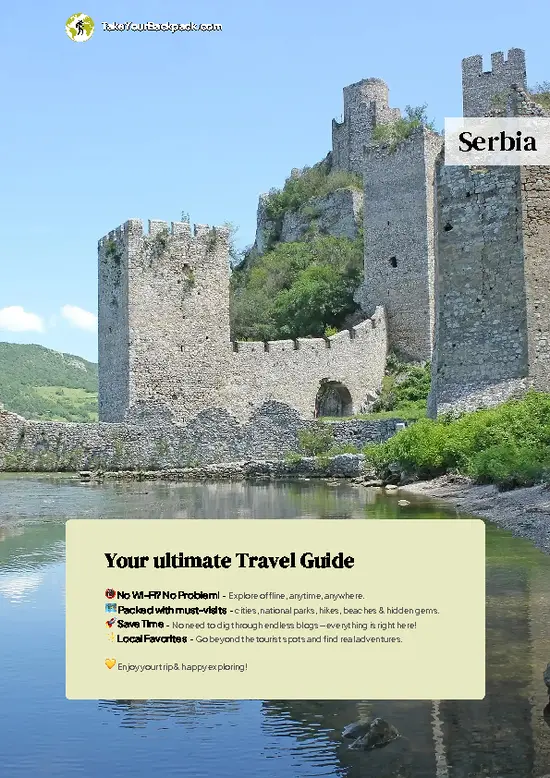
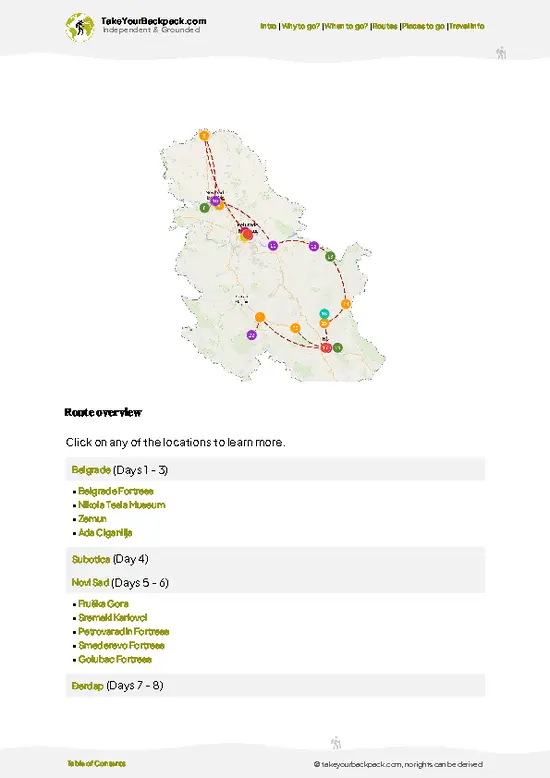
example page 0 from our offline Travel Guide for Serbia
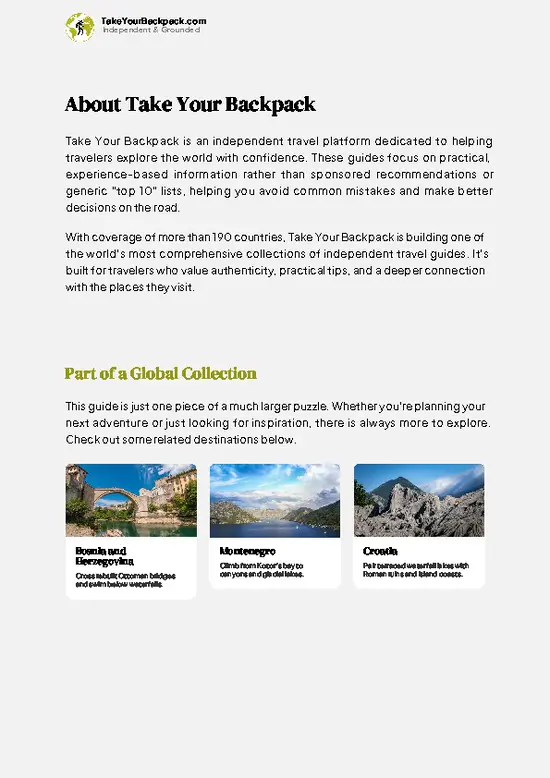
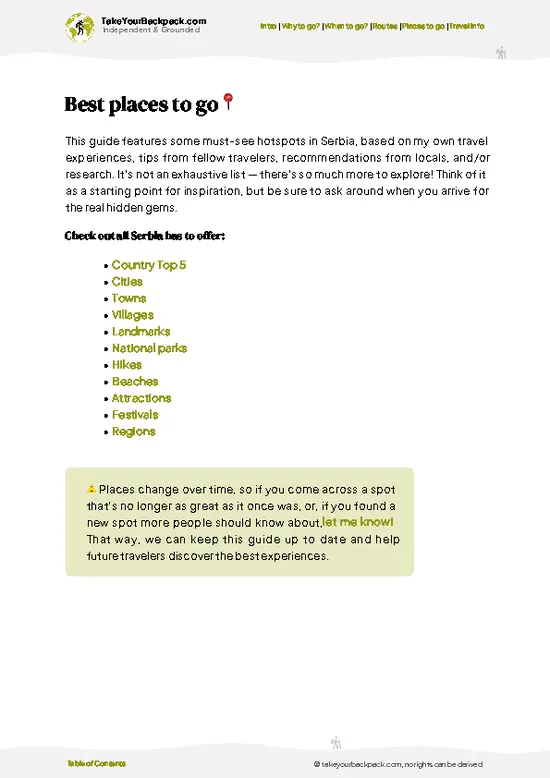
example page 1 from our offline Travel Guide for Serbia
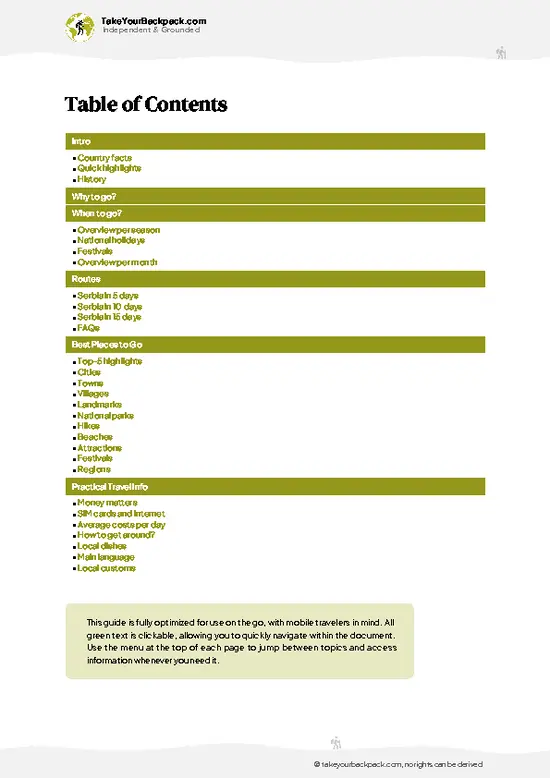
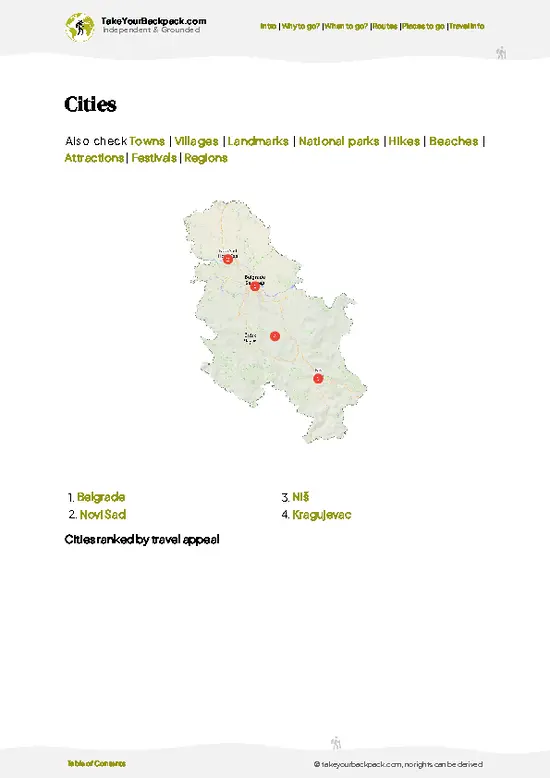
example page 2 from our offline Travel Guide for Serbia
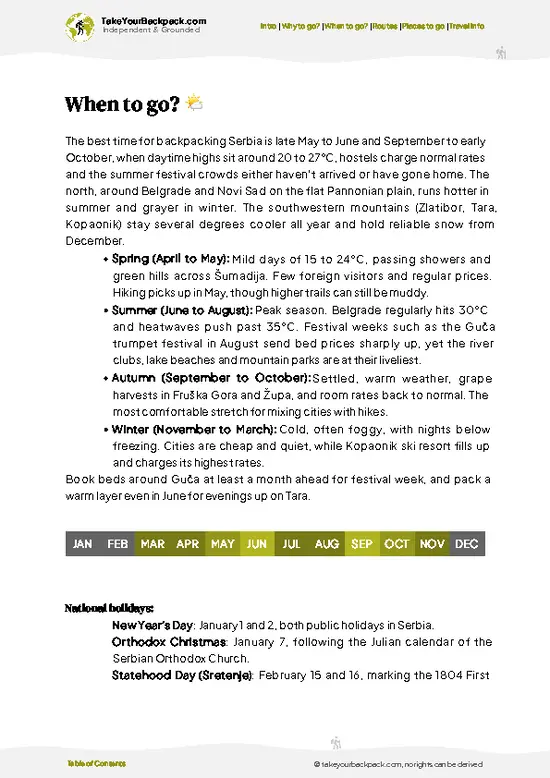
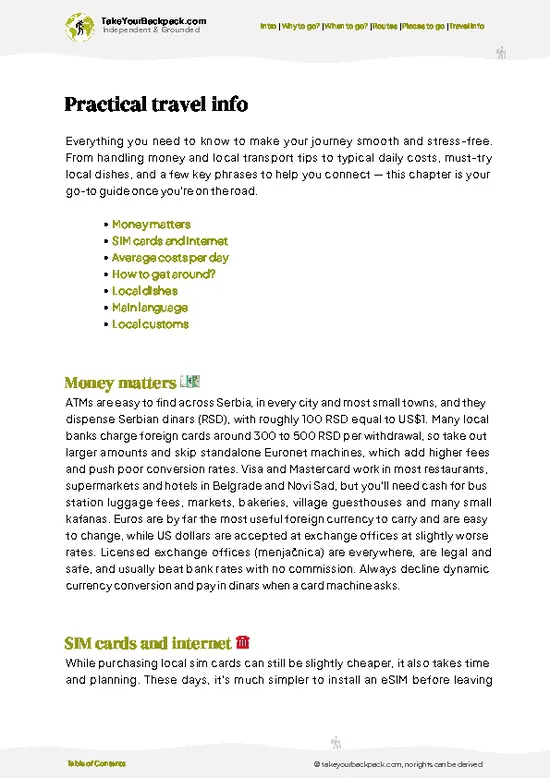
example page 3 from our offline Travel Guide for Serbia
example page 4 from our offline Travel Guide for Serbia
example page 5 from our offline Travel Guide for Serbia
example page 6 from our offline Travel Guide for Serbia
example page 7 from our offline Travel Guide for Serbia
The digital guide (309 pages) contains:
✅ 80 highlights, ranked by travel appeal
✅ Optimized 5, 10 & 15-day travel routes
✅ Cities, national parks, landmarks, beaches
✅ How to get around
✅ Offline-friendly for travel without Wi-Fi
👉 Click to see all 30+ guide features

📅 Plan smarter in minutes, not weeks
✅ Month by month travel advice
✅ Festivals & national holidays
✅ Budget expectations

🗺️ Go to the right places, skip the overrated ones
✅ Honest pros & cons of destinations
✅ Top hikes, parks & viewpoints
✅ Lesser-known places most travelers miss
✅ Clear “worth it vs skip it” guidance

🛏️ Travel smoothly without rookie mistakes
✅ Best areas to stay
✅ Transport systems explained simply
✅ Common scams & safety advice
✅ SIM cards, money & practical tips

🌍 Understand the country, not just visit it
✅ Culture & traditions
✅ 52 Essential phrases & customs
✅ Festivals worth planning around
✅ Traveler-friendly historical context
✅ Insights that make places more meaningful

📱 Built for real travel conditions
✅ Fully downloadable PDF
✅ Works completely offline
✅ Optimized for phone use
✅ Useful in remote areas & buses
✅ Everything in one place
Stop searching, start planning
Get instant access to your full guide. 30‑day money-back guarantee.
+ Add another guide for just

By proceeding you agree to our terms.
Sent to your inbox immediately after payment • 100% Secure Checkout
Best Backpacking Travel Advisor 2025 tourism awardBest Backpacking
Travel Advisor
2025
What others say about Take Your Backpack Guides:
⭐⭐⭐⭐⭐
Fantastic, amazing amount of information!
⭐⭐⭐⭐⭐
My goodness this is amazing, it's what I've been looking for hats off too you!
⭐⭐⭐⭐⭐
I think this is absolutely BRILLIANT
⭐⭐⭐⭐
Very complete and informative. It's still missing places, but I gotta to commend you
⭐⭐⭐⭐⭐
This is truly amazing, thank you, can't wait to explore it with my kids!
⭐⭐⭐⭐⭐
Awesome resource, thank you!
⭐⭐⭐⭐⭐
This is amazing! Can't wait to explore the ones I haven't seen
⭐⭐⭐⭐
I love this! Well done, great idea.
⭐⭐⭐⭐⭐
Thanks for taking the time to make this gem!
⭐⭐⭐⭐⭐
This might be the best website I've ever seen.
⭐⭐⭐⭐⭐
Congratulations, and thank you so much for your work; it's incredibly valuable.
⭐⭐⭐⭐
In all seriousness I think you did a great job pointing out the important spots
⭐⭐⭐⭐⭐
10/10 very good
⭐⭐⭐⭐⭐
As someone who's only just starting to visit regularly this is awesome, thank you.
⭐⭐⭐⭐
Thank you very much! I'm going to visit my dad, it's going to be very useful!
⭐⭐⭐⭐⭐
This is really cool! We'll be travelling for the first time and this definitely come in handy.
⭐⭐⭐⭐⭐
You are now our minister of culture, congratulations 👨‍💼
⭐⭐⭐⭐⭐
Just wanted to tell you that this is a pearl! Going to follow your recommendations.
⭐⭐⭐⭐⭐
This is so cool. I'll definitely be using the resource for my travels soon.
⭐⭐⭐⭐⭐
This is very impressive! Good work.
⭐⭐⭐⭐⭐
This is an amazing and informative site. Very well done!

🛏️ Where to stay?Top Areas to Stay

Serbia has plenty of hostels and budget guesthouses, with dorm beds typically running €10 to €18 a night and private rooms in family-run guesthouses from about €25. In Belgrade, Stari Grad and Dorćol put you within walking distance of Kalemegdan and Knez Mihailova, with lively bars and late-night noise to match, while Savamala sits closer to the riverfront clubs and the Sava waterfront but feels rougher around the edges after dark, and Vračar is quieter and leafier yet still a 20-minute walk from the old town. In Novi Sad the pedestrian Old Town around Zmaj Jovina is the easy pick for cafés and safe evening strolls, and in Niš the streets around the fortress and Kopitareva are compact, cheap … read more 👉
Serbia has plenty of hostels and budget guesthouses, with dorm beds typically running €10 to €18 a night and private rooms in family-run guesthouses from about €25. In Belgrade, Stari Grad and Dorćol put you within walking distance of Kalemegdan and Knez Mihailova, with lively bars and late-night noise to match, while Savamala sits closer to the riverfront clubs and the Sava waterfront but feels rougher around the edges after dark, and Vračar is quieter and leafier yet still a 20-minute walk from the old town. In Novi Sad the pedestrian Old Town around Zmaj Jovina is the easy pick for cafés and safe evening strolls, and in Niš the streets around the fortress and Kopitareva are compact, cheap and close to the nightlife.

If you enjoy meeting fellow travelers, consider choosing hostels with high ratings for atmosphere. On the other hand, if you prefer having your own space, a hotel might be a better option.

SerbiaDiscover the Country

👋 Meet the founderWho’s Behind Take Your Backpack?

Johan, backpacker and founder of TakeYourBackpackHi, I’m Johan (Netherlands 🇳🇱), the creator of TakeYourBackpack. Over the past 3 decades, I’ve backpacked through 90+ countries across six continents, gaining extensive experience with independent travel, long-term trips, and overland routes.

This site is built on a combination of firsthand travel experience and carefully curated insights from other backpackers. Many guides are based on places I’ve personally visited, while others bring together tips, observations, and practical advice shared by trusted travelers I’ve met along the way.

The goal is to provide realistic, experience-driven guidance — not generic itineraries — so you can explore destinations with better context, clearer expectations, and more confidence.