×

Serbia🇷🇸 | best national parksYour Guide to the 10 Best national parks in Serbia

Serbia’s national parks are not one genre. There are five of them, and they range from a forested ridge a short bus ride from Novi Sad to a Danube gorge on the Romanian border, plus a ski mountain that turns pricey in winter. Most are cheap, quiet and lightly signposted, so a backpacker who likes finding the trailhead by squinting at a faded marker will be happy. Western and central parks have the best public transport and the most guesthouses. Eastern and southern ones reward patience, and sometimes a lift from a stranger. Crowds are mostly Serbian weekenders, and they leave by Sunday.

By Johan Kruseman 🇳🇱 | Updated October 18, 2026
Explore the best hikes in Serbia

Why go?What Makes Them Special

Serbia sits where the Pannonian Plain gives way to the Dinaric Alps, the Carpathians and the Balkan range, which means four mountain systems and a major river fit inside a country smaller than Ohio. That compression is the main selling point. A traveler can swap lowland oak forest for spruce slopes or a river canyon in a single morning on a bus, and the Danube and Drina add water to the mix. Conservation took a back seat for decades, so many areas stayed unpolished: wooden shelters, hand-painted trail marks and village kitchens instead of visitor centers and gift shops.
Before choosing Serbia for its parks, know the trade. Infrastructure is uneven. Some trails are well marked, others are suggestions. Park entry is modest (typically a few hundred dinars, roughly US$2 to 6), but getting between … read more 👉
Serbia sits where the Pannonian Plain gives way to the Dinaric Alps, the Carpathians and the Balkan range, which means four mountain systems and a major river fit inside a country smaller than Ohio. That compression is the main selling point. A traveler can swap lowland oak forest for spruce slopes or a river canyon in a single morning on a bus, and the Danube and Drina add water to the mix. Conservation took a back seat for decades, so many areas stayed unpolished: wooden shelters, hand-painted trail marks and village kitchens instead of visitor centers and gift shops.
Before choosing Serbia for its parks, know the trade. Infrastructure is uneven. Some trails are well marked, others are suggestions. Park entry is modest (typically a few hundred dinars, roughly US$2 to 6), but getting between parks by bus can eat a day, and Sunday timetables are optimistic fiction. Signs mix Cyrillic and Latin, and village shops often take only cash. English is common among younger people and hit-or-miss elsewhere, though hospitality tends to cover the gap with coffee and rakija. Come for space, low prices and rough edges, not for polish.
Evaluating the Top Choices
The list of best national parks in Serbia is created based on landscapes, wildlife, adventure opportunities, facilities, and overall experience. If you feel a national park is missing in this list, please let us know.

When to go?Seasonal Guide to Visiting

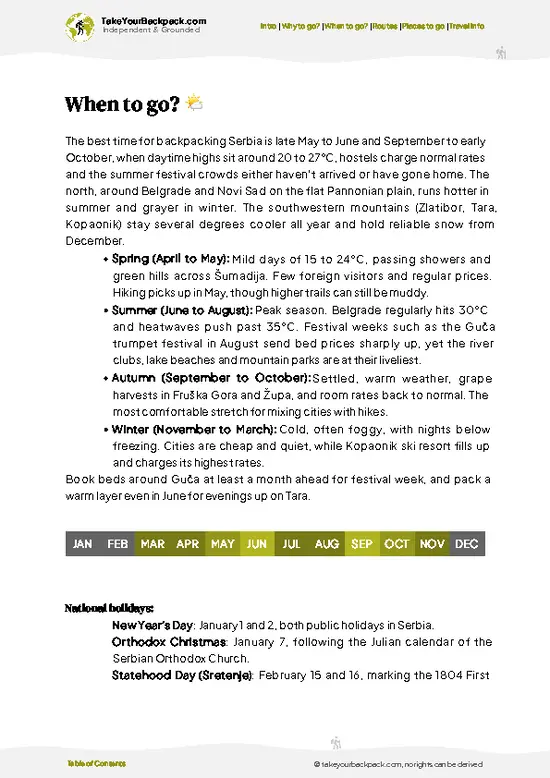
Best months: May to June and September to early October are the best months, because daytime highs sit around 15 to 25°C (59 to 77°F), trails are dry enough to walk and the forests are green or gold rather than baked or buried.
July and August push lowland temperatures to 30 to 38°C (86 to 100°F) in the north and east, which makes the Pannonian side feel like a convection oven with mosquitoes. The mountains in the west and south stay roughly 8 to 12°C cooler, so summer works there, though afternoon thunderstorms arrive with the punctuality of a bus that never does.
Shoulder and winter seasons: April is hit-and-miss: blossoms below, snow patches above 1,200 meters, and muddy tracks everywhere. Late October and November bring fog, shorter days and some guesthouses closing for the season, though … read more 👉
Best months: May to June and September to early October are the best months, because daytime highs sit around 15 to 25°C (59 to 77°F), trails are dry enough to walk and the forests are green or gold rather than baked or buried.
July and August push lowland temperatures to 30 to 38°C (86 to 100°F) in the north and east, which makes the Pannonian side feel like a convection oven with mosquitoes. The mountains in the west and south stay roughly 8 to 12°C cooler, so summer works there, though afternoon thunderstorms arrive with the punctuality of a bus that never does.
Shoulder and winter seasons: April is hit-and-miss: blossoms below, snow patches above 1,200 meters, and muddy tracks everywhere. Late October and November bring fog, shorter days and some guesthouses closing for the season, though prices drop and you may have a trail to yourself.
Winter changes the equation. From December to March, high-altitude areas see snow cover, and the ski-oriented mountain in central Serbia charges peak resort prices, with rooms often double or triple the autumn rate. Lower parks stay open but many trails turn icy, and some rural roads are cleared slowly.
Crowds and prices: Serbian holidays, especially the first days of May and the long summer weekends, fill guesthouses near the western and Danube parks. Book ahead then, or arrive midweek.

national park hoppingPlanning Your Route Efficiently

How many days to allow: A trip linking several national parks in Serbia works best at 7 to 10 days, which gives you real time on trails instead of a blur of bus windows.
The country splits into clusters. The north (Novi Sad and the Fruška Gora ridge) is a short train or bus hop from Belgrade, about 35 to 70 minutes. The west (around Bajina Bašta and the Drina) is 3.5 to 4.5 hours from Belgrade by bus. The central-south mountain is a further 4 to 5 hours, usually via Kraljevo or Raška with a change. The Danube gorge in the east is its own leg, roughly 3.5 to 4.5 hours from Belgrade, with fewer departures.
Direction and pacing: Start in the north, swing west, then drop south, and treat the Danube gorge as a separate loop from Belgrade or tack it on at the end if you have time. Plan 1 to 2 days … read more 👉
How many days to allow: A trip linking several national parks in Serbia works best at 7 to 10 days, which gives you real time on trails instead of a blur of bus windows.
The country splits into clusters. The north (Novi Sad and the Fruška Gora ridge) is a short train or bus hop from Belgrade, about 35 to 70 minutes. The west (around Bajina Bašta and the Drina) is 3.5 to 4.5 hours from Belgrade by bus. The central-south mountain is a further 4 to 5 hours, usually via Kraljevo or Raška with a change. The Danube gorge in the east is its own leg, roughly 3.5 to 4.5 hours from Belgrade, with fewer departures.
Direction and pacing: Start in the north, swing west, then drop south, and treat the Danube gorge as a separate loop from Belgrade or tack it on at the end if you have time. Plan 1 to 2 days per stop, and 2 to 3 if you want a proper multi-day hike.
Common planning mistakes: Travelers judge distance by the map, forgetting that Serbian mountain roads wind, and that a 150 km hop can take four hours. Cure: use bus times, not kilometers. Another is relying on Sunday and holiday departures, which thin out sharply. Check schedules a day before and keep a flexible buffer. Finally, cramming all parks into five days leaves you with photos and blisters but no memory of the trails. Pick fewer, stay longer.

The ListThe Best national parks of Serbia

1 Đerdap

Iron Gates gorge, Roman ruins, Danube cliffs

Sail or hike along the Danube’s narrowest passage, discover ancient Roman sites, and stand atop cliffs overlooking the river’s powerful current.

serbia-national-park-derdap
© Google | Momir D

2 Tara

deep gorges, bear habitat, ancient pine forests

Venture into remote valleys where brown bears roam, walk among centuries-old pines, and look out over the Drina River’s dramatic bends.

serbia-national-park-tara
© Google | Igor Stojanovic

3 Kopaonik National Park

alpine meadows, ski slopes, endemic species

Ski or hike above the tree line, encounter rare mountain plants, and explore a high plateau that draws visitors year-round for outdoor activities.

serbia-national-park-kopaonik-national-park
© Google | Nenad Mut

4 Fruška Gora

monastery trails, deciduous forests, gentle ridges

Follow marked paths linking centuries-old monasteries, pass through oak and beech woods, and enjoy easy day hikes close to Novi Sad.

serbia-national-park-fruska-gora
© Google | M L

5 Uvac Special Nature Reserve

meandering river canyons, griffon vultures, limestone caves

Paddle through looping river bends, watch griffon vultures soar overhead, and explore caves hidden in steep canyon walls.

serbia-national-park-uvac-special-nature-reserve
© Google | Paulo Filipe

6 Golija

dense forests, remote villages, UNESCO biosphere

Hike through thick spruce woods, encounter isolated hamlets, and experience a mountain landscape recognized for its ecological diversity and traditional lifestyles.

serbia-national-park-golija
© Google |

7 Deliblato Sands

sand dunes, steppe grasslands, wind-shaped pines

Cross undulating dunes and open grasslands, noticing how wind and sand have sculpted a unique ecosystem unlike anywhere else in Serbia.

serbia-national-park-deliblato-sands
© Google |

8 Obedska Bara

oxbow lakes, wetland birds, reed beds

Watch herons and spoonbills in a mosaic of marshes and ponds, following boardwalks through one of Europe’s oldest protected wetlands.

serbia-national-park-obedska-bara
© Google |

9 Gornje Podunavlje

Danube backwaters, floodplain forests, wild horses

Travel along river channels lined with willows, glimpse semi-wild horses, and experience the shifting landscapes of the Danube’s floodplain.

10 Sićevo Gorge

limestone cliffs, narrow canyon, endemic plants

Descend into a dramatic gorge where rare flora clings to rock faces and the Nišava River carves a twisting route through rugged terrain.

serbia-national-park-sicevo-gorge
© Google |

11 Zasavica

meandering river, water buffalo, rare orchids

Paddle quiet waterways, observe grazing water buffalo, and discover a reserve known for its botanical richness and traditional farming.

12 Vlasina

floating islands, peat bogs, high-altitude lake

Wander lakeside trails where floating islands drift, spot rare birds, and observe unique wetland habitats shaped by altitude and climate.

serbia-national-park-vlasina
© Google |

13 Ludaško Lake

shallow lake, migratory birds, saline meadows

Observe flocks of waterfowl in a shallow basin, explore saline grasslands, and witness seasonal changes that draw birdwatchers from across Europe.

14 Jelašnica Gorge

vertical cliffs, rare flora, climbing routes

Scramble beneath towering limestone walls, spot endemic plants, and find some of Serbia’s best rock climbing in a compact canyon.

15 Vršac Mountains

rolling hills, vineyards, panoramic viewpoints

Walk gentle slopes above vineyards, reach open summits for wide views, and experience a landscape shaped by both nature and viticulture.

16 Pešter Plateau

karst fields, highland pastures, traditional shepherd huts

Traverse open plateaus dotted with stone huts, encountering wide horizons and a way of life shaped by harsh winters and grazing livestock.

serbia-national-park-pester-plateau
© Google |

Think you know Serbia?

Prove you’re a true local — uncover 6 lesser-known national parks in Serbia that locals tend to keep to themselves.
Loading the map 🌍

Expert viewInsights from Locals and Experts

How many parks to visit: I recommend two or three. Serbia’s parks are spread across a country where intercity buses are slow and rural timetables shrink after midday, so every extra park costs roughly half a day of transit. Two parks with a solid hiking day each beat four ticked-off entrances, and you get the long ridge walk, the quiet picnic meadow and the village lunch rather than a window seat.
Choosing by travel style: If you want easy access and good food, pick the lowland forest park near Novi Sad: trails are gentle, wine cellars and monasteries are close, and a day trip from a city bed works. If you want real hiking and river views, choose the western forested mountain-and-canyon area, where marked loops lead to lookouts over the Drina and guesthouses serve kajmak, smoked meat and pie … read more 👉
How many parks to visit: I recommend two or three. Serbia’s parks are spread across a country where intercity buses are slow and rural timetables shrink after midday, so every extra park costs roughly half a day of transit. Two parks with a solid hiking day each beat four ticked-off entrances, and you get the long ridge walk, the quiet picnic meadow and the village lunch rather than a window seat.
Choosing by travel style: If you want easy access and good food, pick the lowland forest park near Novi Sad: trails are gentle, wine cellars and monasteries are close, and a day trip from a city bed works. If you want real hiking and river views, choose the western forested mountain-and-canyon area, where marked loops lead to lookouts over the Drina and guesthouses serve kajmak, smoked meat and pie in the evening. If you like wilder, emptier territory, the Danube gorge in the east gives cliffs, caves and boat access, though you will need patience with transport. The ski mountain suits winter or a summer bargain, when lifts are quiet and trails are open ridge.
What it costs: Budget US$30 to 50 (RSD 3,000 to 5,000) a day for a backpacker: a dorm or simple room runs RSD 2,500 to 4,500 (US$23 to 42) per person, a hearty meal of grilled meat, bread and salad RSD 800 to 1,500 (US$8 to 14), and local buses RSD 500 to 2,000 (US$5 to 19) per leg. Park entry is usually RSD 200 to 600 (US$2 to 6). A local guide for a full day tends to run RSD 5,000 to 10,000 (US$47 to 94), and boat tours in the gorge are a splurge worth taking for the cliff views, usually RSD 2,000 to 4,000 (US$19 to 38) per person. A two-park trip, including transit, lands around US$250 to 450 total.
Safety and cultural notes: Ticks are common in forested lowlands from spring to autumn, so wear long trousers and check your legs at night; a clean sock line beats a Lyme-disease anecdote. Summer heat brings wildfire risk and bans on open flames, which means campfires are usually off the menu. Nose-horned vipers sun on rocky paths, so look before you sit. Mountain weather turns quickly, and phone signal drops in gorges and on remote ridges, so download offline maps. Trail markers are often faded paint on trees, so carry a GPS app and a paper backup.
On culture, cover shoulders and knees in monasteries, and say hello to everyone you pass. A walker who nods and says “dobar dan” is likelier to be offered a coffee and directions. Carry cash in dinars, and bring your passport near the Romanian border, where checkpoints and border-zone rules apply. Expect an offer of rakija at village guesthouses; a small sip is polite, a second is a negotiation with tomorrow’s hike.

✈️ The backpacker research shortcutSerbia Travel Guide

An offline-friendly backpacking guide with optimized travel routes, ranked highlights, transport advice, and the best areas to stay.
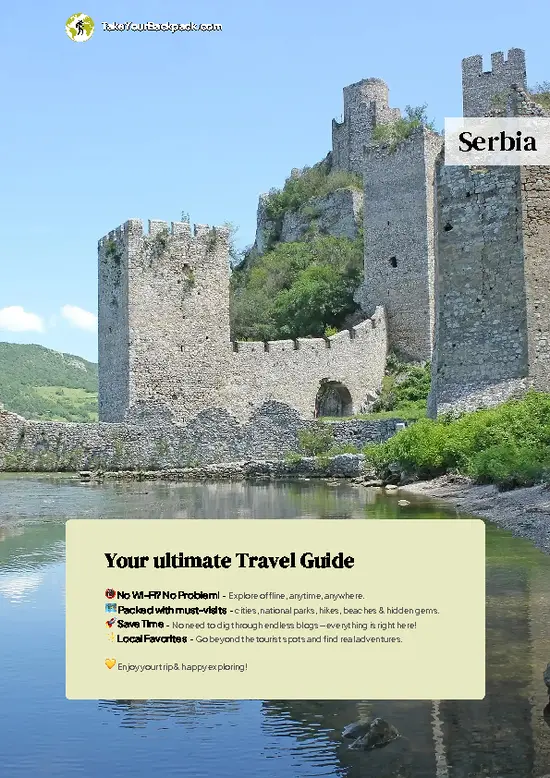
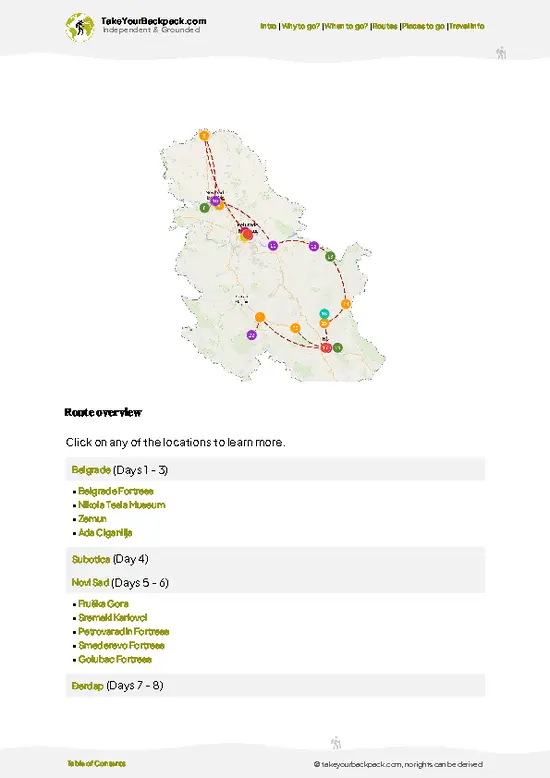
example page 0 from our offline Travel Guide for Serbia
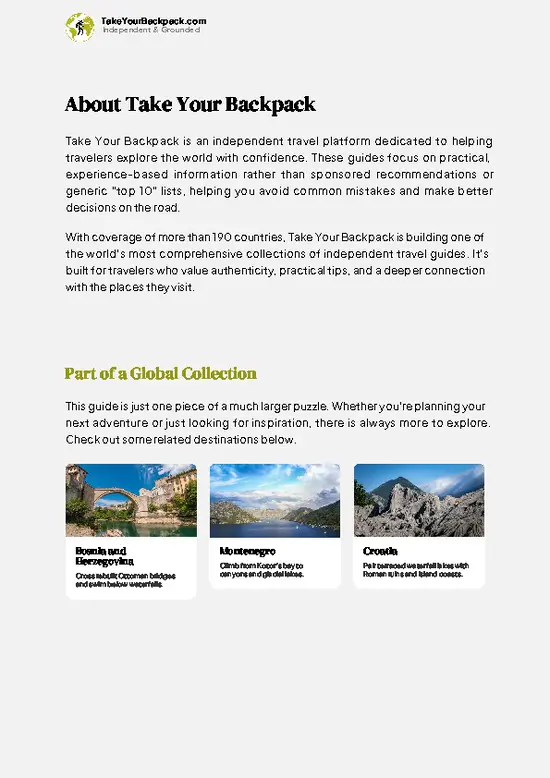
example page 1 from our offline Travel Guide for Serbia
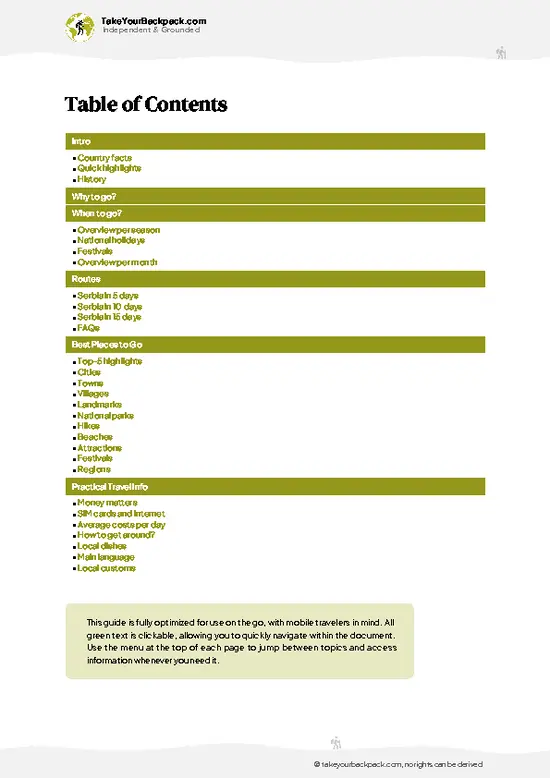
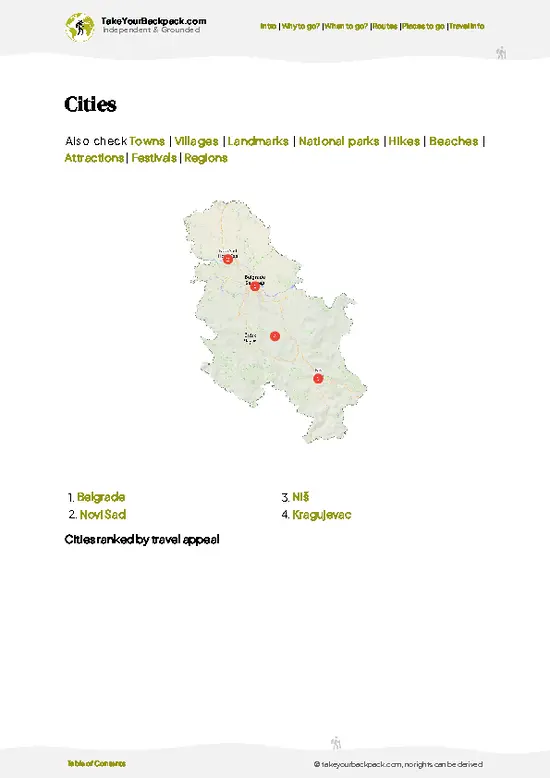
example page 2 from our offline Travel Guide for Serbia
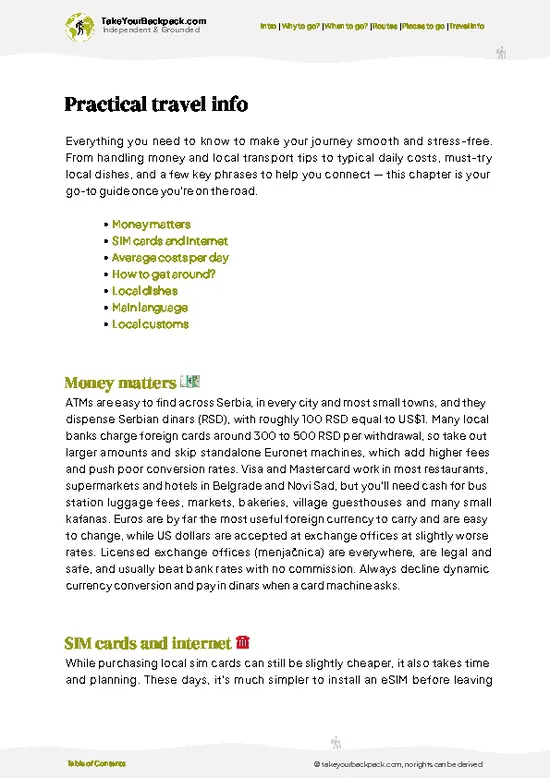
example page 3 from our offline Travel Guide for Serbia
example page 4 from our offline Travel Guide for Serbia
example page 5 from our offline Travel Guide for Serbia
example page 6 from our offline Travel Guide for Serbia
example page 7 from our offline Travel Guide for Serbia
The digital guide (309 pages) contains:
✅ 80 highlights, ranked by travel appeal
✅ Optimized 5, 10 & 15-day travel routes
✅ Cities, national parks, landmarks, beaches
✅ How to get around
✅ Offline-friendly for travel without Wi-Fi
👉 Click to see all 30+ guide features

📅 Plan smarter in minutes, not weeks
✅ Month by month travel advice
✅ Festivals & national holidays
✅ Budget expectations

🗺️ Go to the right places, skip the overrated ones
✅ Honest pros & cons of destinations
✅ Top hikes, parks & viewpoints
✅ Lesser-known places most travelers miss
✅ Clear “worth it vs skip it” guidance

🛏️ Travel smoothly without rookie mistakes
✅ Best areas to stay
✅ Transport systems explained simply
✅ Common scams & safety advice
✅ SIM cards, money & practical tips

🌍 Understand the country, not just visit it
✅ Culture & traditions
✅ 52 Essential phrases & customs
✅ Festivals worth planning around
✅ Traveler-friendly historical context
✅ Insights that make places more meaningful

📱 Built for real travel conditions
✅ Fully downloadable PDF
✅ Works completely offline
✅ Optimized for phone use
✅ Useful in remote areas & buses
✅ Everything in one place
Stop searching, start planning
Get instant access to your full guide. 30‑day money-back guarantee.
+ Add another guide for just

By proceeding you agree to our terms.
Sent to your inbox immediately after payment • 100% Secure Checkout
Best Backpacking Travel Advisor 2025 tourism awardBest Backpacking
Travel Advisor
2025
What others say about Take Your Backpack Guides:
⭐⭐⭐⭐⭐
Fantastic, amazing amount of information!
⭐⭐⭐⭐⭐
My goodness this is amazing, it's what I've been looking for hats off too you!
⭐⭐⭐⭐⭐
I think this is absolutely BRILLIANT
⭐⭐⭐⭐
Very complete and informative. It's still missing places, but I gotta to commend you
⭐⭐⭐⭐⭐
This is truly amazing, thank you, can't wait to explore it with my kids!
⭐⭐⭐⭐⭐
Awesome resource, thank you!
⭐⭐⭐⭐⭐
This is amazing! Can't wait to explore the ones I haven't seen
⭐⭐⭐⭐
I love this! Well done, great idea.
⭐⭐⭐⭐⭐
Thanks for taking the time to make this gem!
⭐⭐⭐⭐⭐
This might be the best website I've ever seen.
⭐⭐⭐⭐⭐
Congratulations, and thank you so much for your work; it's incredibly valuable.
⭐⭐⭐⭐
In all seriousness I think you did a great job pointing out the important spots
⭐⭐⭐⭐⭐
10/10 very good
⭐⭐⭐⭐⭐
As someone who's only just starting to visit regularly this is awesome, thank you.
⭐⭐⭐⭐
Thank you very much! I'm going to visit my dad, it's going to be very useful!
⭐⭐⭐⭐⭐
This is really cool! We'll be travelling for the first time and this definitely come in handy.
⭐⭐⭐⭐⭐
You are now our minister of culture, congratulations 👨‍💼
⭐⭐⭐⭐⭐
Just wanted to tell you that this is a pearl! Going to follow your recommendations.
⭐⭐⭐⭐⭐
This is so cool. I'll definitely be using the resource for my travels soon.
⭐⭐⭐⭐⭐
This is very impressive! Good work.
⭐⭐⭐⭐⭐
This is an amazing and informative site. Very well done!

🛏️ Where to stay?Where to Base Yourself

Serbia has plenty of hostels and budget guesthouses, with dorm beds typically running €10 to €18 a night and private rooms in family-run guesthouses from about €25. In Belgrade, Stari Grad and Dorćol put you within walking distance of Kalemegdan and Knez Mihailova, with lively bars and late-night noise to match, while Savamala sits closer to the riverfront clubs and the Sava waterfront but feels rougher around the edges after dark, and Vračar is quieter and leafier yet still a 20-minute walk from the old town. In Novi Sad the pedestrian Old Town around Zmaj Jovina is the easy pick for cafés and safe evening strolls, and in Niš the streets around the fortress and Kopitareva are compact, cheap … read more 👉
Serbia has plenty of hostels and budget guesthouses, with dorm beds typically running €10 to €18 a night and private rooms in family-run guesthouses from about €25. In Belgrade, Stari Grad and Dorćol put you within walking distance of Kalemegdan and Knez Mihailova, with lively bars and late-night noise to match, while Savamala sits closer to the riverfront clubs and the Sava waterfront but feels rougher around the edges after dark, and Vračar is quieter and leafier yet still a 20-minute walk from the old town. In Novi Sad the pedestrian Old Town around Zmaj Jovina is the easy pick for cafés and safe evening strolls, and in Niš the streets around the fortress and Kopitareva are compact, cheap and close to the nightlife.

If you enjoy meeting fellow travelers, consider choosing hostels with high ratings for atmosphere. On the other hand, if you prefer having your own space, a hotel might be a better option.

SerbiaExpand Your Journey

👋 Meet the founderWho’s Behind Take Your Backpack?

Johan, backpacker and founder of TakeYourBackpackHi, I’m Johan (Netherlands 🇳🇱), the creator of TakeYourBackpack. Over the past 3 decades, I’ve backpacked through 90+ countries across six continents, gaining extensive experience with independent travel, long-term trips, and overland routes.

This site is built on a combination of firsthand travel experience and carefully curated insights from other backpackers. Many guides are based on places I’ve personally visited, while others bring together tips, observations, and practical advice shared by trusted travelers I’ve met along the way.

The goal is to provide realistic, experience-driven guidance — not generic itineraries — so you can explore destinations with better context, clearer expectations, and more confidence.