×

Sierra Leone🇸🇱 | best festivalsWhere to Find the 2 Best festivals in Sierra Leone

Festivals in Sierra Leone are rarely ticketed events with gates and schedules. They are community occasions: drums thumping from a courtyard at dusk, palm oil and smoke drifting from cooking fires, masked dancers in raffia and cloth moving through red-dirt streets. Atmosphere changes sharply by region. Freetown and the peninsula bring beach crowds, sound systems and easy taxis. The provinces in the east, north and south feel quieter and more local, with rough roads, few signs and hosts who expect you to ask permission first. Backpacking independently here costs little, but you trade comfort for access to the real thing.

By Johan Kruseman 🇳🇱 | Updated October 23, 2026
Explore the best regions in Sierra Leone

Why go?Key Factors That Shape the Experience

Sierra Leone suits festivals because public life here still runs on community gatherings. Dozens of ethnic groups, including the Mende, Temne, Limba and Krio, keep separate calendars of ceremonies, and the secret societies that govern initiation and masquerade remain active in many villages. Krio heritage in Freetown, shaped by freed slaves who settled the coast from the late 1700s, adds a separate tradition of street parades and church-and-mosque coexistence, so Christian and Muslim holidays are shared across neighborhoods. Add a country small enough to cross in a day or two, and the variety is remarkable.

What suits it less is infrastructure. Dates are often set locally and shift, so published calendars are rough guides. Roads outside the main highways turn to soupy red mud in the rains, … read more 👉
Sierra Leone suits festivals because public life here still runs on community gatherings. Dozens of ethnic groups, including the Mende, Temne, Limba and Krio, keep separate calendars of ceremonies, and the secret societies that govern initiation and masquerade remain active in many villages. Krio heritage in Freetown, shaped by freed slaves who settled the coast from the late 1700s, adds a separate tradition of street parades and church-and-mosque coexistence, so Christian and Muslim holidays are shared across neighborhoods. Add a country small enough to cross in a day or two, and the variety is remarkable.

What suits it less is infrastructure. Dates are often set locally and shift, so published calendars are rough guides. Roads outside the main highways turn to soupy red mud in the rains, minibuses (poda-podas) leave only when full, and power cuts are routine. Accommodation near rural events may be a basic guesthouse with a bucket shower, or nothing at all. Travelers should expect cash-only payment, patchy mobile data, and the need for a local contact or guide to get into ceremonies with restricted parts. Festivals here are lived, not consumed, and visitors are guests in someone else’s occasion.
Behind the Scenes of Selection
The list of best festivals in Sierra Leone is created based on energy, traditions, crowd experience, activities, and overall excitement. If you feel a festival is missing in this list, please let us know.

When to go?Best Time to Visit Sierra Leone for festivals

Best months for festivals: The best window is November to April, when the dry season brings clear skies, little rain and roads that stay passable, which matters because most outdoor gatherings and masquerades are scheduled then. December to February is the sweet spot, with the dry Harmattan wind carrying fine dust from the Sahara, hazy light that turns sunsets orange, and cooler mornings of around 22 to 25°C. Afternoons climb to 30 to 34°C.
Shoulder and wet seasons: March and April grow hotter and stickier, with highs near 34°C and humidity building before the rains. Events still run, but travel is sweaty work. May to October is the wet season, and between July and September the coast can see 600 to 900 mm of rain a month, with Freetown among the wettest capitals in the world. Rural tracks … read more 👉
Best months for festivals: The best window is November to April, when the dry season brings clear skies, little rain and roads that stay passable, which matters because most outdoor gatherings and masquerades are scheduled then. December to February is the sweet spot, with the dry Harmattan wind carrying fine dust from the Sahara, hazy light that turns sunsets orange, and cooler mornings of around 22 to 25°C. Afternoons climb to 30 to 34°C.
Shoulder and wet seasons: March and April grow hotter and stickier, with highs near 34°C and humidity building before the rains. Events still run, but travel is sweaty work. May to October is the wet season, and between July and September the coast can see 600 to 900 mm of rain a month, with Freetown among the wettest capitals in the world. Rural tracks in the east and north may become impassable, flights and ferries get delayed, and outdoor events shrink or move.
Crowds and prices: Peak pressure comes around Christmas and New Year, when diaspora visitors fill Freetown and the peninsula beaches. Rooms there can cost 30 to 50 percent more, and flights into Lungi are often booked weeks ahead. Inland, prices stay steady year-round.

festival hoppingOptimizing Your Multi-Stop Itinerary

How many days to allow: A trip linking several festivals in Sierra Leone needs 10 to 14 days, because distances are short on the map but slow on the road. The country divides into a western cluster around Freetown and the peninsula, a southern and eastern belt through Bo and Kenema, and a northern arc through Makeni and Kabala. Starting in Freetown and heading inland in a loop works well, since the capital has the best onward transport and the widest choice of rooms.
Time per stop and between regions: Allow 2 to 3 days in Freetown, and 1 to 2 nights at each provincial stop so you can arrive the evening before and leave the morning after. Freetown to Bo takes about 4 to 5 hours by shared car or minibus, Bo to Kenema roughly 2 to 3, and Freetown to Makeni 3 to 4. Northern roads toward Kabala … read more 👉
How many days to allow: A trip linking several festivals in Sierra Leone needs 10 to 14 days, because distances are short on the map but slow on the road. The country divides into a western cluster around Freetown and the peninsula, a southern and eastern belt through Bo and Kenema, and a northern arc through Makeni and Kabala. Starting in Freetown and heading inland in a loop works well, since the capital has the best onward transport and the widest choice of rooms.
Time per stop and between regions: Allow 2 to 3 days in Freetown, and 1 to 2 nights at each provincial stop so you can arrive the evening before and leave the morning after. Freetown to Bo takes about 4 to 5 hours by shared car or minibus, Bo to Kenema roughly 2 to 3, and Freetown to Makeni 3 to 4. Northern roads toward Kabala add another 3 to 4 hours. Expect checkpoints, red dust in the dry season and puddled mud in the wet.
Planning mistakes: The commonest error is booking tight connections. Poda-podas and shared taxis wait until full, so a 9 a.m. departure may leave at 11. Build in a spare day between regions. Another is arriving on the day itself, when rooms are gone and roads are blocked by processions. Arrive early, and confirm dates with a local contact.

The ListThe Best festivals of Sierra Leone

1 Sierra Leone International Film Festival

Freetown screenings, filmmaker Q&As, short documentaries, open-air cinema nights

Catch local shorts and documentaries in Freetown halls, question directors after the credits, and watch films outdoors on plastic chairs beside neighbors and snack vendors.

2 Sierra Leone Independence Day

April 27 parade, National Stadium, flag-draped streets, Lumley Beach parties

Join schoolchildren and military units marching at the National Stadium, then follow the crowds to Lumley and Lakka beaches for sound systems and grilled fish.

Loading the map 🌍

Expert viewWhat You Should Know

How many festivals to attend: Aim for two or three over a trip of two weeks. Dates are fluid, transport is slow, and delays are common, so a packed schedule means you spend more time in a shared taxi than at a ceremony. Two lets you stay long enough to be invited into a compound, share rice and cassava-leaf stew, and hear the drums at 2 a.m. rather than merely photograph them.
Choosing the kind: First-timers and anyone short on comfort tolerance should favor Freetown and peninsula events. Parades, beach parties and religious holidays are easy to reach by taxi or ferry, rooms are plentiful and the streets stay lively until late. Travelers with time and patience gain more from village and masquerade gatherings in the provinces, where the sound of bells, the swish of raffia and the smell of woodsmoke … read more 👉
How many festivals to attend: Aim for two or three over a trip of two weeks. Dates are fluid, transport is slow, and delays are common, so a packed schedule means you spend more time in a shared taxi than at a ceremony. Two lets you stay long enough to be invited into a compound, share rice and cassava-leaf stew, and hear the drums at 2 a.m. rather than merely photograph them.
Choosing the kind: First-timers and anyone short on comfort tolerance should favor Freetown and peninsula events. Parades, beach parties and religious holidays are easy to reach by taxi or ferry, rooms are plentiful and the streets stay lively until late. Travelers with time and patience gain more from village and masquerade gatherings in the provinces, where the sound of bells, the swish of raffia and the smell of woodsmoke come with no stage and no commentary. Those are slower and harder to arrange, and a local guide or host is close to essential.
What it costs: Budget about US$30 to 50 a day in Freetown, covering a guesthouse room at US$20 to 40, street food at US$2 to 5 a meal, and short taxis. Provincial travel runs nearer US$20 to 35 a day. Most community events charge no entry, but expect to offer a gift or contribution of roughly US$5 to 15 to the host or elders. A local guide or fixer costs US$20 to 40 a day, and a shared taxi between towns US$5 to 15 depending on distance. Carry small bills in leones, since change is scarce and cards rarely work outside Freetown.
Safety and etiquette: Crowds in Freetown draw pickpockets, so carry only what you need and keep your phone out of back pockets. After dark, take a taxi rather than walking. Use common sense around large processions, where jostling and loud, sometimes drunken, celebration are normal.

Ask before photographing masked figures, initiates or religious rites, and expect to be refused. Some ceremonies belong to secret societies, and certain areas are closed to outsiders, particularly women in some men’s society spaces and vice versa. Dress modestly, covering shoulders and knees, greet elders first with a handshake, and accept food with your right hand. Follow the lead of your host, who will tell you quickly where to stand and what to avoid.

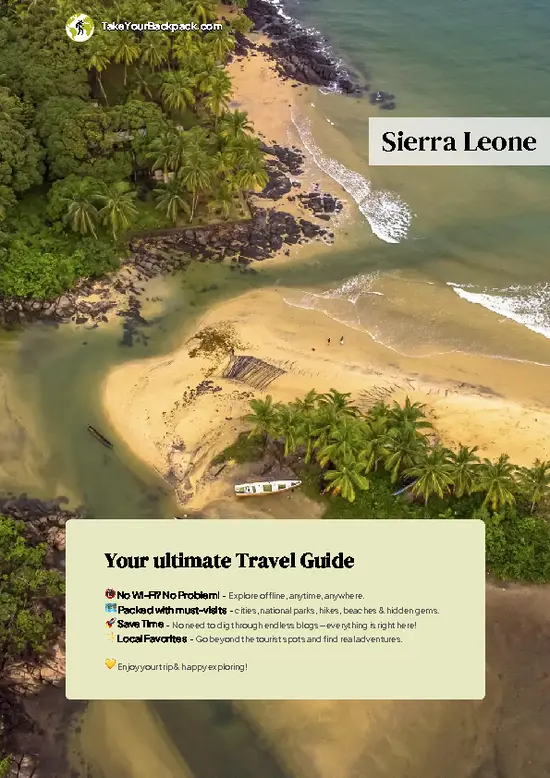
✈️ The backpacker research shortcutSierra Leone Travel Guide

An offline-friendly backpacking guide with optimized travel routes, ranked highlights, transport advice, and the best areas to stay.
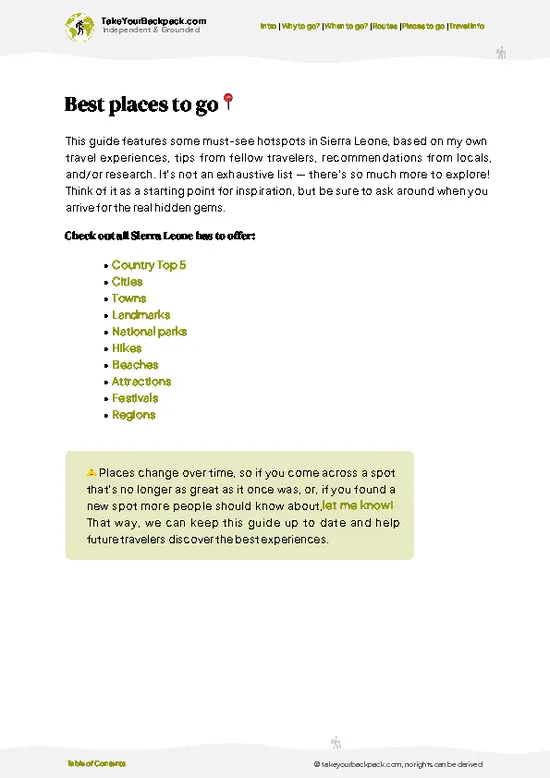
example page 0 from our offline Travel Guide for Sierra Leone
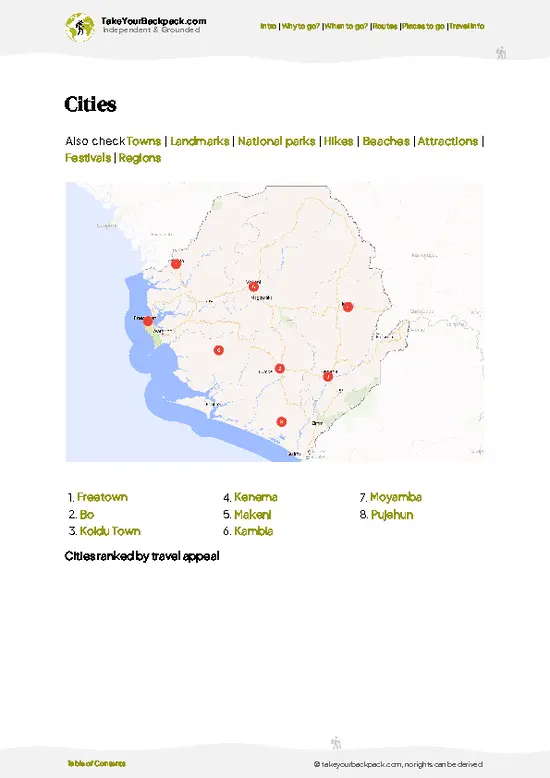
example page 1 from our offline Travel Guide for Sierra Leone
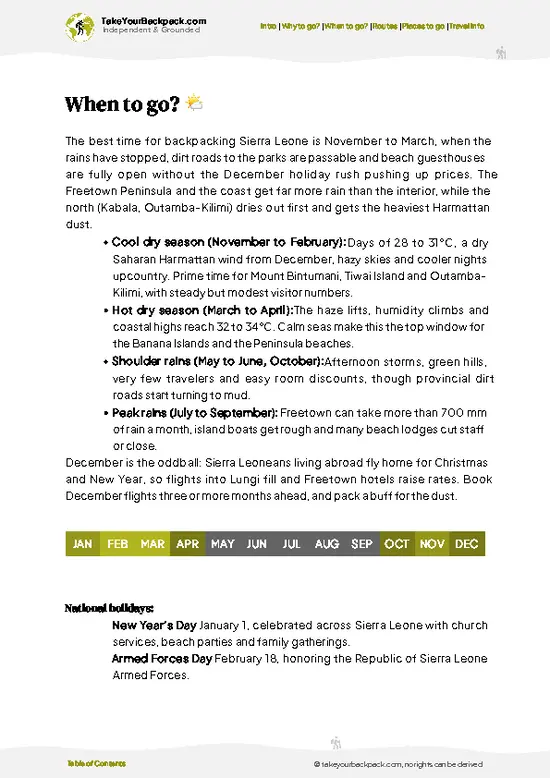
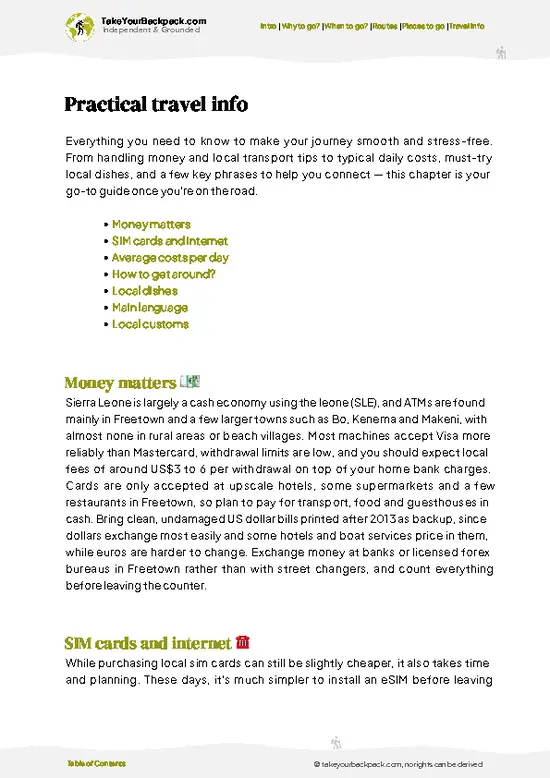
example page 2 from our offline Travel Guide for Sierra Leone
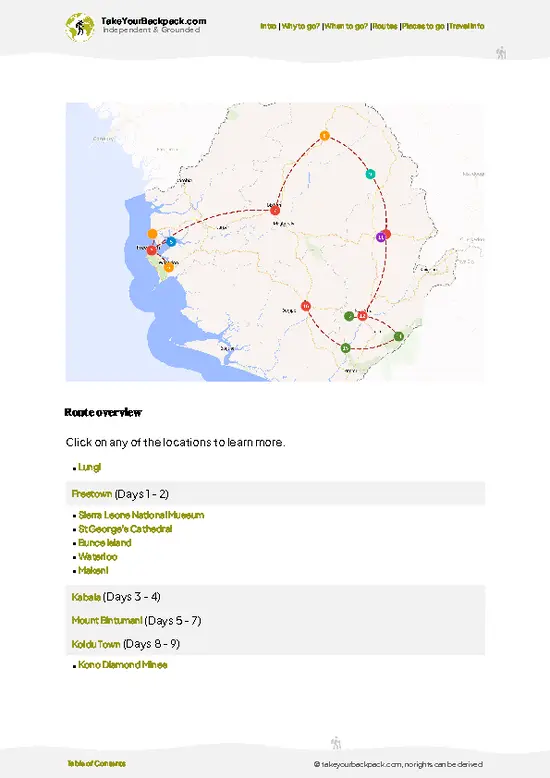
example page 3 from our offline Travel Guide for Sierra Leone
example page 4 from our offline Travel Guide for Sierra Leone
example page 5 from our offline Travel Guide for Sierra Leone
example page 6 from our offline Travel Guide for Sierra Leone
example page 7 from our offline Travel Guide for Sierra Leone
The digital guide (242 pages) contains:
✅ 50 highlights, ranked by travel appeal
✅ Optimized 5, 10 & 15-day travel routes
✅ Cities, national parks, landmarks, beaches
✅ How to get around
✅ Offline-friendly for travel without Wi-Fi
👉 Click to see all 30+ guide features

📅 Plan smarter in minutes, not weeks
✅ Month by month travel advice
✅ Festivals & national holidays
✅ Budget expectations

🗺️ Go to the right places, skip the overrated ones
✅ Honest pros & cons of destinations
✅ Top hikes, parks & viewpoints
✅ Lesser-known places most travelers miss
✅ Clear “worth it vs skip it” guidance

🛏️ Travel smoothly without rookie mistakes
✅ Best areas to stay
✅ Transport systems explained simply
✅ Common scams & safety advice
✅ SIM cards, money & practical tips

🌍 Understand the country, not just visit it
✅ Culture & traditions
✅ 52 Essential phrases & customs
✅ Festivals worth planning around
✅ Traveler-friendly historical context
✅ Insights that make places more meaningful

📱 Built for real travel conditions
✅ Fully downloadable PDF
✅ Works completely offline
✅ Optimized for phone use
✅ Useful in remote areas & buses
✅ Everything in one place
Stop searching, start planning
Get instant access to your full guide. 30‑day money-back guarantee.
+ Add another guide for just

By proceeding you agree to our terms.
Sent to your inbox immediately after payment • 100% Secure Checkout
Best Backpacking Travel Advisor 2025 tourism awardBest Backpacking
Travel Advisor
2025
What others say about Take Your Backpack Guides:
⭐⭐⭐⭐⭐
Fantastic, amazing amount of information!
⭐⭐⭐⭐⭐
My goodness this is amazing, it's what I've been looking for hats off too you!
⭐⭐⭐⭐⭐
I think this is absolutely BRILLIANT
⭐⭐⭐⭐
Very complete and informative. It's still missing places, but I gotta to commend you
⭐⭐⭐⭐⭐
This is truly amazing, thank you, can't wait to explore it with my kids!
⭐⭐⭐⭐⭐
Awesome resource, thank you!
⭐⭐⭐⭐⭐
This is amazing! Can't wait to explore the ones I haven't seen
⭐⭐⭐⭐
I love this! Well done, great idea.
⭐⭐⭐⭐⭐
Thanks for taking the time to make this gem!
⭐⭐⭐⭐⭐
This might be the best website I've ever seen.
⭐⭐⭐⭐⭐
Congratulations, and thank you so much for your work; it's incredibly valuable.
⭐⭐⭐⭐
In all seriousness I think you did a great job pointing out the important spots
⭐⭐⭐⭐⭐
10/10 very good
⭐⭐⭐⭐⭐
As someone who's only just starting to visit regularly this is awesome, thank you.
⭐⭐⭐⭐
Thank you very much! I'm going to visit my dad, it's going to be very useful!
⭐⭐⭐⭐⭐
This is really cool! We'll be travelling for the first time and this definitely come in handy.
⭐⭐⭐⭐⭐
You are now our minister of culture, congratulations 👨‍💼
⭐⭐⭐⭐⭐
Just wanted to tell you that this is a pearl! Going to follow your recommendations.
⭐⭐⭐⭐⭐
This is so cool. I'll definitely be using the resource for my travels soon.
⭐⭐⭐⭐⭐
This is very impressive! Good work.
⭐⭐⭐⭐⭐
This is an amazing and informative site. Very well done!

🛏️ Where to stay?Where to Stay in Sierra Leone

Backpacking Sierra Leone means budget guesthouses and simple beach huts rather than true hostels, with basic double rooms in Freetown typically running SLE 450 to 900 (about US$20 to 40) a night and dorm beds rare. Aberdeen and Lumley on the western side of the city have the most choice, with the beach, bars and nightlife on your doorstep and a calmer, safer feel, while the cheaper rooms around the city center sit near the markets and the Cotton Tree but come with traffic noise and streets that get sketchy after dark. For quiet, head down the peninsula to River Number Two, Tokeh or Bureh Beach, where beach huts and camping put you right on the sand but far from shops, ATMs and anything open … read more 👉
Backpacking Sierra Leone means budget guesthouses and simple beach huts rather than true hostels, with basic double rooms in Freetown typically running SLE 450 to 900 (about US$20 to 40) a night and dorm beds rare. Aberdeen and Lumley on the western side of the city have the most choice, with the beach, bars and nightlife on your doorstep and a calmer, safer feel, while the cheaper rooms around the city center sit near the markets and the Cotton Tree but come with traffic noise and streets that get sketchy after dark. For quiet, head down the peninsula to River Number Two, Tokeh or Bureh Beach, where beach huts and camping put you right on the sand but far from shops, ATMs and anything open late.

If you enjoy meeting fellow travelers, consider choosing hostels with high ratings for atmosphere. On the other hand, if you prefer having your own space, a hotel might be a better option.

Sierra LeoneMore of Sierra Leone

👋 Meet the founderWho’s Behind Take Your Backpack?

Johan, backpacker and founder of TakeYourBackpackHi, I’m Johan (Netherlands 🇳🇱), the creator of TakeYourBackpack. Over the past 3 decades, I’ve backpacked through 90+ countries across six continents, gaining extensive experience with independent travel, long-term trips, and overland routes.

This site is built on a combination of firsthand travel experience and carefully curated insights from other backpackers. Many guides are based on places I’ve personally visited, while others bring together tips, observations, and practical advice shared by trusted travelers I’ve met along the way.

The goal is to provide realistic, experience-driven guidance — not generic itineraries — so you can explore destinations with better context, clearer expectations, and more confidence.