×

Sierra Leone🇸🇱 | best landmarksWhere to Find the Best landmarks in Sierra Leone

Landmarks in Sierra Leone are rarely ticketed monuments with turnstiles. They are rusting slave-trade ruins on river islands, cotton trees whose buttress roots swallow a person, and forest sanctuaries where the air turns damp and green within a step. Around Freetown and the peninsula, red laterite roads and beach villages put sights within a shared taxi ride, with a few small fees and the occasional crowd. Inland and upcountry, the red-dirt tracks slow everything: expect motorbike taxis, river crossings and local guides who know the path. For backpackers and other independent travelers, the further you go, the quieter and cheaper the sites get, and the harder they are to reach.

By Johan Kruseman 🇳🇱 | Updated October 23, 2026
Explore the best national parks in Sierra Leone

Why go?Key Factors That Shape the Experience

Sierra Leone suits landmarks that ask for effort. Its history runs deep: it was a point of departure for enslaved people, then a settlement for freed Black Americans, Caribbean Maroons and recaptured Africans, and those layers sit in crumbling stone, old churches and Krio wooden houses with peeling paint. The geography adds a second kind of landmark, with granite hills, rivers the color of tea, mangrove creeks and forest that hums with insects at dusk. The infrastructure is thin. Signage is minimal, museums are small, and many sites have no staff at all, only a community member who appears when you arrive and expects a modest tip. Roads turn to mud in the rains, and a short distance on the map can eat half a day.

That is also the appeal. You will mostly share sites with villagers, not tour … read more 👉
Sierra Leone suits landmarks that ask for effort. Its history runs deep: it was a point of departure for enslaved people, then a settlement for freed Black Americans, Caribbean Maroons and recaptured Africans, and those layers sit in crumbling stone, old churches and Krio wooden houses with peeling paint. The geography adds a second kind of landmark, with granite hills, rivers the color of tea, mangrove creeks and forest that hums with insects at dusk. The infrastructure is thin. Signage is minimal, museums are small, and many sites have no staff at all, only a community member who appears when you arrive and expects a modest tip. Roads turn to mud in the rains, and a short distance on the map can eat half a day.

That is also the appeal. You will mostly share sites with villagers, not tour groups, and entry is cheap or negotiated on the spot. Before choosing Sierra Leone for its landmarks, know that you will need local guides, small cash in leones, patience with transport, and a tolerance for sites that are overgrown, unlabeled or half restored. Come for atmosphere and the stories people tell you, not for polished displays.
Evaluating the Top Choices
The list of best unique sites in Sierra Leone is created based on history or culture, wow factor, atmosphere, quirks, and memorability. If you feel a unique site is missing in this list, please let us know.

When to go?Best Time to Visit Sierra Leone for landmarks

Best months for landmarks: The best months are December to March, when the dry season brings clear skies, firmer roads and daytime highs of roughly 30 to 34°C. Harmattan winds can blow fine dust from the Sahara between December and February, giving a pale haze at midday and cooler, dry nights, especially upcountry. Rivers run lower, tracks are passable by motorbike, and walking to forest and hilltop sites is more comfortable.
Shoulder seasons: November and April to early May are workable. Early rains arrive as heavy afternoon downpours, the air is sticky and humid, and the red dirt turns slick. Mornings are usually bright enough for outdoor visits, so plan around the clouds that build after noon.
Rainy season: From June to September the country gets some of the heaviest rain in West Africa, … read more 👉
Best months for landmarks: The best months are December to March, when the dry season brings clear skies, firmer roads and daytime highs of roughly 30 to 34°C. Harmattan winds can blow fine dust from the Sahara between December and February, giving a pale haze at midday and cooler, dry nights, especially upcountry. Rivers run lower, tracks are passable by motorbike, and walking to forest and hilltop sites is more comfortable.
Shoulder seasons: November and April to early May are workable. Early rains arrive as heavy afternoon downpours, the air is sticky and humid, and the red dirt turns slick. Mornings are usually bright enough for outdoor visits, so plan around the clouds that build after noon.
Rainy season: From June to September the country gets some of the heaviest rain in West Africa, with the coast around Freetown often receiving over 3,000 mm a year, most of it in these months. Roads in the east and north can become impassable, boat crossings are rougher, and paths to forest and island sites turn to mud. Accommodation prices barely change, since tourist numbers stay small year-round, but transport takes longer and costs more when drivers add a premium for bad roads. Peak crowds only matter on beach weekends and around Christmas near Freetown, when shared taxis fill early.

unique site hoppingOptimizing Your Multi-Stop Itinerary

How many days to combine stops: A trip linking several landmarks in Sierra Leone needs 8 to 14 days, because travel eats more time than the sites themselves. Most visits last 1 to 3 hours, though forest and river sites can take a half day with a guide.
Grouping and direction: Base the start in Freetown and its peninsula, where sites sit 30 to 90 minutes apart by taxi, poda-poda (minibus) or ferry. From there head southeast on the main road toward Bo and the south, about 4 to 6 hours by shared vehicle in the dry season, then loop north through Makeni and back to the capital. Doing it in this direction lets you finish on better roads and leaves a buffer before flights.
Planning mistakes: The commonest mistake is trusting map distances. A 100 km stretch on dirt can take 4 to 6 hours, and shared … read more 👉
How many days to combine stops: A trip linking several landmarks in Sierra Leone needs 8 to 14 days, because travel eats more time than the sites themselves. Most visits last 1 to 3 hours, though forest and river sites can take a half day with a guide.
Grouping and direction: Base the start in Freetown and its peninsula, where sites sit 30 to 90 minutes apart by taxi, poda-poda (minibus) or ferry. From there head southeast on the main road toward Bo and the south, about 4 to 6 hours by shared vehicle in the dry season, then loop north through Makeni and back to the capital. Doing it in this direction lets you finish on better roads and leaves a buffer before flights.
Planning mistakes: The commonest mistake is trusting map distances. A 100 km stretch on dirt can take 4 to 6 hours, and shared vehicles leave only when full, often before 8 a.m. Travelers also cram in one site too many per day. Allow a spare day for every four or five days of travel, start at dawn when the light is soft and the air still cool, and arrive at remote sites before midafternoon, since rain and dusk both come quickly. Carry cash for fuel top-ups and tips, because ATMs outside Freetown, Bo and Kenema are scarce.

The ListThe Best landmarks of Sierra Leone

1 Kono Diamond Mines

Waist-deep sieving pits, kimberlite open pit, Koidu market, licensed dealers, Sewa River dredging

Watch diggers wash gravel in muddy valleys, hear blasting from the fenced Koidu pit, and trace diamond history through Yengema, dealers' scales and market stalls.

Loading the map 🌍

Expert viewWhat You Should Know

How many to visit: Aim for 5 to 7 landmarks in a trip of one to two weeks. That number leaves time for the slow parts, such as waiting for a shared car to fill, a river ferry to cross or rain to pass. Pack in more and you spend your days staring at the back of a seat on red, rutted roads, which is not what you came for. Fewer, and you miss the contrast between coast and interior.
Prioritizing by travel style: History-minded travelers should lean toward colonial and slave-trade sites, where a guide’s voice and the sound of waves against old stone do most of the work. Nature-focused travelers should choose forest and hill sites, where you trade museum labels for birdsong, wet leaves underfoot and a view over the canopy at the top. Short on time or confidence, stay near Freetown, where access … read more 👉
How many to visit: Aim for 5 to 7 landmarks in a trip of one to two weeks. That number leaves time for the slow parts, such as waiting for a shared car to fill, a river ferry to cross or rain to pass. Pack in more and you spend your days staring at the back of a seat on red, rutted roads, which is not what you came for. Fewer, and you miss the contrast between coast and interior.
Prioritizing by travel style: History-minded travelers should lean toward colonial and slave-trade sites, where a guide’s voice and the sound of waves against old stone do most of the work. Nature-focused travelers should choose forest and hill sites, where you trade museum labels for birdsong, wet leaves underfoot and a view over the canopy at the top. Short on time or confidence, stay near Freetown, where access is easiest. If you want solitude, go upcountry, where you may be the only visitor that week.
What it costs: Budget US$30 to 55 a day for basic guesthouses, local meals, and shared transport. Entry fees are usually small, around US$2 to 10 per site, and some community-run sites charge a flat fee for a guide of roughly US$5 to 20. Boat hires to island sites can cost US$20 to 60 per boat, so splitting with others helps. Motorbike taxis for short hops cost US$1 to 5. Carry small leone notes, since change for large bills is hard to find, and keep a little extra for tips. The reward for paying a guide is real: they find the overgrown path and tell the story behind the stones.
Safety and culture: Dress modestly at religious and community sites, and ask before photographing people, shrines or ceremonial objects. Some forests and groves are sacred, so follow your guide’s instructions about where to step and what to touch. Register with the community head or caretaker on arrival, since this is the local custom and shows respect. Avoid walking alone at dusk, keep valuables out of sight in Freetown, and wear sturdy shoes, as laterite turns greasy after rain. Take malaria prevention seriously, carry water and sun protection, and leave remote tracks before dark. Mobile signal is patchy, so tell your guesthouse where you are headed.

✈️ The backpacker research shortcutSierra Leone Travel Guide

An offline-friendly backpacking guide with optimized travel routes, ranked highlights, transport advice, and the best areas to stay.
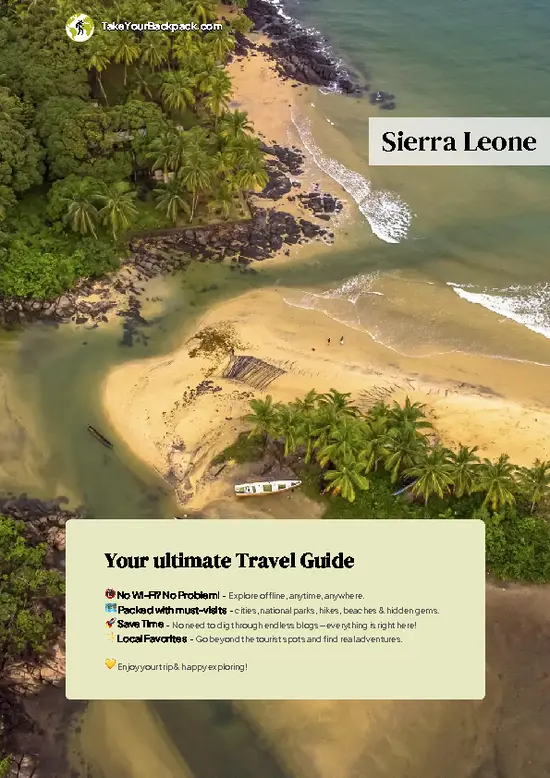
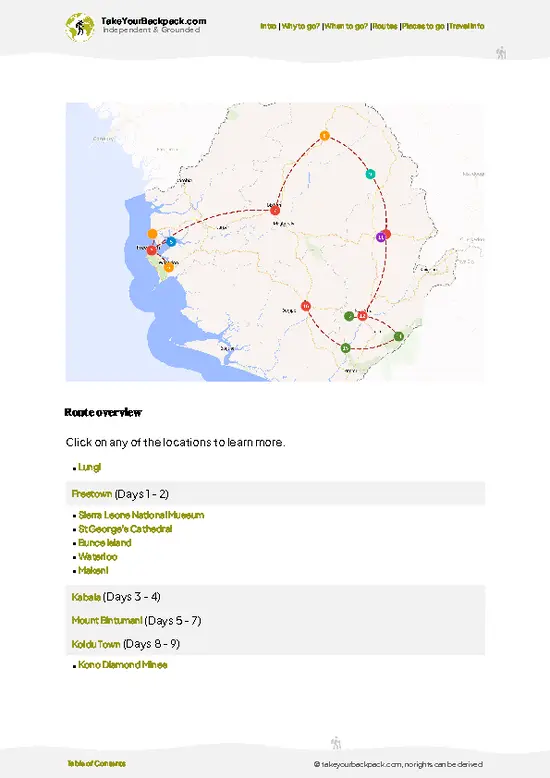
example page 0 from our offline Travel Guide for Sierra Leone
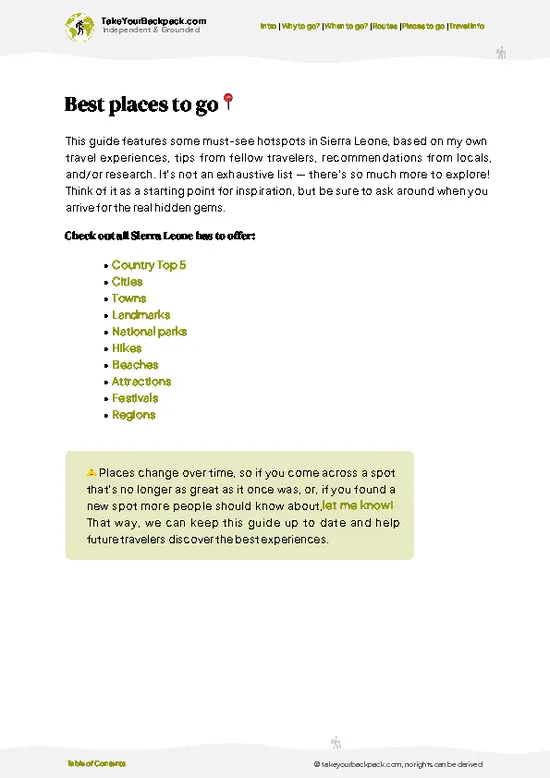
example page 1 from our offline Travel Guide for Sierra Leone
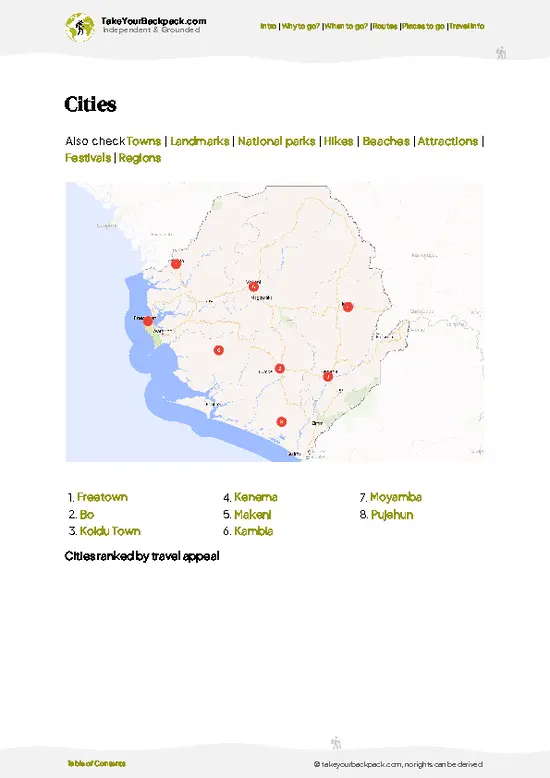
example page 2 from our offline Travel Guide for Sierra Leone
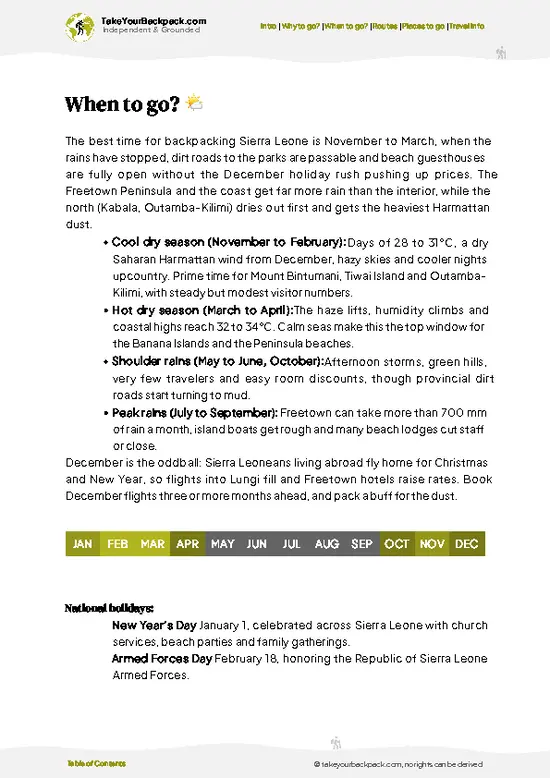
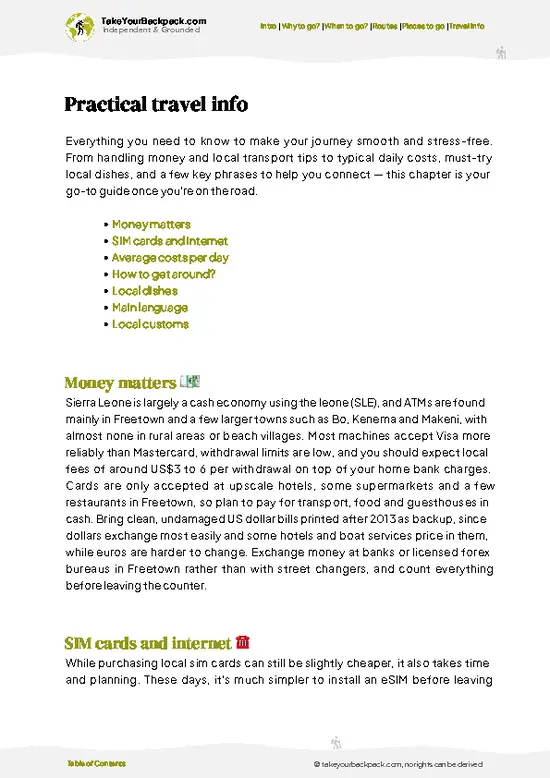
example page 3 from our offline Travel Guide for Sierra Leone
example page 4 from our offline Travel Guide for Sierra Leone
example page 5 from our offline Travel Guide for Sierra Leone
example page 6 from our offline Travel Guide for Sierra Leone
example page 7 from our offline Travel Guide for Sierra Leone
The digital guide (242 pages) contains:
✅ 50 highlights, ranked by travel appeal
✅ Optimized 5, 10 & 15-day travel routes
✅ Cities, national parks, landmarks, beaches
✅ How to get around
✅ Offline-friendly for travel without Wi-Fi
👉 Click to see all 30+ guide features

📅 Plan smarter in minutes, not weeks
✅ Month by month travel advice
✅ Festivals & national holidays
✅ Budget expectations

🗺️ Go to the right places, skip the overrated ones
✅ Honest pros & cons of destinations
✅ Top hikes, parks & viewpoints
✅ Lesser-known places most travelers miss
✅ Clear “worth it vs skip it” guidance

🛏️ Travel smoothly without rookie mistakes
✅ Best areas to stay
✅ Transport systems explained simply
✅ Common scams & safety advice
✅ SIM cards, money & practical tips

🌍 Understand the country, not just visit it
✅ Culture & traditions
✅ 52 Essential phrases & customs
✅ Festivals worth planning around
✅ Traveler-friendly historical context
✅ Insights that make places more meaningful

📱 Built for real travel conditions
✅ Fully downloadable PDF
✅ Works completely offline
✅ Optimized for phone use
✅ Useful in remote areas & buses
✅ Everything in one place
Stop searching, start planning
Get instant access to your full guide. 30‑day money-back guarantee.
+ Add another guide for just

By proceeding you agree to our terms.
Sent to your inbox immediately after payment • 100% Secure Checkout
Best Backpacking Travel Advisor 2025 tourism awardBest Backpacking
Travel Advisor
2025
What others say about Take Your Backpack Guides:
⭐⭐⭐⭐⭐
Fantastic, amazing amount of information!
⭐⭐⭐⭐⭐
My goodness this is amazing, it's what I've been looking for hats off too you!
⭐⭐⭐⭐⭐
I think this is absolutely BRILLIANT
⭐⭐⭐⭐
Very complete and informative. It's still missing places, but I gotta to commend you
⭐⭐⭐⭐⭐
This is truly amazing, thank you, can't wait to explore it with my kids!
⭐⭐⭐⭐⭐
Awesome resource, thank you!
⭐⭐⭐⭐⭐
This is amazing! Can't wait to explore the ones I haven't seen
⭐⭐⭐⭐
I love this! Well done, great idea.
⭐⭐⭐⭐⭐
Thanks for taking the time to make this gem!
⭐⭐⭐⭐⭐
This might be the best website I've ever seen.
⭐⭐⭐⭐⭐
Congratulations, and thank you so much for your work; it's incredibly valuable.
⭐⭐⭐⭐
In all seriousness I think you did a great job pointing out the important spots
⭐⭐⭐⭐⭐
10/10 very good
⭐⭐⭐⭐⭐
As someone who's only just starting to visit regularly this is awesome, thank you.
⭐⭐⭐⭐
Thank you very much! I'm going to visit my dad, it's going to be very useful!
⭐⭐⭐⭐⭐
This is really cool! We'll be travelling for the first time and this definitely come in handy.
⭐⭐⭐⭐⭐
You are now our minister of culture, congratulations 👨‍💼
⭐⭐⭐⭐⭐
Just wanted to tell you that this is a pearl! Going to follow your recommendations.
⭐⭐⭐⭐⭐
This is so cool. I'll definitely be using the resource for my travels soon.
⭐⭐⭐⭐⭐
This is very impressive! Good work.
⭐⭐⭐⭐⭐
This is an amazing and informative site. Very well done!

🛏️ Where to stay?Best Stay Options in Sierra Leone

Backpacking Sierra Leone means budget guesthouses and simple beach huts rather than true hostels, with basic double rooms in Freetown typically running SLE 450 to 900 (about US$20 to 40) a night and dorm beds rare. Aberdeen and Lumley on the western side of the city have the most choice, with the beach, bars and nightlife on your doorstep and a calmer, safer feel, while the cheaper rooms around the city center sit near the markets and the Cotton Tree but come with traffic noise and streets that get sketchy after dark. For quiet, head down the peninsula to River Number Two, Tokeh or Bureh Beach, where beach huts and camping put you right on the sand but far from shops, ATMs and anything open … read more 👉
Backpacking Sierra Leone means budget guesthouses and simple beach huts rather than true hostels, with basic double rooms in Freetown typically running SLE 450 to 900 (about US$20 to 40) a night and dorm beds rare. Aberdeen and Lumley on the western side of the city have the most choice, with the beach, bars and nightlife on your doorstep and a calmer, safer feel, while the cheaper rooms around the city center sit near the markets and the Cotton Tree but come with traffic noise and streets that get sketchy after dark. For quiet, head down the peninsula to River Number Two, Tokeh or Bureh Beach, where beach huts and camping put you right on the sand but far from shops, ATMs and anything open late.

If you enjoy meeting fellow travelers, consider choosing hostels with high ratings for atmosphere. On the other hand, if you prefer having your own space, a hotel might be a better option.

Sierra LeoneWhere to Go Next

👋 Meet the founderWho’s Behind Take Your Backpack?

Johan, backpacker and founder of TakeYourBackpackHi, I’m Johan (Netherlands 🇳🇱), the creator of TakeYourBackpack. Over the past 3 decades, I’ve backpacked through 90+ countries across six continents, gaining extensive experience with independent travel, long-term trips, and overland routes.

This site is built on a combination of firsthand travel experience and carefully curated insights from other backpackers. Many guides are based on places I’ve personally visited, while others bring together tips, observations, and practical advice shared by trusted travelers I’ve met along the way.

The goal is to provide realistic, experience-driven guidance — not generic itineraries — so you can explore destinations with better context, clearer expectations, and more confidence.