×

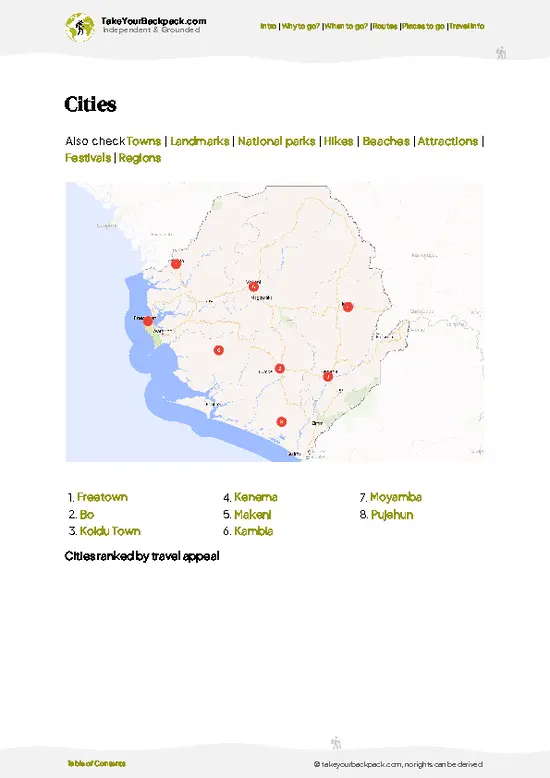
Sierra Leone🇸🇱 | best citiesWhere to Find the 8 Best cities in Sierra Leone

Cities in Sierra Leone are compact, loud and hot, and they run on motorbike taxis, charcoal smoke and the smell of frying plantain and salt fish. The capital on the Atlantic peninsula is crowded, humid and the priciest corner of the country. Upcountry provincial hubs are slower, cheaper and dusty in the dry season, with red laterite roads and market days that set the rhythm. Coastal towns trade traffic for sea breeze and generator hum. For backpackers and independent travelers, the choice is between easy access with paved roads and ATMs, or rawer, cheaper places where you wait for a shared car to fill and pay in cash.

By Johan Kruseman 🇳🇱 | Updated October 23, 2026
Explore the best towns in Sierra Leone

Why go?Key Factors That Shape the Experience

Sierra Leone suits city travel because its towns are small, walkable in pockets and shaped by the country’s past. Founded as a settlement for freed slaves, with a Creole heritage that still shows in wooden houses, church bells and Krio chatter, the country has a layered identity. Krio works as a common language across more than a dozen ethnic groups, so you can talk with almost anyone. English is the official language, and people are quick to greet you and slow to hurry you.

It is less suited to anyone wanting polished urban infrastructure. The civil war of the 1990s and the Ebola outbreak of 2014 to 2016 left gaps in roads, power and tourism services, and you will see both the scars and the recovery. Electricity is patchy, and generators drone through evenings. Cash rules outside the capital, … read more 👉
Sierra Leone suits city travel because its towns are small, walkable in pockets and shaped by the country’s past. Founded as a settlement for freed slaves, with a Creole heritage that still shows in wooden houses, church bells and Krio chatter, the country has a layered identity. Krio works as a common language across more than a dozen ethnic groups, so you can talk with almost anyone. English is the official language, and people are quick to greet you and slow to hurry you.

It is less suited to anyone wanting polished urban infrastructure. The civil war of the 1990s and the Ebola outbreak of 2014 to 2016 left gaps in roads, power and tourism services, and you will see both the scars and the recovery. Electricity is patchy, and generators drone through evenings. Cash rules outside the capital, and the Leone is the currency you will be paying in. Roads turn to red mud in the rains, which can double travel times. Expect heat and humidity year round, with sticky nights and little air conditioning. Come for people, markets, beaches at the edge of town and straightforward conversation. Come prepared for slow transport and limited choice.
Why These Made the Cut
The list of best cities in Sierra Leone is created based on culture, vibe, attractions, transport ease, and local charm. If you feel a city is missing in this list, please let us know.

When to go?Best Time to Visit Sierra Leone for cities

Best months: The best months for cities in Sierra Leone are December to March, when the dry season brings clear skies, little rain and passable roads. Days reach about 30 to 34°C, nights sit near 23 to 25°C, and the Harmattan wind can leave a fine dust haze, especially upcountry from December to February. Light turns orange and hazy at dusk, and laundry dries in an hour.
Shoulder months: November and April to May are workable. Early rains arrive as afternoon downpours that hammer tin roofs and flood gutters, but mornings are often clear and humidity is at its heaviest. Prices for rooms stay fairly steady through these months.
Rainy season: From June to October the coast gets some of the heaviest rainfall in West Africa, with the peak in July and August bringing several thousand millimeters a … read more 👉
Best months: The best months for cities in Sierra Leone are December to March, when the dry season brings clear skies, little rain and passable roads. Days reach about 30 to 34°C, nights sit near 23 to 25°C, and the Harmattan wind can leave a fine dust haze, especially upcountry from December to February. Light turns orange and hazy at dusk, and laundry dries in an hour.
Shoulder months: November and April to May are workable. Early rains arrive as afternoon downpours that hammer tin roofs and flood gutters, but mornings are often clear and humidity is at its heaviest. Prices for rooms stay fairly steady through these months.
Rainy season: From June to October the coast gets some of the heaviest rainfall in West Africa, with the peak in July and August bringing several thousand millimeters a year in total. Unpaved roads to provincial hubs become slick, shared cars slow down, and delays are common. Skies are gray, the air smells of wet earth and woodsmoke, and mosquitoes multiply. You will find fewer visitors and some discounts on rooms, but beaches and day trips are often rained out. The northern interior is usually a little drier than the southern coast. December and the Christmas period fill coastal rooms and raise prices, so book ahead then.

city hoppingOptimizing Your Multi-Stop Itinerary

How many days: A trip linking several cities in Sierra Leone needs 7 to 14 days, because travel eats more time than sightseeing. The country is small, but road conditions and waiting for shared vehicles to fill make distances feel longer than they look.
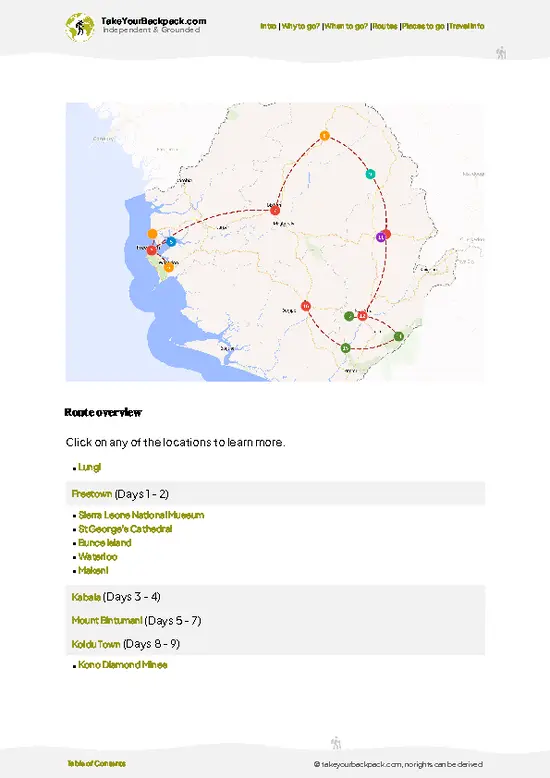
Regions and direction: Three clusters work together: the western peninsula around Freetown, the southern and eastern interior reached along the main highway through Waterloo and Masiaka, and the north toward Makeni. Start in the capital, where the airport transfer, ATMs and SIM cards are easiest to sort out, then work outward and loop back, so you finish near your flight. Going clockwise or counterclockwise matters less than keeping the return leg short.
Pacing: Allow 2 to 3 nights per stop. Freetown to Bo is roughly 4 to 6 hours by shared car … read more 👉
How many days: A trip linking several cities in Sierra Leone needs 7 to 14 days, because travel eats more time than sightseeing. The country is small, but road conditions and waiting for shared vehicles to fill make distances feel longer than they look.
Regions and direction: Three clusters work together: the western peninsula around Freetown, the southern and eastern interior reached along the main highway through Waterloo and Masiaka, and the north toward Makeni. Start in the capital, where the airport transfer, ATMs and SIM cards are easiest to sort out, then work outward and loop back, so you finish near your flight. Going clockwise or counterclockwise matters less than keeping the return leg short.
Pacing: Allow 2 to 3 nights per stop. Freetown to Bo is roughly 4 to 6 hours by shared car or minibus, to Makeni around 3 to 5 hours, and to Kenema 6 to 8 hours or more in the rains. Vehicles leave when full, so mornings are the safest time to depart. The dust, heat and bounce of a packed car are part of the ride.
Common mistakes: Travelers cram in too many stops, plan late afternoon arrivals and forget that darkness falls around 6:30 pm. Instead, leave early, build in a spare day for breakdowns, and carry enough Leones in small notes for fares.

The ListThe Best cities of Sierra Leone

1 Freetown

Peninsula beaches, Cotton Tree site, Bunce Island boats, chimp sanctuary

Ride shared taxis between Atlantic beach bars, hillside viewpoints, a modest national museum and boat trips upriver to the slave fort ruins.

2 Bo

Bo School grounds, tailor lanes, Bo Rangers match days, red-dust market

Visit a working southern town where a colonial-era school, tailors cutting cloth to measure and loud football matches fill a single easy day.

3 Koidu Town

Kimberlite pit, hand-dug diamond sites, Sefadu lanes, night grills

See a mining region up close, from the open pit seen from public roads to crews sifting gravel by hand with a local guide.

4 Kenema

Diamond dealers, Eastern Province market, clock tower junction, palm wine bars

Walk streets where small buying offices weigh stones, then end the day over grilled meat and cold drinks at open-air side-street bars.

5 Makeni

Wusum Hill, northern crossroads, cathedral grounds, pedal-machine tailors

Climb a rocky hill for a view over the plain, then browse market lanes, shady mission grounds and tailors working cloth by pedal.

6 Kambia

Scarcies River landing, Guinea border road, money changers, edge-of-town rice fields

Watch canoes load at the river, then follow the border road past money changers and tea stalls to quiet swamp fields at dawn.

7 Moyamba

Highway junction stalls, chief’s court barri, cotton tree square, village footpaths

Sample snacks at the junction, sit near the chief’s meeting house and follow footpaths past rice swamps and palm groves to nearby villages.

8 Pujehun

Waanje River landing, court barray, swamp farm paths, far-south market

Start in the market lanes, then settle by the river landing or walk swamp paths where oil palms and small cocoa plots line the way.

Loading the map 🌍

Expert viewWhat You Should Know

How many cities to visit: I would advise two to four cities in a single trip. Roads are slow, vehicles leave only when full, and a short hop can eat half a day in dust and diesel fumes. Fewer stops means you actually sit in a market stall with a bowl of cassava leaf and rice instead of staring through a windscreen.
Choosing the kind of city: Pick the coastal capital if you want ATMs, restaurants, nightlife, craft stalls and beach access, and you can tolerate traffic jams, generator noise and higher prices. Pick upcountry hubs if you want a slower pace, cheaper rooms, market days and conversations with people who rarely see visitors. Budget travelers and the curious do best upcountry. Short-stay travelers with limited time are better in and around the capital. The payoff for going inland is … read more 👉
How many cities to visit: I would advise two to four cities in a single trip. Roads are slow, vehicles leave only when full, and a short hop can eat half a day in dust and diesel fumes. Fewer stops means you actually sit in a market stall with a bowl of cassava leaf and rice instead of staring through a windscreen.
Choosing the kind of city: Pick the coastal capital if you want ATMs, restaurants, nightlife, craft stalls and beach access, and you can tolerate traffic jams, generator noise and higher prices. Pick upcountry hubs if you want a slower pace, cheaper rooms, market days and conversations with people who rarely see visitors. Budget travelers and the curious do best upcountry. Short-stay travelers with limited time are better in and around the capital. The payoff for going inland is a quieter, more local trip with red-dirt streets and the smell of palm oil and woodsmoke.
What it costs: Plan on US$30 to 55 a day on a backpacker budget. Guesthouse rooms run roughly US$15 to 40 a night in provincial towns and US$40 to 100 in the capital. Street meals of rice with sauce cost about US$2 to 4, and a motorbike taxi ride across town is usually under US$1 to 2. Shared cars between cities cost around US$6 to 15 per seat depending on distance. Museum or site entry fees are typically small, US$2 to 10, and a local guide for a day is about US$15 to 30. Expect a visit to a city to cost about US$40 to 70 including a night, meals and local transport. Bring clean US dollars and exchange them for Leones, because cards are rarely accepted outside the capital.
Safety and culture: Cities are generally friendly, but petty theft happens in crowded markets and at transport stations, so keep phones and cash out of sight. Avoid walking after dark, especially on poorly lit streets, and use a taxi at night. Greet people before asking anything, as a handshake and a “how di body” go a long way. Ask before photographing people, markets and officials. Dress modestly, particularly in Muslim-majority areas and during Friday prayers. Carry your yellow fever certificate, take malaria prophylaxis and drink only bottled or treated water. Carry small notes, since breaking large ones can be a hassle.

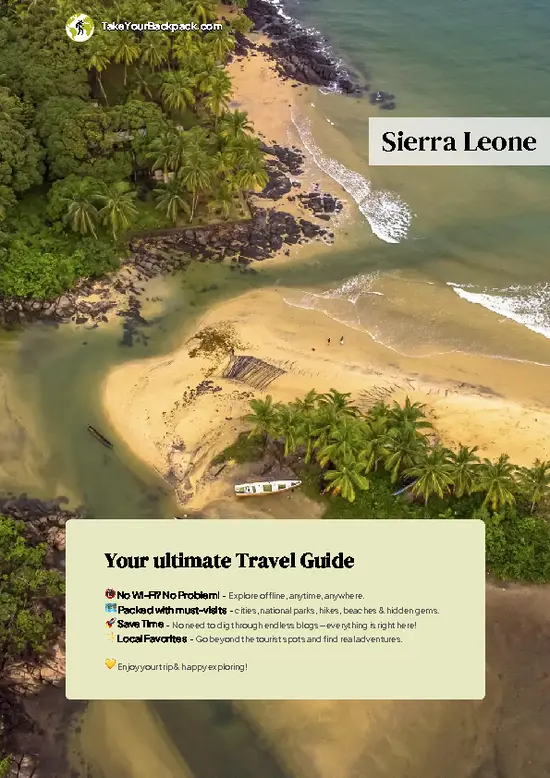
✈️ The backpacker research shortcutSierra Leone Travel Guide

An offline-friendly backpacking guide with optimized travel routes, ranked highlights, transport advice, and the best areas to stay.
example page 0 from our offline Travel Guide for Sierra Leone
example page 1 from our offline Travel Guide for Sierra Leone
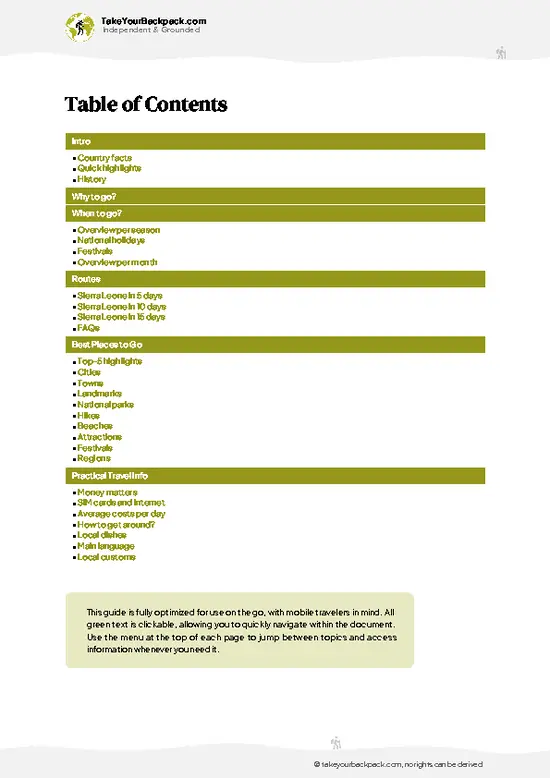
example page 2 from our offline Travel Guide for Sierra Leone
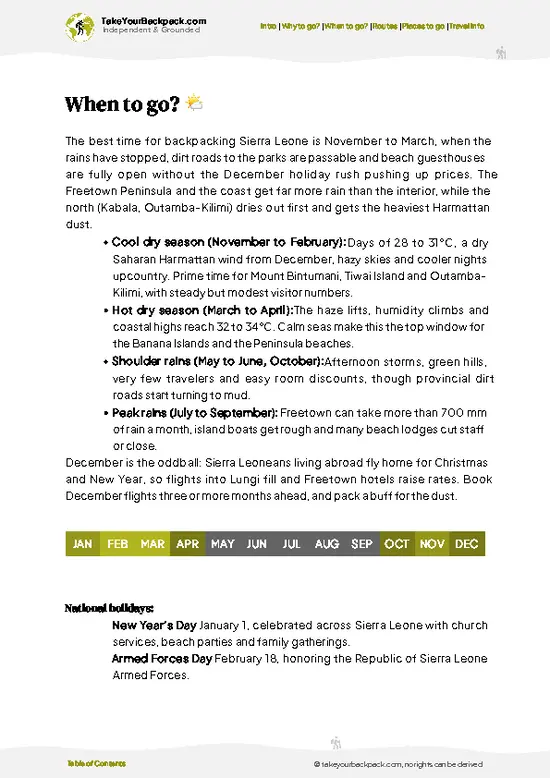
example page 3 from our offline Travel Guide for Sierra Leone
example page 4 from our offline Travel Guide for Sierra Leone
example page 5 from our offline Travel Guide for Sierra Leone
example page 6 from our offline Travel Guide for Sierra Leone
example page 7 from our offline Travel Guide for Sierra Leone
The digital guide (242 pages) contains:
✅ 50 highlights, ranked by travel appeal
✅ Optimized 5, 10 & 15-day travel routes
✅ Cities, national parks, landmarks, beaches
✅ How to get around
✅ Offline-friendly for travel without Wi-Fi
👉 Click to see all 30+ guide features

📅 Plan smarter in minutes, not weeks
✅ Month by month travel advice
✅ Festivals & national holidays
✅ Budget expectations

🗺️ Go to the right places, skip the overrated ones
✅ Honest pros & cons of destinations
✅ Top hikes, parks & viewpoints
✅ Lesser-known places most travelers miss
✅ Clear “worth it vs skip it” guidance

🛏️ Travel smoothly without rookie mistakes
✅ Best areas to stay
✅ Transport systems explained simply
✅ Common scams & safety advice
✅ SIM cards, money & practical tips

🌍 Understand the country, not just visit it
✅ Culture & traditions
✅ 52 Essential phrases & customs
✅ Festivals worth planning around
✅ Traveler-friendly historical context
✅ Insights that make places more meaningful

📱 Built for real travel conditions
✅ Fully downloadable PDF
✅ Works completely offline
✅ Optimized for phone use
✅ Useful in remote areas & buses
✅ Everything in one place
Stop searching, start planning
Get instant access to your full guide. 30‑day money-back guarantee.
+ Add another guide for just

By proceeding you agree to our terms.
Sent to your inbox immediately after payment • 100% Secure Checkout
Best Backpacking Travel Advisor 2025 tourism awardBest Backpacking
Travel Advisor
2025
What others say about Take Your Backpack Guides:
⭐⭐⭐⭐⭐
Fantastic, amazing amount of information!
⭐⭐⭐⭐⭐
My goodness this is amazing, it's what I've been looking for hats off too you!
⭐⭐⭐⭐⭐
I think this is absolutely BRILLIANT
⭐⭐⭐⭐
Very complete and informative. It's still missing places, but I gotta to commend you
⭐⭐⭐⭐⭐
This is truly amazing, thank you, can't wait to explore it with my kids!
⭐⭐⭐⭐⭐
Awesome resource, thank you!
⭐⭐⭐⭐⭐
This is amazing! Can't wait to explore the ones I haven't seen
⭐⭐⭐⭐
I love this! Well done, great idea.
⭐⭐⭐⭐⭐
Thanks for taking the time to make this gem!
⭐⭐⭐⭐⭐
This might be the best website I've ever seen.
⭐⭐⭐⭐⭐
Congratulations, and thank you so much for your work; it's incredibly valuable.
⭐⭐⭐⭐
In all seriousness I think you did a great job pointing out the important spots
⭐⭐⭐⭐⭐
10/10 very good
⭐⭐⭐⭐⭐
As someone who's only just starting to visit regularly this is awesome, thank you.
⭐⭐⭐⭐
Thank you very much! I'm going to visit my dad, it's going to be very useful!
⭐⭐⭐⭐⭐
This is really cool! We'll be travelling for the first time and this definitely come in handy.
⭐⭐⭐⭐⭐
You are now our minister of culture, congratulations 👨‍💼
⭐⭐⭐⭐⭐
Just wanted to tell you that this is a pearl! Going to follow your recommendations.
⭐⭐⭐⭐⭐
This is so cool. I'll definitely be using the resource for my travels soon.
⭐⭐⭐⭐⭐
This is very impressive! Good work.
⭐⭐⭐⭐⭐
This is an amazing and informative site. Very well done!

🛏️ Where to stay?Best Places to Stay in Sierra Leone

Backpacking Sierra Leone means budget guesthouses and simple beach huts rather than true hostels, with basic double rooms in Freetown typically running SLE 450 to 900 (about US$20 to 40) a night and dorm beds rare. Aberdeen and Lumley on the western side of the city have the most choice, with the beach, bars and nightlife on your doorstep and a calmer, safer feel, while the cheaper rooms around the city center sit near the markets and the Cotton Tree but come with traffic noise and streets that get sketchy after dark. For quiet, head down the peninsula to River Number Two, Tokeh or Bureh Beach, where beach huts and camping put you right on the sand but far from shops, ATMs and anything open … read more 👉
Backpacking Sierra Leone means budget guesthouses and simple beach huts rather than true hostels, with basic double rooms in Freetown typically running SLE 450 to 900 (about US$20 to 40) a night and dorm beds rare. Aberdeen and Lumley on the western side of the city have the most choice, with the beach, bars and nightlife on your doorstep and a calmer, safer feel, while the cheaper rooms around the city center sit near the markets and the Cotton Tree but come with traffic noise and streets that get sketchy after dark. For quiet, head down the peninsula to River Number Two, Tokeh or Bureh Beach, where beach huts and camping put you right on the sand but far from shops, ATMs and anything open late.

If you enjoy meeting fellow travelers, consider choosing hostels with high ratings for atmosphere. On the other hand, if you prefer having your own space, a hotel might be a better option.

Sierra LeoneExplore Sierra Leone

👋 Meet the founderWho’s Behind Take Your Backpack?

Johan, backpacker and founder of TakeYourBackpackHi, I’m Johan (Netherlands 🇳🇱), the creator of TakeYourBackpack. Over the past 3 decades, I’ve backpacked through 90+ countries across six continents, gaining extensive experience with independent travel, long-term trips, and overland routes.

This site is built on a combination of firsthand travel experience and carefully curated insights from other backpackers. Many guides are based on places I’ve personally visited, while others bring together tips, observations, and practical advice shared by trusted travelers I’ve met along the way.

The goal is to provide realistic, experience-driven guidance — not generic itineraries — so you can explore destinations with better context, clearer expectations, and more confidence.