×

Sierra Leone🇸🇱 | best attractionsWhere to Find the 6 Best attractions in Sierra Leone

Attractions in Sierra Leone are mostly outdoors and unpolished: no ticket turnstiles, no tour-bus lots, just a path, a boatman and a local guide. The Freetown Peninsula is the easy end, with white-sand beaches, humid forest and a short taxi ride from the capital. Head east and south and the red laterite roads, the diesel smell of shared vehicles and the river crossings slow everything down. Costs stay low, crowds are close to zero, and comfort is thin. Independent backpackers do best here, because nothing is packaged, and every wildlife reserve, island and hilltop asks for a little patience and cash in small notes.

By Johan Kruseman 🇳🇱 | Updated October 23, 2026
Explore the best festivals in Sierra Leone

Why go?Key Factors That Shape the Experience

Sierra Leone suits travelers who like their attractions raw and uncrowded. Tourism here is young. Ten years of civil war ended in 2002, and visitor numbers are still tiny, so you often share a beach, a rainforest trail or a river with nobody but the people who live beside it. That is the draw. Much of the appeal comes from geography: Atlantic coastline, mangrove estuaries, lowland rainforest, and highland ridges in the north and east, all within a country about the size of South Carolina. Heat and humidity cling to everything, and the air smells of woodsmoke, salt fish and wet earth.

The history adds weight. The colonial past as a settlement for freed slaves, and the more recent war, shape what people want to talk about and what they want visitors to understand.

Before choosing it, accept … read more 👉
Sierra Leone suits travelers who like their attractions raw and uncrowded. Tourism here is young. Ten years of civil war ended in 2002, and visitor numbers are still tiny, so you often share a beach, a rainforest trail or a river with nobody but the people who live beside it. That is the draw. Much of the appeal comes from geography: Atlantic coastline, mangrove estuaries, lowland rainforest, and highland ridges in the north and east, all within a country about the size of South Carolina. Heat and humidity cling to everything, and the air smells of woodsmoke, salt fish and wet earth.

The history adds weight. The colonial past as a settlement for freed slaves, and the more recent war, shape what people want to talk about and what they want visitors to understand.

Before choosing it, accept the infrastructure reality. Roads outside the main highways are rough and turn to mud in the rains. Few sites have signs, set fees or opening hours, and most visits need a local guide or a community contact. Cash is king, ATMs are limited outside Freetown, and plans shift. Travelers who treat delays as part of the trip get far more out of it.
How the List Was Created
The list of best attractions in Sierra Leone is created based on cultural significance or entertainment value. If you feel a attraction is missing in this list, please let us know.

When to go?Best Time to Visit Sierra Leone for attractions

Best months and dry season: The best months for attractions in Sierra Leone are December to March, when the dry season keeps roads passable, skies mostly clear and river and forest trails firm underfoot. Daytime highs sit around 30 to 34°C, and December and January bring the Harmattan, a dusty north-easterly wind that leaves a pale haze over the horizon and cools the nights slightly, though it can dull long views. Rain is close to nil in these months.
Shoulder seasons: November and April to early May are workable. Early rains arrive as heavy afternoon downpours, the air turns thick and sticky, and humidity makes hiking tiring, but the forests are green and fewer people are traveling. Boat crossings are usually still fine.
Rainy season: From June to September rainfall peaks. The coast around … read more 👉
Best months and dry season: The best months for attractions in Sierra Leone are December to March, when the dry season keeps roads passable, skies mostly clear and river and forest trails firm underfoot. Daytime highs sit around 30 to 34°C, and December and January bring the Harmattan, a dusty north-easterly wind that leaves a pale haze over the horizon and cools the nights slightly, though it can dull long views. Rain is close to nil in these months.
Shoulder seasons: November and April to early May are workable. Early rains arrive as heavy afternoon downpours, the air turns thick and sticky, and humidity makes hiking tiring, but the forests are green and fewer people are traveling. Boat crossings are usually still fine.
Rainy season: From June to September rainfall peaks. The coast around Freetown can receive over 3,000 mm in a year, with much of it falling in July and August, when dirt roads in the south and east can become slow or impassable and boats may not run in rough seas. Guesthouses are quieter and sometimes negotiable, but travel takes much longer. The Christmas and New Year period brings returning diaspora, so transport and beach rooms fill up and prices on the peninsula rise noticeably.

attraction hoppingOptimizing Your Multi-Stop Itinerary

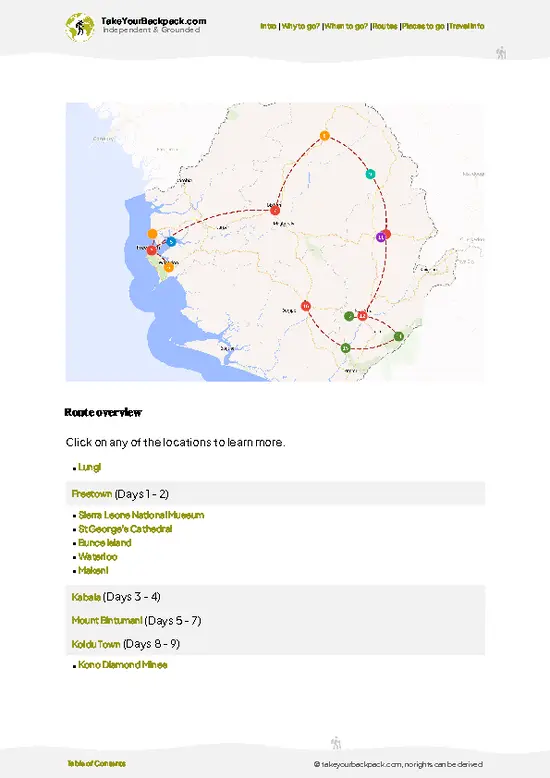
How many days to plan: A trip combining several attractions in Sierra Leone needs 10 to 14 days to avoid constant rushing, since the country is small but the roads are slow. Freetown is the natural arrival and departure hub, and the sensible direction is a loop: peninsula first, then inland and south, then back toward the capital.
Regions and time: The peninsula and nearby coast group easily together and need 2 to 4 days. Bo and Kenema in the south-east, and the eastern forests, work as a second cluster needing 3 to 5 days. The north, around Makeni and the highlands, is a separate leg of 3 to 4 days. Freetown to Bo takes roughly 4 to 6 hours by shared car or minibus on the main highway, while onward stretches on unpaved tracks can easily double in the wet months. Expect departures to leave … read more 👉
How many days to plan: A trip combining several attractions in Sierra Leone needs 10 to 14 days to avoid constant rushing, since the country is small but the roads are slow. Freetown is the natural arrival and departure hub, and the sensible direction is a loop: peninsula first, then inland and south, then back toward the capital.
Regions and time: The peninsula and nearby coast group easily together and need 2 to 4 days. Bo and Kenema in the south-east, and the eastern forests, work as a second cluster needing 3 to 5 days. The north, around Makeni and the highlands, is a separate leg of 3 to 4 days. Freetown to Bo takes roughly 4 to 6 hours by shared car or minibus on the main highway, while onward stretches on unpaved tracks can easily double in the wet months. Expect departures to leave only when the vehicle is full, usually in the morning, and the cabin to smell of fuel, sweat and fried plantain.
Planning mistakes: The most common error is cramming a stop into every day. Allow a buffer day after any long transfer. Another is arriving at dusk, when roads are poorly lit and checkpoints slow things down. Leave early, book rides the day before, and keep small bills for fares. Travelers also forget that boat and park access often needs arrangement ahead, so contact guides before committing to a tight sequence.

The ListThe Best attractions of Sierra Leone

1 National Railway Museum

Narrow-gauge locomotives, rusting track, wooden carriages, Cline Town yard

Climb around sun-bleached steam and diesel engines, step inside old passenger coaches and hear from caretakers which routes each machine once worked.

2 Big Market

Secondhand clothing piles, wax-print fabric, tailors’ lanes, smoked fish

Sift through heaps of imported clothes, pick a length of bright cloth for a tailor to sew, and snack on fried plantain between stalls.

3 Sierra Leone National Museum

Bunce Island displays, Sande masks, nomoli figures, country cloth

Trace the slave-trade story through models and maps, then study carved stone figures, ceremonial drums and strip-woven cloth before heading upcountry.

4 Old Fourah Bay College

Victorian stone facade, old lecture halls, harbor outlook, Cline Town hillside

Walk the high-ceilinged rooms where West Africa’s first students studied, then look over Cline Town rooftops toward the harbor cranes.

sierra-leone-attraction-old-fourah-bay-college
© Google |

5 St George’s Cathedral

Anglican cathedral, Gloucester Street, memorial tablets, Sunday choirs

Slip into the cool nave to read the settler-era plaques, or time a Sunday visit to hear choirs fill the open doors.

6 Peace and Cultural Monument

Open-air monument, Tower Hill streets, colonial facades, reconciliation theme

Circle the monument on foot, then follow the downtown streets past peeling colonial fronts toward the Cotton Tree and nearby Tower Hill.

Loading the map 🌍

Expert viewWhat You Should Know

How many to visit: I advise five to seven attractions across a two-week trip. Roads eat hours, and a single outing often takes a full day once you count the vehicle that leaves when it fills, the checkpoint stops and the walk in through damp, loud forest or hot sand. Packing in more means seeing everything through a car window. Fewer than five leaves you with little to compare, and the contrast between coast, rainforest and river life is what makes the country rewarding.
Which kinds to prioritize: Beach and island lovers should lean toward coastal and peninsula sites, which are the easiest and most comfortable, with cold drinks and grilled fish at the end. Wildlife and trekking travelers should put weight on forest and reserve visits, accepting basic lodging, early starts and the chorus of … read more 👉
How many to visit: I advise five to seven attractions across a two-week trip. Roads eat hours, and a single outing often takes a full day once you count the vehicle that leaves when it fills, the checkpoint stops and the walk in through damp, loud forest or hot sand. Packing in more means seeing everything through a car window. Fewer than five leaves you with little to compare, and the contrast between coast, rainforest and river life is what makes the country rewarding.
Which kinds to prioritize: Beach and island lovers should lean toward coastal and peninsula sites, which are the easiest and most comfortable, with cold drinks and grilled fish at the end. Wildlife and trekking travelers should put weight on forest and reserve visits, accepting basic lodging, early starts and the chorus of insects and birds that fills the canopy at dawn. Anyone drawn to history and culture should add heritage and community stops, where conversation with a local guide is the main event and the payoff is understanding rather than a view.
What it costs: Budget US$30 to 55 a day for a backpacker mixing guesthouses, shared transport and local meals, rising to US$70 to 100 with private cars and better rooms. Per visit, expect entry or community fees of roughly US$3 to 15, guides at US$10 to 25 a day, and boat hire from US$15 to 60 depending on distance. Prices are quoted in dollars or Sierra Leonean leones, and paying in clean, recent US notes often helps. Carry small denominations, since change is scarce.
Safety and etiquette: Swim only where locals do, as Atlantic currents and rip tides are strong. Take malaria prophylaxis, and wear closed shoes in forest and swamp. Avoid walking alone after dark in towns, and hire a registered guide for remote trails. Ask before photographing people, markets or officials, and never photograph military or police posts. Dress modestly away from the beach, especially in Muslim communities in the north, and greet people before asking for anything. A handshake and a few words of Krio go a long way. In the end, a respectful approach opens doors that money alone does not.

✈️ The backpacker research shortcutSierra Leone Travel Guide

An offline-friendly backpacking guide with optimized travel routes, ranked highlights, transport advice, and the best areas to stay.
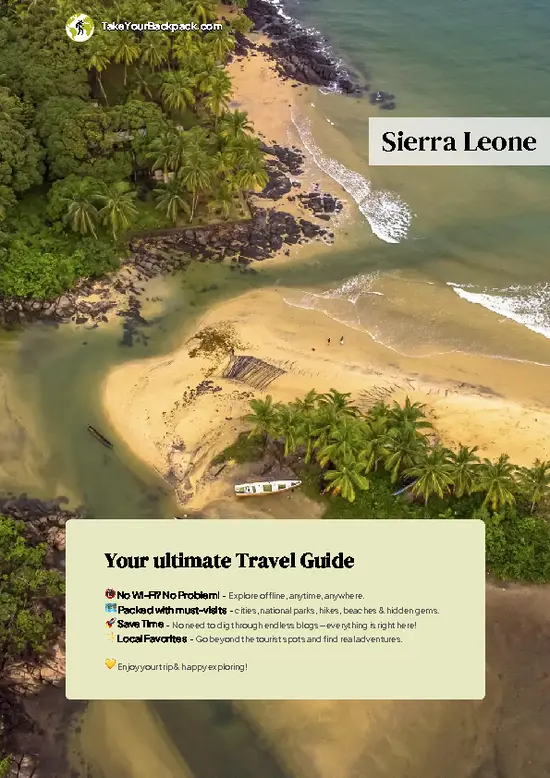
example page 0 from our offline Travel Guide for Sierra Leone
example page 1 from our offline Travel Guide for Sierra Leone
example page 2 from our offline Travel Guide for Sierra Leone
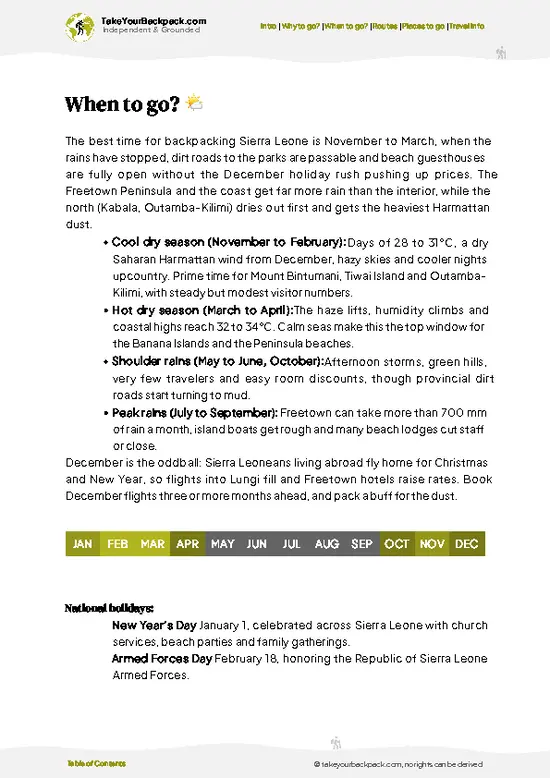
example page 3 from our offline Travel Guide for Sierra Leone
example page 4 from our offline Travel Guide for Sierra Leone
example page 5 from our offline Travel Guide for Sierra Leone
example page 6 from our offline Travel Guide for Sierra Leone
example page 7 from our offline Travel Guide for Sierra Leone
The digital guide (242 pages) contains:
✅ 50 highlights, ranked by travel appeal
✅ Optimized 5, 10 & 15-day travel routes
✅ Cities, national parks, landmarks, beaches
✅ How to get around
✅ Offline-friendly for travel without Wi-Fi
👉 Click to see all 30+ guide features

📅 Plan smarter in minutes, not weeks
✅ Month by month travel advice
✅ Festivals & national holidays
✅ Budget expectations

🗺️ Go to the right places, skip the overrated ones
✅ Honest pros & cons of destinations
✅ Top hikes, parks & viewpoints
✅ Lesser-known places most travelers miss
✅ Clear “worth it vs skip it” guidance

🛏️ Travel smoothly without rookie mistakes
✅ Best areas to stay
✅ Transport systems explained simply
✅ Common scams & safety advice
✅ SIM cards, money & practical tips

🌍 Understand the country, not just visit it
✅ Culture & traditions
✅ 52 Essential phrases & customs
✅ Festivals worth planning around
✅ Traveler-friendly historical context
✅ Insights that make places more meaningful

📱 Built for real travel conditions
✅ Fully downloadable PDF
✅ Works completely offline
✅ Optimized for phone use
✅ Useful in remote areas & buses
✅ Everything in one place
Stop searching, start planning
Get instant access to your full guide. 30‑day money-back guarantee.
+ Add another guide for just

By proceeding you agree to our terms.
Sent to your inbox immediately after payment • 100% Secure Checkout
Best Backpacking Travel Advisor 2025 tourism awardBest Backpacking
Travel Advisor
2025
What others say about Take Your Backpack Guides:
⭐⭐⭐⭐⭐
Fantastic, amazing amount of information!
⭐⭐⭐⭐⭐
My goodness this is amazing, it's what I've been looking for hats off too you!
⭐⭐⭐⭐⭐
I think this is absolutely BRILLIANT
⭐⭐⭐⭐
Very complete and informative. It's still missing places, but I gotta to commend you
⭐⭐⭐⭐⭐
This is truly amazing, thank you, can't wait to explore it with my kids!
⭐⭐⭐⭐⭐
Awesome resource, thank you!
⭐⭐⭐⭐⭐
This is amazing! Can't wait to explore the ones I haven't seen
⭐⭐⭐⭐
I love this! Well done, great idea.
⭐⭐⭐⭐⭐
Thanks for taking the time to make this gem!
⭐⭐⭐⭐⭐
This might be the best website I've ever seen.
⭐⭐⭐⭐⭐
Congratulations, and thank you so much for your work; it's incredibly valuable.
⭐⭐⭐⭐
In all seriousness I think you did a great job pointing out the important spots
⭐⭐⭐⭐⭐
10/10 very good
⭐⭐⭐⭐⭐
As someone who's only just starting to visit regularly this is awesome, thank you.
⭐⭐⭐⭐
Thank you very much! I'm going to visit my dad, it's going to be very useful!
⭐⭐⭐⭐⭐
This is really cool! We'll be travelling for the first time and this definitely come in handy.
⭐⭐⭐⭐⭐
You are now our minister of culture, congratulations 👨‍💼
⭐⭐⭐⭐⭐
Just wanted to tell you that this is a pearl! Going to follow your recommendations.
⭐⭐⭐⭐⭐
This is so cool. I'll definitely be using the resource for my travels soon.
⭐⭐⭐⭐⭐
This is very impressive! Good work.
⭐⭐⭐⭐⭐
This is an amazing and informative site. Very well done!

🛏️ Where to stay?Where to Base Yourself

Backpacking Sierra Leone means budget guesthouses and simple beach huts rather than true hostels, with basic double rooms in Freetown typically running SLE 450 to 900 (about US$20 to 40) a night and dorm beds rare. Aberdeen and Lumley on the western side of the city have the most choice, with the beach, bars and nightlife on your doorstep and a calmer, safer feel, while the cheaper rooms around the city center sit near the markets and the Cotton Tree but come with traffic noise and streets that get sketchy after dark. For quiet, head down the peninsula to River Number Two, Tokeh or Bureh Beach, where beach huts and camping put you right on the sand but far from shops, ATMs and anything open … read more 👉
Backpacking Sierra Leone means budget guesthouses and simple beach huts rather than true hostels, with basic double rooms in Freetown typically running SLE 450 to 900 (about US$20 to 40) a night and dorm beds rare. Aberdeen and Lumley on the western side of the city have the most choice, with the beach, bars and nightlife on your doorstep and a calmer, safer feel, while the cheaper rooms around the city center sit near the markets and the Cotton Tree but come with traffic noise and streets that get sketchy after dark. For quiet, head down the peninsula to River Number Two, Tokeh or Bureh Beach, where beach huts and camping put you right on the sand but far from shops, ATMs and anything open late.

If you enjoy meeting fellow travelers, consider choosing hostels with high ratings for atmosphere. On the other hand, if you prefer having your own space, a hotel might be a better option.

Sierra LeoneExpand Your Journey

👋 Meet the founderWho’s Behind Take Your Backpack?

Johan, backpacker and founder of TakeYourBackpackHi, I’m Johan (Netherlands 🇳🇱), the creator of TakeYourBackpack. Over the past 3 decades, I’ve backpacked through 90+ countries across six continents, gaining extensive experience with independent travel, long-term trips, and overland routes.

This site is built on a combination of firsthand travel experience and carefully curated insights from other backpackers. Many guides are based on places I’ve personally visited, while others bring together tips, observations, and practical advice shared by trusted travelers I’ve met along the way.

The goal is to provide realistic, experience-driven guidance — not generic itineraries — so you can explore destinations with better context, clearer expectations, and more confidence.