×

Singapore🇸🇬 | best townsExplore the 12 Best towns in Singapore

Singapore has no scattered country towns, so its “towns” are districts and planning-area centers within one city-state roughly 50 km wide, and that shapes everything. Three types exist: historic ethnic quarters in the central core, heartland new towns built by the public housing board, and fringe or island settlements reached by bus or boat. The core is dense, walkable and busiest, with the highest prices. Heartland towns are cheaper and calmer, and sit on the MRT. Fringe spots cost little but need extra transfers. For backpackers, the MRT puts every type within an hour, so choose by atmosphere and crowds rather than distance.

By Johan Kruseman 🇳🇱 | Updated October 19, 2026
Explore the best national parks in Singapore

Why go?Why These town Stand Out

Singapore suits towns in an unusual way: planning, not slow growth, created them. Since independence in 1965 the government has moved most residents into self-contained housing estates, each with its own MRT station, hawker center, market, library and polyclinic. That is why the island feels like a chain of neighborhoods rather than one blur of city, and why daily life in each is easy to observe on foot.

The older core has a different origin. The colonial-era plan of 1822 assigned separate zones to Chinese, Malay, Indian and Arab communities, and their shophouses, temples and mosques survive because of conservation rules from the 1980s onward. You get four cultures in a few square kilometers, but expect polished restoration rather than weathered authenticity.

Before choosing Singapore for … read more 👉
Singapore suits towns in an unusual way: planning, not slow growth, created them. Since independence in 1965 the government has moved most residents into self-contained housing estates, each with its own MRT station, hawker center, market, library and polyclinic. That is why the island feels like a chain of neighborhoods rather than one blur of city, and why daily life in each is easy to observe on foot.

The older core has a different origin. The colonial-era plan of 1822 assigned separate zones to Chinese, Malay, Indian and Arab communities, and their shophouses, temples and mosques survive because of conservation rules from the 1980s onward. You get four cultures in a few square kilometers, but expect polished restoration rather than weathered authenticity.

Before choosing Singapore for its towns, know three things. First, distances are tiny but heat is not: temperatures sit around 25 to 32°C with humidity often above 80 percent, so walking is slower than the map suggests. Second, costs are high by Southeast Asian standards, mainly for beds and alcohol, while hawker food stays cheap. Third, rules are strictly enforced, and the order that makes everything run smoothly also means less spontaneity than in neighboring countries. Come for clean, efficient, layered neighborhoods, not for rough edges.
Why These Made the Cut
The list of best towns in Singapore is created based on charm, local culture, atmosphere, hidden gems, and visitor appeal. If you feel a town is missing in this list, please let us know.

When to go?When to Plan Your Trip

Best months: February to April is the best window, because these are the driest months of the year, with February typically getting around 100 to 150 mm of rain against 250 mm or more in December. Daytime highs stay near 31 to 33°C, humidity is slightly lower, and long walks between neighborhoods are far more comfortable.

Weather by season: Singapore has no true winter or summer, so seasons are defined by monsoons. The Northeast Monsoon from November to January brings the heaviest rain, often long afternoon downpours that can stall outdoor walking for an hour or two. The Southwest Monsoon from June to September is drier but occasionally brings early-morning squalls. From August to October, smoke from fires in Indonesia can produce haze that makes outdoor days less pleasant. A pocket umbrella … read more 👉
Best months: February to April is the best window, because these are the driest months of the year, with February typically getting around 100 to 150 mm of rain against 250 mm or more in December. Daytime highs stay near 31 to 33°C, humidity is slightly lower, and long walks between neighborhoods are far more comfortable.

Weather by season: Singapore has no true winter or summer, so seasons are defined by monsoons. The Northeast Monsoon from November to January brings the heaviest rain, often long afternoon downpours that can stall outdoor walking for an hour or two. The Southwest Monsoon from June to September is drier but occasionally brings early-morning squalls. From August to October, smoke from fires in Indonesia can produce haze that makes outdoor days less pleasant. A pocket umbrella works year-round, since showers arrive in any month.

Peak periods and prices: Prices rise sharply when the Formula 1 night race takes place, usually in September or October, and around December school holidays. Dorm beds that cost S$30 to 50 (US$22 to 37) can climb by 30 to 50 percent. Chinese New Year in January or February closes many family-run shops and eateries for two to three days, though the districts themselves are lively with lights and markets. Ramadan evening bazaars and Deepavali lighting add atmosphere, but also crowds. June and July bring sale-season shopper traffic in the core, so book accommodation early.

town hoppingTips for Visiting Multiple Destinations

How many days to allow: A trip combining several towns in Singapore needs 3 to 5 days, because the real constraint is heat and transit time, not distance. Cross-island MRT rides run about 20 to 45 minutes, and the far east to far west can take 60 to 75 minutes with a transfer.

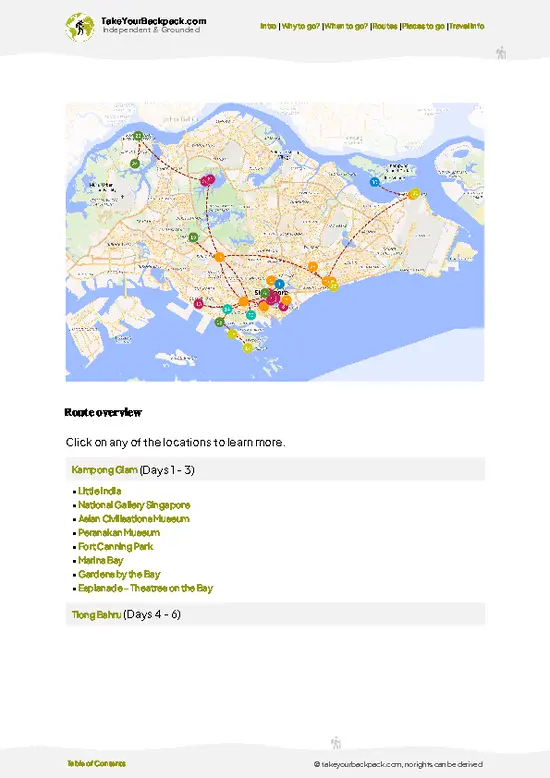
Grouping and direction: Cluster by region. The central core has several historic quarters within 10 to 20 minutes of each other by MRT, so they pair well on one day or two half days. The east and west heartland areas sit on opposite ends of the island, as do the north and the Changi coast. A sensible order is to start in the core, then move east, then loop back through the north or west, so you cross the island once. Plan 3 to 4 hours per stop, or a full day for fringe areas that need a bus or boat connection.

Common … read more 👉
How many days to allow: A trip combining several towns in Singapore needs 3 to 5 days, because the real constraint is heat and transit time, not distance. Cross-island MRT rides run about 20 to 45 minutes, and the far east to far west can take 60 to 75 minutes with a transfer.

Grouping and direction: Cluster by region. The central core has several historic quarters within 10 to 20 minutes of each other by MRT, so they pair well on one day or two half days. The east and west heartland areas sit on opposite ends of the island, as do the north and the Changi coast. A sensible order is to start in the core, then move east, then loop back through the north or west, so you cross the island once. Plan 3 to 4 hours per stop, or a full day for fringe areas that need a bus or boat connection.

Common planning mistakes: Travelers often stack four stops in a day and zigzag across the island, losing two hours to transfers. Group by line and area instead. Many also schedule walking at midday, when heat peaks between 11 a.m. and 3 p.m. Do outdoor streets early and save air-conditioned centers for midday. Avoid moving between regions during the MRT peaks of roughly 7:30 to 9:30 a.m. and 5:30 to 7:30 p.m. Check that Monday closures at museums and Friday midday prayer hours at mosques do not clash with your plan.

The ListHighly Recommended towns of Singapore

1 Marina Bay

Skyline views, waterfront promenades, iconic landmarks

Absorb panoramic cityscapes, walk beside the bay, and visit architectural icons in Singapore’s most photographed urban district.

singapore-city-marina-bay
© Google |

2 Chinatown

Temple street, market alleys, clan houses

Browse narrow lanes filled with incense, antiques, and street food, and visit historic buildings reflecting the area’s migrant past.

singapore-city-chinatown
© Google |

3 Little India

Spice shops, sari stores, Hindu temples

Immerse yourself in colourful markets, sample regional Indian cuisine, and observe rituals in ornate temples along busy streets.

singapore-city-little-india
© Google |

4 Clarke Quay

Riverside bars, restored warehouses, nightlife hub

Spend evenings by the river, explore repurposed godowns, and join crowds drawn to the city’s most concentrated cluster of bars and clubs.

5 Tiong Bahru

Art Deco blocks, indie bakeries, morning markets

Wander leafy lanes lined with 1930s flats, discover independent shops, and sample local breakfasts in a neighborhood shaped by daily rituals.

6 Joo Chiat

Colorful shophouses, heritage murals, kueh shops

Stroll through streets where old-world architecture meets contemporary cafés, and taste handmade sweets in a district known for its multicultural roots.

singapore-city-joo-chiat
© Google |

7 Katong

Peranakan terraces, laksa stalls, pastel facades

Trace the area’s layered heritage through ornate shophouses, traditional bakeries, and a street food scene rooted in Eurasian and Peranakan influences.

8 Changi Village

Ferry terminal, rustic cafés, beach park

Catch boats to offshore islands, eat at laid-back eateries, and watch planes overhead from a breezy seaside park.

9 East Coast

Seaside park, cycling paths, hawker centres

Cycle along breezy waterfront trails, picnic under casuarina trees, and eat fresh seafood at open-air food courts by the sea.

10 Bukit Timah

Nature reserves, colonial bungalows, elite schools

Hike forested trails, spot wildlife, and glimpse Singapore’s residential affluence in a district where greenery and old estates dominate the landscape.

11 Pasir Ris

Mangrove boardwalks, family resorts, birdlife

Explore coastal wetlands, stay at beachside chalets, and observe wildlife in a town designed for outdoor recreation.

12 Geylang

Late-night eateries, durian stalls, shophouse lanes

Experience a lively enclave famous for its after-dark food scene, bustling fruit vendors, and a mix of residential and commercial life.

Loading the map 🌍

Expert viewInsights from Locals and Experts

How many towns to visit: Plan on 4 to 5 towns in a first trip. Each needs 3 to 4 hours to read properly, and the heat limits you to roughly two good outdoor blocks a day, one morning and one late afternoon. Fewer than four and you miss how different the island’s districts are. More than five and you spend your day on trains.

Choosing between the types: Prioritize by travel style. If you want culture and history, spend most of your time in the central ethnic quarters, where temples, mosques and shophouses sit within walking distance. If you want everyday life and low cost, add two heartland new towns, where hawker meals run S$4 to 7 (US$3 to 5) and the crowds are residents rather than tour groups. If you want space and quiet, choose one fringe or island settlement. Photographers should aim … read more 👉
How many towns to visit: Plan on 4 to 5 towns in a first trip. Each needs 3 to 4 hours to read properly, and the heat limits you to roughly two good outdoor blocks a day, one morning and one late afternoon. Fewer than four and you miss how different the island’s districts are. More than five and you spend your day on trains.

Choosing between the types: Prioritize by travel style. If you want culture and history, spend most of your time in the central ethnic quarters, where temples, mosques and shophouses sit within walking distance. If you want everyday life and low cost, add two heartland new towns, where hawker meals run S$4 to 7 (US$3 to 5) and the crowds are residents rather than tour groups. If you want space and quiet, choose one fringe or island settlement. Photographers should aim for the core early, before 9 a.m., when light is soft and streets are empty. Food-focused travelers lose nothing by skipping the core on a second day.

What it costs: Budget S$80 to 140 a day (US$60 to 105) for a backpacker staying in dorms. That covers a bed at S$30 to 60 (US$22 to 45), three hawker or food-court meals at S$12 to 20 (US$9 to 15), and local transport. MRT and bus rides cost roughly S$1 to 2.50 (US$0.75 to 1.90) each, so S$6 to 12 (US$4.50 to 9) a day is typical, and a contactless bank card works at the gates. Many temples, shrines and street scenes are free. Museums charge about S$10 to 25 (US$7.50 to 19) for foreign visitors. Guided walks cost S$25 to 60 (US$19 to 45), and tip-based walking tours exist. A bumboat to an outlying island is about S$4 to 6 (US$3 to 4.50) each way, and bike rental runs S$10 to 15 (US$7.50 to 11) a day. Restaurants add 10 percent service charge plus 9 percent GST, and tipping is not expected. Alcohol is the budget breaker, with a beer at S$12 to 18 (US$9 to 13.50) in bars.

Safety and cultural rules: Singapore is among the safest places in Asia for solo travelers, including at night, and petty theft is rare. The real risks are health and law. Dengue mosquitoes are present, so use repellent at dawn and dusk. Heat exhaustion is common among newcomers, so carry water and shade your midday. Fines apply for littering, smoking outside designated areas, eating or drinking on the MRT and jaywalking. Vaping is banned, and drug offenses carry severe penalties up to the death sentence, so never carry anything for someone else. Dress modestly and remove shoes at temples and mosques, and avoid photographing worshippers closely. Do not touch or point your feet at religious images. Keep tone low in residential heartland blocks, where families live in the same buildings you are walking past.

✈️ The backpacker research shortcutSingapore Travel Guide

An offline-friendly backpacking guide with optimized travel routes, ranked highlights, transport advice, and the best areas to stay.
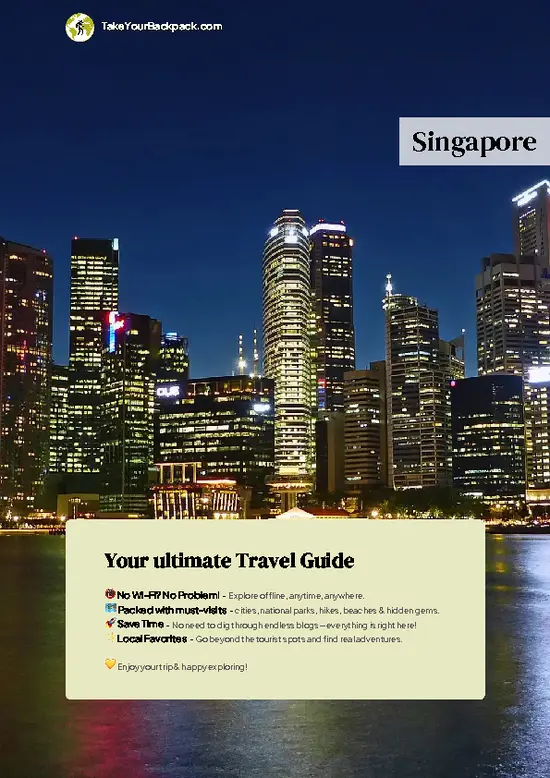
example page 0 from our offline Travel Guide for Singapore
example page 1 from our offline Travel Guide for Singapore
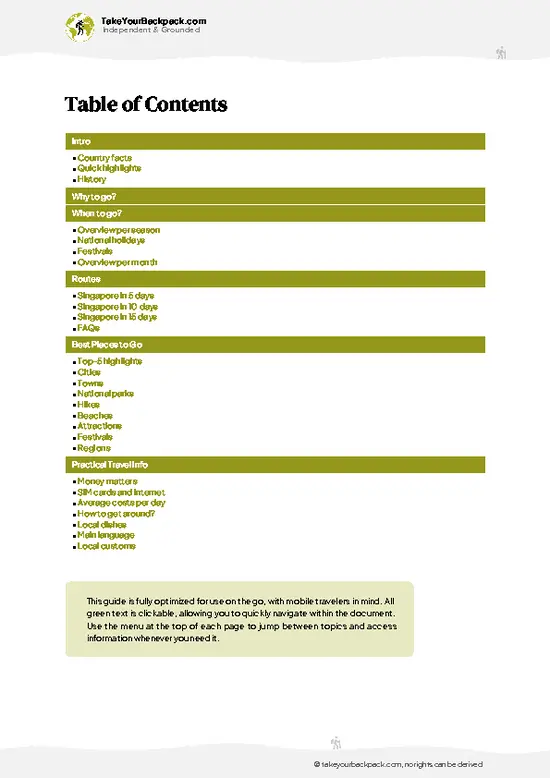
example page 2 from our offline Travel Guide for Singapore
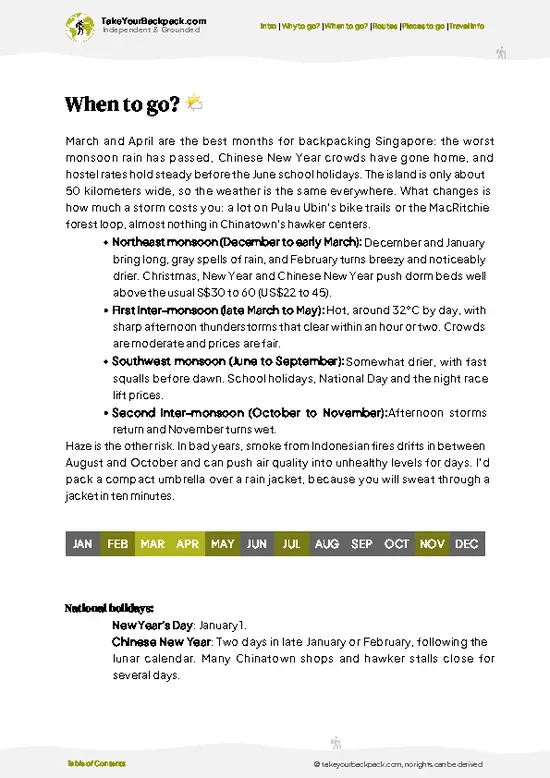
example page 3 from our offline Travel Guide for Singapore
example page 4 from our offline Travel Guide for Singapore
example page 5 from our offline Travel Guide for Singapore
example page 6 from our offline Travel Guide for Singapore
example page 7 from our offline Travel Guide for Singapore
The digital guide (246 pages) contains:
✅ 63 highlights, ranked by travel appeal
✅ Optimized 5, 10 & 15-day travel routes
✅ Cities, national parks, landmarks, beaches
✅ How to get around
✅ Offline-friendly for travel without Wi-Fi
👉 Click to see all 30+ guide features

📅 Plan smarter in minutes, not weeks
✅ Month by month travel advice
✅ Festivals & national holidays
✅ Budget expectations

🗺️ Go to the right places, skip the overrated ones
✅ Honest pros & cons of destinations
✅ Top hikes, parks & viewpoints
✅ Lesser-known places most travelers miss
✅ Clear “worth it vs skip it” guidance

🛏️ Travel smoothly without rookie mistakes
✅ Best areas to stay
✅ Transport systems explained simply
✅ Common scams & safety advice
✅ SIM cards, money & practical tips

🌍 Understand the country, not just visit it
✅ Culture & traditions
✅ Local customs
✅ Festivals worth planning around
✅ Traveler-friendly historical context
✅ Insights that make places more meaningful

📱 Built for real travel conditions
✅ Fully downloadable PDF
✅ Works completely offline
✅ Optimized for phone use
✅ Useful in remote areas & buses
✅ Everything in one place
Stop searching, start planning
Get instant access to your full guide. 30‑day money-back guarantee.
+ Add another guide for just

By proceeding you agree to our terms.
Sent to your inbox immediately after payment • 100% Secure Checkout
Best Backpacking Travel Advisor 2025 tourism awardBest Backpacking
Travel Advisor
2025
What others say about Take Your Backpack Guides:
⭐⭐⭐⭐⭐
Fantastic, amazing amount of information!
⭐⭐⭐⭐⭐
My goodness this is amazing, it's what I've been looking for hats off too you!
⭐⭐⭐⭐⭐
I think this is absolutely BRILLIANT
⭐⭐⭐⭐
Very complete and informative. It's still missing places, but I gotta to commend you
⭐⭐⭐⭐⭐
This is truly amazing, thank you, can't wait to explore it with my kids!
⭐⭐⭐⭐⭐
Awesome resource, thank you!
⭐⭐⭐⭐⭐
This is amazing! Can't wait to explore the ones I haven't seen
⭐⭐⭐⭐
I love this! Well done, great idea.
⭐⭐⭐⭐⭐
Thanks for taking the time to make this gem!
⭐⭐⭐⭐⭐
This might be the best website I've ever seen.
⭐⭐⭐⭐⭐
Congratulations, and thank you so much for your work; it's incredibly valuable.
⭐⭐⭐⭐
In all seriousness I think you did a great job pointing out the important spots
⭐⭐⭐⭐⭐
10/10 very good
⭐⭐⭐⭐⭐
As someone who's only just starting to visit regularly this is awesome, thank you.
⭐⭐⭐⭐
Thank you very much! I'm going to visit my dad, it's going to be very useful!
⭐⭐⭐⭐⭐
This is really cool! We'll be travelling for the first time and this definitely come in handy.
⭐⭐⭐⭐⭐
You are now our minister of culture, congratulations 👨‍💼
⭐⭐⭐⭐⭐
Just wanted to tell you that this is a pearl! Going to follow your recommendations.
⭐⭐⭐⭐⭐
This is so cool. I'll definitely be using the resource for my travels soon.
⭐⭐⭐⭐⭐
This is very impressive! Good work.
⭐⭐⭐⭐⭐
This is an amazing and informative site. Very well done!

🛏️ Where to stay?Where to Stay: Singapore Edition

Singapore has plenty of hostels and capsule-style dorms, with beds typically running S$30 to 60 (about US$22 to 45) a night, and almost all of them sit in a few central districts. Chinatown puts you closest to hawker centers and a short walk or MRT ride from Marina Bay, Little India is the cheapest and noisiest, with crowded streets on weekend nights, and Kampong Glam (around Bugis) has the best bar scene on Haji Lane and Arab Street. If you want quiet, look a few blocks away from Clarke Quay, whose riverside clubs run late. Safety is excellent in every one of these areas.

If you enjoy meeting fellow travelers, consider choosing hostels with high ratings for atmosphere. On the other hand, if … read more 👉
Singapore has plenty of hostels and capsule-style dorms, with beds typically running S$30 to 60 (about US$22 to 45) a night, and almost all of them sit in a few central districts. Chinatown puts you closest to hawker centers and a short walk or MRT ride from Marina Bay, Little India is the cheapest and noisiest, with crowded streets on weekend nights, and Kampong Glam (around Bugis) has the best bar scene on Haji Lane and Arab Street. If you want quiet, look a few blocks away from Clarke Quay, whose riverside clubs run late. Safety is excellent in every one of these areas.

If you enjoy meeting fellow travelers, consider choosing hostels with high ratings for atmosphere. On the other hand, if you prefer having your own space, a hotel might be a better option.

SingaporeExplore Beyond This Category

👋 Meet the founderWho’s Behind Take Your Backpack?

Johan, backpacker and founder of TakeYourBackpackHi, I’m Johan (Netherlands 🇳🇱), the creator of TakeYourBackpack. Over the past 3 decades, I’ve backpacked through 90+ countries across six continents, gaining extensive experience with independent travel, long-term trips, and overland routes.

This site is built on a combination of firsthand travel experience and carefully curated insights from other backpackers. Many guides are based on places I’ve personally visited, while others bring together tips, observations, and practical advice shared by trusted travelers I’ve met along the way.

The goal is to provide realistic, experience-driven guidance — not generic itineraries — so you can explore destinations with better context, clearer expectations, and more confidence.