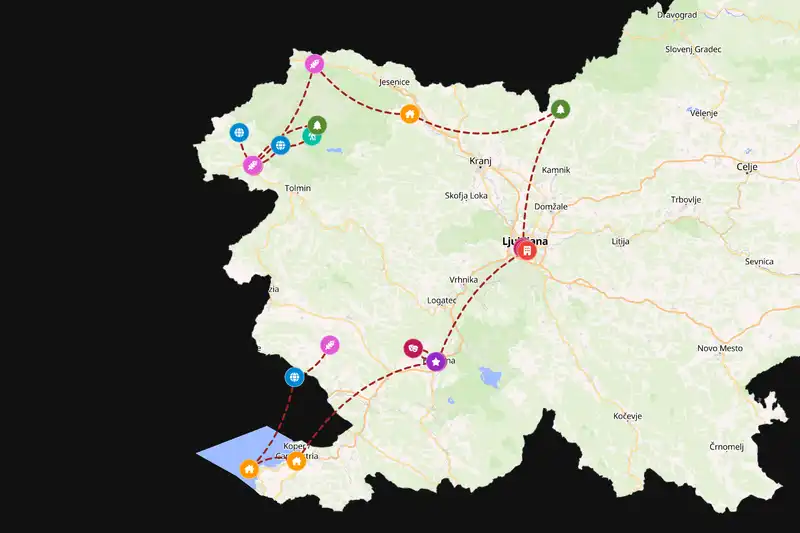
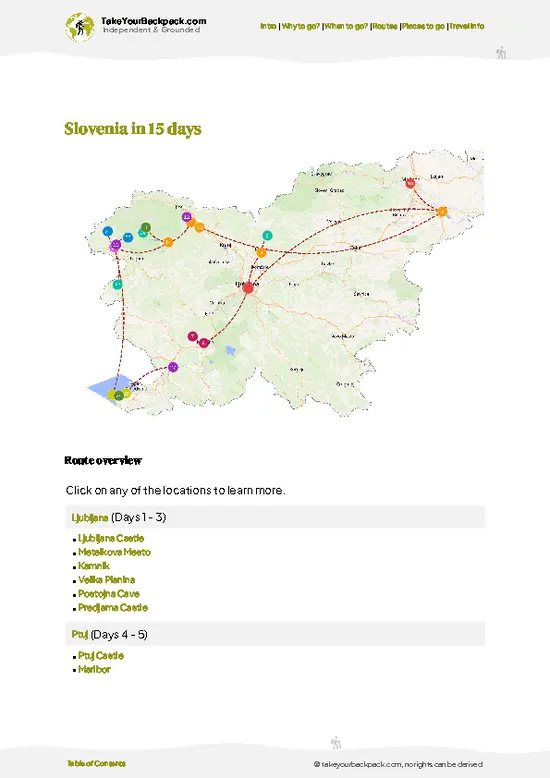
This 15-day loop is for travelers who want the full sweep of Slovenia at a relaxed, unhurried pace, from Roman-era towns on the Drava River to glacial lakes, war history in the Soča Valley, wine villages and finally the Adriatic. It suits first-timers who want depth, and repeat visitors who skipped the east and the Vipava Valley last time. Every leg works on public transport: intercity trains (including the scenic Bohinj railway), regional buses, the Ljubljana Castle funicular and seasonal summer buses in the Trenta Valley and to Predjama. No leg asks for more than one long travel day in a row.
Days 1-2: Ljubljana
Start in
Ljubljana, Slovenia’s capital, because nearly every train and bus line in the country fans out from here, and two nights is enough to get your bearings before heading east. Skip the funicular on the way up to
Ljubljana Castle and take the footpath from the old town instead. It is a 15 to 20 minute climb through the trees, and the tower view stretches from the red roofs …
read more 👉This 15-day loop is for travelers who want the full sweep of Slovenia at a relaxed, unhurried pace, from Roman-era towns on the Drava River to glacial lakes, war history in the Soča Valley, wine villages and finally the Adriatic. It suits first-timers who want depth, and repeat visitors who skipped the east and the Vipava Valley last time. Every leg works on public transport: intercity trains (including the scenic Bohinj railway), regional buses, the Ljubljana Castle funicular and seasonal summer buses in the Trenta Valley and to Predjama. No leg asks for more than one long travel day in a row.
Days 1-2: Ljubljana
Start in Ljubljana, Slovenia’s capital, because nearly every train and bus line in the country fans out from here, and two nights is enough to get your bearings before heading east. Skip the funicular on the way up to Ljubljana Castle and take the footpath from the old town instead. It is a 15 to 20 minute climb through the trees, and the tower view stretches from the red roofs to the Kamnik Alps on a clear day.
Give your second morning to the National Museum of Slovenia, where the Divje Babe bone flute, thought to be around 50,000 to 60,000 years old, and the bronze Vače situla tell the story of this land long before the city existed. In the evening, walk ten minutes north of the train station to Metelkova Mesto, a former Yugoslav army barracks taken over by artists and squatters. Its mosaic-covered walls, tiny bars and gig spaces are the closest thing the capital has to an underground scene, and they get going late.Days 3-4: Ptuj and Maribor
The train to Ptuj takes 2 to 2.5 hours with a change at Pragersko, an easy morning that leaves the afternoon free. Ptuj is the oldest town in the country, with Roman roots and a compact center of church towers and arcaded houses above the Drava. Climb to Ptuj Castle for its collection of Kurent masks (the shaggy, horned costumes paraded at the town’s pre-Lent carnival), plus displays of historic musical instruments and weapons.
On day four, take the train to Maribor, under an hour away. Slovenia’s second city is relaxed and student-heavy, and the riverside Lent district holds the Old Vine, a grapevine over 400 years old that still produces wine. Wander the embankment, have lunch in the old town, and head back to Ptuj for a quieter evening.Days 5-7: Bohinjska Bistrica, Bled and Triglav National Park
Day five is the route’s longest haul: plan on 5 to 6 hours from Ptuj to Bohinjska Bistrica, changing in Ljubljana and connecting by train via Jesenice or by bus via Bled. It is worth the effort. Basing yourself here rather than in Bled gets you cheaper rooms, a working train station for the next leg and a 6-kilometer bus or bike ride to the shore of Lake Bohinj.
Ride the bus 35 to 45 minutes to Bled on day six and pair it with Vintgar Gorge, where wooden boardwalks hang over the clear green Radovna River for about 1.6 kilometers. Go early, since tour buses fill the walkways by late morning. Back at the lake, a loop on foot takes around 1.5 hours, and the island church is worth seeing from the water at least once.
Day seven is for Triglav National Park and the Triglav Lakes Valley. From the far western end of Lake Bohinj, a steep path climbs the Komarča cliff to Black Lake, then continues past a chain of high alpine lakes toward the hut at the Double Lake. The round trip takes a full 8 to 10 hours with over 1,000 meters of climbing, so start at first light, carry plenty of water and do not attempt it in fresh snow.Days 8-10: Kobarid and the Soča Valley
The Bohinj railway is the reason this route runs west from here. The train dives through a 6-kilometer tunnel and emerges at Most na Soči in about an hour, and a regional bus then follows the river past Tolmin to Kobarid in around 40 minutes. It is a small village with good restaurants and a lot of history for its size, and a calm base for three nights.
Spend day nine at the Kobarid Museum, which covers the Isonzo Front of the First World War and the 1917 Battle of Caporetto, the defeat Hemingway wrote into A Farewell to Arms. Afterward, walk out of the village across the Napoleon Bridge to Kozjak Waterfall, roughly 1 to 1.5 hours each way. The final approach ends in a rock chamber where the water drops into an emerald pool.
On day ten, catch the bus up the Soca Valley to Bovec, then a summer bus into the Trenta Valley to walk a section of the Soča Valley Trail, which follows the river down from near its source. Check the seasonal timetable the night before, since the Trenta buses run mainly in the warmer months. The water here is a shade of blue-green that looks fake in photos and freezing when you put your hand in it.Days 11-12: Vipava Valley and the Postojna Caves
Leave the Alps by bus to Nova Gorica (about 1 hour 15 minutes), then connect to Vipava, around 45 minutes further. The landscape changes fast in this corner of Slovenia: vineyards, stone houses and the bora wind replace the mountain air. The Vipava River rises from a cluster of springs right in town, and local cellars pour zelen and pinela, two white grapes you will rarely see outside this valley.
Use the evening or a morning to visit Vipavski Križ, a walled hilltop village with a monastery, and the stone wine village of Goče, about 6 kilometers from Vipava and best reached by bike or taxi. On day twelve, take the bus 20 to 30 minutes to Postojna for Postojna Cave, where an electric train carries you deep inside before the walking tour starts. In summer a shuttle bus continues to Predjama Castle, built into the mouth of a cave in a sheer cliff. Book the cave online in July and August to secure the time slot you want.Days 13-15: Škocjan Caves, Piran and Strunjan
Day thirteen takes you to the coast with a major stop on the way. Ride the bus back to Postojna, then the train to Divača in 30 to 40 minutes and walk around 40 minutes to the Škocjan Caves. Where Postojna dazzles with decoration, Škocjan overwhelms with scale: the Reka River thunders through an underground canyon, and the footbridge crosses it about 45 meters up. Afterward, continue by train to Koper and bus to Piran.
Piran’s marble Tartini Square, Venetian lanes and town walls fill a slow evening, and the rocky promenade along the point is where people swim at Piran Beach, using ladders straight into the sea. On day fourteen, walk the coastal path toward Strunjan Landscape Park, about 1.5 to 2 hours each way, where flysch cliffs around 80 meters high drop to the Adriatic, the tallest on this stretch of coastline. On day fifteen, a bus gets you back to Ljubljana in about 2.5 hours, or across the Italian border toward Trieste.
If a friend were passing through on that coastal walk, I would send them down to the twin Fiesa lakes between Piran and Strunjan with a towel and an early start, because the little cove below them is far quieter than the Piran promenade.v2.webp)
 Best Backpacking