×

Suriname🇸🇷 | best citiesWhere to Find the Best cities in Suriname

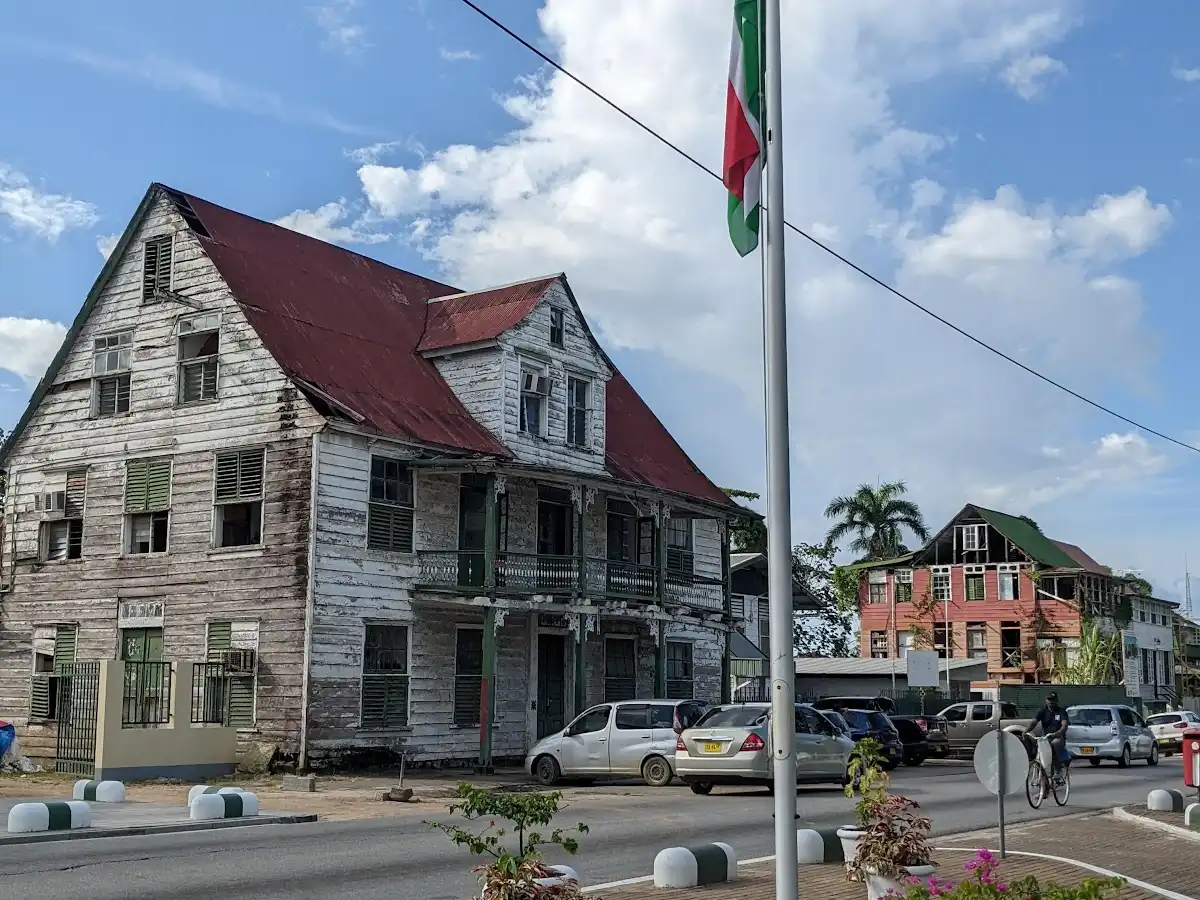
Cities in Suriname are small, low-slung and wooden, and they run on river time. Most of the country lives on a thin coastal strip, so the urban experience is concentrated there: creaking colonial timber, mosques and synagogues a few blocks apart, the smell of frying roti and diesel, and midday heat that flattens the streets by 1 p.m. Prices are higher than in neighboring Guyana, and distances come with long, dusty bus rides. The capital has the most guesthouses and food stalls, while border towns and river settlements are rougher, quieter and cheaper. For independent travel, this means choosing between comfort and easy logistics or raw, slow-moving places.

By Johan Kruseman 🇳🇱 | Updated October 20, 2026
Explore the best towns in Suriname

Why go?Understanding Their Importance

Suriname’s cities exist because of water and plantation history. Dutch colonists built along tidal rivers on a flat, muddy coast, then brought laborers from Java, India, West Africa and China. The result is a country of roughly 600,000 people where Hindustani, Javanese, Creole, Maroon and Indigenous communities share neighborhoods, so a single street can mix gamelan-style snacks, Hindu temples and Dutch-named canals. Dutch is the official language, and Sranan Tongo is what you hear in the markets.

The geography shapes everything. About 80 percent of the country is rainforest, and the cities cling to the narrow northern coast, linked by a few paved roads. Heat and humidity sit around 27 to 32°C all year, with the air thick and the light hard and white by midday. Timber buildings need constant … read more 👉
Suriname’s cities exist because of water and plantation history. Dutch colonists built along tidal rivers on a flat, muddy coast, then brought laborers from Java, India, West Africa and China. The result is a country of roughly 600,000 people where Hindustani, Javanese, Creole, Maroon and Indigenous communities share neighborhoods, so a single street can mix gamelan-style snacks, Hindu temples and Dutch-named canals. Dutch is the official language, and Sranan Tongo is what you hear in the markets.

The geography shapes everything. About 80 percent of the country is rainforest, and the cities cling to the narrow northern coast, linked by a few paved roads. Heat and humidity sit around 27 to 32°C all year, with the air thick and the light hard and white by midday. Timber buildings need constant repair, and some stand peeling and tilted in the sun.

Travelers should know that this is not a destination for urban sightseeing marathons. Cities are compact, often quiet on Sundays, and the main draw is the cultural mix and food rather than monuments. Transport between them is by minibus, shared taxi or private driver, with few fixed timetables. Cash is still important outside the capital, and the cost of eating and sleeping is moderate to high for South America. Choose Suriname for its atmosphere and diversity, and treat the interior as a separate trip.
Why These Made the Cut
The list of best cities in Suriname is created based on culture, vibe, attractions, transport ease, and local charm. If you feel a city is missing in this list, please let us know.

When to go?Optimal Periods for Travel

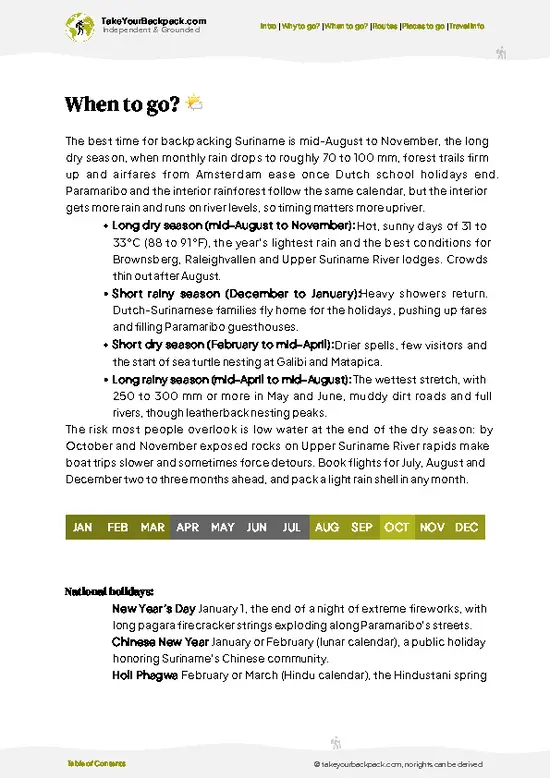
Best months for city travel: The best time for Suriname’s cities is the long dry season from mid-August to early December, when rain drops to a few days a month and streets stay passable. Temperatures hover around 29 to 33°C by day and 23 to 25°C at night, with humidity that never fully lifts but eases with the trade-wind breeze off the Atlantic coast.
Shoulder seasons and rain: A short dry spell from February to early April is the second good window. It is warm and bright, with occasional heavy afternoon showers. The long rainy season runs from mid-April to mid-August, with the heaviest downpours in May and June. Coastal rainfall can reach 300 mm or more in the wettest months, and the sudden storms flood gutters, turn unpaved side streets to mud and fill the air with the smell of wet wood … read more 👉
Best months for city travel: The best time for Suriname’s cities is the long dry season from mid-August to early December, when rain drops to a few days a month and streets stay passable. Temperatures hover around 29 to 33°C by day and 23 to 25°C at night, with humidity that never fully lifts but eases with the trade-wind breeze off the Atlantic coast.
Shoulder seasons and rain: A short dry spell from February to early April is the second good window. It is warm and bright, with occasional heavy afternoon showers. The long rainy season runs from mid-April to mid-August, with the heaviest downpours in May and June. Coastal rainfall can reach 300 mm or more in the wettest months, and the sudden storms flood gutters, turn unpaved side streets to mud and fill the air with the smell of wet wood and earth. Buses run, but delays are common.
Crowds and prices: Crowds are never heavy. Suriname gets a small number of visitors, and the pressure points are December and the Dutch school holidays in July and August, when Surinamese families abroad return. Flights and some guesthouses cost 10 to 30 percent more then, and rooms in the capital can fill up. Public holidays such as Diwali, Eid and Keti Koti close shops and change opening hours for a day or two. Outside those dates, you can usually book a room the same day.

city hoppingOptimizing Your Multi-Stop Itinerary

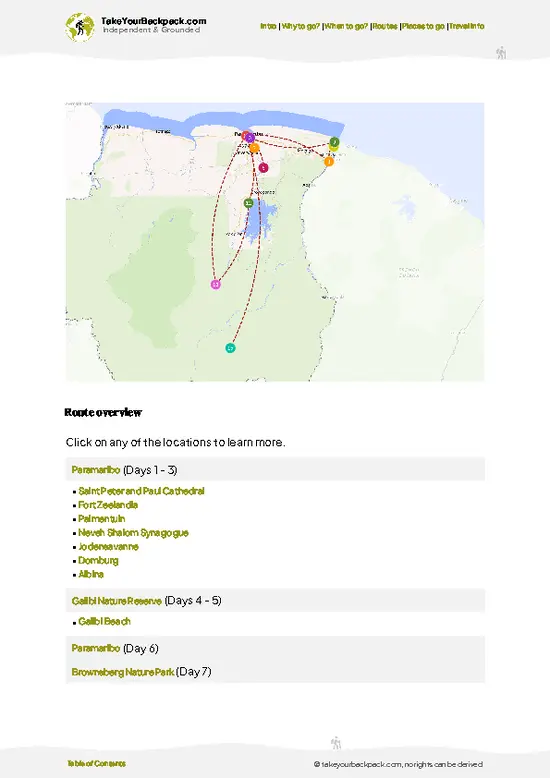
How long to allow: A trip linking several cities in Suriname needs 7 to 10 days, because roads are few and transport is slow. Nearly everything starts and ends at the capital and the international airport about 45 km to the south, so it works best as a loop or out-and-back along the coast.
Direction and pacing: Travel from the central coast outward: start in the capital, then head west toward the Guyana border region or east toward the French Guiana crossing, whichever fits your onward plans. Allow 2 to 3 days in the capital and 1 to 2 days in each smaller stop. Main roads are paved but narrow, and trucks and potholes slow things down. Typical drives run 2 to 4 hours between the capital and nearby coastal towns, and up to 5 to 6 hours to the far west or east, including river ferry waits.
Planning … read more 👉
How long to allow: A trip linking several cities in Suriname needs 7 to 10 days, because roads are few and transport is slow. Nearly everything starts and ends at the capital and the international airport about 45 km to the south, so it works best as a loop or out-and-back along the coast.
Direction and pacing: Travel from the central coast outward: start in the capital, then head west toward the Guyana border region or east toward the French Guiana crossing, whichever fits your onward plans. Allow 2 to 3 days in the capital and 1 to 2 days in each smaller stop. Main roads are paved but narrow, and trucks and potholes slow things down. Typical drives run 2 to 4 hours between the capital and nearby coastal towns, and up to 5 to 6 hours to the far west or east, including river ferry waits.
Planning mistakes: The classic error is trying to cover everything in a week, which leaves you in a minibus for most of the day. Another is relying on afternoon departures, when shared transport runs thin and rains can close sections of road. Leave in the early morning, when the light is soft and the air still cool. Keep a buffer day before any international border crossing or flight, because ferries and immigration offices work to their own clock. Book sleeping places the day before in smaller towns, where choices are few.

The ListTop cities of Suriname

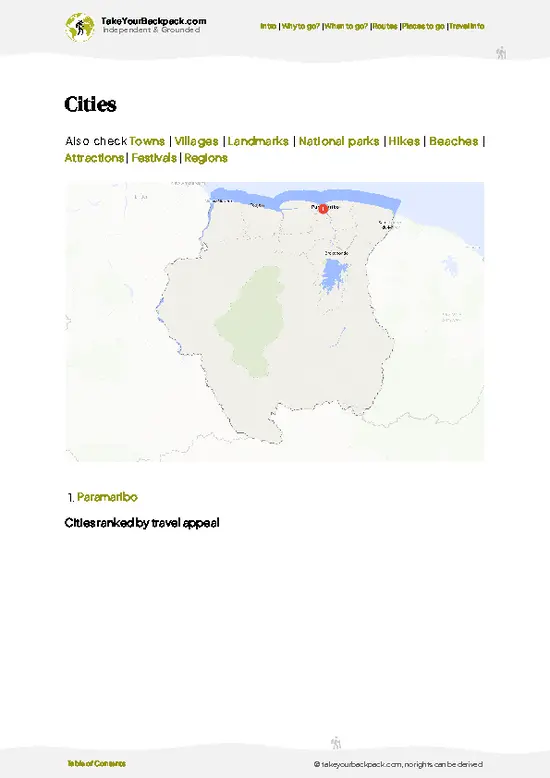
1 Paramaribo

Wooden cathedral, star-shaped fort, mosque beside synagogue, Waterkant market stalls

Walk the compact wooden center from riverside Fort Zeelandia to Independence Square, tasting roti at market stands and comparing faiths on Keizerstraat.

suriname-city-paramaribo
© Google |
Loading the map 🌍

Expert viewInsights from Locals and Experts

How many cities to visit: I advise three or four urban stops in one trip. Suriname’s distances are short on a map but long in practice, with minibuses that leave when full and road stretches of baking asphalt. More than four means most of your days are spent in transit, and you gain little extra. Three gives you one anchor and two contrasting places, and you still have time to sit at a riverfront stall with a cold Parbo beer and watch the evening light turn the water copper.
Choosing by travel style: If you want comfort and variety, prioritize the capital, where guesthouses, restaurants and tour operators cluster. If you prefer slow, local experiences, pick smaller coastal or border towns, where the pace drops, Sranan Tongo replaces English, and a plate of rice with chicken or fish costs far … read more 👉
How many cities to visit: I advise three or four urban stops in one trip. Suriname’s distances are short on a map but long in practice, with minibuses that leave when full and road stretches of baking asphalt. More than four means most of your days are spent in transit, and you gain little extra. Three gives you one anchor and two contrasting places, and you still have time to sit at a riverfront stall with a cold Parbo beer and watch the evening light turn the water copper.
Choosing by travel style: If you want comfort and variety, prioritize the capital, where guesthouses, restaurants and tour operators cluster. If you prefer slow, local experiences, pick smaller coastal or border towns, where the pace drops, Sranan Tongo replaces English, and a plate of rice with chicken or fish costs far less. Culture seekers should aim for places with strong Javanese, Hindustani or Maroon presence, where food and festivals are the main attraction. Use the capital as a base for day trips rather than hopping between many small towns.
What it costs: Budget US$40 to 70 a day for independent travel: dorms or simple guesthouse rooms at US$20 to 40, street food and warung meals at US$4 to 8, and restaurant dinners at US$10 to 20. Shared transport between towns costs roughly US$3 to 15 a leg, while a private driver runs US$60 to 120 a day. Museums and fort entries are small, typically US$2 to 6, and guided city walks run US$15 to 35. Carry Surinamese dollars for markets and small shops, because card acceptance is patchy outside the capital, and bring a few euros or US dollars as a backup.
Safety and culture: Suriname is generally relaxed, but petty theft happens, especially after dark in quiet streets. Walk in the evening only on well-lit roads, keep phones out of sight, and use taxis for late returns. Mosquitoes are a daily reality, so repellent and long sleeves at dusk matter, and a yellow fever certificate is often required. Dress modestly when entering mosques, temples and Maroon or Indigenous communities, and ask before photographing people. Greet shopkeepers first, because it is expected and gets you a warmer response. On Sundays and religious holidays, many shops close, so plan your meals and cash ahead.

✈️ The backpacker research shortcutSuriname Travel Guide

An offline-friendly backpacking guide with optimized travel routes, ranked highlights, transport advice, and the best areas to stay.
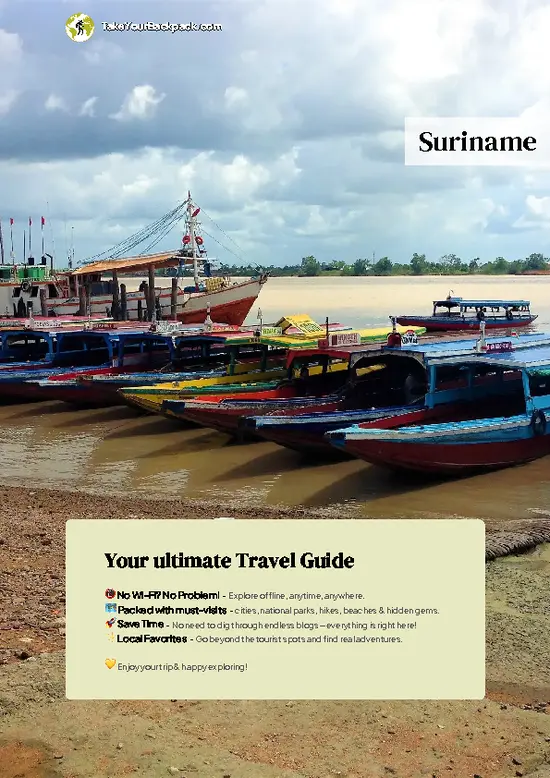
example page 0 from our offline Travel Guide for Suriname
example page 1 from our offline Travel Guide for Suriname
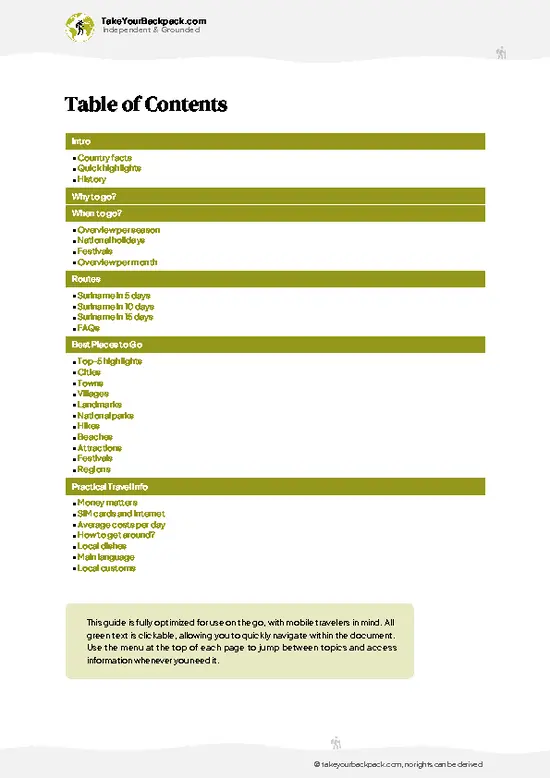
example page 2 from our offline Travel Guide for Suriname
example page 3 from our offline Travel Guide for Suriname
example page 4 from our offline Travel Guide for Suriname
example page 5 from our offline Travel Guide for Suriname
example page 6 from our offline Travel Guide for Suriname
example page 7 from our offline Travel Guide for Suriname
The digital guide (153 pages) contains:
✅ 40 highlights, ranked by travel appeal
✅ Optimized 5, 10 & 15-day travel routes
✅ Cities, national parks, landmarks, beaches
✅ How to get around
✅ Offline-friendly for travel without Wi-Fi
👉 Click to see all 30+ guide features

📅 Plan smarter in minutes, not weeks
✅ Month by month travel advice
✅ Festivals & national holidays
✅ Budget expectations

🗺️ Go to the right places, skip the overrated ones
✅ Honest pros & cons of destinations
✅ Top hikes, parks & viewpoints
✅ Lesser-known places most travelers miss
✅ Clear “worth it vs skip it” guidance

🛏️ Travel smoothly without rookie mistakes
✅ Best areas to stay
✅ Transport systems explained simply
✅ Common scams & safety advice
✅ SIM cards, money & practical tips

🌍 Understand the country, not just visit it
✅ Culture & traditions
✅ 52 Essential phrases & customs
✅ Festivals worth planning around
✅ Traveler-friendly historical context
✅ Insights that make places more meaningful

📱 Built for real travel conditions
✅ Fully downloadable PDF
✅ Works completely offline
✅ Optimized for phone use
✅ Useful in remote areas & buses
✅ Everything in one place
Stop searching, start planning
Get instant access to your full guide. 30‑day money-back guarantee.
+ Add another guide for just

By proceeding you agree to our terms.
Sent to your inbox immediately after payment • 100% Secure Checkout
Best Backpacking Travel Advisor 2025 tourism awardBest Backpacking
Travel Advisor
2025
What others say about Take Your Backpack Guides:
⭐⭐⭐⭐⭐
Fantastic, amazing amount of information!
⭐⭐⭐⭐⭐
My goodness this is amazing, it's what I've been looking for hats off too you!
⭐⭐⭐⭐⭐
I think this is absolutely BRILLIANT
⭐⭐⭐⭐
Very complete and informative. It's still missing places, but I gotta to commend you
⭐⭐⭐⭐⭐
This is truly amazing, thank you, can't wait to explore it with my kids!
⭐⭐⭐⭐⭐
Awesome resource, thank you!
⭐⭐⭐⭐⭐
This is amazing! Can't wait to explore the ones I haven't seen
⭐⭐⭐⭐
I love this! Well done, great idea.
⭐⭐⭐⭐⭐
Thanks for taking the time to make this gem!
⭐⭐⭐⭐⭐
This might be the best website I've ever seen.
⭐⭐⭐⭐⭐
Congratulations, and thank you so much for your work; it's incredibly valuable.
⭐⭐⭐⭐
In all seriousness I think you did a great job pointing out the important spots
⭐⭐⭐⭐⭐
10/10 very good
⭐⭐⭐⭐⭐
As someone who's only just starting to visit regularly this is awesome, thank you.
⭐⭐⭐⭐
Thank you very much! I'm going to visit my dad, it's going to be very useful!
⭐⭐⭐⭐⭐
This is really cool! We'll be travelling for the first time and this definitely come in handy.
⭐⭐⭐⭐⭐
You are now our minister of culture, congratulations 👨‍💼
⭐⭐⭐⭐⭐
Just wanted to tell you that this is a pearl! Going to follow your recommendations.
⭐⭐⭐⭐⭐
This is so cool. I'll definitely be using the resource for my travels soon.
⭐⭐⭐⭐⭐
This is very impressive! Good work.
⭐⭐⭐⭐⭐
This is an amazing and informative site. Very well done!

🛏️ Where to stay?Where to Stay in Suriname

Suriname has a small but workable spread of hostels and guesthouses, nearly all in Paramaribo, where dorm beds run about SRD 550 to 950 (US$15 to 25) and private rooms in family-run guesthouses cost about SRD 1,100 to 1,850 (US$30 to 50). The wooden streets of the historic inner city near the Waterkant put you within walking distance of the UNESCO-listed center and riverfront food stalls, but the area empties after dark, so take a taxi at night. The leafier residential pocket around the Kleine Waterstraat entertainment strip is livelier, with bars and casinos on your doorstep, while neighborhoods further out such as Zorg en Hoop are quieter and cheaper but need a bus or taxi for most sights. … read more 👉
Suriname has a small but workable spread of hostels and guesthouses, nearly all in Paramaribo, where dorm beds run about SRD 550 to 950 (US$15 to 25) and private rooms in family-run guesthouses cost about SRD 1,100 to 1,850 (US$30 to 50). The wooden streets of the historic inner city near the Waterkant put you within walking distance of the UNESCO-listed center and riverfront food stalls, but the area empties after dark, so take a taxi at night. The leafier residential pocket around the Kleine Waterstraat entertainment strip is livelier, with bars and casinos on your doorstep, while neighborhoods further out such as Zorg en Hoop are quieter and cheaper but need a bus or taxi for most sights.

If you enjoy meeting fellow travelers, consider choosing hostels with high ratings for atmosphere. On the other hand, if you prefer having your own space, a hotel might be a better option.

SurinameMore of Suriname

👋 Meet the founderWho’s Behind Take Your Backpack?

Johan, backpacker and founder of TakeYourBackpackHi, I’m Johan (Netherlands 🇳🇱), the creator of TakeYourBackpack. Over the past 3 decades, I’ve backpacked through 90+ countries across six continents, gaining extensive experience with independent travel, long-term trips, and overland routes.

This site is built on a combination of firsthand travel experience and carefully curated insights from other backpackers. Many guides are based on places I’ve personally visited, while others bring together tips, observations, and practical advice shared by trusted travelers I’ve met along the way.

The goal is to provide realistic, experience-driven guidance — not generic itineraries — so you can explore destinations with better context, clearer expectations, and more confidence.