×

Suriname🇸🇷 | best regionsWhere to Find the 2 Best regions in Suriname

Suriname’s regions split along one line: the coastal belt versus the interior. Along the Atlantic strip, you get Paramaribo’s wooden colonial facades, the smell of roti and peanut sauce, mosque calls mixing with church bells, and paved roads with minibuses. Beyond it, roughly 80 percent of the country is rainforest, where red dirt tracks give way to river dugouts, humidity clings to your shirt and nights are loud with frogs. Costs climb sharply once a boat or plane is involved. Independent travel is easy on the coast and gets organized, and pricier, deeper in. Crowds are thin everywhere.

By Johan Kruseman 🇳🇱 | Updated October 20, 2026
Explore the best cities in Suriname

Why go?Understanding Their Importance

Suriname is unusual because people and forest sit so close together. Javanese, Hindustani, Creole, Maroon, Indigenous, Chinese and Dutch-descended communities share a country of about 600,000 people, so a single day can move from a Hindu temple to a Javanese warung to a Maroon village. Roughly 90 percent of the land is forest, and the population clusters on a narrow northern coastal plain. That geography shapes everything. Roads exist along the coast and a few corridors, while the interior depends on rivers, small planes and long dugout rides, which is why trips there cost more than in neighboring Guyana or French Guiana’s cheaper corners.

Before choosing Suriname, know that tourism infrastructure is small. Dutch is the official language, English works in many tourist-facing places, and Sranan … read more 👉
Suriname is unusual because people and forest sit so close together. Javanese, Hindustani, Creole, Maroon, Indigenous, Chinese and Dutch-descended communities share a country of about 600,000 people, so a single day can move from a Hindu temple to a Javanese warung to a Maroon village. Roughly 90 percent of the land is forest, and the population clusters on a narrow northern coastal plain. That geography shapes everything. Roads exist along the coast and a few corridors, while the interior depends on rivers, small planes and long dugout rides, which is why trips there cost more than in neighboring Guyana or French Guiana’s cheaper corners.

Before choosing Suriname, know that tourism infrastructure is small. Dutch is the official language, English works in many tourist-facing places, and Sranan Tongo is the street lingua franca. Heat sits around 27 to 32°C with high humidity, and mosquitoes are a constant, so malaria and yellow fever precautions matter. Many interior stays are run by village communities and operators, so you book ahead and pay in cash. The reward is quiet: howler monkeys at dawn, tea-colored rivers, and almost no one else on the trail.
Evaluating the Top Choices
The list of best regions in Suriname is created based on landscapes, local culture, attractions, vibes, and overall appeal. If you feel a region is missing in this list, please let us know.

When to go?Optimal Periods for Travel

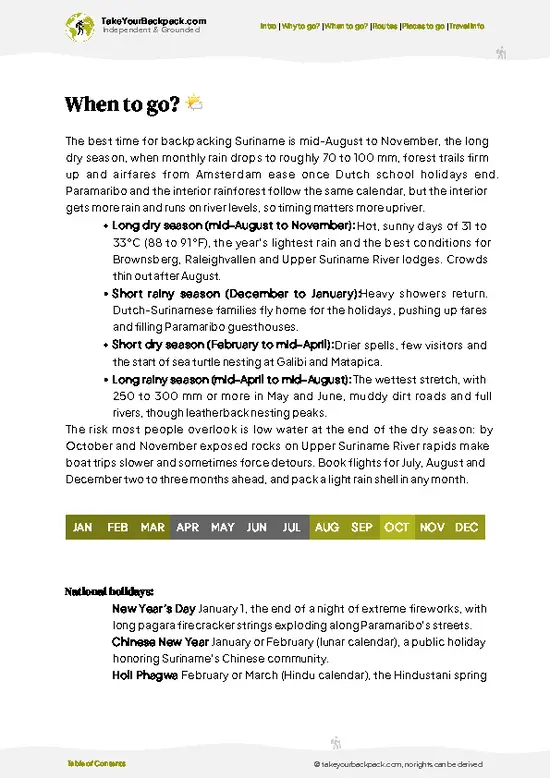
Best months: The best window is August to mid-November, the long dry season, when rivers are navigable, trails are firmer and rainfall drops to roughly 60 to 100 mm a month on the coast. Days run 30 to 33°C, and the forest smells of dust and warm leaves rather than rot.
Rain and shoulder seasons: Suriname has two wet and two dry seasons. The long rains run from about late April to July, with 250 to 350 mm a month and afternoon downpours that turn red roads to slick clay. Interior rivers rise, rapids become safer for boats in some places and harder in others, and mosquitoes multiply. The short rains arrive from December to late January, usually lighter and easier to plan around. February to early April is a short dry spell, with warm, humid mornings and fewer crowds.
Crowds and prices: Crowds … read more 👉
Best months: The best window is August to mid-November, the long dry season, when rivers are navigable, trails are firmer and rainfall drops to roughly 60 to 100 mm a month on the coast. Days run 30 to 33°C, and the forest smells of dust and warm leaves rather than rot.
Rain and shoulder seasons: Suriname has two wet and two dry seasons. The long rains run from about late April to July, with 250 to 350 mm a month and afternoon downpours that turn red roads to slick clay. Interior rivers rise, rapids become safer for boats in some places and harder in others, and mosquitoes multiply. The short rains arrive from December to late January, usually lighter and easier to plan around. February to early April is a short dry spell, with warm, humid mornings and fewer crowds.
Crowds and prices: Crowds stay light all year, with the main bump around Christmas to New Year and Dutch school holidays in July and August, when flights from Amsterdam rise in price. Interior lodges and flights fill first in the dry season, so book weeks ahead then. In the wet months, operators often discount, and some remote camps close or run fewer departures. Coastal areas stay open year-round, though sea-turtle nesting on the northern beaches peaks from February to April, which can shape your timing.

region hoppingOptimizing Your Multi-Stop Itinerary

How many days: A trip combining several regions in Suriname needs 10 to 14 days, because interior travel eats time in dugouts, buses and waiting for departures. Under a week works for one coast base and one interior trip, but not both done well.
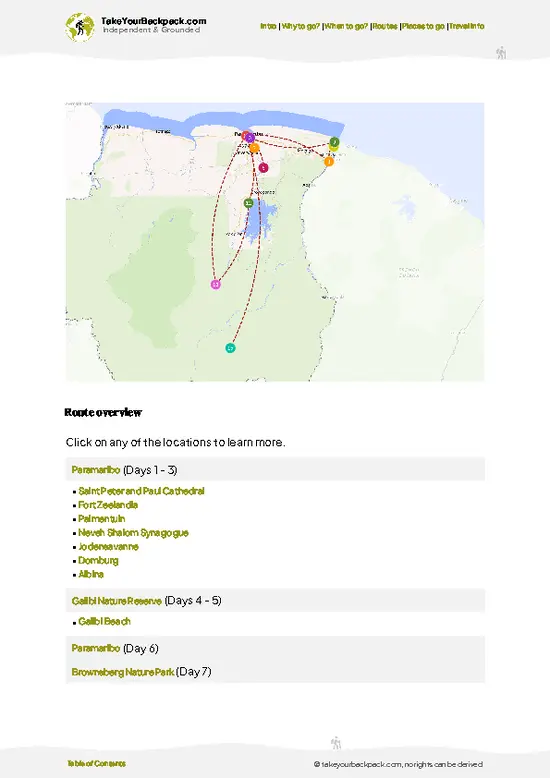
Direction and grouping: Start in Paramaribo, the only real hub, and group the coastal and near-coast stops first. They connect by paved roads and shared minibuses, with journeys of 1 to 3 hours. Then head into the interior, where you need to arrange boats or small planes from Paramaribo’s Zorg en Hoop airstrip. The eastern and southern interior use different river systems, so do one, not both. Western routes can end near the Guyana border at Nieuw Nickerie, a 4 to 5 hour drive from the capital, and the eastern route toward Albina and the French Guiana … read more 👉
How many days: A trip combining several regions in Suriname needs 10 to 14 days, because interior travel eats time in dugouts, buses and waiting for departures. Under a week works for one coast base and one interior trip, but not both done well.
Direction and grouping: Start in Paramaribo, the only real hub, and group the coastal and near-coast stops first. They connect by paved roads and shared minibuses, with journeys of 1 to 3 hours. Then head into the interior, where you need to arrange boats or small planes from Paramaribo’s Zorg en Hoop airstrip. The eastern and southern interior use different river systems, so do one, not both. Western routes can end near the Guyana border at Nieuw Nickerie, a 4 to 5 hour drive from the capital, and the eastern route toward Albina and the French Guiana crossing takes about 2 to 3 hours.
Pacing and planning mistakes: Allow 2 to 3 days for each coastal stop and 3 to 4 days for an interior stay, since the boat ride alone can take 4 to 8 hours. The common mistake is packing in too many stops, then losing a day to a missed boat or flooded track. Another is booking a flight out the same day you return upriver. Leave a buffer day before any international departure, and book interior transport through a local operator rather than hoping to turn up and join one.

The ListTop regions of Suriname

1 Boven Saramacca

Korjaal river travel, Matawai Maroon villages, rapids and rock pools, Moravian churches, night sounds

Travel upriver by dugout korjaal past forest walls and rapids, then visit stilt-house villages, bathe in warm brown rock pools and walk to farm plots.

2 Tumuc-Humac Mountains

Lawa River, Tapanahony, granite inselbergs, hammock camps

Travel for days by dugout through rapids and Maroon villages, sleeping in hammocks beneath a canopy that runs unbroken toward Brazil.

suriname-region-tumuc-humac-mountains
© Google | Camille Daudigny
Loading the map 🌍

Expert viewInsights from Locals and Experts

How many regions: I would advise two to three regions for most backpackers, with one coastal base and one or two interior stays. Interior travel is slow, and the boat rides, forest walks and river swims need time to be enjoyable rather than a rushed tick-off. Visit more and you spend your budget on transport, not on the humid dawn on a river or the taste of fresh fish cooked over a fire.
Prioritizing by travel style: If you like culture and food, spend more time on the coast: Javanese warung lunches, Hindustani roti shops, Creole markets and mosques beside synagogues. If you want wildlife and wilderness, put the interior first, where you get nights in hammocks under mosquito nets, birdsong at 5 a.m. and tannin-dark water. Short on cash, go coastal and add one interior trip. With more money … read more 👉
How many regions: I would advise two to three regions for most backpackers, with one coastal base and one or two interior stays. Interior travel is slow, and the boat rides, forest walks and river swims need time to be enjoyable rather than a rushed tick-off. Visit more and you spend your budget on transport, not on the humid dawn on a river or the taste of fresh fish cooked over a fire.
Prioritizing by travel style: If you like culture and food, spend more time on the coast: Javanese warung lunches, Hindustani roti shops, Creole markets and mosques beside synagogues. If you want wildlife and wilderness, put the interior first, where you get nights in hammocks under mosquito nets, birdsong at 5 a.m. and tannin-dark water. Short on cash, go coastal and add one interior trip. With more money and time, add a second interior stay, because deeper trips deliver the quietest forest.
What it costs: Budget US$40 to 70 a day on the coast, covering a dorm or basic guesthouse (US$15 to 30), meals at local places (US$4 to 10), and minibuses. Interior stays are all-inclusive packages, typically US$100 to 200 a day covering lodging, meals, boat transport and guides. Small-plane flights to some villages cost about US$100 to 200 each way. Entry fees to reserves and villages are modest, often US$5 to 20, and are paid in cash. Many operators accept US dollars or euros, while local prices use Surinamese dollars, so carry small notes and check the exchange rate before leaving the capital.
Safety and culture: Suriname is generally calm and welcoming, but petty theft happens in Paramaribo, so keep phones out of sight after dark. Malaria prevention, yellow fever vaccination and strong repellent are standard advice, and treat river water before drinking. In Maroon and Indigenous villages, ask before photographing people or ceremonies, dress modestly, and follow the village captain’s rules. Never swim in rapids without local advice. Sunday is quiet, with many shops closed, and most interior communities are alcohol and noise conscious. Learn a few words of Sranan Tongo, and you get warmer greetings and better conversations.

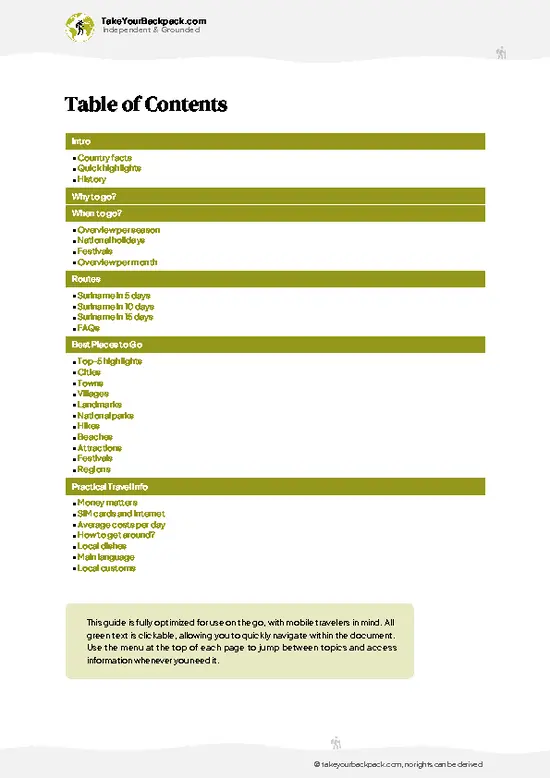
✈️ The backpacker research shortcutSuriname Travel Guide

An offline-friendly backpacking guide with optimized travel routes, ranked highlights, transport advice, and the best areas to stay.
example page 0 from our offline Travel Guide for Suriname
example page 1 from our offline Travel Guide for Suriname
example page 2 from our offline Travel Guide for Suriname
example page 3 from our offline Travel Guide for Suriname
example page 4 from our offline Travel Guide for Suriname
example page 5 from our offline Travel Guide for Suriname
example page 6 from our offline Travel Guide for Suriname
example page 7 from our offline Travel Guide for Suriname
The digital guide (153 pages) contains:
✅ 40 highlights, ranked by travel appeal
✅ Optimized 5, 10 & 15-day travel routes
✅ Cities, national parks, landmarks, beaches
✅ How to get around
✅ Offline-friendly for travel without Wi-Fi
👉 Click to see all 30+ guide features

📅 Plan smarter in minutes, not weeks
✅ Month by month travel advice
✅ Festivals & national holidays
✅ Budget expectations

🗺️ Go to the right places, skip the overrated ones
✅ Honest pros & cons of destinations
✅ Top hikes, parks & viewpoints
✅ Lesser-known places most travelers miss
✅ Clear “worth it vs skip it” guidance

🛏️ Travel smoothly without rookie mistakes
✅ Best areas to stay
✅ Transport systems explained simply
✅ Common scams & safety advice
✅ SIM cards, money & practical tips

🌍 Understand the country, not just visit it
✅ Culture & traditions
✅ 52 Essential phrases & customs
✅ Festivals worth planning around
✅ Traveler-friendly historical context
✅ Insights that make places more meaningful

📱 Built for real travel conditions
✅ Fully downloadable PDF
✅ Works completely offline
✅ Optimized for phone use
✅ Useful in remote areas & buses
✅ Everything in one place
Stop searching, start planning
Get instant access to your full guide. 30‑day money-back guarantee.
+ Add another guide for just

By proceeding you agree to our terms.
Sent to your inbox immediately after payment • 100% Secure Checkout
Best Backpacking Travel Advisor 2025 tourism awardBest Backpacking
Travel Advisor
2025
What others say about Take Your Backpack Guides:
⭐⭐⭐⭐⭐
Fantastic, amazing amount of information!
⭐⭐⭐⭐⭐
My goodness this is amazing, it's what I've been looking for hats off too you!
⭐⭐⭐⭐⭐
I think this is absolutely BRILLIANT
⭐⭐⭐⭐
Very complete and informative. It's still missing places, but I gotta to commend you
⭐⭐⭐⭐⭐
This is truly amazing, thank you, can't wait to explore it with my kids!
⭐⭐⭐⭐⭐
Awesome resource, thank you!
⭐⭐⭐⭐⭐
This is amazing! Can't wait to explore the ones I haven't seen
⭐⭐⭐⭐
I love this! Well done, great idea.
⭐⭐⭐⭐⭐
Thanks for taking the time to make this gem!
⭐⭐⭐⭐⭐
This might be the best website I've ever seen.
⭐⭐⭐⭐⭐
Congratulations, and thank you so much for your work; it's incredibly valuable.
⭐⭐⭐⭐
In all seriousness I think you did a great job pointing out the important spots
⭐⭐⭐⭐⭐
10/10 very good
⭐⭐⭐⭐⭐
As someone who's only just starting to visit regularly this is awesome, thank you.
⭐⭐⭐⭐
Thank you very much! I'm going to visit my dad, it's going to be very useful!
⭐⭐⭐⭐⭐
This is really cool! We'll be travelling for the first time and this definitely come in handy.
⭐⭐⭐⭐⭐
You are now our minister of culture, congratulations 👨‍💼
⭐⭐⭐⭐⭐
Just wanted to tell you that this is a pearl! Going to follow your recommendations.
⭐⭐⭐⭐⭐
This is so cool. I'll definitely be using the resource for my travels soon.
⭐⭐⭐⭐⭐
This is very impressive! Good work.
⭐⭐⭐⭐⭐
This is an amazing and informative site. Very well done!

🛏️ Where to stay?Where to Stay in Suriname

Suriname has a small but workable spread of hostels and guesthouses, nearly all in Paramaribo, where dorm beds run about SRD 550 to 950 (US$15 to 25) and private rooms in family-run guesthouses cost about SRD 1,100 to 1,850 (US$30 to 50). The wooden streets of the historic inner city near the Waterkant put you within walking distance of the UNESCO-listed center and riverfront food stalls, but the area empties after dark, so take a taxi at night. The leafier residential pocket around the Kleine Waterstraat entertainment strip is livelier, with bars and casinos on your doorstep, while neighborhoods further out such as Zorg en Hoop are quieter and cheaper but need a bus or taxi for most sights. … read more 👉
Suriname has a small but workable spread of hostels and guesthouses, nearly all in Paramaribo, where dorm beds run about SRD 550 to 950 (US$15 to 25) and private rooms in family-run guesthouses cost about SRD 1,100 to 1,850 (US$30 to 50). The wooden streets of the historic inner city near the Waterkant put you within walking distance of the UNESCO-listed center and riverfront food stalls, but the area empties after dark, so take a taxi at night. The leafier residential pocket around the Kleine Waterstraat entertainment strip is livelier, with bars and casinos on your doorstep, while neighborhoods further out such as Zorg en Hoop are quieter and cheaper but need a bus or taxi for most sights.

If you enjoy meeting fellow travelers, consider choosing hostels with high ratings for atmosphere. On the other hand, if you prefer having your own space, a hotel might be a better option.

SurinameMore of Suriname

👋 Meet the founderWho’s Behind Take Your Backpack?

Johan, backpacker and founder of TakeYourBackpackHi, I’m Johan (Netherlands 🇳🇱), the creator of TakeYourBackpack. Over the past 3 decades, I’ve backpacked through 90+ countries across six continents, gaining extensive experience with independent travel, long-term trips, and overland routes.

This site is built on a combination of firsthand travel experience and carefully curated insights from other backpackers. Many guides are based on places I’ve personally visited, while others bring together tips, observations, and practical advice shared by trusted travelers I’ve met along the way.

The goal is to provide realistic, experience-driven guidance — not generic itineraries — so you can explore destinations with better context, clearer expectations, and more confidence.