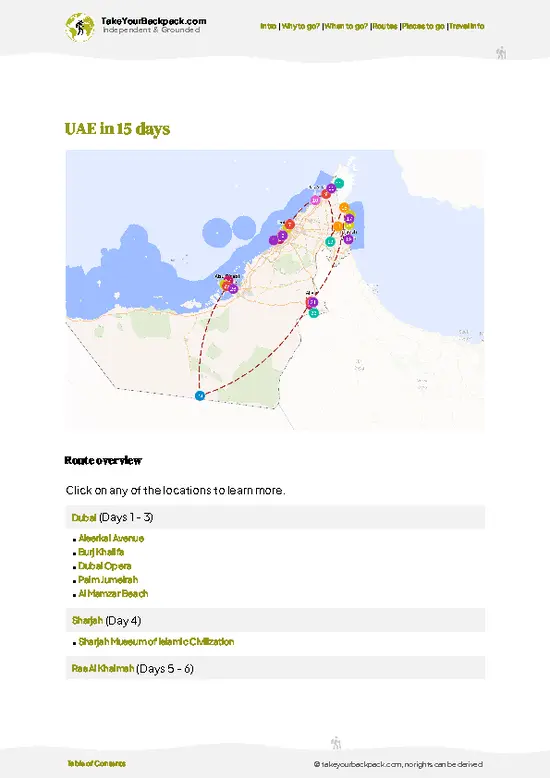
This 15-day loop is for travelers who want to see how varied the United Arab Emirates gets once you leave the glass towers: coral-stone ruins, a mountain road near 1,900 meters, snorkeling on the Gulf of Oman and a night among the high dunes of the Empty Quarter. The pace is relaxed, with two nights almost everywhere and no back-to-back long drives. The first five days use the Dubai Metro, city buses and intercity buses to Sharjah and Ras Al Khaimah. From Ras Al Khaimah you pick up a rental car, which is the only practical way to reach Jebel Jais, the east coast and Liwa. You drop it in Abu Dhabi and finish on the Etihad Rail passenger train or a flight.
Days 1-3: Dubai
Start with the city’s creative side before its famous height.
Alserkal Avenue Arts District in Al Quoz is a block of converted warehouses holding galleries, a small cinema and specialty coffee roasters, all free to wander, and it’s a good jet-lag morning because everything sits in the shade. Save
Burj Khalifa At The Top Observation …
read more 👉This 15-day loop is for travelers who want to see how varied the United Arab Emirates gets once you leave the glass towers: coral-stone ruins, a mountain road near 1,900 meters, snorkeling on the Gulf of Oman and a night among the high dunes of the Empty Quarter. The pace is relaxed, with two nights almost everywhere and no back-to-back long drives. The first five days use the Dubai Metro, city buses and intercity buses to Sharjah and Ras Al Khaimah. From Ras Al Khaimah you pick up a rental car, which is the only practical way to reach Jebel Jais, the east coast and Liwa. You drop it in Abu Dhabi and finish on the Etihad Rail passenger train or a flight.
Days 1-3: Dubai
Start with the city’s creative side before its famous height. Alserkal Avenue Arts District in Al Quoz is a block of converted warehouses holding galleries, a small cinema and specialty coffee roasters, all free to wander, and it’s a good jet-lag morning because everything sits in the shade. Save Burj Khalifa At The Top Observation Deck for an early slot, when the light comes in low over the desert to the east and the crowds are thinner than at sunset. Directly next door, Dubai Opera is the building shaped like a dhow hull; check the program before you fly, because a ballet or concert there is one of the better-value evenings in town.
Give a full day to Palm Jumeirah. Ride the monorail out along the trunk for the overhead view of the fronds, then walk the boardwalk on the outer crescent, which faces the skyline across the water and costs nothing.Days 4-5: Sharjah
On the way out of Dubai, spend the morning at Al Mamzar Beach, a park of lawns and sheltered coves right at the Sharjah border with a small entry fee and far fewer people than the Jumeirah strip. A short bus or taxi ride takes you into Sharjah, the most conservative emirate: no alcohol anywhere, and shoulders and knees should stay covered in public. The reason to sleep here is the Sharjah Museum of Islamic Civilization on the waterfront, set in a former souk under a gold-mosaic dome, with astrolabes, Qur’an manuscripts and ceramics spread over two floors. Two to three hours is enough, and the evening walk along the lagoon front is calm and cool.Days 5-7: Ras Al Khaimah
Intercity buses from Sharjah reach Ras Al Khaimah in about 1.5 hours. Start at Al Jazirah Al Hamra, an abandoned pearling village of coral-stone houses, wind towers and a mosque, left empty in the late 20th century and now partly restored. Go late in the afternoon when the stone turns orange. Nearby, Ras Al Khaimah’s Dhayah Fort sits on a rocky hill above date gardens, a climb of a couple of hundred steps to the only hilltop fort in the country, with views to the Hajar peaks and the sea.
Collect your rental car and drive up Jebel Jais. The road switchbacks to around 1,900 meters, the highest paved point in the UAE, and in winter the top runs 10 degrees Celsius or more cooler than the coast, so pack a fleece. Short marked trails leave from the viewing decks, and the Jais Flight zipline launches from up here if you want the adrenaline.Days 7-9: Dibba Al-Fujairah and the East Coast
Cross the mountains toward the Gulf of Oman with two stops. At Wadi Shawka, walk the short trails around the dam in the morning, when the rock is still cool. Then pass through Masafi, the small town known for its spring water, where the roadside stalls sell pottery, carpets and plants. Base yourself in Dibba Al-Fujairah, a low-rise fishing town at the foot of mountains that drop straight into the sea.
The next day is for the water. Rent snorkel gear on the beach facing Snoopy Island, a rocky islet off Al Aqah where you can see reef fish, rays and sometimes turtles in calm months. On the drive south, stop at Al Badiyah Mosque, a tiny four-domed mud-and-stone mosque usually dated to the 15th century and the oldest in the UAE that is still in use; dress modestly and visit outside prayer times. Continue to Khor Fakkan Beach, a long curved bay in Sharjah’s east-coast enclave with a corniche, cafés and a mountain backdrop.Days 9-11: Al Ain
Leave Dibba after breakfast and stop at Fujairah Fort, the restored mud-brick fort beside the old village on the edge of Fujairah city, before driving about 2.5 hours inland to Al Ain. This is the green city of the UAE, and you see why on the Al Ain Oasis Trail: shaded paths through palm groves fed by falaj irrigation channels that have carried water here for centuries. Walk it early, then spend the late afternoon at Al Ain Zoo, where Arabian oryx, sand gazelles and big cats live in large desert enclosures; the evening hours are cooler and more of the animals are moving.
With the car, the sunset drive up Jebel Hafeet is easy. The road climbs about 12 kilometers in a long series of curves to a summit above 1,200 meters, with the plains of Oman spreading out below.Days 11-13: Liwa Oasis
The drive from Al Ain to Liwa Oasis takes about 3.5 to 4 hours, mostly on empty highway, so fill up the tank and carry water. Liwa is a crescent of farming villages on the northern rim of the Rub’ al Khali, and the dunes around it are among the tallest on the Arabian Peninsula. Two nights give you one sunset and one sunrise in the sand, plus time for the date farms and the small forts along the oasis road. Stick to the paved roads in a regular rental car and book a local operator if you want to go off-road. Lodging runs from simple hotels in the main town of Mezaira’a to desert resorts that are expensive but worth it for a single night.Days 13-15: Abu Dhabi
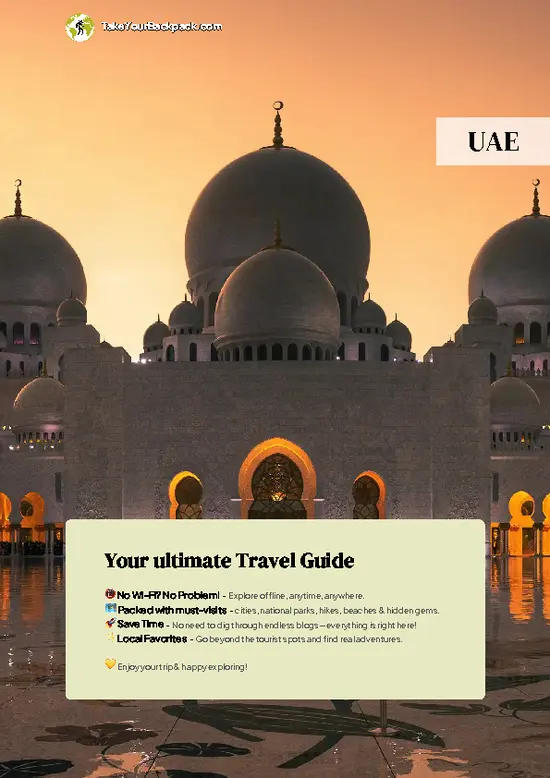
The road back to Abu Dhabi takes 2.5 to 3 hours, which leaves time to return the car and freshen up before dusk at the Sheikh Zayed Grand Mosque. Entry is free with an online booking, and at sunset the white marble shifts to blue under its night lighting. Give your final full day to the Louvre Abu Dhabi, where the perforated dome scatters light over galleries arranged by era rather than by region, then cool off at Corniche Beach, the city’s main public beach, with lifeguards, shade and the skyline right behind you. On day 15, fly out of Abu Dhabi or take the Etihad Rail train to Dubai, about 64 minutes.
If a friend were doing this loop, I would send them to Al Rams, the old fishing town about 20 minutes’ drive north of Ras Al Khaimah city, for the last hour of light along the harbor among coral-stone houses and moored dhows, with small cash for tea at a cafeteria.
 Best Backpacking


