×
United Kingdom🇬🇧 | 14 days itinerary

A Complete 14-Day Plan for the UK

By Johan Kruseman 🇳🇱 | Updated May 1, 2026
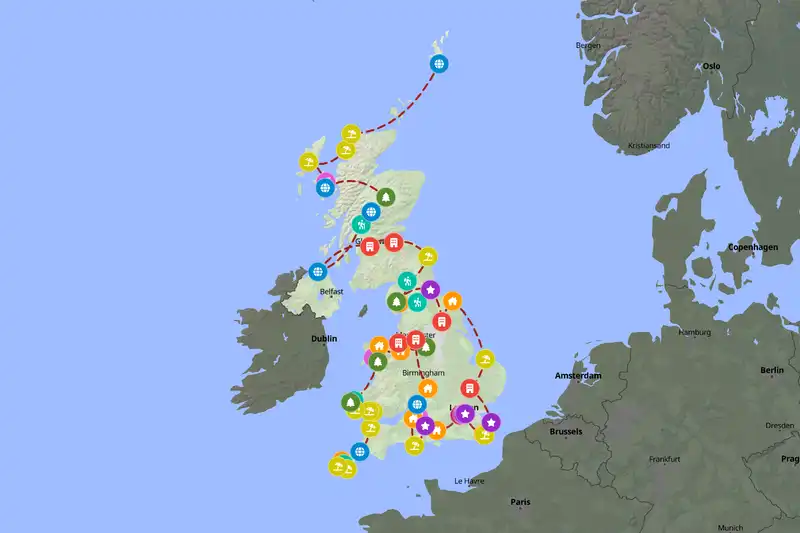
This 14-day route is for travelers who want a balanced first or second trip to the UK: big-city culture, storybook countryside, and a taste of the north, all at a moderate pace. You’ll rely mainly on trains with a few short bus or taxi hops, keeping travel days reasonable while still covering England’s greatest hits from London to York and the Lake District.

Days 1-4: Deep-Dive London - History, Art, and the Thames

Start with four nights in London so you can actually settle in rather than treating the capital like a layover. Use one day to pair the British Museum with the National Gallery, giving yourself time to linger over a few masterpieces instead of sprinting through every room. Another day, lean into science and design by combining the Natural History Museum with the Science Museum and the Victoria and Albert Museum, all within walking distance so you can mix and match depending on your energy. Carve out an afternoon for the Palace of Westminster and Westminster Abbey area, then another … read more 👉
This 14-day route is for travelers who want a balanced first or second trip to the UK: big-city culture, storybook countryside, and a taste of the north, all at a moderate pace. You’ll rely mainly on trains with a few short bus or taxi hops, keeping travel days reasonable while still covering England’s greatest hits from London to York and the Lake District.

Days 1-4: Deep-Dive London - History, Art, and the Thames

Start with four nights in London so you can actually settle in rather than treating the capital like a layover. Use one day to pair the British Museum with the National Gallery, giving yourself time to linger over a few masterpieces instead of sprinting through every room. Another day, lean into science and design by combining the Natural History Museum with the Science Museum and the Victoria and Albert Museum, all within walking distance so you can mix and match depending on your energy. Carve out an afternoon for the Palace of Westminster and Westminster Abbey area, then another for the Tower of London and a stroll across Tower Bridge, finishing with sunset views along the river and maybe a quick look at Maritime Greenwich if you fancy a boat ride down the Thames.

Days 5-7: Oxfordshire Grandeur and Cotswold Charm

Leave London by train toward Oxfordshire and base yourself in the countryside, using local buses or short taxis to explore. Spend a day at Blenheim Palace, where the scale of the house and grounds gives you a very different angle on British history than the royal sites in London. Then shift into slower gear in the Cotswolds region, wandering stone villages and rolling hills, and make time for Lacock as a classic village stop that feels almost too perfectly preserved. This phase is all about long lunches, short walks, and evenings where you don’t need a plan beyond “find a pub and stay awhile.”

Days 8-10: Roman Bath, Cathedral Splendour, and the South West Coast

Head to Bath for two nights, using the first afternoon to simply walk the crescents and soak up the Georgian architecture before diving into The Roman Baths on your full day. From Bath, take a short hop to Salisbury, where you can visit the cathedral and, if you didn’t already, connect to Stonehenge via bus or tour without turning it into a frantic day. Then continue south-west into Cornwall, basing in St. Ives for sea air and coastal walks; this is where the trip shifts from city-and-castle mode into cliff paths, beaches, and slower mornings with coffee overlooking the water.

Days 11-14: Northern Stories - York and the Lake District

Travel by train up to York, giving yourself two nights to walk the city walls, get lost in medieval lanes, and feel how different the north of England is from London and the south. From there, continue to the Lake District National Park, basing in Keswick for three nights so you can hike, take lake cruises, and explore nearby Hawkshead as a classic Lakeland village without packing and unpacking every day. This final phase is about fresh air and big views, and the contrast makes your earlier museum days feel richer when you think back on them during a quiet evening by the water.

My favorite stretch of this route is the train ride from York into the Lake District, when the city sprawl falls away and you suddenly realize just how green and wild England can be.
Loading the map 🌍
film
0
0
0a
London
Pixabay
film
1
1
1a
British Museum
Pixabay
film
2
2
2a
National Gallery
film
3
3
3a
Victoria and Albert Museum
Pixabay
film
4
4
4a
Palace of Westminster and Westminster Abbey
Franck Diverd
film
5
5
5a
Tower of London
Unsplash
film
6
6
6a
Tower Bridge
Pixabay
film
7
7
7a
Maritime Greenwich
film
8
8
8a
Cotswolds
Mallgosia Mocek
film
9
9
9a
Blenheim Palace
Katy
film
10
10
10a
Lacock
film
11
11
11a
Bath
Raj Patel
film
12
12
12a
Stonehenge
film
13
13
13a
St. Ives
film
14
14
14a
Porthcurno Beach
film
15
15
15a
York
film
16
16
16a
Lake District
Pixabay
film
17
17
17a
Keswick

🛏️ Where to stay?Your Route at a Glance

✈️ The backpacker research shortcutthe UK Travel Guide

An offline-friendly backpacking guide with optimized travel routes, ranked highlights, transport advice, and the best areas to stay.
example page 0 from our offline Travel Guide for United Kingdomexample page 1 from our offline Travel Guide for United Kingdomexample page 2 from our offline Travel Guide for United Kingdomexample page 3 from our offline Travel Guide for United Kingdomexample page 4 from our offline Travel Guide for United Kingdomexample page 5 from our offline Travel Guide for United Kingdom
The digital guide (446 pages) contains:
145 highlights, ranked by travel appeal
Optimized 7, 14 & 21-day travel routes
Best neighborhoods to stay
How to get around
Offline-friendly for travel without Wi-Fi
👉 See all 30+ guide features

📅 Plan smarter in minutes, not weeks
Month by month travel advice
Festivals & national holidays
Budget expectations

🗺️ Go to the right places, skip the overrated ones
Honest pros & cons of destinations
Top hikes, parks & viewpoints
Lesser-known places most travelers miss
Clear “worth it vs skip it” guidance

🛏️ Travel smoothly without rookie mistakes
Best areas to stay
Transport systems explained simply
Common scams & safety advice
SIM cards, money & practical tips

🌍 Understand the country, not just visit it
Culture & traditions
Local customs
Festivals worth planning around
Traveler-friendly historical context
Insights that make places more meaningful

📱 Built for real travel conditions
Fully downloadable PDF
Works completely offline
Optimized for phone use
Useful in remote areas & buses
Everything in one place
Save weeks of stressful planning
Get instant access to the full guide directly. 30-day money-back guarantee.


Sent to your inbox immediately after payment • 100% Secure Checkout
Best Backpacking Travel Advisor 2025 tourism awardBest Backpacking
Travel Advisor
2025
What others say about Take Your Backpack Guides:
⭐⭐⭐⭐⭐
Fantastic, amazing amount of information!
⭐⭐⭐⭐⭐
My goodness this is amazing, it's what I've been looking for hats off too you!
⭐⭐⭐⭐⭐
I think this is absolutely BRILLIANT
⭐⭐⭐⭐
Very complete and informative. It's still missing places, but I gotta to commend you
⭐⭐⭐⭐⭐
This is truly amazing, thank you, can't wait to explore it with my kids!
⭐⭐⭐⭐⭐
Awesome resource, thank you!
⭐⭐⭐⭐⭐
This is amazing! Can't wait to explore the ones I haven't seen
⭐⭐⭐⭐
I love this! Well done, great idea.
⭐⭐⭐⭐⭐
Thanks for taking the time to make this gem!
⭐⭐⭐⭐⭐
This might be the best website I've ever seen.
⭐⭐⭐⭐⭐
Congratulations, and thank you so much for your work; it's incredibly valuable.
⭐⭐⭐⭐
In all seriousness I think you did a great job pointing out the important spots
⭐⭐⭐⭐⭐
10/10 very good
⭐⭐⭐⭐⭐
As someone who's only just starting to visit regularly this is awesome, thank you.
⭐⭐⭐⭐
Thank you very much! I'm going to visit my dad, it's going to be very useful!
⭐⭐⭐⭐⭐
This is really cool! We'll be travelling for the first time and this definitely come in handy.
⭐⭐⭐⭐⭐
You are now our minister of culture, congratulations 👨‍💼
⭐⭐⭐⭐⭐
Just wanted to tell you that this is a pearl! Going to follow your recommendations.
⭐⭐⭐⭐⭐
This is so cool. I'll definitely be using the resource for my travels soon.
⭐⭐⭐⭐⭐
This is very impressive! Good work.
⭐⭐⭐⭐⭐
This is an amazing and informative site. Very well done!

🧭 RouteAlternative Routes

Travel the UK your way — from a quick highlights trip to a slow-paced adventure.

🙋 FAQBackpacking FAQ

Yes, the UK is very easy to backpack independently, especially for a first big trip. English everywhere, clear signage, and a culture that’s used to solo travelers all work in your favor. The main challenge is cost, not logistics, so your job is to outsmart the prices.

Hostels are common in cities and major hiking areas (London, Edinburgh, Glasgow, Manchester, Liverpool, Bristol, Bath, York, the Lake District, Snowdonia, Scottish Highlands). In smaller towns you’ll lean on budget hotels, guesthouses, or camping. Book ahead for summer, bank holidays, and big events (Edinburgh Fringe, football matches, Glastonbury, etc.).

Train and bus networks are dense, and walking cities is safe and straightforward. You can improvise your route as you go, but you save a lot of money by planning long-distance trains and buses a bit in advance. Contactless cards and phone payments make day-to-day life easy: you tap onto buses, the Tube, and many local trains without thinking about tickets.

The social side is simple: pubs, hostel common rooms, and long-distance trails (West Highland Way, Hadrian’s Wall Path, South West Coast Path sections) are natural places to meet people. Locals are generally helpful if you’re polite and concise. The weather is the only real wildcard, so pack a light waterproof, quick-dry layers, and shoes that can handle rain and mud.

If you’re comfortable reading timetables, using basic map apps, and handling your own bookings, the UK is one of the easiest countries to roam solo on a budget.
For a first-time backpacking trip, 10–14 days is the sweet spot if you want more than just London without burning out.

Rough timing tiers that actually work on a budget:

4–5 days (ultra-short): Focus on one city and its orbit. Example: London + a single day trip (Brighton, Oxford, Cambridge, or Bath). You’ll barely scratch the surface but you won’t waste time in transit.

7 days (classic week): Two bases. Example: 4 days London, 3 days Edinburgh (or 3 London, 2 Edinburgh, 2 York/Manchester). This gives you a taste of England and Scotland without racing.

10–14 days (ideal first trip): Three to four bases. Example: London → York → Edinburgh → Highlands day trips, or London → Bath/Bristol → Snowdonia/Lake District → Manchester/Liverpool. You can mix cities with at least one hiking region.

3+ weeks: You can start doing the UK justice. England, Scotland, and Wales all get time, maybe a hop to Northern Ireland. You can walk a multi-day trail (West Highland Way, parts of the South West Coast Path) and still enjoy cities.

Because transport and accommodation are pricey, it’s better to spend longer in fewer places than to try to “collect” cities. A slow 10 days in 3–4 spots beats a frantic 10 days in 7–8 places. If you’re on a very tight budget, shoulder seasons (spring and autumn) stretch your money further and make last-minute hostel hunting less stressful.
Yes, you can absolutely get around the UK without a car, and for backpackers it’s usually the smarter move.

Trains: Fast, frequent between major cities (London–Edinburgh, London–Manchester, London–Bristol, etc.), but expensive if you buy last minute. Book advance tickets when you can, travel off-peak, and check if a railcard makes sense (16–25, 26–30, Two Together, or regional cards). For some routes, slower regional trains or split tickets can be cheaper than a single direct fare.

Coaches (buses): This is where budget travelers win. National Express and Megabus connect most cities and many airports. They’re slower than trains but often dramatically cheaper, especially if you book early or travel at odd hours. Overnight coaches can save you a night’s accommodation on long hops.

Local transport: Cities have solid bus networks; London adds the Tube, Overground, and trains. You tap in and out with a contactless card or phone in most places, and daily caps keep costs from spiraling in London. In smaller towns, buses may be infrequent, so check schedules and avoid assuming you can rock up late at night.

Ferries: Useful for islands (Isle of Skye via bridge or bus, Isle of Wight, Scottish islands, Northern Ireland). They’re easy to use but sometimes require planning around limited sailings.

On foot and bike: City centers are walkable, and many of the UK’s best bits are on long-distance trails. For rural areas with poor bus service, consider basing yourself in a town with a train station and doing day hikes from there.

You only really “need” a car if you want very remote corners (tiny Highland villages, obscure coastal coves, scattered stone circles) on a tight schedule. For most backpackers, public transport plus a bit of walking covers 90% of what’s worth your time.
For a budget backpacker, “must-visit” means places that give you a strong sense of the UK’s character without draining your wallet. Think mix of history, pub culture, and landscapes.

London (but on your terms): Not optional, but you don’t need to spend a fortune. Free world-class museums (British Museum, National Gallery, Tate Modern), markets (Borough, Camden, Brick Lane), and walks along the Thames or through parks (Hyde Park, Hampstead Heath). Stay in a hostel outside Zone 1 and use a contactless card for transport.

Edinburgh: Compact, atmospheric, and easy to explore on foot. The Royal Mile, Arthur’s Seat hike, Calton Hill, and the Old Town give you history and views without paid attractions. It’s busy and pricey in August (Fringe Festival), so other months are better for budgets.

A northern English city (York, Manchester, or Liverpool):
- York: Medieval walls, narrow lanes, and a very walkable center. Great if you like history and cozy pubs.
- Manchester: Music, nightlife, and a gritty, creative feel. Good base for cheap flights and trains.
- Liverpool: Beatles history, docks, and a friendly, chatty vibe.
Pick one based on what excites you; all three are worth a stop.

A hiking region:
- Scottish Highlands: Glencoe, Fort William, or a stretch of the West Highland Way. Big scenery, moody weather, and both wild camping (where legal and responsible) and hostels.
- Lake District (England): Classic hills, lakes, and stone villages. Great day hikes from bases like Keswick or Ambleside.
- Snowdonia/Eryri (Wales): Mountain feel with good value hostels and campsites. Routes up Yr Wyddfa (Snowdon) range from easy-ish to demanding.

Bath or Oxford/Cambridge (pick one stop):
- Bath: Georgian architecture, Roman history, and a very walkable center.
- Oxford or Cambridge: College courtyards, riverside walks, and cheap or free college chapels and museums.

If you have extra time, add: Brighton (seaside + alternative culture), Bristol (street art and music), or a Scottish island (Skye is popular but busy; others are quieter).
If you’re short on time or cash, skip anything that eats hours in transit without giving you a new side of the UK.

Over-collecting cities: You don’t need London + Bath + Oxford + Cambridge + Brighton + Manchester + Liverpool + York in one trip. After 3–4 cities, they start to blur. Pick a couple that match your interests and move on to nature.

Expensive “tick-box” attractions (unless you’re obsessed):
- London Eye: Great view, high price, long queues. Free or cheap viewpoints (Sky Garden with booking, Primrose Hill, Greenwich Park) scratch the same itch.
- Madame Tussauds and similar wax museums: Costly and generic; you could be anywhere in the world.
- Overpriced bus tours where you can easily walk or use public transport.

Far-flung corners on a tight schedule:
- Trying to do both the far north of Scotland and Cornwall in one short trip is a time and money sink. Distances are long, and you’ll spend days on trains or buses instead of actually being somewhere.
- Very remote islands if you only have a week. Ferries, weather delays, and sparse buses can hijack your schedule.

Shopping-focused areas: High-end shopping streets (Oxford Street, Knightsbridge, designer outlets) are easy to skip unless you specifically want them. They add little to understanding the UK and drain your budget fast.

Overcrowded “Instagram stops” where the logistics outweigh the payoff: Some tiny villages or viewpoints made famous online are hard to reach without a car and packed in peak season. If getting there requires multiple awkward bus changes and a pricey stay, you’re usually better off choosing a more accessible town or trail with similar scenery.

If you’re really squeezed for time, prioritize: London (short, focused stay), one other city that fits your style, and one hiking or coastal area. Everything else is optional garnish.

🇬🇧 the UKMore of the UK

Ready to build a truly unique trip? Predefined routes are perfect for first-time visitors, but there is so much more to discover. Whether you are chasing a city trip, pristine national parks, local food scenes, or quiet beaches, pick a category to design your own path.