×

United Kingdom🇬🇧 | best townsThe 10 Top towns in the UK

Towns in the United Kingdom (UK) come in flavors that have little to do with each other, which is how you end up eating a pasty in a rain-lashed harbor one week and a scone in a honey-stone market square the next. Expect compact centers you can walk in 20 minutes, a pub on almost every corner, and a train station that usually sits closer to the action than the bus stop. Southern England charges southern prices and draws the biggest crowds. The north of England, Wales and Scotland cost less, empty out faster and reward anyone willing to check a bus timetable. Scottish and Welsh towns can sit a long way from a station, so access shifts from effortless to a planning exercise. For backpacking or any independent trip, the sensible approach is to pick by character first and let the weather and your wallet argue about the rest.

By Johan Kruseman 🇳🇱 | Updated October 18, 2026
Explore the best villages in the UK

Why go?What Makes Them Special

The UK has an unusual number of towns that still make sense on foot, because most of them grew around a market, a port, a river crossing or a mill long before anyone owned a car. The result is dense, walkable centers with a castle, abbey, guildhall or harbor wall still doing its original job of dominating the skyline. Layers of Roman, medieval, Georgian and industrial building sit within a few streets of each other, so a single afternoon can cover a thousand years without a ticket booth in sight.

The rail and bus network is the other advantage. Few countries let you reach so many small places without driving, though you should know that fares bought on the day can cost several times the advance price, and that rural services thin out sharply on Sundays. Weather is a character in every itinerary. … read more 👉
The UK has an unusual number of towns that still make sense on foot, because most of them grew around a market, a port, a river crossing or a mill long before anyone owned a car. The result is dense, walkable centers with a castle, abbey, guildhall or harbor wall still doing its original job of dominating the skyline. Layers of Roman, medieval, Georgian and industrial building sit within a few streets of each other, so a single afternoon can cover a thousand years without a ticket booth in sight.

The rail and bus network is the other advantage. Few countries let you reach so many small places without driving, though you should know that fares bought on the day can cost several times the advance price, and that rural services thin out sharply on Sundays. Weather is a character in every itinerary. Rain arrives on its own schedule, so the best towns are the ones with a warm pub, a museum or a covered market to retreat to, and the UK has plenty of all three.

Before choosing the UK for its towns, understand that regions behave differently. England, Scotland, Wales and Northern Ireland each have their own character, accents and sometimes their own rules, such as Scotland’s right to roam and its separate banknotes, which shops in England may grudgingly accept. Prices are high by European standards, especially for accommodation in popular spots in summer. Pubs often stop serving food mid-evening, and many shops close by 5:30 pm in smaller places. None of this is a flaw, just local rhythm. Plan around it and the UK delivers an exceptional density of character per kilometer.
How the List Was Created
The list of best towns in the UK is created based on charm, local culture, atmosphere, hidden gems, and visitor appeal. If you feel a town is missing in this list, please let us know.

When to go?Seasonal Guide to Visiting

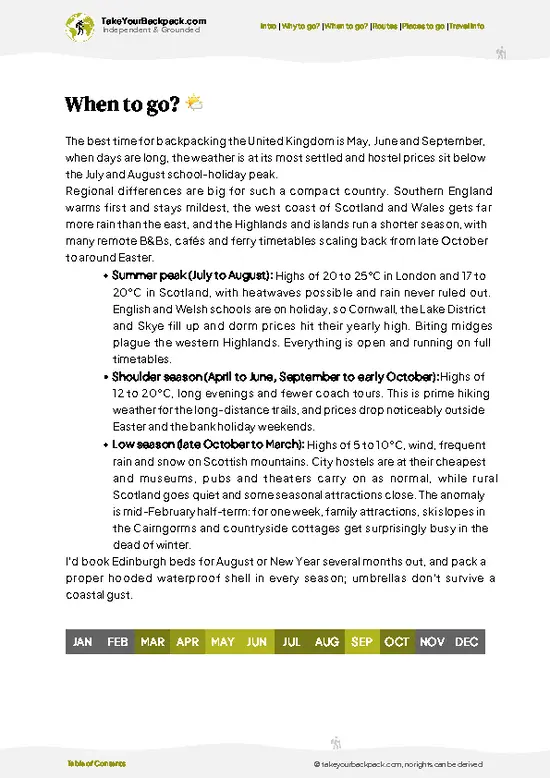
Best months and why: May, June and September are the best months for towns in the UK, because days run 14 to 17 hours long in early summer, temperatures sit around 12 to 20°C, and the school-holiday crowds have not yet arrived or have already gone home. Everything is open, outdoor tables appear, and you have a fair chance of seeing the sun at least once.

Shoulder seasons and peak crowds: April and October are the shoulder months, with highs of 9 to 14°C and showers that come and go several times before lunch. Some seasonal attractions, particularly in coastal towns and the Scottish Highlands, open late or close early, so check hours before you go. Rain is spread throughout the year, but western areas such as Wales, northwest England and western Scotland get roughly twice as much as the east, … read more 👉
Best months and why: May, June and September are the best months for towns in the UK, because days run 14 to 17 hours long in early summer, temperatures sit around 12 to 20°C, and the school-holiday crowds have not yet arrived or have already gone home. Everything is open, outdoor tables appear, and you have a fair chance of seeing the sun at least once.

Shoulder seasons and peak crowds: April and October are the shoulder months, with highs of 9 to 14°C and showers that come and go several times before lunch. Some seasonal attractions, particularly in coastal towns and the Scottish Highlands, open late or close early, so check hours before you go. Rain is spread throughout the year, but western areas such as Wales, northwest England and western Scotland get roughly twice as much as the east, often 1,000 to 1,500 mm a year against 600 to 700 mm in eastern England.

July and August bring peak prices and peak crowds. Dorm beds and budget rooms in popular southern and coastal towns can cost 30 to 60 percent more than in spring, and weekends in summer fill up weeks in advance. Scotland has a separate hazard in midges, the biting insects that flourish from June to August on calm, damp evenings, so a repellent is worth packing. Edinburgh in August adds festival pricing on top of that.

Winter: November to February is cheap and quiet, with highs of 4 to 8°C and daylight in the north shrinking to about seven hours in December. Festive markets and Christmas lights make December briefly busy, and some rural attractions and ferries cut back or shut until spring. It suits anyone happy to spend afternoons in pubs and museums, and who accepts that the sun sets around 4 pm.

town hoppingPlanning Your Route Efficiently

How many days to allow: A trip linking several towns in the UK needs 10 to 14 days, which allows four to six stops without turning the trip into a series of platform sprints. Shorter is possible, but the UK is deceptive: the country looks small on a map, and a single train delay can eat an afternoon.

Grouping regions and direction: Cluster by region rather than by fame. Southern England pairs naturally with the southwest, and a loop from London via Bath and Bristol into Devon and Cornwall works with trains of one to three hours between legs. The Midlands connect to northern England through Birmingham, Manchester and York, where journeys are often 1.5 to 2.5 hours. The big jump is the one from northern England to Scotland, roughly 2.5 to 4.5 hours by rail from York or Manchester to Edinburgh … read more 👉
How many days to allow: A trip linking several towns in the UK needs 10 to 14 days, which allows four to six stops without turning the trip into a series of platform sprints. Shorter is possible, but the UK is deceptive: the country looks small on a map, and a single train delay can eat an afternoon.

Grouping regions and direction: Cluster by region rather than by fame. Southern England pairs naturally with the southwest, and a loop from London via Bath and Bristol into Devon and Cornwall works with trains of one to three hours between legs. The Midlands connect to northern England through Birmingham, Manchester and York, where journeys are often 1.5 to 2.5 hours. The big jump is the one from northern England to Scotland, roughly 2.5 to 4.5 hours by rail from York or Manchester to Edinburgh or Glasgow, so make it once and do not double back. Wales fits as a side loop from Chester, Bristol or Cardiff. Travel north in a single direction where you can, because London is the hub that sells the cheapest onward tickets, and a one-way route avoids paying twice for the same corridor.

Time per stop and common mistakes: Most towns need one to two nights, since a walkable center takes half a day to cover and the rest is pubs, hills or a short coastal walk. Three nights makes sense only if you want a base for day trips.

The classic error is cramming too many stops into too few days, then spending each morning on a luggage-dragging hunt for the correct platform. Cap yourself at one move a day. Another is buying rail tickets on the day, which can cost two to four times the advance fare, so book 4 to 12 weeks ahead for long hops. Rural Sunday timetables sometimes shrink to a handful of buses or nothing at all, so schedule long transfers for weekdays and leave the slow, local ones for when you actually have time.

The ListHighly Recommended towns of the UK

1 Bath

Roman baths, Georgian crescents, honey-stone streets

Wander among grand terraces and ancient pools, where daily life unfolds between architectural landmarks and a steady stream of local activity.

united-kingdom-city-bath
© Google | Raj Patel

2 St Ives

Artists’ studios, sandy beaches, tidal harbour

Watch changing light inspire painters and surfers alike, with narrow alleys leading to hidden coves and bustling waterfronts.

united-kingdom-city-st-ives
© Google |

3 Whitby

Abbey ruins, fishing harbour, cliffside paths

Climb steep steps to windswept ruins, then descend for fresh seafood and stories of explorers and legends along the North Sea.

4 Stratford-upon-Avon

Shakespeare sites, timbered houses, riverside gardens

Trace the playwright’s footsteps through half-timbered lanes, then unwind by the Avon as punts and theatre-goers pass by.

5 Canterbury

cathedral precincts, pilgrim routes, timbered houses

Walk ancient paths through a city shaped by religious history, literary connections, and well-preserved medieval architecture.

6 Chester

Roman walls, black-and-white rows, riverside walks

Circle ancient defences, browse unique galleries above street level, and follow the Dee for a blend of history and daily bustle.

7 Durham

Cathedral skyline, wooded peninsula, university cloisters

Cross arched bridges to a city shaped by learning and faith, where riverside paths wind beneath towers and quiet courtyards.

8 Winchester

cathedral close, market square, Saxon heritage

Explore a small city where early English history is visible in quiet streets, green spaces, and a prominent cathedral.

9 Llandudno

Victorian promenade, seaside pier, twin headlands

Stroll the wide esplanade, ride the tramway to panoramic cliffs, and experience a classic coastal resort shaped by sea and sky.

united-kingdom-city-llandudno
© Google |

10 Falmouth

Deep-water harbour, maritime museum, student nightlife

Board ferries to nearby coves, visit working docks, and discover a town where maritime heritage meets a youthful, energetic scene.

11 Oban

Harbourfront, ferry port, seafood stalls

Sample fresh catch at the quay, watch ferries depart for distant isles, and feel the pulse of a working gateway to the Hebrides.

12 Penzance

Harbour quays, subtropical gardens, art deco lido

Explore palm-lined streets and tidal pools, then catch ferries or stroll galleries in a town shaped by sea breezes and creative energy.

13 Rye

Cobbled lanes, hilltop church, timbered inns

Climb winding streets past centuries-old buildings, then pause for views across marshland and a town shaped by tides and trade.

united-kingdom-city-rye
© Google | Zach Dills

14 Ambleside

Lakehead jetties, slate cottages, waterfall trails

Begin hikes from the heart of town, with easy access to boat trips, woodland paths, and classic Lakeland scenery all around.

15 Keswick

Market square, Derwentwater shore, fell walks

Set out from a lively centre for lakeside rambles and mountain trails, returning to local shops and weekly outdoor markets.

united-kingdom-city-keswick
© Google |

16 Fort William

Ben Nevis base, rail terminus, lochside high street

Gear up for mountain ascents or scenic rail journeys, with outdoor shops and pubs catering to walkers and cyclists year-round.

17 Stirling

Hilltop castle, old town lanes, battlefield views

Survey sweeping landscapes from castle walls, then descend to winding streets and reminders of pivotal moments in Scottish history.

united-kingdom-city-stirling
© Google |

18 Conwy

Medieval walls, castle views, estuary setting

Trace the compact lanes beneath stone ramparts, then watch tides shift along the waterfront as fishing boats and seabirds come and go.

19 Tenby

Walled town, pastel facades, tidal islands

Circle sturdy ramparts, cross to offshore sands at low tide, and experience a town where the sea shapes every daily rhythm.

20 Salisbury

Cathedral spire, medieval grid, riverside meadows

Admire England’s tallest spire, then wander quiet water meadows and a city centre laid out for easy exploration on foot.

21 Shrewsbury

Looping river, Tudor facades, market halls

Navigate a maze of medieval streets, cross stone bridges, and sample local produce in a town encircled by the Severn.

22 Aberystwyth

Seafront promenade, university campus, ruined castle

Watch sunsets from the promenade, climb to hilltop ruins, and experience a lively student town on the edge of Cardigan Bay.

23 Totnes

Hilltop castle, alternative shops, Dart Valley

Browse independent stores and riverside markets, then climb to a Norman keep for views across a town known for its creative spirit.

24 Matlock

Derwent gorge, Victorian parks, cable car

Ride above wooded valleys, relax in riverside gardens, and explore a spa town shaped by geology and 19th-century ambition.

25 Inverness

River Ness, Highland gateway, Victorian market

Begin Highland journeys from a riverside centre, where local markets and castle views frame a city at the edge of wild landscapes.

26 Bangor

Marina, Victorian pier, North Down coast

Watch yachts in sheltered waters, stroll the restored pier, and use this seaside town as a base for exploring the Ards Peninsula.

27 Hexham

Abbey, market place, Tyne Valley

Pause in a lively square beneath ancient towers, then set out for riverside walks and Roman sites in the surrounding countryside.

28 Kirkwall

Norse cathedral, harbour piers, Orkney hub

Step inside sandstone churches, browse local shops, and use this compact centre as a launch point for exploring the Orkney archipelago.

29 Lerwick

Shetland port, stone lanes, fishing fleet

Experience island life where ferries, trawlers, and seabirds converge, and narrow streets reveal a blend of Nordic and Scottish influences.

30 Armagh

Twin cathedrals, orchard country, Georgian streets

Visit ancient churches, explore leafy avenues, and discover a small city at the heart of Northern Ireland’s apple-growing region.

Think you know the UK?

Prove you’re a true local — uncover 20 lesser-known towns in the UK that locals tend to keep to themselves.
Loading the map 🌍

Expert viewInsights from Locals and Experts

How many towns to visit: Plan on four to six towns for a trip of two weeks, and three or four for ten days. That count leaves you at least one full day in each place, with slack for the inevitable delay, rain or the discovery that a particular pub only serves food until 8 pm. Cram in eight and you see eight train stations.

Choosing the kind of town: Decide by travel style. Anyone chasing history and architecture should favor cathedral and market towns in the south and Midlands, which are walkable and photogenic, though they draw tour groups at midday. Hikers and budget travelers do better in northern England, Wales and Scotland, where trailheads sit at the edge of town, rooms are cheaper and crowds thin dramatically outside July and August. Coastal towns suit slower trips, but many shut cafes … read more 👉
How many towns to visit: Plan on four to six towns for a trip of two weeks, and three or four for ten days. That count leaves you at least one full day in each place, with slack for the inevitable delay, rain or the discovery that a particular pub only serves food until 8 pm. Cram in eight and you see eight train stations.

Choosing the kind of town: Decide by travel style. Anyone chasing history and architecture should favor cathedral and market towns in the south and Midlands, which are walkable and photogenic, though they draw tour groups at midday. Hikers and budget travelers do better in northern England, Wales and Scotland, where trailheads sit at the edge of town, rooms are cheaper and crowds thin dramatically outside July and August. Coastal towns suit slower trips, but many shut cafes and attractions between November and March. University towns have the best cheap eating and the liveliest evenings, but term time makes accommodation tight. Mix one or two of each rather than stacking identical stops.

What it actually costs: The UK is not cheap. A tight budget runs about £60 to 85 (US$75 to 108) a day: a dorm bed at £20 to 40, a supermarket meal deal at £3.50 to 4.50, a pub main at £13 to 18, and local buses at £2 to 5 a ride. Add a double room in a guesthouse and the figure climbs to £110 to 160 (US$140 to 200). Costs in London and the southeast run well above this, and in Scotland in August beds can double.

Entry fees are where budgets quietly bleed. Castles and abbeys often charge £10 to 25 each, and guided walking tours run £10 to 20 per person, though free tours operate on a tip basis in many towns. Cathedrals frequently ask for a suggested donation of £5 to 10. If you plan three or more historic sites, a membership such as the National Trust or English Heritage pass (roughly £35 to 60 for a short-term overseas visitor option) can pay for itself fast, and many town museums are free.

Transport traps: Walk-up rail fares are the biggest drain. A single long-distance ticket bought on the day can run £60 to 150, while the same seat booked weeks ahead might be £20 to 50. Railcards cost about £30 a year and save a third on most fares, so buy one if you will take more than a few trips. Delays and strikes occasionally strand travelers, and rural last buses can leave as early as 5 or 6 pm, so confirm the final departure before a day out.

Safety and local etiquette: Towns in the UK are generally safe, and violent crime against visitors is rare. Pickpocketing and phone snatching happen in busy centers and around stations, so keep valuables zipped. Weekend nights in town centers can get rowdy near closing time, so stay a few streets from the loudest clubs if you like sleep. Emergency services answer on 999 or 112.

Culture is mostly about queuing and pub manners. Join lines without cutting, order drinks at the bar (table service is rare), and take your own bag to shops since plastic ones cost a few pence. Tipping is 10 to 12.5 percent in restaurants if service is not already added, and not expected for a pint. Rural walkers should respect gates, livestock and footpath signs, and mountain weather in Wales and Scotland can turn within an hour, so carry waterproofs even on a sunny morning.

✈️ The backpacker research shortcutthe UK Travel Guide

An offline-friendly backpacking guide with optimized travel routes, ranked highlights, transport advice, and the best areas to stay.
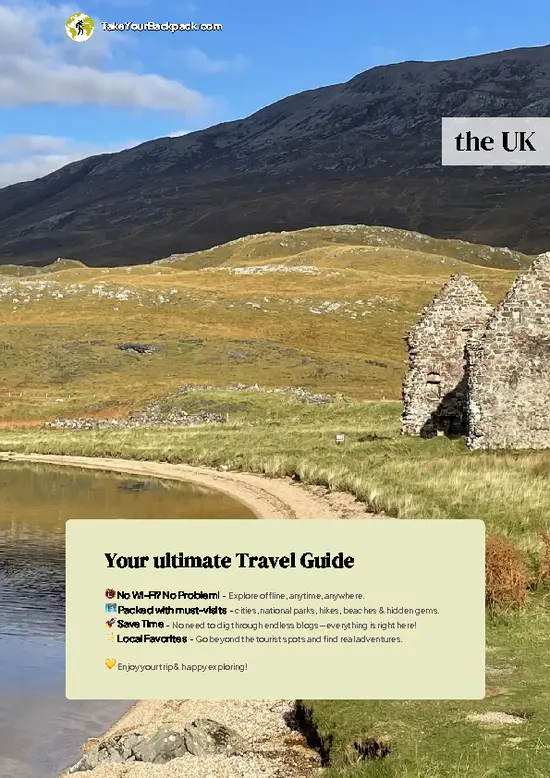
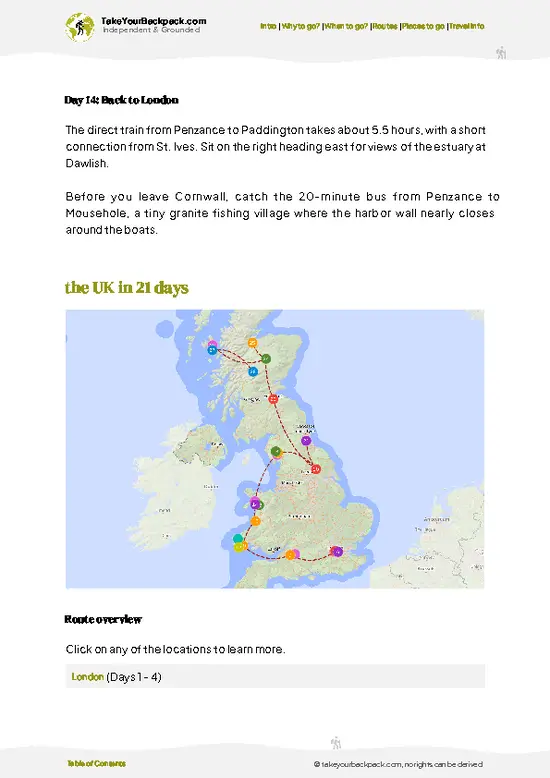
example page 0 from our offline Travel Guide for United Kingdom
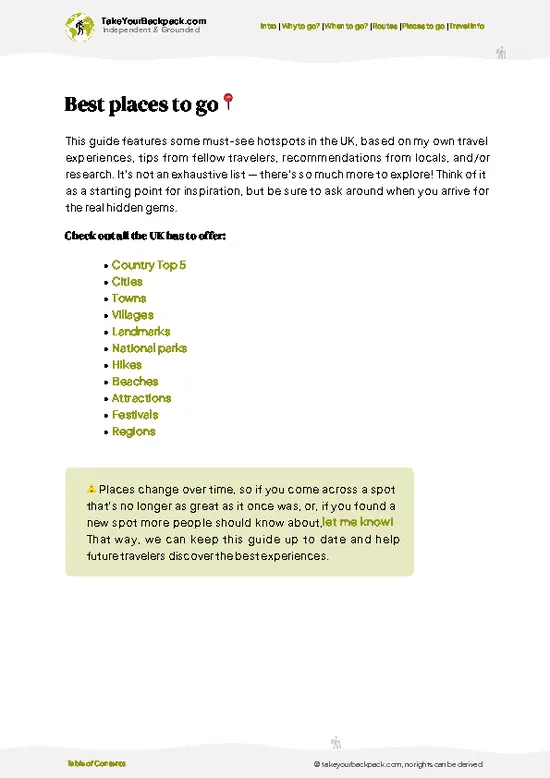
example page 1 from our offline Travel Guide for United Kingdom
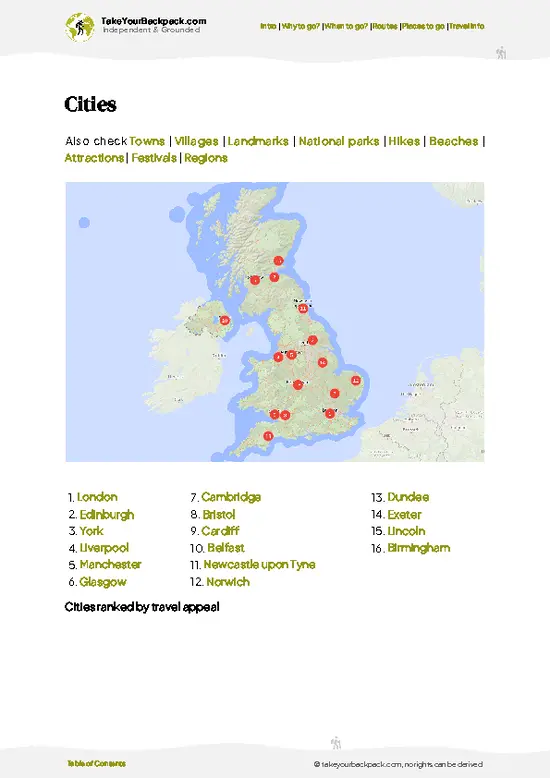
example page 2 from our offline Travel Guide for United Kingdom
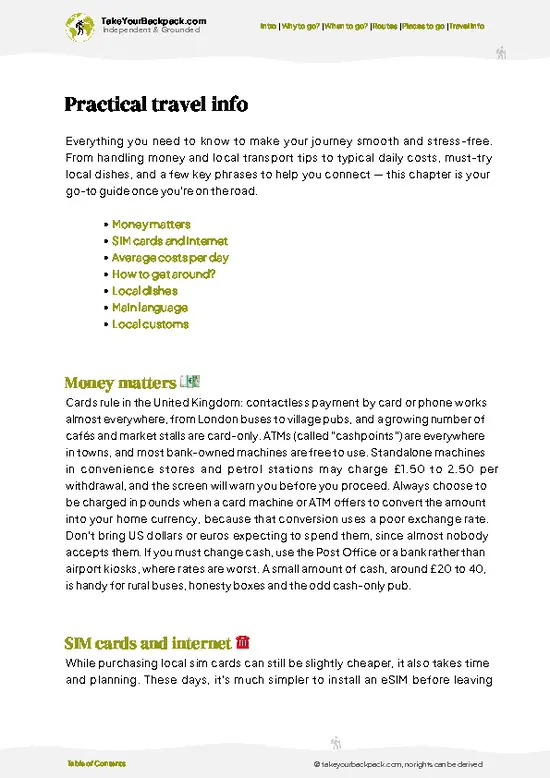
example page 3 from our offline Travel Guide for United Kingdom
example page 4 from our offline Travel Guide for United Kingdom
example page 5 from our offline Travel Guide for United Kingdom
example page 6 from our offline Travel Guide for United Kingdom
example page 7 from our offline Travel Guide for United Kingdom
The digital guide (526 pages) contains:
✅ 146 highlights, ranked by travel appeal
✅ Optimized 7, 14 & 21-day travel routes
✅ Cities, national parks, landmarks, beaches
✅ How to get around
✅ Offline-friendly for travel without Wi-Fi
👉 Click to see all 30+ guide features

📅 Plan smarter in minutes, not weeks
✅ Month by month travel advice
✅ Festivals & national holidays
✅ Budget expectations

🗺️ Go to the right places, skip the overrated ones
✅ Honest pros & cons of destinations
✅ Top hikes, parks & viewpoints
✅ Lesser-known places most travelers miss
✅ Clear “worth it vs skip it” guidance

🛏️ Travel smoothly without rookie mistakes
✅ Best areas to stay
✅ Transport systems explained simply
✅ Common scams & safety advice
✅ SIM cards, money & practical tips

🌍 Understand the country, not just visit it
✅ Culture & traditions
✅ Local customs
✅ Festivals worth planning around
✅ Traveler-friendly historical context
✅ Insights that make places more meaningful

📱 Built for real travel conditions
✅ Fully downloadable PDF
✅ Works completely offline
✅ Optimized for phone use
✅ Useful in remote areas & buses
✅ Everything in one place
Stop searching, start planning
Get instant access to your full guide. 30‑day money-back guarantee.
+ Add another guide for just

By proceeding you agree to our terms.
Sent to your inbox immediately after payment • 100% Secure Checkout
Best Backpacking Travel Advisor 2025 tourism awardBest Backpacking
Travel Advisor
2025
What others say about Take Your Backpack Guides:
⭐⭐⭐⭐⭐
Fantastic, amazing amount of information!
⭐⭐⭐⭐⭐
My goodness this is amazing, it's what I've been looking for hats off too you!
⭐⭐⭐⭐⭐
I think this is absolutely BRILLIANT
⭐⭐⭐⭐
Very complete and informative. It's still missing places, but I gotta to commend you
⭐⭐⭐⭐⭐
This is truly amazing, thank you, can't wait to explore it with my kids!
⭐⭐⭐⭐⭐
Awesome resource, thank you!
⭐⭐⭐⭐⭐
This is amazing! Can't wait to explore the ones I haven't seen
⭐⭐⭐⭐
I love this! Well done, great idea.
⭐⭐⭐⭐⭐
Thanks for taking the time to make this gem!
⭐⭐⭐⭐⭐
This might be the best website I've ever seen.
⭐⭐⭐⭐⭐
Congratulations, and thank you so much for your work; it's incredibly valuable.
⭐⭐⭐⭐
In all seriousness I think you did a great job pointing out the important spots
⭐⭐⭐⭐⭐
10/10 very good
⭐⭐⭐⭐⭐
As someone who's only just starting to visit regularly this is awesome, thank you.
⭐⭐⭐⭐
Thank you very much! I'm going to visit my dad, it's going to be very useful!
⭐⭐⭐⭐⭐
This is really cool! We'll be travelling for the first time and this definitely come in handy.
⭐⭐⭐⭐⭐
You are now our minister of culture, congratulations 👨‍💼
⭐⭐⭐⭐⭐
Just wanted to tell you that this is a pearl! Going to follow your recommendations.
⭐⭐⭐⭐⭐
This is so cool. I'll definitely be using the resource for my travels soon.
⭐⭐⭐⭐⭐
This is very impressive! Good work.
⭐⭐⭐⭐⭐
This is an amazing and informative site. Very well done!

🛏️ Where to stay?Best Places to Stay in the UK

The United Kingdom has plenty of hostels, with London dorm beds typically £25 to 50 (US$32 to 65) a night and most other cities closer to £18 to 35 (US$23 to 45), climbing sharply on summer weekends and during the Edinburgh festivals in August. In London, King’s Cross has the best transport links and the most beds, Camden and Shoreditch put you next to late bars and live music but are loud after midnight, and Earl’s Court is quieter and handy for Heathrow on the Piccadilly line, though it is a longer ride to the East End. In Edinburgh, the Old Town puts the castle and the Royal Mile outside your door at the cost of stag-party noise, while in Glasgow the West End is calmer and studenty, with … read more 👉
The United Kingdom has plenty of hostels, with London dorm beds typically £25 to 50 (US$32 to 65) a night and most other cities closer to £18 to 35 (US$23 to 45), climbing sharply on summer weekends and during the Edinburgh festivals in August. In London, King’s Cross has the best transport links and the most beds, Camden and Shoreditch put you next to late bars and live music but are loud after midnight, and Earl’s Court is quieter and handy for Heathrow on the Piccadilly line, though it is a longer ride to the East End. In Edinburgh, the Old Town puts the castle and the Royal Mile outside your door at the cost of stag-party noise, while in Glasgow the West End is calmer and studenty, with cheap food on Byres Road and a short subway ride to the center.

If you enjoy meeting fellow travelers, consider choosing hostels with high ratings for atmosphere. On the other hand, if you prefer having your own space, a hotel might be a better option.

the UKExplore the UK

👋 Meet the founderWho’s Behind Take Your Backpack?

Johan, backpacker and founder of TakeYourBackpackHi, I’m Johan (Netherlands 🇳🇱), the creator of TakeYourBackpack. Over the past 3 decades, I’ve backpacked through 90+ countries across six continents, gaining extensive experience with independent travel, long-term trips, and overland routes.

This site is built on a combination of firsthand travel experience and carefully curated insights from other backpackers. Many guides are based on places I’ve personally visited, while others bring together tips, observations, and practical advice shared by trusted travelers I’ve met along the way.

The goal is to provide realistic, experience-driven guidance — not generic itineraries — so you can explore destinations with better context, clearer expectations, and more confidence.