×

Uzbekistan🇺🇿 | best hikesWhere to Find the Best hikes in Uzbekistan

Hikes in Uzbekistan are not a Himalayan scramble, and that is the appeal. The country is mostly desert and steppe, so the walking happens in the eastern mountains: the Chimgan and Chatkal ranges near Tashkent, the Nuratau hills in the center, and the Hissar and Zarafshan spurs in the south. Near Tashkent you get day trips by shared taxi, easy access and weekend crowds. Further out, trails are quiet, with village homestays at US$15 to 30 including meals. For independent travelers, going midweek and leaving before 8 a.m. keeps the heat off and the trails yours.

By Johan Kruseman 🇳🇱 | Updated October 19, 2026
Explore the best beaches in Uzbekistan

Why go?What Makes Them Special

Uzbekistan suits hikers who like culture with their cardio. The mountains sit at the edge of the Tian Shan and Pamir-Alay systems, and the walking tends to run through villages, orchards and shepherd pastures rather than empty wilderness. Lodging, bread and tea are almost always a short walk away, which lowers the barrier for first-timers. Fixed hut networks and marked long-distance trails are rare, so expect to rely on local guides, drivers and homestay hosts rather than trail signs.

The climate shapes everything. Summers on the plains are brutal, so the high ground is where Uzbeks escape too, and that means weekends near Tashkent get busy while the rest of the country stays calm. Infrastructure is improving fast, with high-speed trains linking Tashkent, Samarkand and Bukhara, but the last … read more 👉
Uzbekistan suits hikers who like culture with their cardio. The mountains sit at the edge of the Tian Shan and Pamir-Alay systems, and the walking tends to run through villages, orchards and shepherd pastures rather than empty wilderness. Lodging, bread and tea are almost always a short walk away, which lowers the barrier for first-timers. Fixed hut networks and marked long-distance trails are rare, so expect to rely on local guides, drivers and homestay hosts rather than trail signs.

The climate shapes everything. Summers on the plains are brutal, so the high ground is where Uzbeks escape too, and that means weekends near Tashkent get busy while the rest of the country stays calm. Infrastructure is improving fast, with high-speed trains linking Tashkent, Samarkand and Bukhara, but the last stretch to trailheads usually needs a pre-arranged taxi.

Before you choose Uzbekistan, know that it is a moderate-altitude destination for most routes, not a place for big summits. Maps are patchy, so download offline maps and a GPX track before leaving town. Some areas near borders require a permit, and a good guide or homestay host will sort this for you. Mobile data helps, but coverage drops in the valleys, so tell your host your plan.
How the List Was Created
The list of best hikes in Uzbekistan is created based on scenery, challenge, trail quality, landmarks, and overall enjoyment. If you feel a hike is missing in this list, please let us know.

When to go?When to Plan Your Trip

Best months: The best months for hikes in Uzbekistan are April to early June and September to October, when daytime temperatures in the foothills sit around 15 to 28°C and the lowland furnace has not yet started or has just cooled. Spring brings green slopes and wildflowers, and most of the year's rain, with Tashkent seeing roughly 100 to 150 mm in March and April, so pack a shell.
Shoulder and summer: Late March and November are shoulder months. Lower trails are walkable, but nights drop near freezing and higher paths can be muddy or snowy. Prices for homestays stay flat through the year, mostly US$15 to 30, though transport to the mountains rises slightly on summer weekends.

July and August push lowland cities past 38 to 42°C. In the mountains, 1,500 to 2,500 meters, it is 8 to 12 degrees … read more 👉
Best months: The best months for hikes in Uzbekistan are April to early June and September to October, when daytime temperatures in the foothills sit around 15 to 28°C and the lowland furnace has not yet started or has just cooled. Spring brings green slopes and wildflowers, and most of the year's rain, with Tashkent seeing roughly 100 to 150 mm in March and April, so pack a shell.
Shoulder and summer: Late March and November are shoulder months. Lower trails are walkable, but nights drop near freezing and higher paths can be muddy or snowy. Prices for homestays stay flat through the year, mostly US$15 to 30, though transport to the mountains rises slightly on summer weekends.

July and August push lowland cities past 38 to 42°C. In the mountains, 1,500 to 2,500 meters, it is 8 to 12 degrees cooler, so summer works for hikers who start at dawn and are off the trail by noon. Do not plan a long walk in the plains or desert edges then. Southern areas near Surkhandarya warm up earlier, so go in March or April there.
Winter: From December to February, snow closes many higher paths and some guesthouses close. Chimgan area sees skiers, and low-level walks are possible on dry days, but it is a thin season for hiking.

hike hoppingTips for Visiting Multiple Destinations

How many days: A trip combining several hikes in Uzbekistan needs 10 to 14 days, with at least two or three days of actual walking. Cities and mountains are far apart, so the planning is mostly about transport, not trail distance.
Grouping and direction: Start in Tashkent, where the Chimgan and Chatkal foothills are 1.5 to 3 hours by road. Then head southwest by train to Samarkand (about 2 hours on the Afrosiyob), and from there reach the Nuratau hills by road in 3 to 4 hours. Finally, swing to the south with a day of travel to Termez or the Hissar side. This west to south direction avoids doubling back and puts the lowland cities in the cooler seasons. Give each mountain stop 2 to 3 days. Lingering less than that means you spend more time in a car than on foot.

The common mistake is trying … read more 👉
How many days: A trip combining several hikes in Uzbekistan needs 10 to 14 days, with at least two or three days of actual walking. Cities and mountains are far apart, so the planning is mostly about transport, not trail distance.
Grouping and direction: Start in Tashkent, where the Chimgan and Chatkal foothills are 1.5 to 3 hours by road. Then head southwest by train to Samarkand (about 2 hours on the Afrosiyob), and from there reach the Nuratau hills by road in 3 to 4 hours. Finally, swing to the south with a day of travel to Termez or the Hissar side. This west to south direction avoids doubling back and puts the lowland cities in the cooler seasons. Give each mountain stop 2 to 3 days. Lingering less than that means you spend more time in a car than on foot.

The common mistake is trying to cram a hike into every city stop. Distances between regions are 4 to 8 hours by road and longer by shared taxi, and trains sell out in high season, so book them 5 to 7 days ahead. Another error is scheduling a hike the morning after a long transfer. Instead, arrive the day before, sleep in the village and start walking early. Keep one spare day for weather, especially in spring.

The ListThe Best hikes of Uzbekistan

1 Beldersay Trail

Big Chimgan summit, Soviet cable car, limestone crest, turquoise reservoir

Climb from juniper slopes to a broken limestone ridge at 3,309 meters, with a rattling ropeway to spare your legs on the lower slope.

Loading the map 🌍

Expert viewInsights from Locals and Experts

How many hikes to plan: Three to five hikes is the right number for a two to three week trip. Uzbekistan’s trails sit in separate mountain pockets, and each one costs you a travel day on either side, so a sixth hike mostly buys you more time in shared taxis. Three gives you variety and a rest buffer. Five suits you only if the days between them are not packed with Silk Road cities you also want to see.

Which kind to prioritize: If this is your first trip to Central Asia, pick one easy day walk near a big city, one canyon or foothill hike, and one high mountain trek, in that order of effort. Culture-first travelers should favor village-to-village foothill walks, where tea with a family often becomes part of the day. Trekkers chasing altitude should put their energy into the Chatkal and Tien … read more 👉
How many hikes to plan: Three to five hikes is the right number for a two to three week trip. Uzbekistan’s trails sit in separate mountain pockets, and each one costs you a travel day on either side, so a sixth hike mostly buys you more time in shared taxis. Three gives you variety and a rest buffer. Five suits you only if the days between them are not packed with Silk Road cities you also want to see.

Which kind to prioritize: If this is your first trip to Central Asia, pick one easy day walk near a big city, one canyon or foothill hike, and one high mountain trek, in that order of effort. Culture-first travelers should favor village-to-village foothill walks, where tea with a family often becomes part of the day. Trekkers chasing altitude should put their energy into the Chatkal and Tien Shan side of the country and treat the rest as acclimatization. Budget travelers do best with trailheads reachable by public minibus, since a private transfer can cost more than the hike itself. Skip anything that needs a permit you have not arranged ahead if it lies near a border.

What it costs: Plan on US$25 to 45 a day on the trail circuit, covering a homestay or basic guesthouse (US$10 to 25 with meals often included), food, and local transport. Most day hikes carry no entry fee, but some protected areas charge a small ticket, usually under US$5. A local guide for a day hike runs about US$30 to 60, and a multi-day trek with guide, cook and gear commonly lands at US$60 to 120 per person a day, dropping as the group grows. Shared taxis to trailheads cost US$3 to 10 a seat, while a chartered car for the day is US$30 to 70. Pay in Uzbek som; cash is king in mountain villages, and card machines vanish once you leave the cities. Carry small notes, because change is scarce.

Safety and local etiquette: Mountain weather turns fast, so start before 7 a.m. and be off ridges by early afternoon, when storms build in summer. Register your stay as required, keep your passport copy on you, and expect police checkpoints on roads toward border zones. Photographing military sites is a bad idea. Shepherd dogs guard flocks and can be aggressive, so stop, drop your poles and walk wide. Tap water is not safe to drink, so bring a filter or purification tablets, and fill up only from sources above the last pasture.

Dress modestly in villages: covered shoulders and knees are expected, and in hot lowland zones lightweight long sleeves are both polite and practical. Ask before photographing people, especially women. If you are invited to a meal, accept the tea and bread at least, remove shoes at the door, and avoid pointing your feet toward the host. Alcohol is available in cities but not welcome in many village homes, so leave it in your bag. Mobile signal drops quickly in the valleys, so tell your host your route and expected return time before you set off.

✈️ The backpacker research shortcutUzbekistan Travel Guide

An offline-friendly backpacking guide with optimized travel routes, ranked highlights, transport advice, and the best areas to stay.
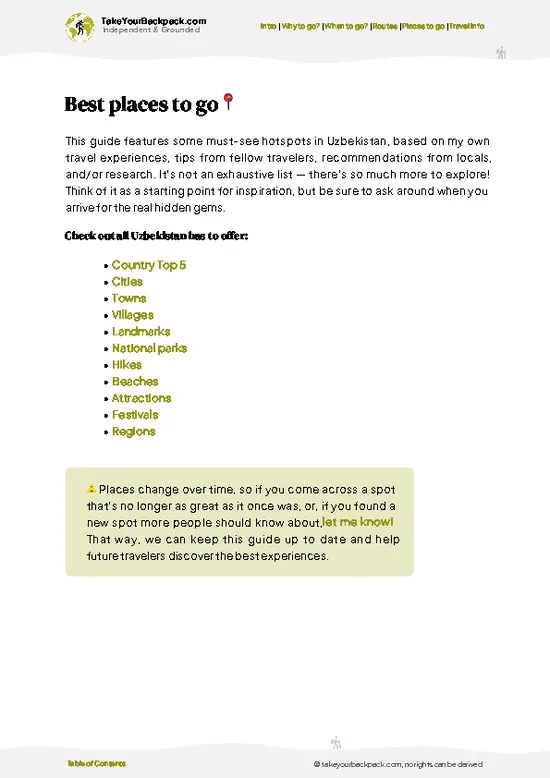
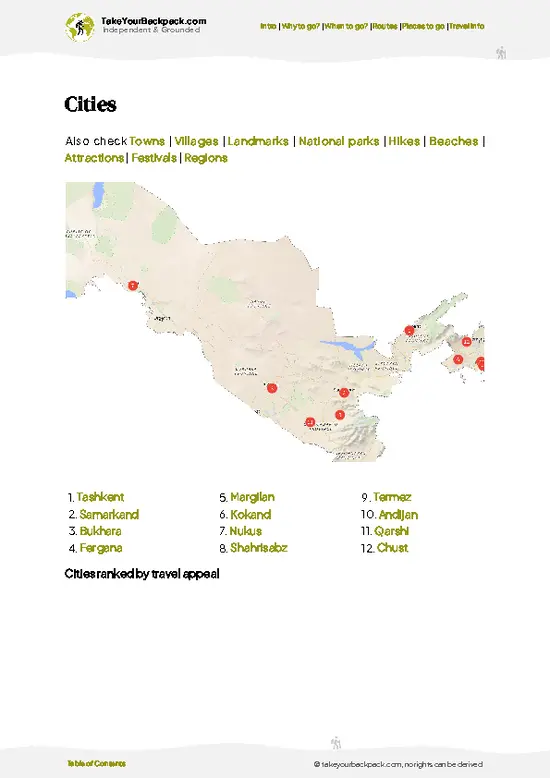
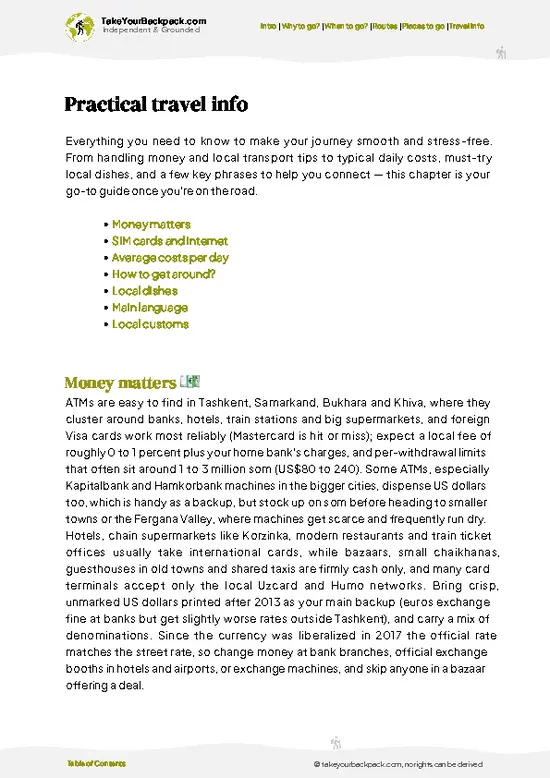
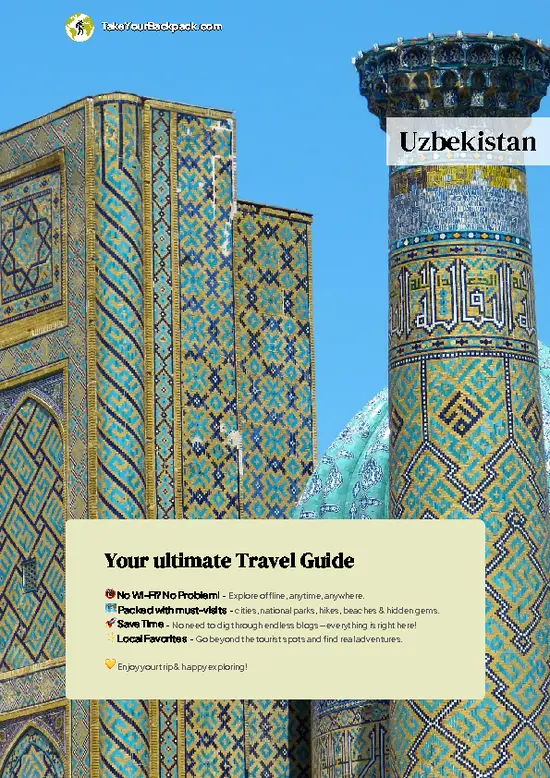
example page 0 from our offline Travel Guide for Uzbekistan
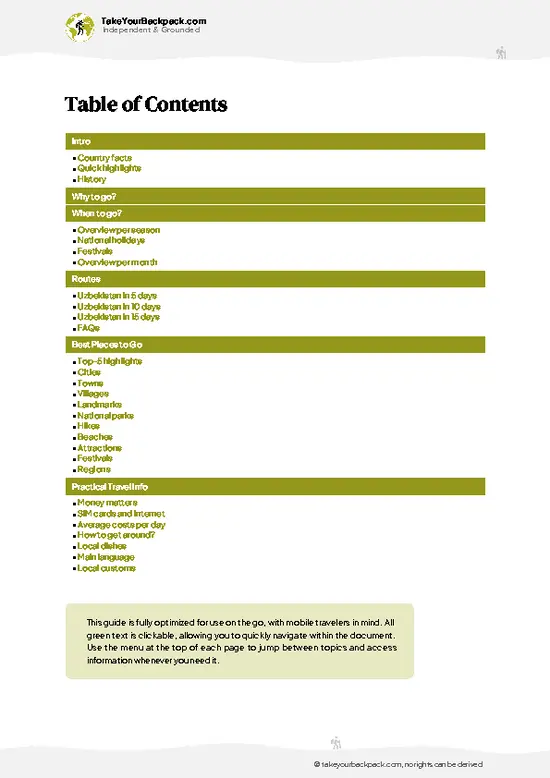
example page 1 from our offline Travel Guide for Uzbekistan
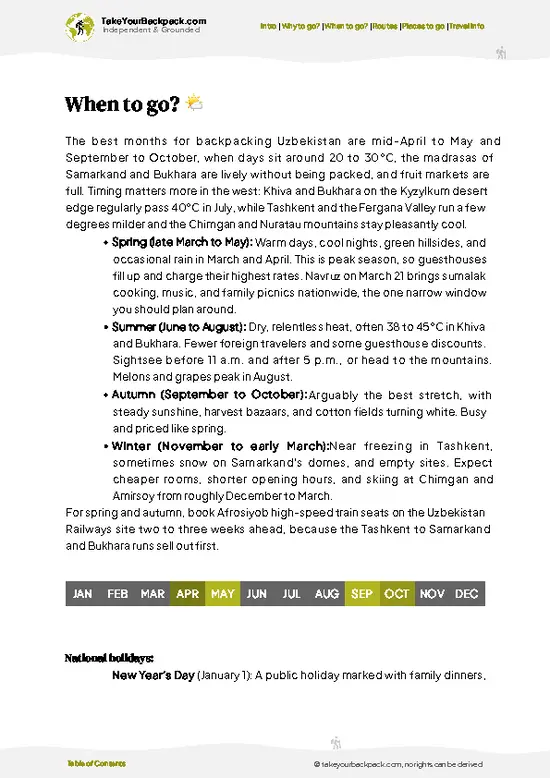
example page 2 from our offline Travel Guide for Uzbekistan
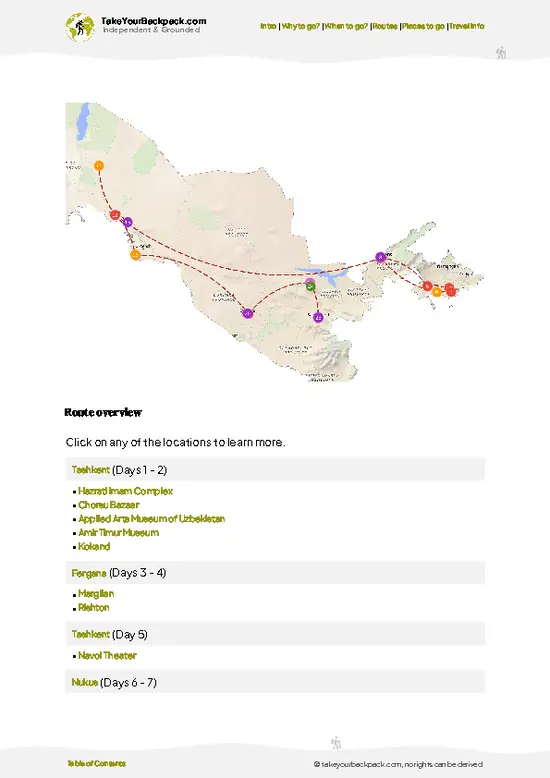
example page 3 from our offline Travel Guide for Uzbekistan
example page 4 from our offline Travel Guide for Uzbekistan
example page 5 from our offline Travel Guide for Uzbekistan
example page 6 from our offline Travel Guide for Uzbekistan
example page 7 from our offline Travel Guide for Uzbekistan
The digital guide (246 pages) contains:
✅ 74 highlights, ranked by travel appeal
✅ Optimized 5, 10 & 15-day travel routes
✅ Cities, national parks, landmarks, beaches
✅ How to get around
✅ Offline-friendly for travel without Wi-Fi
👉 Click to see all 30+ guide features

📅 Plan smarter in minutes, not weeks
✅ Month by month travel advice
✅ Festivals & national holidays
✅ Budget expectations

🗺️ Go to the right places, skip the overrated ones
✅ Honest pros & cons of destinations
✅ Top hikes, parks & viewpoints
✅ Lesser-known places most travelers miss
✅ Clear “worth it vs skip it” guidance

🛏️ Travel smoothly without rookie mistakes
✅ Best areas to stay
✅ Transport systems explained simply
✅ Common scams & safety advice
✅ SIM cards, money & practical tips

🌍 Understand the country, not just visit it
✅ Culture & traditions
✅ 52 Essential phrases & customs
✅ Festivals worth planning around
✅ Traveler-friendly historical context
✅ Insights that make places more meaningful

📱 Built for real travel conditions
✅ Fully downloadable PDF
✅ Works completely offline
✅ Optimized for phone use
✅ Useful in remote areas & buses
✅ Everything in one place
Stop searching, start planning
Get instant access to your full guide. 30‑day money-back guarantee.
+ Add another guide for just

By proceeding you agree to our terms.
Sent to your inbox immediately after payment • 100% Secure Checkout
Best Backpacking Travel Advisor 2025 tourism awardBest Backpacking
Travel Advisor
2025
What others say about Take Your Backpack Guides:
⭐⭐⭐⭐⭐
Fantastic, amazing amount of information!
⭐⭐⭐⭐⭐
My goodness this is amazing, it's what I've been looking for hats off too you!
⭐⭐⭐⭐⭐
I think this is absolutely BRILLIANT
⭐⭐⭐⭐
Very complete and informative. It's still missing places, but I gotta to commend you
⭐⭐⭐⭐⭐
This is truly amazing, thank you, can't wait to explore it with my kids!
⭐⭐⭐⭐⭐
Awesome resource, thank you!
⭐⭐⭐⭐⭐
This is amazing! Can't wait to explore the ones I haven't seen
⭐⭐⭐⭐
I love this! Well done, great idea.
⭐⭐⭐⭐⭐
Thanks for taking the time to make this gem!
⭐⭐⭐⭐⭐
This might be the best website I've ever seen.
⭐⭐⭐⭐⭐
Congratulations, and thank you so much for your work; it's incredibly valuable.
⭐⭐⭐⭐
In all seriousness I think you did a great job pointing out the important spots
⭐⭐⭐⭐⭐
10/10 very good
⭐⭐⭐⭐⭐
As someone who's only just starting to visit regularly this is awesome, thank you.
⭐⭐⭐⭐
Thank you very much! I'm going to visit my dad, it's going to be very useful!
⭐⭐⭐⭐⭐
This is really cool! We'll be travelling for the first time and this definitely come in handy.
⭐⭐⭐⭐⭐
You are now our minister of culture, congratulations 👨‍💼
⭐⭐⭐⭐⭐
Just wanted to tell you that this is a pearl! Going to follow your recommendations.
⭐⭐⭐⭐⭐
This is so cool. I'll definitely be using the resource for my travels soon.
⭐⭐⭐⭐⭐
This is very impressive! Good work.
⭐⭐⭐⭐⭐
This is an amazing and informative site. Very well done!

🛏️ Where to stay?Best Places to Stay in Uzbekistan

Uzbekistan has a growing hostel scene, with dorm beds typically running 100,000 to 190,000 so’m (US$8 to 15) and family-run guesthouses with breakfast offering private rooms from about US$20 to 35. In Tashkent, Mirabad and the streets around Amir Timur Square put you near metro lines, cafés and the city’s modest bar scene, while the Chorsu area in the old town is cheaper and closer to the bazaar but quieter after dark. In Samarkand, beds clustered between the Registan and Gur-e-Amir keep the big monuments walkable. Staying inside Bukhara’s old town around Lyabi-Hauz or within Khiva’s walled Itchan Kala gives you the most atmosphere and very safe, sleepy nights, though nightlife is close to nonexistent. … read more 👉
Uzbekistan has a growing hostel scene, with dorm beds typically running 100,000 to 190,000 so’m (US$8 to 15) and family-run guesthouses with breakfast offering private rooms from about US$20 to 35. In Tashkent, Mirabad and the streets around Amir Timur Square put you near metro lines, cafés and the city’s modest bar scene, while the Chorsu area in the old town is cheaper and closer to the bazaar but quieter after dark. In Samarkand, beds clustered between the Registan and Gur-e-Amir keep the big monuments walkable. Staying inside Bukhara’s old town around Lyabi-Hauz or within Khiva’s walled Itchan Kala gives you the most atmosphere and very safe, sleepy nights, though nightlife is close to nonexistent.

If you enjoy meeting fellow travelers, consider choosing hostels with high ratings for atmosphere. On the other hand, if you prefer having your own space, a hotel might be a better option.

UzbekistanExplore Uzbekistan

👋 Meet the founderWho’s Behind Take Your Backpack?

Johan, backpacker and founder of TakeYourBackpackHi, I’m Johan (Netherlands 🇳🇱), the creator of TakeYourBackpack. Over the past 3 decades, I’ve backpacked through 90+ countries across six continents, gaining extensive experience with independent travel, long-term trips, and overland routes.

This site is built on a combination of firsthand travel experience and carefully curated insights from other backpackers. Many guides are based on places I’ve personally visited, while others bring together tips, observations, and practical advice shared by trusted travelers I’ve met along the way.

The goal is to provide realistic, experience-driven guidance — not generic itineraries — so you can explore destinations with better context, clearer expectations, and more confidence.