×

Uzbekistan🇺🇿 | best landmarksWhere to Find the 7 Best landmarks in Uzbekistan

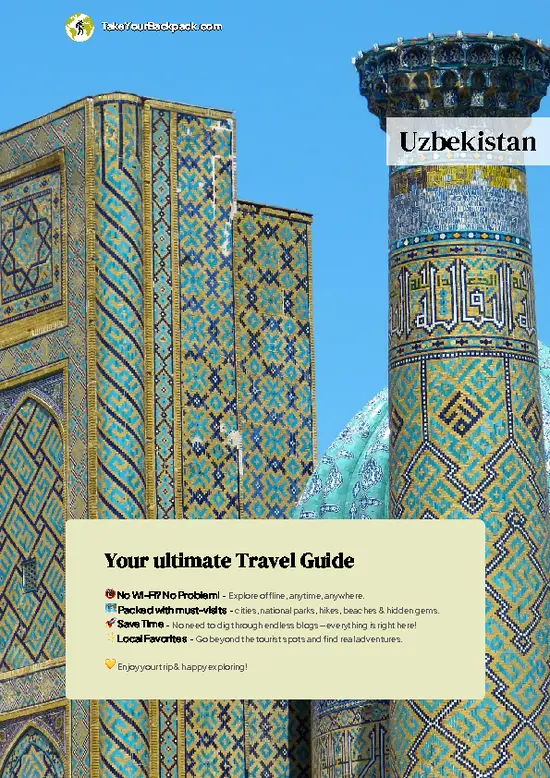
Landmarks in Uzbekistan mean Silk Road monuments: turquoise-tiled madrassas, mausoleums and fortress walls, mostly in the oasis cities of the central and southern belt. Samarkand and Bukhara are polished, busy and easy, with tickets of roughly 30,000 to 100,000 soum (US$2.50 to 8) and crowds that thin out before 9 a.m. Khiva sits in a walled old town you can cross on foot in minutes. Tashkent is more Soviet than ancient. For independent travelers, the Fergana Valley and the far west are cheaper, quieter and slower to reach. Go at dawn or the last hour before sunset, when the light turns the brick amber and the tour groups are gone.

By Johan Kruseman 🇳🇱 | Updated October 19, 2026
Explore the best national parks in Uzbekistan

Why go?What Makes Them Special

Uzbekistan sits where the old Silk Road routes crossed, and it shows. Merchants, scholars and conquerors, from Timur to the Russian Empire, all left monuments here, and the arid climate has helped them last. Brick, glazed tile and dry air go together well. Because the best sites cluster in a handful of oasis cities set in desert and steppe, you get exceptional density without spending days in transit.

The country is also unusually easy to move through. The high-speed Afrosiyob train links Tashkent, Samarkand and Bukhara, and tickets cost a fraction of European fares. Prices stay low by international standards, though foreigners often pay higher entry fees than locals, and a camera fee sometimes applies.

Know before you choose it: much of what you see is heavily restored, sometimes in bright, … read more 👉
Uzbekistan sits where the old Silk Road routes crossed, and it shows. Merchants, scholars and conquerors, from Timur to the Russian Empire, all left monuments here, and the arid climate has helped them last. Brick, glazed tile and dry air go together well. Because the best sites cluster in a handful of oasis cities set in desert and steppe, you get exceptional density without spending days in transit.

The country is also unusually easy to move through. The high-speed Afrosiyob train links Tashkent, Samarkand and Bukhara, and tickets cost a fraction of European fares. Prices stay low by international standards, though foreigners often pay higher entry fees than locals, and a camera fee sometimes applies.

Know before you choose it: much of what you see is heavily restored, sometimes in bright, near-new tile, so the atmosphere varies from raw and weathered to very polished. Many sites are active mosques or shrines, which means modest dress matters, with covered shoulders and knees. The main cities are well worn by tour groups, while remote fortresses in Karakalpakstan need long, dusty drives. Summer heat can make midday sightseeing miserable, so plan around the sun and treat the cooler hours as prime time.
Why These Made the Cut
The list of best unique sites in Uzbekistan is created based on history or culture, wow factor, atmosphere, quirks, and memorability. If you feel a unique site is missing in this list, please let us know.

When to go?When to Plan Your Trip

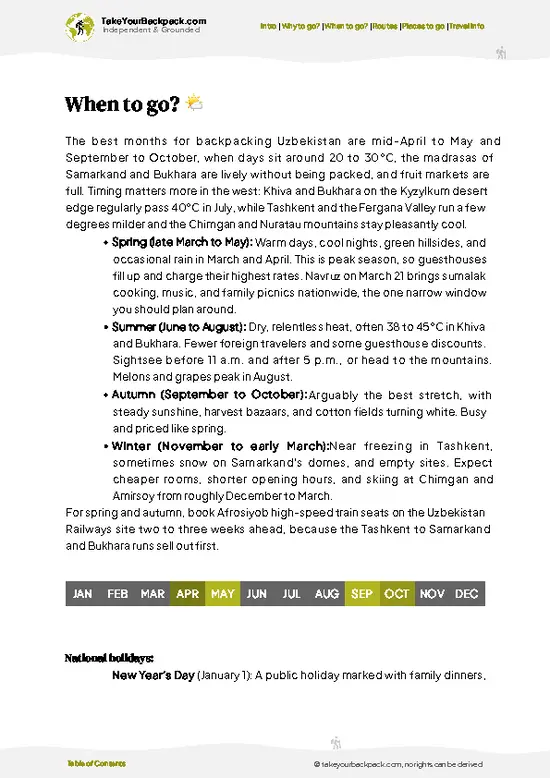
Best months: spring and autumn: April to early June and September to October are the best months for landmarks in Uzbekistan, with daytime highs of about 18 to 30°C and clear skies that make the tilework glow. Spring is the greenest and brings the most rain, still only around 20 to 50 mm a month in Samarkand and Tashkent. Autumn is drier, steadier and a touch warmer.
Summer and winter: From late June to August, Khiva, Bukhara and the Karakalpak desert routinely reach 38 to 42°C. Tashkent and Samarkand are slightly cooler but still hot. Do your sightseeing before 11 a.m. and after 5 p.m., and use the middle of the day for shade, tea and a nap. Summer does bring a small drop in hotel rates in some places.
Cold season and crowds: November to March is cold, with temperatures from around -5 to 8°C … read more 👉
Best months: spring and autumn: April to early June and September to October are the best months for landmarks in Uzbekistan, with daytime highs of about 18 to 30°C and clear skies that make the tilework glow. Spring is the greenest and brings the most rain, still only around 20 to 50 mm a month in Samarkand and Tashkent. Autumn is drier, steadier and a touch warmer.
Summer and winter: From late June to August, Khiva, Bukhara and the Karakalpak desert routinely reach 38 to 42°C. Tashkent and Samarkand are slightly cooler but still hot. Do your sightseeing before 11 a.m. and after 5 p.m., and use the middle of the day for shade, tea and a nap. Summer does bring a small drop in hotel rates in some places.
Cold season and crowds: November to March is cold, with temperatures from around -5 to 8°C and occasional snow in Samarkand and Tashkent. Prices drop, crowds nearly vanish, and some guesthouses in Khiva close or run on limited heating. Fog and short days limit photo time, yet a frosty, empty courtyard has its own appeal. Peak crowds and highest prices fall in April, May and late September to October, so book trains and beds ahead then. Navruz in late March brings celebrations and busier trains.

unique site hoppingTips for Visiting Multiple Destinations

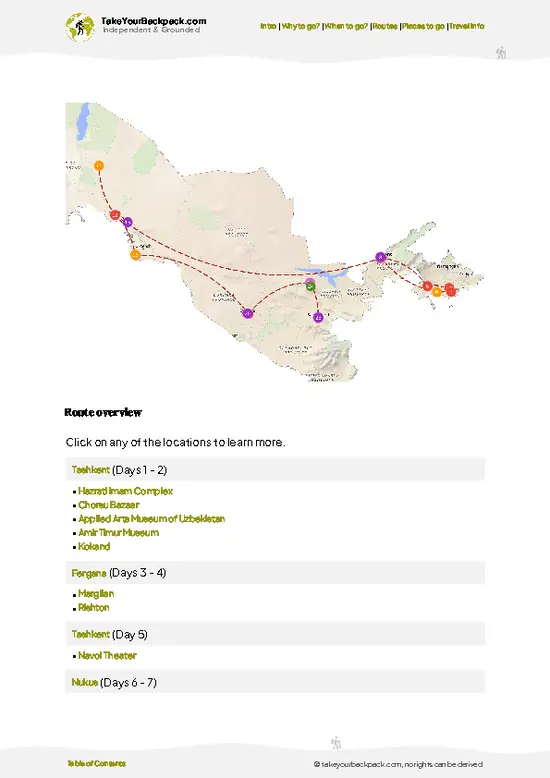
How many days to allow: A trip linking several of Uzbekistan's major landmark cities needs 7 to 12 days. Less than a week turns into a blur of train stations, while two weeks lets you add the Fergana Valley or the far west.
Regions that cluster well: The classic arc runs Tashkent, Samarkand, Bukhara, Khiva, then back. Tashkent to Samarkand takes about 2 to 2.5 hours on the Afrosiyob, and Samarkand to Bukhara about 1.5 to 2 hours. Bukhara to Khiva is the long leg, around 6 to 8 hours by shared taxi or road. The new Khiva rail link has made this easier, but check current schedules. Flying into Tashkent and out of Urgench (near Khiva), or the reverse, avoids a repeat trip across the desert.
Time per stop: Allow 2 to 3 days in Samarkand and Bukhara, 1 to 2 in Khiva and 1 day in Tashkent. Half-day … read more 👉
How many days to allow: A trip linking several of Uzbekistan's major landmark cities needs 7 to 12 days. Less than a week turns into a blur of train stations, while two weeks lets you add the Fergana Valley or the far west.
Regions that cluster well: The classic arc runs Tashkent, Samarkand, Bukhara, Khiva, then back. Tashkent to Samarkand takes about 2 to 2.5 hours on the Afrosiyob, and Samarkand to Bukhara about 1.5 to 2 hours. Bukhara to Khiva is the long leg, around 6 to 8 hours by shared taxi or road. The new Khiva rail link has made this easier, but check current schedules. Flying into Tashkent and out of Urgench (near Khiva), or the reverse, avoids a repeat trip across the desert.
Time per stop: Allow 2 to 3 days in Samarkand and Bukhara, 1 to 2 in Khiva and 1 day in Tashkent. Half-day side trips such as Shakhrisabz take about 1.5 hours each way from Samarkand.
Common planning mistakes: The biggest is cramming Khiva into a one-night dash from Bukhara and losing a full day to the road. Book it as a proper stop or skip it. Another is leaving train tickets until arrival, since popular departures sell out days ahead in high season. Travelers also schedule midday walking tours in summer. Move sightseeing to the morning and use the afternoon for the journey between cities.

The ListThe Best landmarks of Uzbekistan

1 Ark of Bukhara

Sloping gate ramp, emir’s court, Zindan cells, mud-brick walls

Climb the ramp into the emirs’ former citadel, then cross rooms of coins and costumes to a terrace overlooking Registan square.

uzbekistan-unique-site-ark-of-bukhara
© Google |

2 Shah-i-Zinda

Pilgrim stairway, glazed tomb lane, Qusam shrine, Timurid terracotta

Count the 36 steps up to a narrow lane of tiled mausoleums, where carving and glaze shift from tomb to tomb.

uzbekistan-unique-site-shah-i-zinda
© Google |

3 Bibi-Khanym Mosque

Blue dome, marble Quran stand, half-restored arches, bazaar neighbor

Cross a huge courtyard to a carved stone Quran stand, then compare raw stabilized brick with polished sections before tasting dried fruit next door.

uzbekistan-unique-site-bibi-khanym-mosque
© Google |

4 Samanid Mausoleum

Basket-weave brick, 9th-century tomb, Ismail Samani Park

Circle a small baked-brick cube as the sun shifts its woven patterns, then step inside to see the squinch-supported dome.

uzbekistan-unique-site-samanid-mausoleum
© Google |

5 Chorsu Bazaar

Blue-domed hall, stamped non, qurut and spices, Kukeldash Madrasah

Taste warm bread, dried fruit and dairy beneath the dome, watch butchers work the meat hall, then escape to a madrasah courtyard.

6 Chilpik

Round mudbrick tower, Zoroastrian funerary site, desert hilltop, night sky

Walk the circular walls, climb the loose slope for views over the Amu Darya plain, and stay for the dark.

7 Gyaur Kala

Eroded ramparts, wall towers, potsherd-strewn interior, empty steppe

Follow the outer walls around a ruined fortified settlement and watch the clay turn orange against a flat, silent horizon.

Loading the map 🌍

Expert viewInsights from Locals and Experts

How many landmarks to see: Aim for 8 to 12 major sites across a 7 to 10 day trip. Past that, the madrassas start to blur into one long blue facade, and your feet and your wallet both give out. Choose a few and give each one an hour or two of attention.
Prioritizing by travel style: First-timers and photographers should put the great Registan-style plazas and tiled madrassa complexes first, since the scale and tilework are what Uzbekistan is known for. History and culture seekers get more from mausoleums, observatories and working shrines, where the story outweighs the surface. Travelers wanting solitude should look to desert fortresses and smaller regional towns, which cost less and have almost no crowds, though transport takes longer. If you are short on days, skip most museums attached to … read more 👉
How many landmarks to see: Aim for 8 to 12 major sites across a 7 to 10 day trip. Past that, the madrassas start to blur into one long blue facade, and your feet and your wallet both give out. Choose a few and give each one an hour or two of attention.
Prioritizing by travel style: First-timers and photographers should put the great Registan-style plazas and tiled madrassa complexes first, since the scale and tilework are what Uzbekistan is known for. History and culture seekers get more from mausoleums, observatories and working shrines, where the story outweighs the surface. Travelers wanting solitude should look to desert fortresses and smaller regional towns, which cost less and have almost no crowds, though transport takes longer. If you are short on days, skip most museums attached to monuments and spend that time on the monuments themselves.
Budget per day and per visit: A comfortable backpacker budget with landmarks included runs US$30 to 55 a day: dorm or guesthouse bed US$10 to 25, meals US$6 to 12, city transport US$1 to 4, and sights on top. Main entry tickets usually cost 30,000 to 100,000 soum (roughly US$2.50 to 8) per site, with minaret climbs, camera fees and some museums extra, often 10,000 to 50,000 soum. A multi-site day can easily reach US$15 to 25 in tickets. Local guides cost about US$25 to 50 for a half day, and they are worth hiring for one or two major complexes rather than all of them. Taxis within cities cost US$1 to 5 per ride via apps such as Yandex Go. Carry some cash soum, since card machines at smaller sites fail often.
Safety and cultural considerations: Uzbekistan is generally safe, and petty crime is low. The main risks are heat, sun and overpaying: agree taxi fares first or use a ride app. Register your accommodation if requested, and keep your passport copy handy for police checks near stations and some monuments.
Respect at religious sites: Many landmarks are working mosques, shrines or cemeteries. Cover shoulders and knees, remove shoes where asked, and keep voices low near prayer. Women may be asked to wear a headscarf at certain shrines. Ask before photographing people, especially women and older men. Drones need a permit, and photography near government buildings, stations and bridges can draw unwanted attention. Shops inside monuments may press you to buy, so a polite “no, thank you” and a smile ends it. Bring a refillable bottle, sunscreen and a hat, as shade in the old city squares is scarce. Go early, and your photos will be cleaner.

✈️ The backpacker research shortcutUzbekistan Travel Guide

An offline-friendly backpacking guide with optimized travel routes, ranked highlights, transport advice, and the best areas to stay.
example page 0 from our offline Travel Guide for Uzbekistan
example page 1 from our offline Travel Guide for Uzbekistan
example page 2 from our offline Travel Guide for Uzbekistan
example page 3 from our offline Travel Guide for Uzbekistan
example page 4 from our offline Travel Guide for Uzbekistan
example page 5 from our offline Travel Guide for Uzbekistan
example page 6 from our offline Travel Guide for Uzbekistan
example page 7 from our offline Travel Guide for Uzbekistan
The digital guide (246 pages) contains:
✅ 74 highlights, ranked by travel appeal
✅ Optimized 5, 10 & 15-day travel routes
✅ Cities, national parks, landmarks, beaches
✅ How to get around
✅ Offline-friendly for travel without Wi-Fi
👉 Click to see all 30+ guide features

📅 Plan smarter in minutes, not weeks
✅ Month by month travel advice
✅ Festivals & national holidays
✅ Budget expectations

🗺️ Go to the right places, skip the overrated ones
✅ Honest pros & cons of destinations
✅ Top hikes, parks & viewpoints
✅ Lesser-known places most travelers miss
✅ Clear “worth it vs skip it” guidance

🛏️ Travel smoothly without rookie mistakes
✅ Best areas to stay
✅ Transport systems explained simply
✅ Common scams & safety advice
✅ SIM cards, money & practical tips

🌍 Understand the country, not just visit it
✅ Culture & traditions
✅ 52 Essential phrases & customs
✅ Festivals worth planning around
✅ Traveler-friendly historical context
✅ Insights that make places more meaningful

📱 Built for real travel conditions
✅ Fully downloadable PDF
✅ Works completely offline
✅ Optimized for phone use
✅ Useful in remote areas & buses
✅ Everything in one place
Stop searching, start planning
Get instant access to your full guide. 30‑day money-back guarantee.
+ Add another guide for just

By proceeding you agree to our terms.
Sent to your inbox immediately after payment • 100% Secure Checkout
Best Backpacking Travel Advisor 2025 tourism awardBest Backpacking
Travel Advisor
2025
What others say about Take Your Backpack Guides:
⭐⭐⭐⭐⭐
Fantastic, amazing amount of information!
⭐⭐⭐⭐⭐
My goodness this is amazing, it's what I've been looking for hats off too you!
⭐⭐⭐⭐⭐
I think this is absolutely BRILLIANT
⭐⭐⭐⭐
Very complete and informative. It's still missing places, but I gotta to commend you
⭐⭐⭐⭐⭐
This is truly amazing, thank you, can't wait to explore it with my kids!
⭐⭐⭐⭐⭐
Awesome resource, thank you!
⭐⭐⭐⭐⭐
This is amazing! Can't wait to explore the ones I haven't seen
⭐⭐⭐⭐
I love this! Well done, great idea.
⭐⭐⭐⭐⭐
Thanks for taking the time to make this gem!
⭐⭐⭐⭐⭐
This might be the best website I've ever seen.
⭐⭐⭐⭐⭐
Congratulations, and thank you so much for your work; it's incredibly valuable.
⭐⭐⭐⭐
In all seriousness I think you did a great job pointing out the important spots
⭐⭐⭐⭐⭐
10/10 very good
⭐⭐⭐⭐⭐
As someone who's only just starting to visit regularly this is awesome, thank you.
⭐⭐⭐⭐
Thank you very much! I'm going to visit my dad, it's going to be very useful!
⭐⭐⭐⭐⭐
This is really cool! We'll be travelling for the first time and this definitely come in handy.
⭐⭐⭐⭐⭐
You are now our minister of culture, congratulations 👨‍💼
⭐⭐⭐⭐⭐
Just wanted to tell you that this is a pearl! Going to follow your recommendations.
⭐⭐⭐⭐⭐
This is so cool. I'll definitely be using the resource for my travels soon.
⭐⭐⭐⭐⭐
This is very impressive! Good work.
⭐⭐⭐⭐⭐
This is an amazing and informative site. Very well done!

🛏️ Where to stay?Top Places to Consider Staying

Uzbekistan has a growing hostel scene, with dorm beds typically running 100,000 to 190,000 so’m (US$8 to 15) and family-run guesthouses with breakfast offering private rooms from about US$20 to 35. In Tashkent, Mirabad and the streets around Amir Timur Square put you near metro lines, cafés and the city’s modest bar scene, while the Chorsu area in the old town is cheaper and closer to the bazaar but quieter after dark. In Samarkand, beds clustered between the Registan and Gur-e-Amir keep the big monuments walkable. Staying inside Bukhara’s old town around Lyabi-Hauz or within Khiva’s walled Itchan Kala gives you the most atmosphere and very safe, sleepy nights, though nightlife is close to nonexistent. … read more 👉
Uzbekistan has a growing hostel scene, with dorm beds typically running 100,000 to 190,000 so’m (US$8 to 15) and family-run guesthouses with breakfast offering private rooms from about US$20 to 35. In Tashkent, Mirabad and the streets around Amir Timur Square put you near metro lines, cafés and the city’s modest bar scene, while the Chorsu area in the old town is cheaper and closer to the bazaar but quieter after dark. In Samarkand, beds clustered between the Registan and Gur-e-Amir keep the big monuments walkable. Staying inside Bukhara’s old town around Lyabi-Hauz or within Khiva’s walled Itchan Kala gives you the most atmosphere and very safe, sleepy nights, though nightlife is close to nonexistent.

If you enjoy meeting fellow travelers, consider choosing hostels with high ratings for atmosphere. On the other hand, if you prefer having your own space, a hotel might be a better option.

UzbekistanMore Places Across Uzbekistan

👋 Meet the founderWho’s Behind Take Your Backpack?

Johan, backpacker and founder of TakeYourBackpackHi, I’m Johan (Netherlands 🇳🇱), the creator of TakeYourBackpack. Over the past 3 decades, I’ve backpacked through 90+ countries across six continents, gaining extensive experience with independent travel, long-term trips, and overland routes.

This site is built on a combination of firsthand travel experience and carefully curated insights from other backpackers. Many guides are based on places I’ve personally visited, while others bring together tips, observations, and practical advice shared by trusted travelers I’ve met along the way.

The goal is to provide realistic, experience-driven guidance — not generic itineraries — so you can explore destinations with better context, clearer expectations, and more confidence.