×

Uzbekistan🇺🇿 | best attractionsWhere to Find the 10 Best attractions in Uzbekistan

Uzbekistan packs its attractions into a handful of Silk Road cities, and each one has a different pace. Samarkand is the big-ticket stop, with the longest ticket queues and the highest prices. Bukhara is compact and walkable, so you can see a lot without a single taxi. Khiva is a walled town you can cross in minutes, calmest once the day-trippers leave. Out west, Karakalpakstan is remote, cheap and nearly empty of crowds. For independent travel, fast trains link the main cities, and a morning visit (before 9 a.m.) beats the tour buses and the midday heat.

By Johan Kruseman 🇳🇱 | Updated October 19, 2026
Explore the best festivals in Uzbekistan

Why go?What Makes Them Special

Uzbekistan sits where the old Silk Road routes crossed, and that history left a concentration of Timurid and Islamic-era monuments that few countries can match. The sites are mostly clustered in a few oasis cities, separated by desert, so the country suits travelers who like depth over sprawl. Because of the dry continental climate, tilework and mud-brick survive well, but the same climate shapes how you visit: summer afternoons are punishing and shaded courtyards become your friend.

Infrastructure is a real strength. The high-speed Afrosiyob train and a growing network of comfortable intercity services make hopping between cities easy, and the e-visa system has removed most paperwork for many nationalities. Many monuments have been heavily restored, and some areas feel polished rather than … read more 👉
Uzbekistan sits where the old Silk Road routes crossed, and that history left a concentration of Timurid and Islamic-era monuments that few countries can match. The sites are mostly clustered in a few oasis cities, separated by desert, so the country suits travelers who like depth over sprawl. Because of the dry continental climate, tilework and mud-brick survive well, but the same climate shapes how you visit: summer afternoons are punishing and shaded courtyards become your friend.

Infrastructure is a real strength. The high-speed Afrosiyob train and a growing network of comfortable intercity services make hopping between cities easy, and the e-visa system has removed most paperwork for many nationalities. Many monuments have been heavily restored, and some areas feel polished rather than lived-in, so expect restored showpiece districts alongside quieter neighborhoods where daily life carries on around you.

Before you commit, know that English is limited outside hotels and major sites, cash is still useful for small entries, and a separate camera or photo fee can apply at some places. Go in with a rough plan, carry small bills, and the country rewards you with hospitality that surprises almost everyone.
Why These Made the Cut
The list of best attractions in Uzbekistan is created based on cultural significance or entertainment value. If you feel a attraction is missing in this list, please let us know.

When to go?When to Plan Your Trip

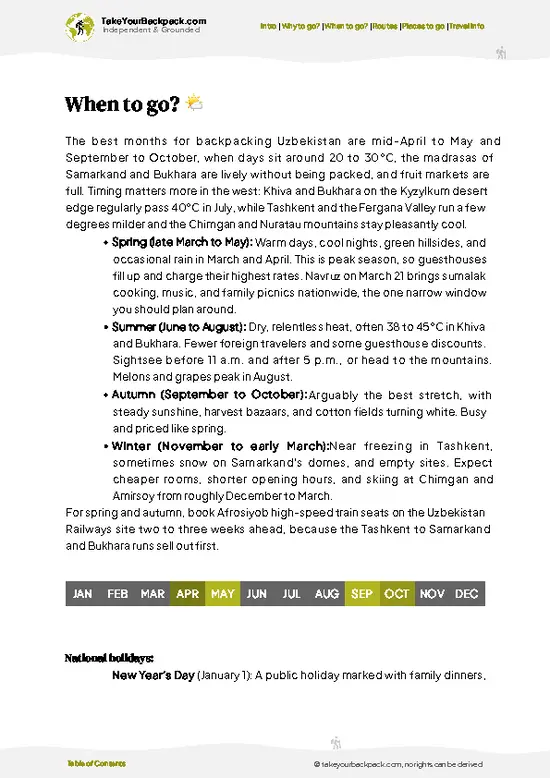
Best months for Uzbekistan’s attractions: The best months are April to May and September to October, when daytime temperatures sit around 18 to 30°C and you can walk outdoor sites without baking. Spring brings green edges to the oases and the odd shower, while autumn is dry and golden, with fruit markets at their best.
Summer and winter: From June to August, Samarkand, Bukhara and Khiva regularly hit 35 to 42°C, and the stone courtyards in Khiva hold the heat well into the evening. If you travel then, start at 7 or 8 a.m., break from noon to 4 p.m., and return for the cooler light. The far west near the Aral region is hotter and drier still.
Shoulder periods and prices: March and November are cooler, roughly 5 to 18°C, with more rain (March is usually the wettest month) but far thinner crowds. … read more 👉
Best months for Uzbekistan’s attractions: The best months are April to May and September to October, when daytime temperatures sit around 18 to 30°C and you can walk outdoor sites without baking. Spring brings green edges to the oases and the odd shower, while autumn is dry and golden, with fruit markets at their best.
Summer and winter: From June to August, Samarkand, Bukhara and Khiva regularly hit 35 to 42°C, and the stone courtyards in Khiva hold the heat well into the evening. If you travel then, start at 7 or 8 a.m., break from noon to 4 p.m., and return for the cooler light. The far west near the Aral region is hotter and drier still.
Shoulder periods and prices: March and November are cooler, roughly 5 to 18°C, with more rain (March is usually the wettest month) but far thinner crowds. December to February is cold, often 0 to 8°C and occasionally below freezing, with a chance of snow in Samarkand and Tashkent. Some guesthouses close or heat only part of the building, though low-season rooms can be 20 to 30 percent cheaper. Spring and autumn fill up, so book the best-located guesthouses a few weeks ahead. Nowruz in late March brings festivities and busy trains.

attraction hoppingTips for Visiting Multiple Destinations

How many days to plan: A trip linking the main attractions needs 8 to 12 days, and 10 gives you room to breathe. The standard loop covers Tashkent, Samarkand, Bukhara and Khiva, with an optional detour west to Karakalpakstan or east to the Fergana Valley if you have a few extra days.
Direction and timing: Most travelers go Tashkent to Samarkand to Bukhara to Khiva and then fly or train back, or reverse it so the long Khiva leg comes first. Allow 2 to 3 days in Samarkand, 2 in Bukhara and 1 to 2 in Khiva, since Khiva’s walled core is small. Tashkent needs a day at most, and it works best as the arrival and departure hub.
Getting between stops: Tashkent to Samarkand takes roughly 2 to 2.5 hours on the Afrosiyob, and Samarkand to Bukhara about 1.5 to 2 hours by fast train. Bukhara to Khiva is the … read more 👉
How many days to plan: A trip linking the main attractions needs 8 to 12 days, and 10 gives you room to breathe. The standard loop covers Tashkent, Samarkand, Bukhara and Khiva, with an optional detour west to Karakalpakstan or east to the Fergana Valley if you have a few extra days.
Direction and timing: Most travelers go Tashkent to Samarkand to Bukhara to Khiva and then fly or train back, or reverse it so the long Khiva leg comes first. Allow 2 to 3 days in Samarkand, 2 in Bukhara and 1 to 2 in Khiva, since Khiva’s walled core is small. Tashkent needs a day at most, and it works best as the arrival and departure hub.
Getting between stops: Tashkent to Samarkand takes roughly 2 to 2.5 hours on the Afrosiyob, and Samarkand to Bukhara about 1.5 to 2 hours by fast train. Bukhara to Khiva is the slog: around 6 to 8 hours by road or a longer rail leg, so budget a half day.
Common planning mistakes: Travelers often cram Khiva as a day trip, cut Samarkand to one afternoon or schedule train trips tightly with no buffer. Instead, book trains early, leave a slack morning before long hauls and spend a night in Khiva so you see it before and after the crowds.

The ListThe Best attractions of Uzbekistan

1 Registan

Three madrasas, tiger portal, gilded prayer hall

Face three tiled facades across an open square, then look up inside Tilya-Kori at a painted ceiling that imitates a dome.

2 Itchan Kala

Kalta Minor, 213 wooden columns, rampart walks

Walk a walled desert town of glazed minarets, a khan’s citadel and palace courtyards, and finish on the wall-top path at sunset.

3 Gur-e-Amir Mausoleum

Jade cenotaph, gilded ceiling, ribbed turquoise dome

Enter a dim tomb chamber where gold leaf covers the vault, and find the dark green slab over Timur’s grave.

4 Po-i-Kalyan

Kalyan Minaret, 288-dome mosque, floodlit plaza

Photograph a 12th-century brick tower from an open square, then step into a shaded mosque courtyard and return after dark for the lights.

5 Lyab-i Hauz

Mulberry-ringed pool, teahouse platforms, simurgh arch

Sit by a stone-edged pond under old trees with green tea, and look for the bird-and-sun portal on the madrasa.

6 Ulugh Beg Observatory

Buried sextant arc, star catalog, Kohak Hill

Descend beside a curved marble track cut into the hill, then see replicas, charts and the 1,018-star catalog in the small museum.

7 Hazrati Imam Complex

Uthman Quran, Barak-Khan portal, working mosque

Visit a free courtyard complex with an oversized early Quran manuscript, a tiled madrasah and craft shops in former student cells.

8 Khiva Juma Mosque

Elm column forest, roof light wells, brick minaret

Wander among 213 carved wooden pillars in half-dark, then climb the slim minaret for a view across the rooftops.

9 Savitsky Museum

Banned avant-garde canvases, Karakalpak silver, Aral paintings

Spend a morning among rescued Soviet-era paintings, heavy bridal jewelry and canvases recording the vanished Aral shoreline.

10 Amir Timur Museum

Painted dome hall, Timurid maps, weapons and manuscripts

Stand under a gold-and-blue ceiling, then trace Timur’s conquests on wall maps and study swords, chain mail and old manuscripts.

11 Applied Arts Museum of Uzbekistan

Carved ganch plaster, suzani, ikat, Rishtan ceramics

Walk through a carved-plaster house filled with embroidered hangings, warp-dyed silks and glazed plates, and learn to tell regional styles apart.

12 State Museum of History of Uzbekistan

Kushan Buddhist heads, Zoroastrian ossuaries, ganch ceilings

Trace Bactrian, Sogdian and Buddhist finds in a former mansion, then glance up at its carved plaster ceilings.

13 Minor Mosque

White marble, blue-gold interior, Anhor canal path

Compare a plain pale exterior with a richly patterned prayer hall, then take the evening canal promenade beside it.

Think you know Uzbekistan?

Prove you’re a true local — uncover 4 lesser-known attractions in Uzbekistan that locals tend to keep to themselves.
Loading the map 🌍

Expert viewInsights from Locals and Experts

How many attractions to visit: Plan on 2 to 3 major sights per city and a total of 10 to 14 across a 10-day trip. Beyond that, the tilework and domes start to blur, and your wallet and feet will tire. Better to see fewer sites well, then spend the leftover hours in tea houses and bazaars.
What to prioritize: If you love architecture and photography, put the big monument complexes first and go at opening time. Budget travelers should lean on free or cheap street-level experiences like old-town lanes, bazaars and courtyards, which cost nothing. History buffs should add a museum or two and a guide for the main sites. If you want fewer crowds, add a remote or off-circuit stop rather than a second famous city.
What it costs: A realistic backpacker budget is US$30 to 50 a day, or about 380,000 to … read more 👉
How many attractions to visit: Plan on 2 to 3 major sights per city and a total of 10 to 14 across a 10-day trip. Beyond that, the tilework and domes start to blur, and your wallet and feet will tire. Better to see fewer sites well, then spend the leftover hours in tea houses and bazaars.
What to prioritize: If you love architecture and photography, put the big monument complexes first and go at opening time. Budget travelers should lean on free or cheap street-level experiences like old-town lanes, bazaars and courtyards, which cost nothing. History buffs should add a museum or two and a guide for the main sites. If you want fewer crowds, add a remote or off-circuit stop rather than a second famous city.
What it costs: A realistic backpacker budget is US$30 to 50 a day, or about 380,000 to 640,000 soums, covering a guesthouse dorm or basic room, food and local transport. Most monument entries run roughly 40,000 to 100,000 soums (US$3 to 8), with extra camera fees at some sites and higher prices for foreigners than locals. A licensed guide is around US$25 to 60 for a half day. Intercity trains cost roughly US$10 to 30 depending on class and route, and shared taxis are cheaper. Carry cash in small notes, because card acceptance at smaller sites is patchy.
Safety and cultural considerations: Uzbekistan is generally safe for independent travelers, with low violent crime, but watch for taxi overcharging and keep your passport handy for police checks. Dress modestly at mosques and mausoleums: cover shoulders and knees, and remove shoes where asked. Women should carry a light scarf. Ask before photographing people, and avoid photographing military sites, bridges and metro stations in Tashkent where signs forbid it. Heat is the most common problem, so carry at least 1.5 liters of water, use sunscreen and plan outdoor visits for early morning. Register your accommodation if asked, and keep any hotel registration slips until you leave.

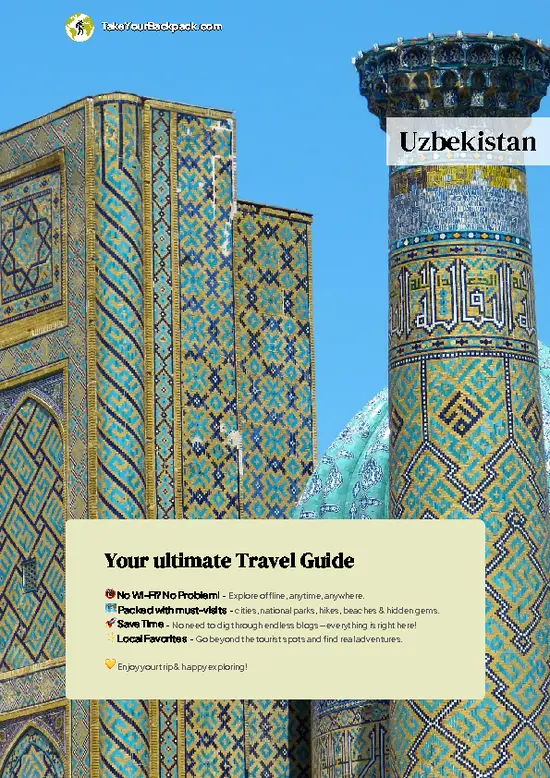
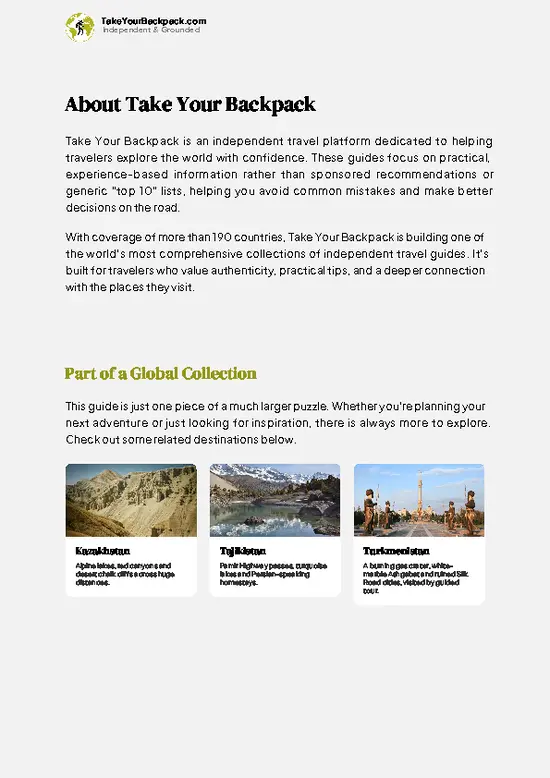
✈️ The backpacker research shortcutUzbekistan Travel Guide

An offline-friendly backpacking guide with optimized travel routes, ranked highlights, transport advice, and the best areas to stay.
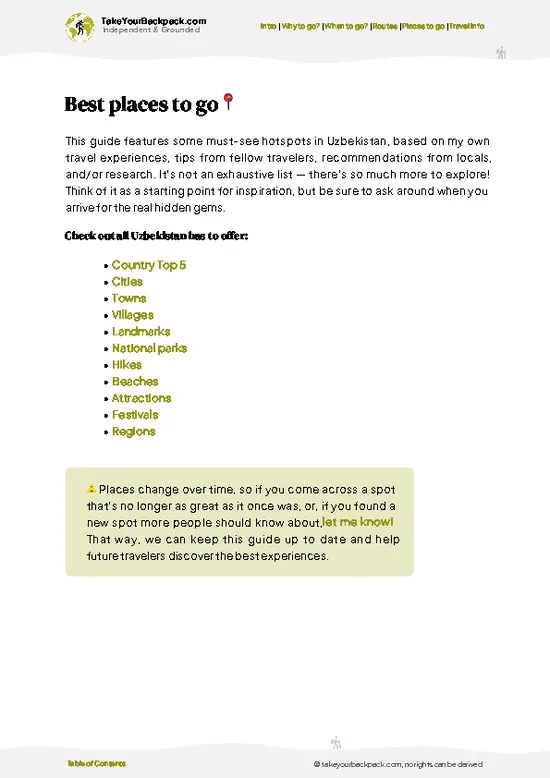
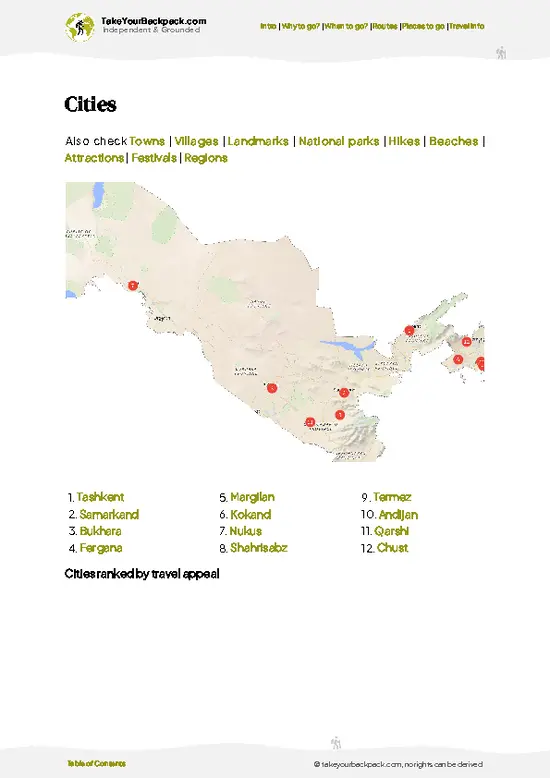
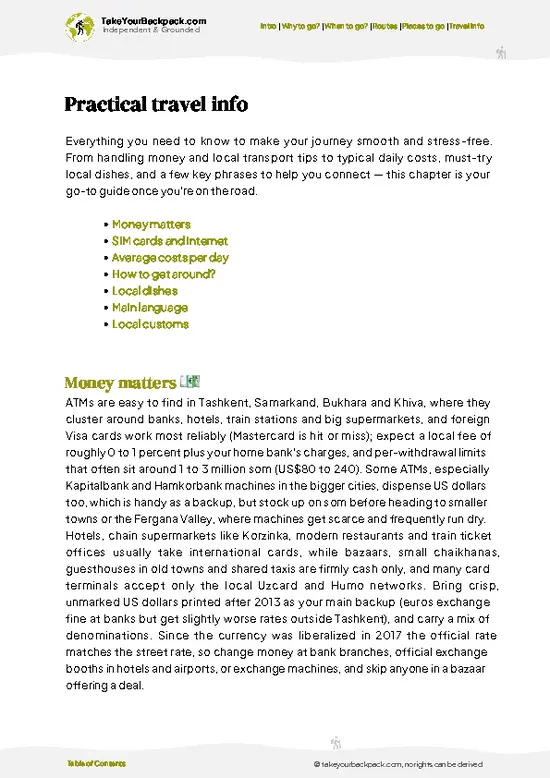
example page 0 from our offline Travel Guide for Uzbekistan
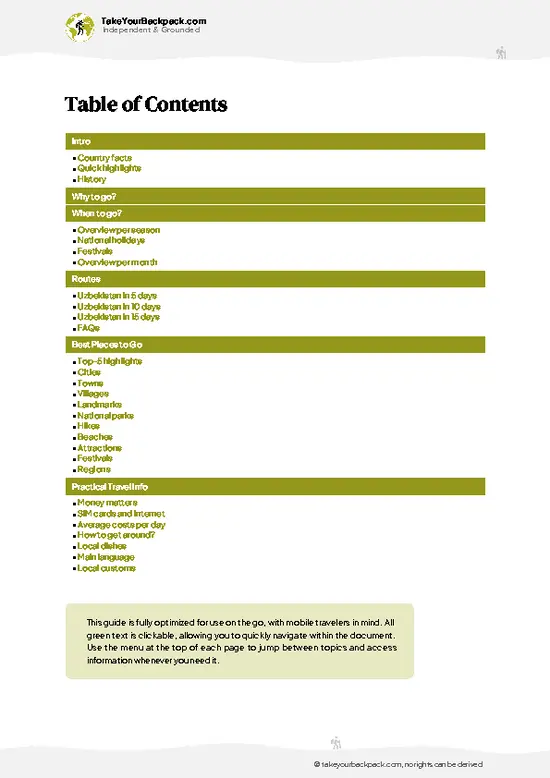
example page 1 from our offline Travel Guide for Uzbekistan
example page 2 from our offline Travel Guide for Uzbekistan
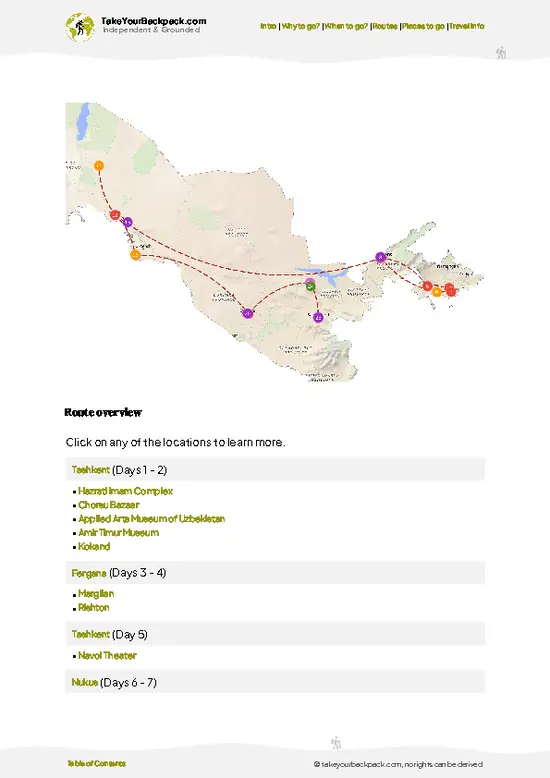
example page 3 from our offline Travel Guide for Uzbekistan
example page 4 from our offline Travel Guide for Uzbekistan
example page 5 from our offline Travel Guide for Uzbekistan
example page 6 from our offline Travel Guide for Uzbekistan
example page 7 from our offline Travel Guide for Uzbekistan
The digital guide (246 pages) contains:
✅ 74 highlights, ranked by travel appeal
✅ Optimized 5, 10 & 15-day travel routes
✅ Cities, national parks, landmarks, beaches
✅ How to get around
✅ Offline-friendly for travel without Wi-Fi
👉 Click to see all 30+ guide features

📅 Plan smarter in minutes, not weeks
✅ Month by month travel advice
✅ Festivals & national holidays
✅ Budget expectations

🗺️ Go to the right places, skip the overrated ones
✅ Honest pros & cons of destinations
✅ Top hikes, parks & viewpoints
✅ Lesser-known places most travelers miss
✅ Clear “worth it vs skip it” guidance

🛏️ Travel smoothly without rookie mistakes
✅ Best areas to stay
✅ Transport systems explained simply
✅ Common scams & safety advice
✅ SIM cards, money & practical tips

🌍 Understand the country, not just visit it
✅ Culture & traditions
✅ 52 Essential phrases & customs
✅ Festivals worth planning around
✅ Traveler-friendly historical context
✅ Insights that make places more meaningful

📱 Built for real travel conditions
✅ Fully downloadable PDF
✅ Works completely offline
✅ Optimized for phone use
✅ Useful in remote areas & buses
✅ Everything in one place
Stop searching, start planning
Get instant access to your full guide. 30‑day money-back guarantee.
+ Add another guide for just

By proceeding you agree to our terms.
Sent to your inbox immediately after payment • 100% Secure Checkout
Best Backpacking Travel Advisor 2025 tourism awardBest Backpacking
Travel Advisor
2025
What others say about Take Your Backpack Guides:
⭐⭐⭐⭐⭐
Fantastic, amazing amount of information!
⭐⭐⭐⭐⭐
My goodness this is amazing, it's what I've been looking for hats off too you!
⭐⭐⭐⭐⭐
I think this is absolutely BRILLIANT
⭐⭐⭐⭐
Very complete and informative. It's still missing places, but I gotta to commend you
⭐⭐⭐⭐⭐
This is truly amazing, thank you, can't wait to explore it with my kids!
⭐⭐⭐⭐⭐
Awesome resource, thank you!
⭐⭐⭐⭐⭐
This is amazing! Can't wait to explore the ones I haven't seen
⭐⭐⭐⭐
I love this! Well done, great idea.
⭐⭐⭐⭐⭐
Thanks for taking the time to make this gem!
⭐⭐⭐⭐⭐
This might be the best website I've ever seen.
⭐⭐⭐⭐⭐
Congratulations, and thank you so much for your work; it's incredibly valuable.
⭐⭐⭐⭐
In all seriousness I think you did a great job pointing out the important spots
⭐⭐⭐⭐⭐
10/10 very good
⭐⭐⭐⭐⭐
As someone who's only just starting to visit regularly this is awesome, thank you.
⭐⭐⭐⭐
Thank you very much! I'm going to visit my dad, it's going to be very useful!
⭐⭐⭐⭐⭐
This is really cool! We'll be travelling for the first time and this definitely come in handy.
⭐⭐⭐⭐⭐
You are now our minister of culture, congratulations 👨‍💼
⭐⭐⭐⭐⭐
Just wanted to tell you that this is a pearl! Going to follow your recommendations.
⭐⭐⭐⭐⭐
This is so cool. I'll definitely be using the resource for my travels soon.
⭐⭐⭐⭐⭐
This is very impressive! Good work.
⭐⭐⭐⭐⭐
This is an amazing and informative site. Very well done!

🛏️ Where to stay?Where to Stay: Uzbekistan Edition

Uzbekistan has a growing hostel scene, with dorm beds typically running 100,000 to 190,000 so’m (US$8 to 15) and family-run guesthouses with breakfast offering private rooms from about US$20 to 35. In Tashkent, Mirabad and the streets around Amir Timur Square put you near metro lines, cafés and the city’s modest bar scene, while the Chorsu area in the old town is cheaper and closer to the bazaar but quieter after dark. In Samarkand, beds clustered between the Registan and Gur-e-Amir keep the big monuments walkable. Staying inside Bukhara’s old town around Lyabi-Hauz or within Khiva’s walled Itchan Kala gives you the most atmosphere and very safe, sleepy nights, though nightlife is close to nonexistent. … read more 👉
Uzbekistan has a growing hostel scene, with dorm beds typically running 100,000 to 190,000 so’m (US$8 to 15) and family-run guesthouses with breakfast offering private rooms from about US$20 to 35. In Tashkent, Mirabad and the streets around Amir Timur Square put you near metro lines, cafés and the city’s modest bar scene, while the Chorsu area in the old town is cheaper and closer to the bazaar but quieter after dark. In Samarkand, beds clustered between the Registan and Gur-e-Amir keep the big monuments walkable. Staying inside Bukhara’s old town around Lyabi-Hauz or within Khiva’s walled Itchan Kala gives you the most atmosphere and very safe, sleepy nights, though nightlife is close to nonexistent.

If you enjoy meeting fellow travelers, consider choosing hostels with high ratings for atmosphere. On the other hand, if you prefer having your own space, a hotel might be a better option.

UzbekistanExplore Beyond This Category

👋 Meet the founderWho’s Behind Take Your Backpack?

Johan, backpacker and founder of TakeYourBackpackHi, I’m Johan (Netherlands 🇳🇱), the creator of TakeYourBackpack. Over the past 3 decades, I’ve backpacked through 90+ countries across six continents, gaining extensive experience with independent travel, long-term trips, and overland routes.

This site is built on a combination of firsthand travel experience and carefully curated insights from other backpackers. Many guides are based on places I’ve personally visited, while others bring together tips, observations, and practical advice shared by trusted travelers I’ve met along the way.

The goal is to provide realistic, experience-driven guidance — not generic itineraries — so you can explore destinations with better context, clearer expectations, and more confidence.