×

Uzbekistan🇺🇿 | best villagesWhere to Find the Best villages in Uzbekistan

Villages in Uzbekistan are not cute postcards on a hiking trail. They are working oasis settlements, where mud-brick walls, irrigation canals and apricot orchards sit between the big Silk Road cities. In the Fergana Valley, craft workshops mean you can watch silk or ceramics being made for a few dollars. The mountain villages near Tashkent and Samarkand are cooler, quieter and simple to reach by shared taxi, which suits independent travelers. The far west, around Karakalpakstan, is harsher, emptier and slower to cross. Go early in the morning, bring small bills, and a family homestay will often feed you better than any restaurant.

By Johan Kruseman 🇳🇱 | Updated October 19, 2026
Explore the best landmarks in Uzbekistan

Why go?What Makes Them Special

Uzbekistan works for villages because almost all life here follows water. Rivers like the Zeravshan and the Syr Darya feed narrow green strips in a desert country, so settlements cluster tightly around canals, and a visitor sees a landscape where every field and courtyard is deliberate. Centuries of Silk Road trade left behind specialist crafts, from silk weaving to pottery and knife making, and many are still practiced in family compounds rather than staged for tour groups. The Soviet era added cotton monoculture and collective farms, so the rural look is part Persian, part Turkic, part Russian.

Before you choose Uzbekistan for its villages, know that distances are long and rural public transport is thin. Most places are reached by shared taxi from a regional hub, and drivers leave when … read more 👉
Uzbekistan works for villages because almost all life here follows water. Rivers like the Zeravshan and the Syr Darya feed narrow green strips in a desert country, so settlements cluster tightly around canals, and a visitor sees a landscape where every field and courtyard is deliberate. Centuries of Silk Road trade left behind specialist crafts, from silk weaving to pottery and knife making, and many are still practiced in family compounds rather than staged for tour groups. The Soviet era added cotton monoculture and collective farms, so the rural look is part Persian, part Turkic, part Russian.

Before you choose Uzbekistan for its villages, know that distances are long and rural public transport is thin. Most places are reached by shared taxi from a regional hub, and drivers leave when the car is full, so mornings work best. Homestays are the usual way to sleep, and they are family homes with set meals, not hotels. Expect conservative dress expectations, especially in the Fergana Valley and the south, and cash in soums, since cards rarely work outside towns. Little English is spoken, so a few Uzbek or Russian phrases help, and a translation app earns its place on your phone.
Behind the Scenes of Selection
The list of best villages in Uzbekistan is created based on authenticity, scenic beauty, community spirit, traditions, and overall character. If you feel a village is missing in this list, please let us know.

When to go?When to Plan Your Trip

Best months for village visits: The best months are April to early June and September to October, when daytime temperatures sit around 18 to 30°C and orchards, fields and mountain paths are at their best. Spring brings blossom and green hills, though April can bring rain (Tashkent gets roughly 80 to 100 mm in the wettest spring months). Autumn is harvest season, so you see fruit drying on rooftops, melons stacked and wedding celebrations in full swing.
Summer and winter: July and August are brutal across the lowlands, with Khorezm, Bukhara and the desert regions regularly hitting 40°C or more. If you travel then, head for the mountain villages in the Chimgan and Nuratau areas, where it is 8 to 12°C cooler, and start walking at dawn. Winter from December to February is cold, with lows around … read more 👉
Best months for village visits: The best months are April to early June and September to October, when daytime temperatures sit around 18 to 30°C and orchards, fields and mountain paths are at their best. Spring brings blossom and green hills, though April can bring rain (Tashkent gets roughly 80 to 100 mm in the wettest spring months). Autumn is harvest season, so you see fruit drying on rooftops, melons stacked and wedding celebrations in full swing.
Summer and winter: July and August are brutal across the lowlands, with Khorezm, Bukhara and the desert regions regularly hitting 40°C or more. If you travel then, head for the mountain villages in the Chimgan and Nuratau areas, where it is 8 to 12°C cooler, and start walking at dawn. Winter from December to February is cold, with lows around -5 to 0°C in the north and snow in the hills. Homestay prices drop and few visitors are around, but some mountain roads and guesthouses close or run limited services.
Prices and crowds: Peak pressure falls on the city sights, not the villages, yet homestay rooms can rise by 10 to 20 percent in April, May and September. Book ahead then. Navruz in late March brings family gatherings and holiday transport crowding, so buy onward tickets early.

village hoppingTips for Visiting Multiple Destinations

How many days to plan: A trip combining several villages in Uzbekistan needs 10 to 14 days, enough for three to four village stops plus the cities that link them. Fewer than eight days turns it into a car ride with photo breaks.
Which regions pair well: The most natural cluster runs through the Tashkent, Fergana Valley region in the east, then Samarkand, then Bukhara in the west. Travel in one direction, east to west, using the fast Afrosiyob and Sharq trains between Tashkent, Samarkand and Bukhara (about 2 hours Tashkent to Samarkand, 1.5 hours onward to Bukhara). The Fergana Valley sits 4 to 5 hours from Tashkent by shared taxi or train and mountain roads, so treat it as its own loop. Khorezm and Karakalpakstan add a long leg of 6 to 8 hours from Bukhara, best kept for trips of 12 days or … read more 👉
How many days to plan: A trip combining several villages in Uzbekistan needs 10 to 14 days, enough for three to four village stops plus the cities that link them. Fewer than eight days turns it into a car ride with photo breaks.
Which regions pair well: The most natural cluster runs through the Tashkent, Fergana Valley region in the east, then Samarkand, then Bukhara in the west. Travel in one direction, east to west, using the fast Afrosiyob and Sharq trains between Tashkent, Samarkand and Bukhara (about 2 hours Tashkent to Samarkand, 1.5 hours onward to Bukhara). The Fergana Valley sits 4 to 5 hours from Tashkent by shared taxi or train and mountain roads, so treat it as its own loop. Khorezm and Karakalpakstan add a long leg of 6 to 8 hours from Bukhara, best kept for trips of 12 days or more.
Pacing and common mistakes: Allow one night, or two for hiking areas, per village. Local transfers from a regional hub usually take 1 to 3 hours. The classic error is cramming a village into a day trip with a late start, since shared taxis fill early and return cars thin out by mid-afternoon. Another is stacking three long transfers in a row. Put a city night between hard legs, buy train tickets several days ahead, and plan the village days around morning departures.

The ListThe Best villages of Uzbekistan

1 Sentyab

Tandoor bread routine, orchard channels, Nurata foothills, homestay dinners

Walk mud-brick lanes at dawn, follow irrigation channels through family orchards, and climb the slopes behind the houses for a wide look over the plain.

Loading the map 🌍

Expert viewInsights from Locals and Experts

How many villages to visit: Plan on three to four villages on a two-week trip. Rural transfers eat half a day each, and a homestay evening, with dinner, tea and conversation, is the whole point. Five or more turns it into a checklist, and you end up seeing the inside of a shared taxi.
Choosing the kind that fits you: If you love craft and culture, favor the Fergana Valley, where workshops open their doors and you can buy directly from the maker. If you want hiking and quiet, choose mountain settlements in the Nuratau or Chimgan areas, with simple stays and village-to-village walks. If you want remote and rugged, Karakalpakstan and the Aral Sea region suit self-sufficient travelers with time, because roads are long and services sparse. Families and first-timers will find the mountain and Fergana … read more 👉
How many villages to visit: Plan on three to four villages on a two-week trip. Rural transfers eat half a day each, and a homestay evening, with dinner, tea and conversation, is the whole point. Five or more turns it into a checklist, and you end up seeing the inside of a shared taxi.
Choosing the kind that fits you: If you love craft and culture, favor the Fergana Valley, where workshops open their doors and you can buy directly from the maker. If you want hiking and quiet, choose mountain settlements in the Nuratau or Chimgan areas, with simple stays and village-to-village walks. If you want remote and rugged, Karakalpakstan and the Aral Sea region suit self-sufficient travelers with time, because roads are long and services sparse. Families and first-timers will find the mountain and Fergana options easiest.
What it costs: Budget US$25 to 45 a day in the villages. Homestays run about US$15 to 30 a night with dinner and breakfast included, and a shared taxi between a regional hub and a village is roughly US$2 to 8 per seat. Private taxis for a day cost US$30 to 60. Workshop visits are often free or cost US$1 to 3, and village museums charge small entry fees, usually under US$3. A local guide for a day hike is around US$20 to 40. Carry cash in Uzbek soums, since ATMs are rare outside district towns. Withdraw in the city before you leave.
Culture and safety: Villages are very safe for travelers, and petty crime is rare. The practical risks are heat, long walks without water, and unmarked mountain trails, so carry 2 to 3 liters and tell your host your route. Dress modestly, with covered shoulders and knees, particularly in the Fergana Valley and the south. Remove your shoes before entering a home, accept tea when offered, and use your right hand to take bread or pass things. Ask before photographing people, especially women. Bring a small gift such as sweets or tea for the host family, and avoid alcohol unless the household serves it first. Register through your homestay if asked, and keep your passport handy, since police checks occasionally happen on rural roads.

✈️ The backpacker research shortcutUzbekistan Travel Guide

An offline-friendly backpacking guide with optimized travel routes, ranked highlights, transport advice, and the best areas to stay.
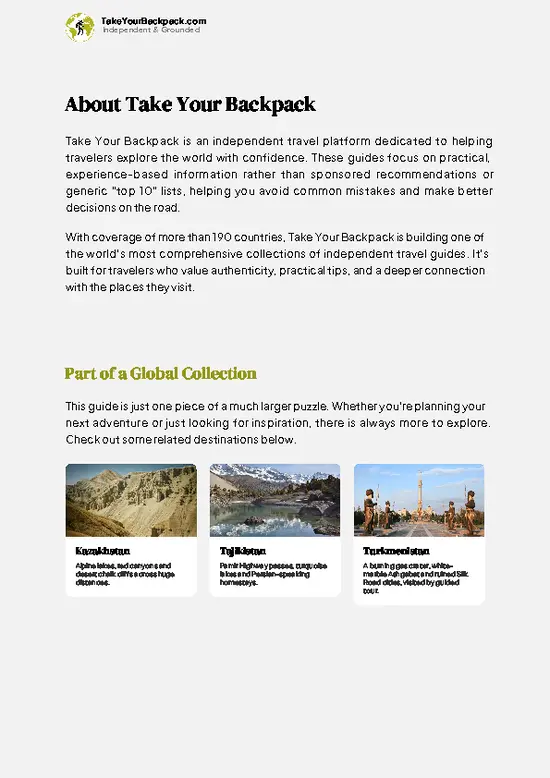
example page 0 from our offline Travel Guide for Uzbekistan
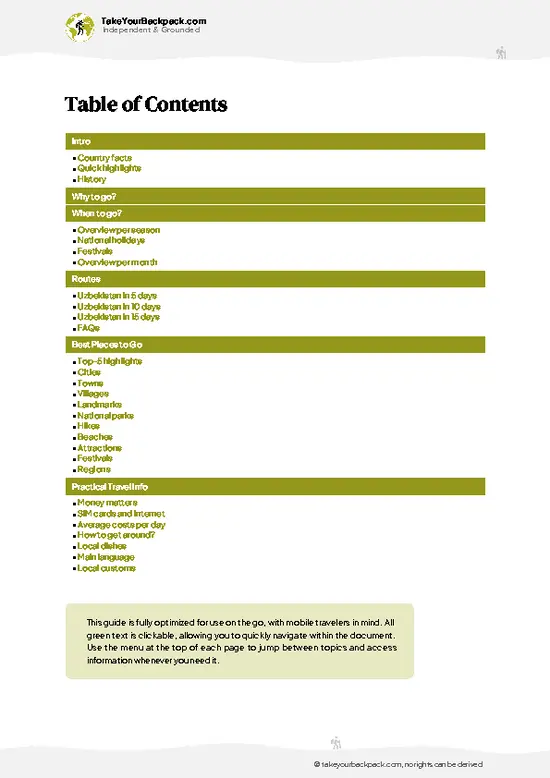
example page 1 from our offline Travel Guide for Uzbekistan
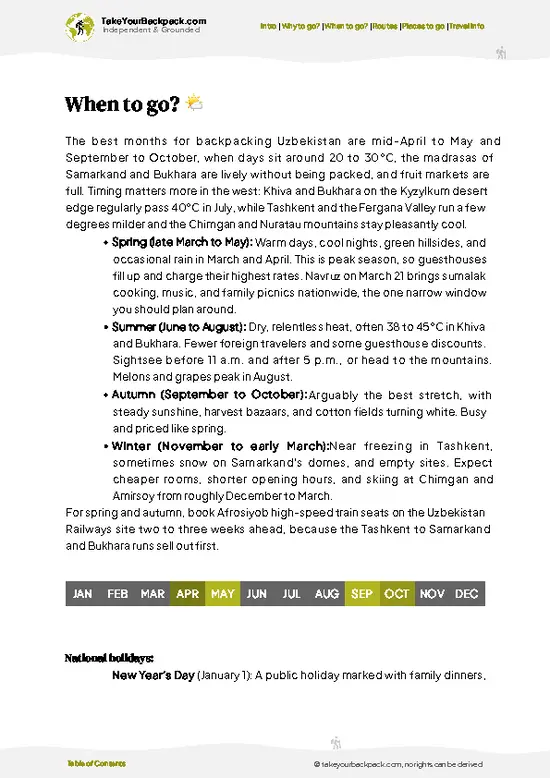
example page 2 from our offline Travel Guide for Uzbekistan
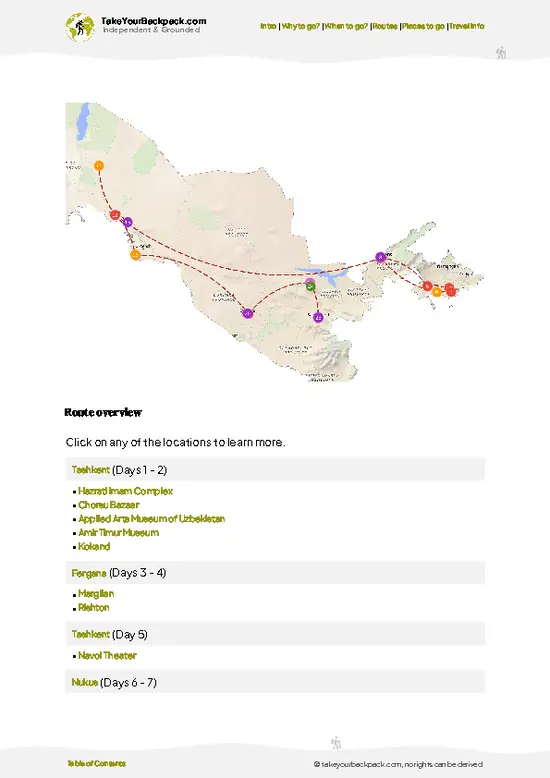
example page 3 from our offline Travel Guide for Uzbekistan
example page 4 from our offline Travel Guide for Uzbekistan
example page 5 from our offline Travel Guide for Uzbekistan
example page 6 from our offline Travel Guide for Uzbekistan
example page 7 from our offline Travel Guide for Uzbekistan
The digital guide (246 pages) contains:
✅ 74 highlights, ranked by travel appeal
✅ Optimized 5, 10 & 15-day travel routes
✅ Cities, national parks, landmarks, beaches
✅ How to get around
✅ Offline-friendly for travel without Wi-Fi
👉 Click to see all 30+ guide features

📅 Plan smarter in minutes, not weeks
✅ Month by month travel advice
✅ Festivals & national holidays
✅ Budget expectations

🗺️ Go to the right places, skip the overrated ones
✅ Honest pros & cons of destinations
✅ Top hikes, parks & viewpoints
✅ Lesser-known places most travelers miss
✅ Clear “worth it vs skip it” guidance

🛏️ Travel smoothly without rookie mistakes
✅ Best areas to stay
✅ Transport systems explained simply
✅ Common scams & safety advice
✅ SIM cards, money & practical tips

🌍 Understand the country, not just visit it
✅ Culture & traditions
✅ 52 Essential phrases & customs
✅ Festivals worth planning around
✅ Traveler-friendly historical context
✅ Insights that make places more meaningful

📱 Built for real travel conditions
✅ Fully downloadable PDF
✅ Works completely offline
✅ Optimized for phone use
✅ Useful in remote areas & buses
✅ Everything in one place
Stop searching, start planning
Get instant access to your full guide. 30‑day money-back guarantee.
+ Add another guide for just

By proceeding you agree to our terms.
Sent to your inbox immediately after payment • 100% Secure Checkout
Best Backpacking Travel Advisor 2025 tourism awardBest Backpacking
Travel Advisor
2025
What others say about Take Your Backpack Guides:
⭐⭐⭐⭐⭐
Fantastic, amazing amount of information!
⭐⭐⭐⭐⭐
My goodness this is amazing, it's what I've been looking for hats off too you!
⭐⭐⭐⭐⭐
I think this is absolutely BRILLIANT
⭐⭐⭐⭐
Very complete and informative. It's still missing places, but I gotta to commend you
⭐⭐⭐⭐⭐
This is truly amazing, thank you, can't wait to explore it with my kids!
⭐⭐⭐⭐⭐
Awesome resource, thank you!
⭐⭐⭐⭐⭐
This is amazing! Can't wait to explore the ones I haven't seen
⭐⭐⭐⭐
I love this! Well done, great idea.
⭐⭐⭐⭐⭐
Thanks for taking the time to make this gem!
⭐⭐⭐⭐⭐
This might be the best website I've ever seen.
⭐⭐⭐⭐⭐
Congratulations, and thank you so much for your work; it's incredibly valuable.
⭐⭐⭐⭐
In all seriousness I think you did a great job pointing out the important spots
⭐⭐⭐⭐⭐
10/10 very good
⭐⭐⭐⭐⭐
As someone who's only just starting to visit regularly this is awesome, thank you.
⭐⭐⭐⭐
Thank you very much! I'm going to visit my dad, it's going to be very useful!
⭐⭐⭐⭐⭐
This is really cool! We'll be travelling for the first time and this definitely come in handy.
⭐⭐⭐⭐⭐
You are now our minister of culture, congratulations 👨‍💼
⭐⭐⭐⭐⭐
Just wanted to tell you that this is a pearl! Going to follow your recommendations.
⭐⭐⭐⭐⭐
This is so cool. I'll definitely be using the resource for my travels soon.
⭐⭐⭐⭐⭐
This is very impressive! Good work.
⭐⭐⭐⭐⭐
This is an amazing and informative site. Very well done!

🛏️ Where to stay?Where to Base Yourself

Uzbekistan has a growing hostel scene, with dorm beds typically running 100,000 to 190,000 so’m (US$8 to 15) and family-run guesthouses with breakfast offering private rooms from about US$20 to 35. In Tashkent, Mirabad and the streets around Amir Timur Square put you near metro lines, cafés and the city’s modest bar scene, while the Chorsu area in the old town is cheaper and closer to the bazaar but quieter after dark. In Samarkand, beds clustered between the Registan and Gur-e-Amir keep the big monuments walkable. Staying inside Bukhara’s old town around Lyabi-Hauz or within Khiva’s walled Itchan Kala gives you the most atmosphere and very safe, sleepy nights, though nightlife is close to nonexistent. … read more 👉
Uzbekistan has a growing hostel scene, with dorm beds typically running 100,000 to 190,000 so’m (US$8 to 15) and family-run guesthouses with breakfast offering private rooms from about US$20 to 35. In Tashkent, Mirabad and the streets around Amir Timur Square put you near metro lines, cafés and the city’s modest bar scene, while the Chorsu area in the old town is cheaper and closer to the bazaar but quieter after dark. In Samarkand, beds clustered between the Registan and Gur-e-Amir keep the big monuments walkable. Staying inside Bukhara’s old town around Lyabi-Hauz or within Khiva’s walled Itchan Kala gives you the most atmosphere and very safe, sleepy nights, though nightlife is close to nonexistent.

If you enjoy meeting fellow travelers, consider choosing hostels with high ratings for atmosphere. On the other hand, if you prefer having your own space, a hotel might be a better option.

UzbekistanExpand Your Journey

👋 Meet the founderWho’s Behind Take Your Backpack?

Johan, backpacker and founder of TakeYourBackpackHi, I’m Johan (Netherlands 🇳🇱), the creator of TakeYourBackpack. Over the past 3 decades, I’ve backpacked through 90+ countries across six continents, gaining extensive experience with independent travel, long-term trips, and overland routes.

This site is built on a combination of firsthand travel experience and carefully curated insights from other backpackers. Many guides are based on places I’ve personally visited, while others bring together tips, observations, and practical advice shared by trusted travelers I’ve met along the way.

The goal is to provide realistic, experience-driven guidance — not generic itineraries — so you can explore destinations with better context, clearer expectations, and more confidence.