×

Venezuela🇻🇪 | best townsEssential 5 towns to Explore in Venezuela

Towns in Venezuela are small, hot, friendly and rarely set up for visitors, which is exactly why independent travel works here. The Andes give you cool mountain air, cheap guesthouses and the easiest tourist infrastructure. The Caribbean coast offers colonial streets and beach villages, but weekends and holidays fill them with Venezuelan families and push prices up. The Gran Sabana in the southeast is remote and costs the most, since almost everything runs through tours. Skip the oil-belt and big industrial cities, which have nothing for a backpacker. Prioritize one or two regions rather than the whole country.

By Johan Kruseman 🇳🇱 | Updated October 20, 2026
Explore the best villages in Venezuela

Why go?What Makes Them Special

Venezuela suits towns because its geography is split into distinct pockets. The Andes, the Caribbean coast, the arid Falcón peninsula and the Guiana Highlands each sit hours apart, and each has its own food, climate and building style. Spanish colonial grids, plazas with a church and a statue of Bolívar, and a strong habit of sitting outside in the evening give most towns a shared, readable rhythm.
What sets the country apart is that tourism infrastructure is thin. There are few polished tourist towns, so you get local life with little filtering. The cost is reliability. Power cuts, water interruptions, slow internet and fuel shortages affect buses and tours, and schedules slip. A trip that depends on tight connections is not worth planning.
Before choosing Venezuela for towns, know that US … read more 👉
Venezuela suits towns because its geography is split into distinct pockets. The Andes, the Caribbean coast, the arid Falcón peninsula and the Guiana Highlands each sit hours apart, and each has its own food, climate and building style. Spanish colonial grids, plazas with a church and a statue of Bolívar, and a strong habit of sitting outside in the evening give most towns a shared, readable rhythm.
What sets the country apart is that tourism infrastructure is thin. There are few polished tourist towns, so you get local life with little filtering. The cost is reliability. Power cuts, water interruptions, slow internet and fuel shortages affect buses and tours, and schedules slip. A trip that depends on tight connections is not worth planning.
Before choosing Venezuela for towns, know that US dollars in cash are the practical currency for most purchases, foreign cards rarely work and ATMs rarely pay out to foreigners. Big cities carry serious crime risk and government travel advisories are strict, so check them before booking. Towns are generally calmer than the cities but still call for daytime travel and low-key habits. Go if you accept rough edges. Skip it if you need predictability.
Why These Made the Cut
The list of best towns in Venezuela is created based on charm, local culture, atmosphere, hidden gems, and visitor appeal. If you feel a town is missing in this list, please let us know.

When to go?Best Time to Visit Venezuela for towns

Best months and weather: The best months for towns in Venezuela are December to March, when the dry season brings sunny days, low humidity and passable roads in nearly every region. Rain falls mainly from May to November, usually as afternoon downpours, and the Gran Sabana and Andean valleys can see 2,000 mm or more over the year, much of it in that stretch. Lowland and coastal towns stay hot year-round at roughly 28 to 34°C. The Andes are far cooler, with days of about 15 to 24°C in mountain towns and nights that can drop near freezing at higher elevations.
Shoulder seasons and peak periods: April and November are workable shoulder months with fewer visitors and softer prices. The wet months are worth avoiding for coastal and mountain hiking, since trails turn muddy, cloud covers the views … read more 👉
Best months and weather: The best months for towns in Venezuela are December to March, when the dry season brings sunny days, low humidity and passable roads in nearly every region. Rain falls mainly from May to November, usually as afternoon downpours, and the Gran Sabana and Andean valleys can see 2,000 mm or more over the year, much of it in that stretch. Lowland and coastal towns stay hot year-round at roughly 28 to 34°C. The Andes are far cooler, with days of about 15 to 24°C in mountain towns and nights that can drop near freezing at higher elevations.
Shoulder seasons and peak periods: April and November are workable shoulder months with fewer visitors and softer prices. The wet months are worth avoiding for coastal and mountain hiking, since trails turn muddy, cloud covers the views and landslides can close roads. The southeast is the exception: waterfalls run strongest from June to October, though river crossings and tours are more affected by weather and access.
The peak periods are Carnival (February or early March), Semana Santa (March or April) and the Christmas to New Year stretch. Coastal towns fill with domestic travelers, and guesthouse prices can rise 30 to 100 percent, with buses booked out days ahead. Mountain towns also get busy but stay manageable. Midweek in January or February gives the best mix of dry weather and space.

town hoppingTips for Visiting Multiple Destinations

How many days to plan: A trip combining several towns in Venezuela needs 10 to 14 days, and that only works if you stick to two regions. Three regions needs three weeks, because road delays, fuel shortages and canceled departures regularly eat a day or two.
Grouping regions and direction: The Andes and the Caribbean coast pair well, linked through Caracas or Valencia. Mérida to the central coast by road takes about 12 to 15 hours, usually done as an overnight bus or a short flight where services are running. The Gran Sabana is the awkward one. From Ciudad Bolívar it is another 10 to 12 hours to the Brazilian border, so it only makes sense as a separate trip or as a dedicated entry or exit toward Brazil. A sensible direction is to start in the Andes while you are fresh and finish at the coast, … read more 👉
How many days to plan: A trip combining several towns in Venezuela needs 10 to 14 days, and that only works if you stick to two regions. Three regions needs three weeks, because road delays, fuel shortages and canceled departures regularly eat a day or two.
Grouping regions and direction: The Andes and the Caribbean coast pair well, linked through Caracas or Valencia. Mérida to the central coast by road takes about 12 to 15 hours, usually done as an overnight bus or a short flight where services are running. The Gran Sabana is the awkward one. From Ciudad Bolívar it is another 10 to 12 hours to the Brazilian border, so it only makes sense as a separate trip or as a dedicated entry or exit toward Brazil. A sensible direction is to start in the Andes while you are fresh and finish at the coast, where slow beach days absorb delays.
Time per stop and common mistakes: Allow 2 to 4 nights per town. One night is not worth it after a long transfer, and more than four needs a specific reason such as hiking.
The usual mistakes are stacking three regions into two weeks, booking nonrefundable onward flights, and traveling at night to save a hotel bill. Instead, leave a buffer day before any flight or border crossing, buy bus tickets a day ahead, and take long road legs by day.

The ListTop towns of Venezuela

1 Choroní

Palm-backed crescent beach, fishing harbor, cacao farms, drumming weekends

Wake to nets hauled onto the sand at the harbor, then spend days on a sheltered beach and in family cacao groves.

2 La Asunción

Hilltop fort, colonial plaza, Nueva Cádiz museum, quiet capital

Climb to the old cannon-lined fortress for views over the valley, then wander calm low-rise streets and the island’s oldest church.

3 Ocumare de la Costa

Cata cove, mangrove lagoon, river-mouth fishing, seafood stalls

Spend a full day on a wide palm-fringed beach, then paddle through mangroves and eat fried fish where the peñeros land.

4 San Antonio del Táchira

Border bridge, money changers, produce market, Colombia transit

Watch porters and families cross the Río Táchira bridge, then browse the market streets that show how daily life straddles the border.

5 Tucupita

Caño Manamo riverfront, Warao crafts, delta gateway, dugout canoes

Meet river traders along the waterfront at dawn, buy palm-fiber hammocks and baskets, then board a boat toward Orinoco Delta communities.

Loading the map 🌍

Expert viewInsights from Locals and Experts

How many towns to visit: Three towns is the number to plan for, four at most. Transfers are slow, services get canceled and every extra stop adds a day of transport with little to see. Three lets you stay 3 to 4 nights each, which is long enough to hike, meet people and absorb a delay without wrecking the trip.
Choosing the kind of town: Mountain towns in the Andes suit first-timers and hikers, because guesthouses, tour agencies and restaurants are clustered and easy to compare. Coastal villages suit slower travelers who want swimming and seafood, but they are crowded on weekends and holidays and more expensive then. Remote towns in the southeast suit confident travelers with bigger budgets, because nearly everything runs through guided trips. Large industrial cities are not worth the time … read more 👉
How many towns to visit: Three towns is the number to plan for, four at most. Transfers are slow, services get canceled and every extra stop adds a day of transport with little to see. Three lets you stay 3 to 4 nights each, which is long enough to hike, meet people and absorb a delay without wrecking the trip.
Choosing the kind of town: Mountain towns in the Andes suit first-timers and hikers, because guesthouses, tour agencies and restaurants are clustered and easy to compare. Coastal villages suit slower travelers who want swimming and seafood, but they are crowded on weekends and holidays and more expensive then. Remote towns in the southeast suit confident travelers with bigger budgets, because nearly everything runs through guided trips. Large industrial cities are not worth the time or the risk.
What it costs: Budget US$30 to 50 a day in the Andes and on the coast, covering a guesthouse bed (US$10 to 25), meals (US$8 to 15) and local transport. The Gran Sabana and boat or flight-based trips often run US$60 to 120 a day, because guides, jeeps and permits are fixed costs. Typical per-visit costs are US$5 to 15 for park or site entry, US$25 to 60 for a day guide, and US$10 to 20 for a longer intercity bus. Carry clean, undamaged US$ bills in small denominations, since torn or marked notes are often refused and change is hard to find. Foreign cards rarely work. Prices are often quoted in dollars with a bolívar equivalent that shifts, so confirm the total before ordering or boarding.
Safety and cultural points: Travel between towns in daylight. Night buses and night walking are where most incidents happen. Keep phones out of sight, leave jewelry at home and take a registered taxi for evening trips. Avoid border zones near Colombia, and check your government’s advisory before booking. Police and military checkpoints are common, so carry your passport and a copy and stay calm and polite. Never offer a bribe.
Greet with a buenos días or buenas tardes before asking anything, since skipping it comes across as cold. Keep political opinions to yourself, as the economic situation is a sensitive topic and many families depend on remittances. Ask before photographing people, and never photograph military sites. Expect water and power interruptions, so bring a headlamp, a power bank and purification tablets, and avoid depending on a single hotel booking staying ready.
Delays and mistakes that cost money: Buying tours from street touts, relying on cash machines and setting a schedule with no slack are the three most common drains. Book guides through your guesthouse, withdraw or exchange enough dollars before leaving a larger city, and keep one spare day before any flight.

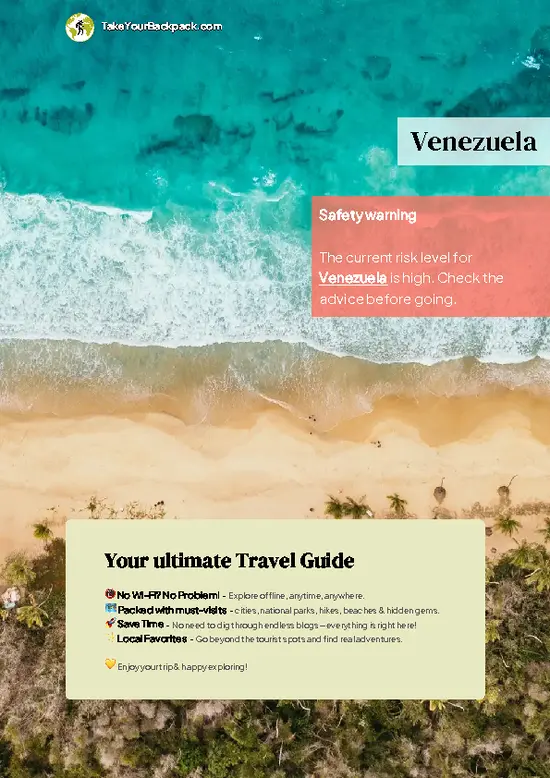
✈️ The backpacker research shortcutVenezuela Travel Guide

An offline-friendly backpacking guide with optimized travel routes, ranked highlights, transport advice, and the best areas to stay.
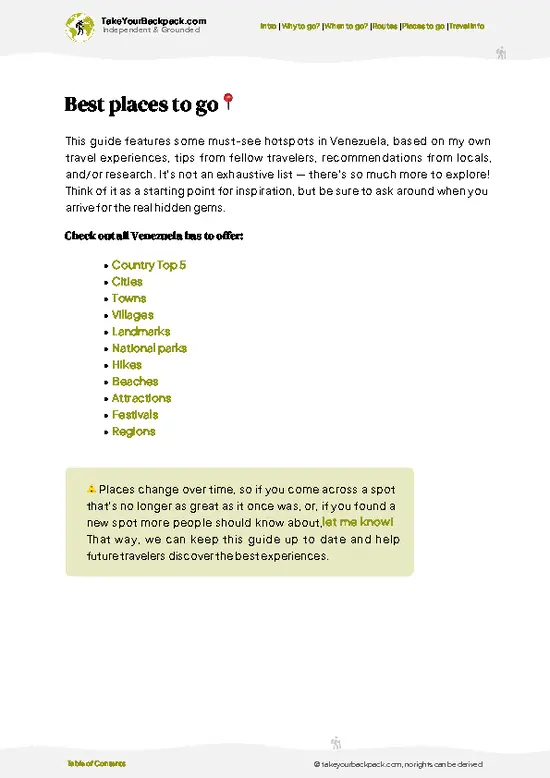
example page 0 from our offline Travel Guide for Venezuela
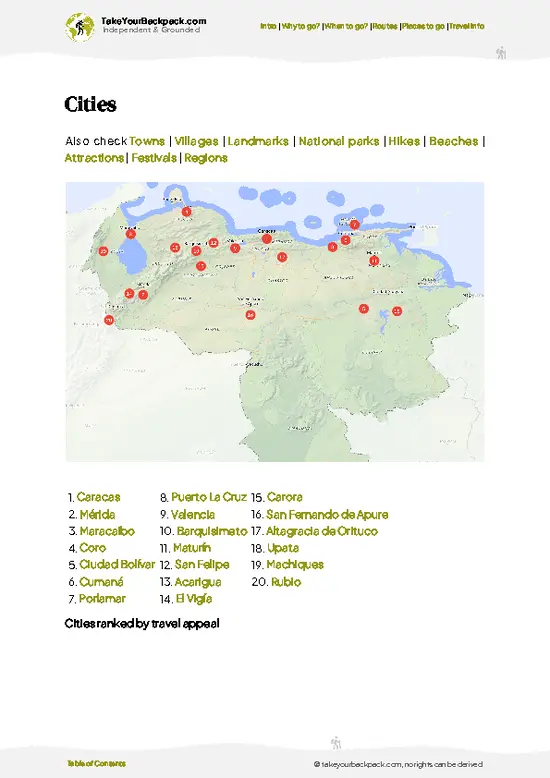
example page 1 from our offline Travel Guide for Venezuela
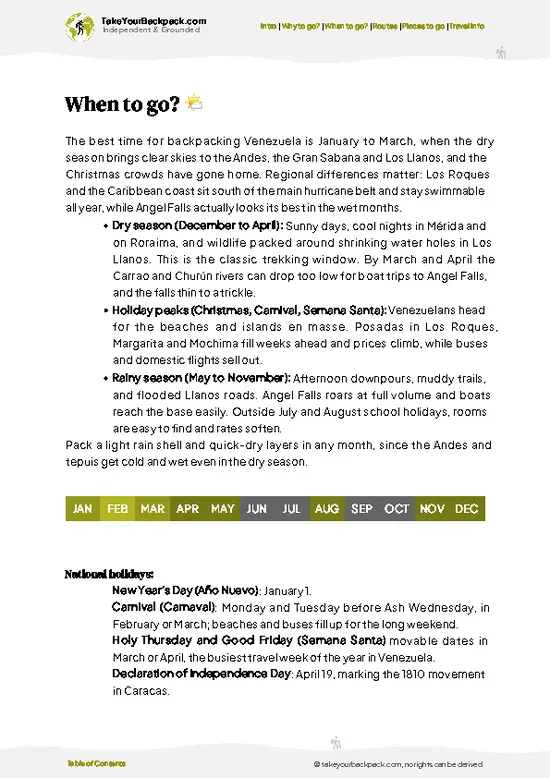
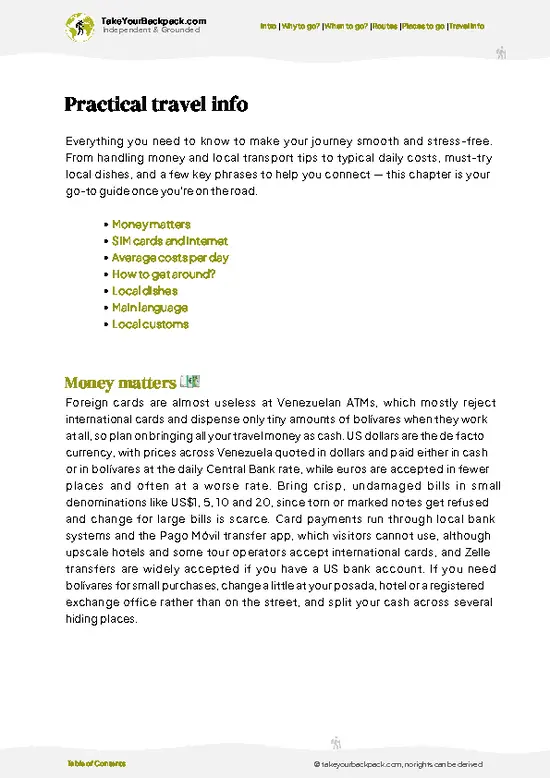
example page 2 from our offline Travel Guide for Venezuela
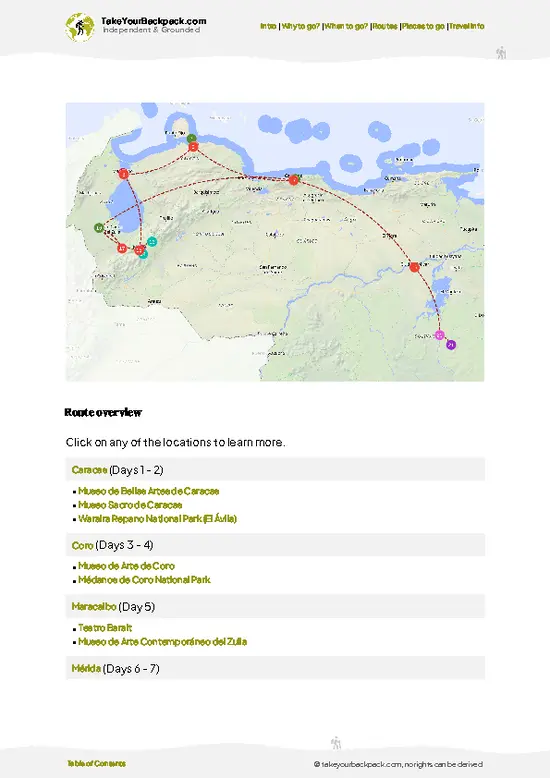
example page 3 from our offline Travel Guide for Venezuela
example page 4 from our offline Travel Guide for Venezuela
example page 5 from our offline Travel Guide for Venezuela
example page 6 from our offline Travel Guide for Venezuela
example page 7 from our offline Travel Guide for Venezuela
The digital guide (290 pages) contains:
✅ 91 highlights, ranked by travel appeal
✅ Optimized 5, 10 & 15-day travel routes
✅ Cities, national parks, landmarks, beaches
✅ How to get around
✅ Offline-friendly for travel without Wi-Fi
👉 Click to see all 30+ guide features

📅 Plan smarter in minutes, not weeks
✅ Month by month travel advice
✅ Festivals & national holidays
✅ Budget expectations

🗺️ Go to the right places, skip the overrated ones
✅ Honest pros & cons of destinations
✅ Top hikes, parks & viewpoints
✅ Lesser-known places most travelers miss
✅ Clear “worth it vs skip it” guidance

🛏️ Travel smoothly without rookie mistakes
✅ Best areas to stay
✅ Transport systems explained simply
✅ Common scams & safety advice
✅ SIM cards, money & practical tips

🌍 Understand the country, not just visit it
✅ Culture & traditions
✅ 52 Essential phrases & customs
✅ Festivals worth planning around
✅ Traveler-friendly historical context
✅ Insights that make places more meaningful

📱 Built for real travel conditions
✅ Fully downloadable PDF
✅ Works completely offline
✅ Optimized for phone use
✅ Useful in remote areas & buses
✅ Everything in one place
Stop searching, start planning
Get instant access to your full guide. 30‑day money-back guarantee.
+ Add another guide for just

By proceeding you agree to our terms.
Sent to your inbox immediately after payment • 100% Secure Checkout
Best Backpacking Travel Advisor 2025 tourism awardBest Backpacking
Travel Advisor
2025
What others say about Take Your Backpack Guides:
⭐⭐⭐⭐⭐
Fantastic, amazing amount of information!
⭐⭐⭐⭐⭐
My goodness this is amazing, it's what I've been looking for hats off too you!
⭐⭐⭐⭐⭐
I think this is absolutely BRILLIANT
⭐⭐⭐⭐
Very complete and informative. It's still missing places, but I gotta to commend you
⭐⭐⭐⭐⭐
This is truly amazing, thank you, can't wait to explore it with my kids!
⭐⭐⭐⭐⭐
Awesome resource, thank you!
⭐⭐⭐⭐⭐
This is amazing! Can't wait to explore the ones I haven't seen
⭐⭐⭐⭐
I love this! Well done, great idea.
⭐⭐⭐⭐⭐
Thanks for taking the time to make this gem!
⭐⭐⭐⭐⭐
This might be the best website I've ever seen.
⭐⭐⭐⭐⭐
Congratulations, and thank you so much for your work; it's incredibly valuable.
⭐⭐⭐⭐
In all seriousness I think you did a great job pointing out the important spots
⭐⭐⭐⭐⭐
10/10 very good
⭐⭐⭐⭐⭐
As someone who's only just starting to visit regularly this is awesome, thank you.
⭐⭐⭐⭐
Thank you very much! I'm going to visit my dad, it's going to be very useful!
⭐⭐⭐⭐⭐
This is really cool! We'll be travelling for the first time and this definitely come in handy.
⭐⭐⭐⭐⭐
You are now our minister of culture, congratulations 👨‍💼
⭐⭐⭐⭐⭐
Just wanted to tell you that this is a pearl! Going to follow your recommendations.
⭐⭐⭐⭐⭐
This is so cool. I'll definitely be using the resource for my travels soon.
⭐⭐⭐⭐⭐
This is very impressive! Good work.
⭐⭐⭐⭐⭐
This is an amazing and informative site. Very well done!

🛏️ Where to stay?Where to Base Yourself

Backpacking Venezuela means sleeping mostly in family-run posadas rather than dorm hostels, with private doubles typically around US$15 to 40 a night and only a handful of true dorms, mostly in the Andes and on the coast. In Caracas, Chacao, Altamira and Los Palos Grandes have the most options plus the city’s safest streets, walkable cafés and its best nightlife, though prices run higher and the historic center is a metro ride away. Mérida has the cheapest, most traveler-friendly posadas, clustered around the center near Plaza Bolívar close to tour agencies and the cable car, while beach towns like Choroní and the islands of Los Roques offer quiet posadas with little nightlife, and Los Roques … read more 👉
Backpacking Venezuela means sleeping mostly in family-run posadas rather than dorm hostels, with private doubles typically around US$15 to 40 a night and only a handful of true dorms, mostly in the Andes and on the coast. In Caracas, Chacao, Altamira and Los Palos Grandes have the most options plus the city’s safest streets, walkable cafés and its best nightlife, though prices run higher and the historic center is a metro ride away. Mérida has the cheapest, most traveler-friendly posadas, clustered around the center near Plaza Bolívar close to tour agencies and the cable car, while beach towns like Choroní and the islands of Los Roques offer quiet posadas with little nightlife, and Los Roques costs far more.

If you enjoy meeting fellow travelers, consider choosing hostels with high ratings for atmosphere. On the other hand, if you prefer having your own space, a hotel might be a better option.

VenezuelaExpand Your Journey

👋 Meet the founderWho’s Behind Take Your Backpack?

Johan, backpacker and founder of TakeYourBackpackHi, I’m Johan (Netherlands 🇳🇱), the creator of TakeYourBackpack. Over the past 3 decades, I’ve backpacked through 90+ countries across six continents, gaining extensive experience with independent travel, long-term trips, and overland routes.

This site is built on a combination of firsthand travel experience and carefully curated insights from other backpackers. Many guides are based on places I’ve personally visited, while others bring together tips, observations, and practical advice shared by trusted travelers I’ve met along the way.

The goal is to provide realistic, experience-driven guidance — not generic itineraries — so you can explore destinations with better context, clearer expectations, and more confidence.