×

Austria🇦🇹 | best attractionsExplore the 10 Best attractions in Austria

Attractions in Austria fall into a few distinct families, and the country’s geography decides which one you meet. Vienna and Salzburg concentrate imperial palaces, music halls and museums, so they run on timed tickets, queues and entry fees of roughly €15 to 30. The Alps of Tyrol, Salzburgerland and Vorarlberg offer lakes, cable cars and peaks, where lift prices are the main cost and summer weekends crowd the valleys. Carinthia, Styria and Burgenland are quieter and cheaper, with fewer visitors and more dependence on regional trains or buses. For independent travel, the dense rail network makes cities easy, while mountain choices need more planning.

By Johan Kruseman 🇳🇱 | Updated October 19, 2026
Explore the best festivals in Austria

Why go?Understanding Their Importance

Austria suits attractions because centuries of Habsburg rule left a capital built for an empire, with palaces, collections and concert culture far larger than a country of nine million people would otherwise support. That legacy sits beside an Alpine landscape covering about two thirds of the territory, so mountains, lakes and glaciers are within reach of nearly every town. The two halves differ in how they work. Cultural sites are ticketed, well maintained and priced for a wealthy country, while nature is often free to enter but costs money the moment a lift, hut or guided route is involved.

Infrastructure is a real strength. Rail and regional bus services reach most valleys, regional cards bundle entries and transport, and signage and opening hours are dependable. The downside is that Austria … read more 👉
Austria suits attractions because centuries of Habsburg rule left a capital built for an empire, with palaces, collections and concert culture far larger than a country of nine million people would otherwise support. That legacy sits beside an Alpine landscape covering about two thirds of the territory, so mountains, lakes and glaciers are within reach of nearly every town. The two halves differ in how they work. Cultural sites are ticketed, well maintained and priced for a wealthy country, while nature is often free to enter but costs money the moment a lift, hut or guided route is involved.

Infrastructure is a real strength. Rail and regional bus services reach most valleys, regional cards bundle entries and transport, and signage and opening hours are dependable. The downside is that Austria is a high-cost, high-demand destination, and the best-known lakes and old towns fill up fast in summer. Weather also matters more than visitors expect, because Alpine cloud can erase the point of a lift ride. Before choosing Austria, decide whether you want heritage, mountains or both, since each has a different price curve and a different seasonal logic. Smaller regions give lower costs but fewer connections, so they reward flexible schedules.
Behind the Scenes of Selection
The list of best attractions in Austria is created based on cultural significance or entertainment value. If you feel a attraction is missing in this list, please let us know.

When to go?Seasonal Guide to Visiting

Best months: The best months for attractions in Austria are June to September, because Alpine lifts, huts and lake areas are fully open and daytime highs in the valleys sit around 20 to 27°C. Cities are reliable year-round, but high mountain terrain is not, so timing depends on what you want.
Shoulder seasons: April to May and October bring lower prices and thinner crowds, with city highs around 10 to 18°C. The trade-off is that many cable cars and mountain huts close for maintenance, often from mid-April to late May and again from late October to mid-December. Rain is frequent in spring, and the Alps see most of their precipitation in summer, often as afternoon thunderstorms, so mornings are the safer window for high viewpoints.
Peak periods and winter: July and August are busiest around lakes … read more 👉
Best months: The best months for attractions in Austria are June to September, because Alpine lifts, huts and lake areas are fully open and daytime highs in the valleys sit around 20 to 27°C. Cities are reliable year-round, but high mountain terrain is not, so timing depends on what you want.
Shoulder seasons: April to May and October bring lower prices and thinner crowds, with city highs around 10 to 18°C. The trade-off is that many cable cars and mountain huts close for maintenance, often from mid-April to late May and again from late October to mid-December. Rain is frequent in spring, and the Alps see most of their precipitation in summer, often as afternoon thunderstorms, so mornings are the safer window for high viewpoints.
Peak periods and winter: July and August are busiest around lakes in Salzburgerland and Carinthia, where accommodation can cost 30 to 60 percent more than in shoulder months. Winter from December to March makes the Alps ski country, with lodging in Tyrol and Vorarlberg peaking at Christmas, New Year and February school holidays. Vienna fills at Christmas markets from late November, while January and February are cold, around -2 to 4°C, but quiet. Indoor sites in Vienna and Salzburg stay open throughout, which makes them useful rainy-day fallbacks.

attraction hoppingOptimizing Your Multi-Stop Itinerary

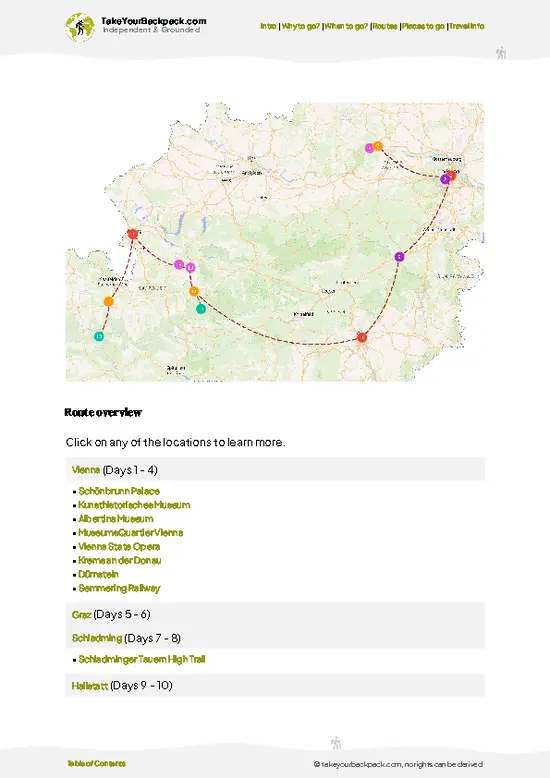
How long you need: A trip combining several attractions in Austria needs 7 to 12 days, because distances are short but mountain transfers are slower than the map suggests. Fewer than seven days forces a choice between regions.
Grouping and direction: The country links well along its main east-west rail axis. Vienna pairs with the Danube valley and Burgenland, Salzburg with the Salzkammergut lakes and the Salzburg Alps, and Innsbruck with the Tyrolean valleys. Traveling west to east or east to west avoids backtracking, and flying into Vienna and out of Innsbruck or Salzburg (or the reverse) saves a return leg. Vienna to Salzburg takes about 2.5 to 3 hours by train, Salzburg to Innsbruck roughly 2 hours, and Vienna to Innsbruck around 4.5 to 5 hours. Southern regions such as Carinthia and Styria … read more 👉
How long you need: A trip combining several attractions in Austria needs 7 to 12 days, because distances are short but mountain transfers are slower than the map suggests. Fewer than seven days forces a choice between regions.
Grouping and direction: The country links well along its main east-west rail axis. Vienna pairs with the Danube valley and Burgenland, Salzburg with the Salzkammergut lakes and the Salzburg Alps, and Innsbruck with the Tyrolean valleys. Traveling west to east or east to west avoids backtracking, and flying into Vienna and out of Innsbruck or Salzburg (or the reverse) saves a return leg. Vienna to Salzburg takes about 2.5 to 3 hours by train, Salzburg to Innsbruck roughly 2 hours, and Vienna to Innsbruck around 4.5 to 5 hours. Southern regions such as Carinthia and Styria sit better on a separate loop via Graz or Klagenfurt, with 3 to 4 hours of travel from Vienna.
Time per stop and common mistakes: Cities need 2 to 3 days each, while alpine bases need 2 to 4 days so weather can be absorbed. The usual mistake is packing in too many stops, which turns the trip into transit. Another is treating mountain valleys as short rail hops, when the last stretch often requires a bus every 1 to 2 hours. Stay put longer and take day trips instead.

The ListThe Best attractions of Austria

1 Kunsthistorisches Museum

Old Masters, Egyptian antiquities, grand marble halls

Browse collections spanning ancient to Renaissance art in a palatial setting designed for the imperial collections of the Habsburgs.

Austria - Kunsthistorisches Museum

2 Belvedere Palace

baroque gardens, Klimt paintings, hilltop views

Wander landscaped terraces and galleries displaying Austrian art, then look out over Vienna from the palace’s elevated grounds.

austria-attraction-belvedere-palace
© Google |

3 Albertina Museum

graphic art collection, Habsburg staterooms, central Vienna

View original works by Dürer and Monet while moving between ornate imperial halls and modern exhibition spaces in the city center.

austria-attraction-albertina-museum
© Google |

4 Hohensalzburg Fortress

hilltop stronghold, panoramic ramparts, medieval interiors

Climb or ride up to explore fortified towers, historic chambers, and sweeping views over Salzburg and the surrounding Alps.

austria-attraction-hohensalzburg-fortress
© Google |

5 Vienna State Opera

opera repertoire, grand auditorium, marble staircases

Attend a performance or take a guided tour to experience the acoustics, stagecraft, and architectural details of this renowned opera house.

Austria - Vienna State Opera

6 Leopold Museum

Viennese Modernism, Egon Schiele, white cube galleries

Discover early twentieth-century Austrian art in bright, minimalist rooms that highlight the evolution of modernist painting and sculpture.

7 Spanish Riding School

Lipizzaner horses, baroque arena, equestrian tradition

Watch classical dressage performances or morning training sessions in a historic hall dedicated to centuries-old horsemanship.

austria-attraction-spanish-riding-school
© Google |

8 Tiergarten Schönbrunn

historic zoo, rare species, landscaped enclosures

Observe animals from around the world in the world’s oldest operating zoo, set within the grounds of Schönbrunn Palace.

Austria - Tiergarten Schönbrunn

9 Mozart’s Birthplace

Salzburg townhouse, original manuscripts, family artifacts

Step into the preserved rooms where Mozart spent his early years and see personal items that shaped his musical beginnings.

austria-attraction-mozarts-birthplace
© Google |

10 Mozarthaus Vienna

composer’s apartment, multimedia displays, city center location

Tour the only surviving Vienna residence of Mozart, exploring his daily life and creative process through interactive exhibits.

11 MuseumsQuartier Vienna

contemporary art spaces, open courtyards, cultural complex

Relax in outdoor lounges or visit multiple museums and galleries clustered in a former imperial stable block turned creative hub.

12 Haus der Musik

interactive sound exhibits, composer biographies, modern museum

Experiment with sound installations and learn about Vienna’s musical heritage through hands-on displays and multimedia presentations.

13 Burgtheater

Austrian drama, neoclassical façade, Ringstrasse landmark

Attend a German-language performance or join a backstage tour to experience the traditions and architecture of Austria’s national theater.

Austria - Burgtheahter

Think you know Austria?

Prove you’re a true local — uncover 3 lesser-known attractions in Austria that locals tend to keep to themselves.
Loading the map 🌍

Expert viewInsights from Locals and Experts

How many attractions to plan: Plan one major attraction per day, with a second only if it is a short city visit. That means roughly 6 to 10 on a 10-day trip. Austria’s sights are spread across valleys and cities, and the transfer between them takes real time. Alpine lifts also run on weather, so an extra buffer day lets you swap an overcast day for a clear one. Experienced travelers leave one flexible slot per region rather than filling every day.
Choosing between kinds: Heritage sites reward travelers who like history, music and architecture, and they are dependable in any weather. Nature attractions suit hikers and photographers, but depend on visibility, so they are best booked late in your stay. If your budget is tight, favor free or low-cost walking, lakes and village centers, and choose … read more 👉
How many attractions to plan: Plan one major attraction per day, with a second only if it is a short city visit. That means roughly 6 to 10 on a 10-day trip. Austria’s sights are spread across valleys and cities, and the transfer between them takes real time. Alpine lifts also run on weather, so an extra buffer day lets you swap an overcast day for a clear one. Experienced travelers leave one flexible slot per region rather than filling every day.
Choosing between kinds: Heritage sites reward travelers who like history, music and architecture, and they are dependable in any weather. Nature attractions suit hikers and photographers, but depend on visibility, so they are best booked late in your stay. If your budget is tight, favor free or low-cost walking, lakes and village centers, and choose only one or two paid lift rides. Mixed travelers do best with a city, then a lake or valley, then one high-altitude day.
What it costs: A budget backpacker can manage on US$65 to 110 (€60 to 100) a day, including hostel dorm beds at about €30 to 50, supermarket food and local transport. Museums and palaces typically charge €10 to 30 each, and guided tours add €15 to 40. Cable cars are the largest single cost, often €30 to 70 return for big-name peaks. Regional passes and city cards (such as Vienna’s transit-plus-discount cards or the Salzburg Card) save money only if you visit several paid sites in 24 to 72 hours. Do the arithmetic before buying. Advance online tickets for popular palaces also save queueing, since walk-up lines can run 30 to 60 minutes in summer.
Safety and cultural notes: Austria is very safe, with petty theft the main risk in crowded Vienna sites and train stations. The real danger is the mountains. Weather turns fast, so check the forecast the evening before, start early, and turn back if cloud closes in. Wear proper boots, carry layers even in July, and note that mountain huts take cash more often than you expect. Rescue is excellent but helicopter evacuation can be billed, so travel insurance that covers hiking is worth having.
Etiquette: Greet shopkeepers and hut staff with “Grüß Gott” or “Hallo”, keep quiet in concert halls and churches, and follow Sunday closures, since most shops and many smaller sites are shut or limited. Stay on marked paths, close pasture gates, and give grazing cows distance, especially when calves are present.

✈️ The backpacker research shortcutAustria Travel Guide

An offline-friendly backpacking guide with optimized travel routes, ranked highlights, transport advice, and the best areas to stay.
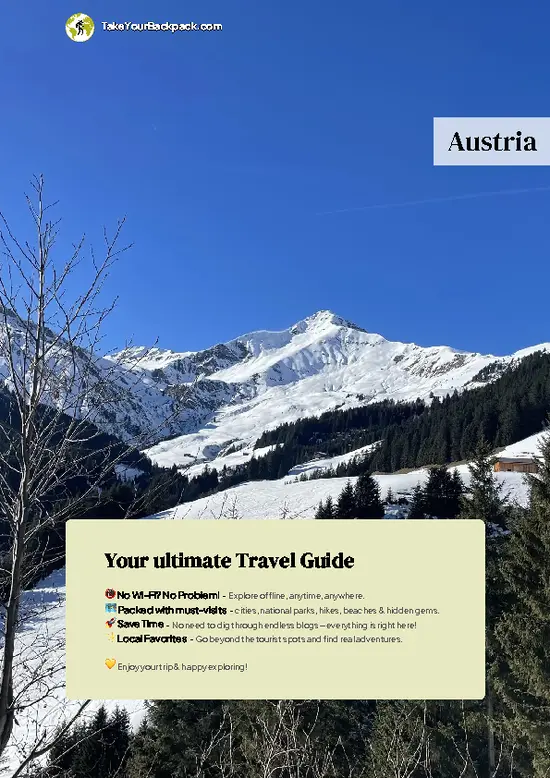
example page 0 from our offline Travel Guide for Austria
example page 1 from our offline Travel Guide for Austria
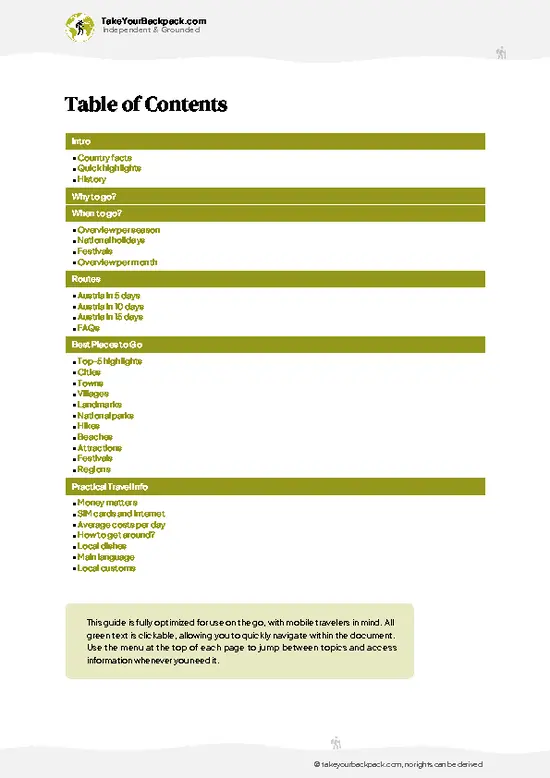
example page 2 from our offline Travel Guide for Austria
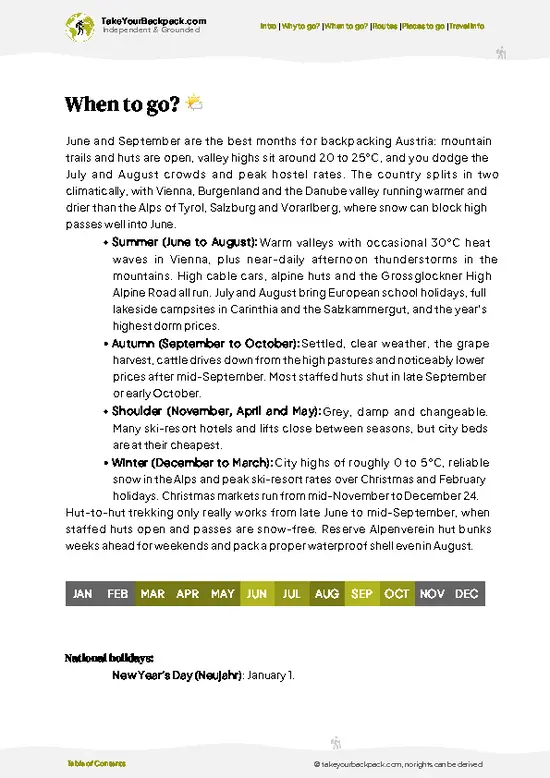
example page 3 from our offline Travel Guide for Austria
example page 4 from our offline Travel Guide for Austria
example page 5 from our offline Travel Guide for Austria
example page 6 from our offline Travel Guide for Austria
example page 7 from our offline Travel Guide for Austria
The digital guide (354 pages) contains:
✅ 90 highlights, ranked by travel appeal
✅ Optimized 5, 10 & 15-day travel routes
✅ Cities, national parks, landmarks, beaches
✅ How to get around
✅ Offline-friendly for travel without Wi-Fi
👉 Click to see all 30+ guide features

📅 Plan smarter in minutes, not weeks
✅ Month by month travel advice
✅ Festivals & national holidays
✅ Budget expectations

🗺️ Go to the right places, skip the overrated ones
✅ Honest pros & cons of destinations
✅ Top hikes, parks & viewpoints
✅ Lesser-known places most travelers miss
✅ Clear “worth it vs skip it” guidance

🛏️ Travel smoothly without rookie mistakes
✅ Best areas to stay
✅ Transport systems explained simply
✅ Common scams & safety advice
✅ SIM cards, money & practical tips

🌍 Understand the country, not just visit it
✅ Culture & traditions
✅ 52 Essential phrases & customs
✅ Festivals worth planning around
✅ Traveler-friendly historical context
✅ Insights that make places more meaningful

📱 Built for real travel conditions
✅ Fully downloadable PDF
✅ Works completely offline
✅ Optimized for phone use
✅ Useful in remote areas & buses
✅ Everything in one place
Stop searching, start planning
Get instant access to your full guide. 30‑day money-back guarantee.
+ Add another guide for just

By proceeding you agree to our terms.
Sent to your inbox immediately after payment • 100% Secure Checkout
Best Backpacking Travel Advisor 2025 tourism awardBest Backpacking
Travel Advisor
2025
What others say about Take Your Backpack Guides:
⭐⭐⭐⭐⭐
Fantastic, amazing amount of information!
⭐⭐⭐⭐⭐
My goodness this is amazing, it's what I've been looking for hats off too you!
⭐⭐⭐⭐⭐
I think this is absolutely BRILLIANT
⭐⭐⭐⭐
Very complete and informative. It's still missing places, but I gotta to commend you
⭐⭐⭐⭐⭐
This is truly amazing, thank you, can't wait to explore it with my kids!
⭐⭐⭐⭐⭐
Awesome resource, thank you!
⭐⭐⭐⭐⭐
This is amazing! Can't wait to explore the ones I haven't seen
⭐⭐⭐⭐
I love this! Well done, great idea.
⭐⭐⭐⭐⭐
Thanks for taking the time to make this gem!
⭐⭐⭐⭐⭐
This might be the best website I've ever seen.
⭐⭐⭐⭐⭐
Congratulations, and thank you so much for your work; it's incredibly valuable.
⭐⭐⭐⭐
In all seriousness I think you did a great job pointing out the important spots
⭐⭐⭐⭐⭐
10/10 very good
⭐⭐⭐⭐⭐
As someone who's only just starting to visit regularly this is awesome, thank you.
⭐⭐⭐⭐
Thank you very much! I'm going to visit my dad, it's going to be very useful!
⭐⭐⭐⭐⭐
This is really cool! We'll be travelling for the first time and this definitely come in handy.
⭐⭐⭐⭐⭐
You are now our minister of culture, congratulations 👨‍💼
⭐⭐⭐⭐⭐
Just wanted to tell you that this is a pearl! Going to follow your recommendations.
⭐⭐⭐⭐⭐
This is so cool. I'll definitely be using the resource for my travels soon.
⭐⭐⭐⭐⭐
This is very impressive! Good work.
⭐⭐⭐⭐⭐
This is an amazing and informative site. Very well done!

🛏️ Where to stay?Top Places to Consider Staying

Hostels are plentiful in Austria, with dorm beds typically running €25 to €45 a night and the widest choice in Vienna, Salzburg, Innsbruck and Graz, plus youth hostels and budget guesthouses in smaller towns and alpine resorts. In Vienna, Neubau and Mariahilf near Westbahnhof put you in walking distance of the MuseumsQuartier and plenty of bars, while Favoriten around the Hauptbahnhof is cheaper and has excellent transport links but little character after dark; Leopoldstadt sits between the two, close to the Prater and the center but quieter at night. In Salzburg, beds near the station in Elisabeth-Vorstadt cost noticeably less than anything in the Altstadt (a 15 to 20 minute walk away), and … read more 👉
Hostels are plentiful in Austria, with dorm beds typically running €25 to €45 a night and the widest choice in Vienna, Salzburg, Innsbruck and Graz, plus youth hostels and budget guesthouses in smaller towns and alpine resorts. In Vienna, Neubau and Mariahilf near Westbahnhof put you in walking distance of the MuseumsQuartier and plenty of bars, while Favoriten around the Hauptbahnhof is cheaper and has excellent transport links but little character after dark; Leopoldstadt sits between the two, close to the Prater and the center but quieter at night. In Salzburg, beds near the station in Elisabeth-Vorstadt cost noticeably less than anything in the Altstadt (a 15 to 20 minute walk away), and in Innsbruck the area around the main station keeps you close to the old town and the Nordkette cable car.

If you enjoy meeting fellow travelers, consider choosing hostels with high ratings for atmosphere. On the other hand, if you prefer having your own space, a hotel might be a better option.

AustriaMore Places Across Austria

👋 Meet the founderWho’s Behind Take Your Backpack?

Johan, backpacker and founder of TakeYourBackpackHi, I’m Johan (Netherlands 🇳🇱), the creator of TakeYourBackpack. Over the past 3 decades, I’ve backpacked through 90+ countries across six continents, gaining extensive experience with independent travel, long-term trips, and overland routes.

This site is built on a combination of firsthand travel experience and carefully curated insights from other backpackers. Many guides are based on places I’ve personally visited, while others bring together tips, observations, and practical advice shared by trusted travelers I’ve met along the way.

The goal is to provide realistic, experience-driven guidance — not generic itineraries — so you can explore destinations with better context, clearer expectations, and more confidence.