×

Bulgaria🇧🇬 | best regionsYour Guide to the Best regions in Bulgaria

Bulgaria packs Black Sea beaches, Balkan ridgelines, Roman-era towns and ski villages into a country smaller than Ohio, which means your regional choice decides almost everything. The coast swings between party strips and empty sand, the mountains trade crowds for cheap huts and long trail days, and the interior towns run on stone, wine and unhurried coffee. Prices stay low by European standards, though resort zones raise them in July. Independent travelers get the best deal with trains and buses that connect most hubs, if you accept that timetables are suggestions. Pick a region by mood first, then check the bus.

By Johan Kruseman 🇳🇱 | Updated October 18, 2026
Explore the best cities in Bulgaria

Why go?Understanding Their Importance

Bulgaria suits regional travel because so much geography sits in so little space. The Balkan Mountains run east to west through the middle, the Rila, Pirin and Rhodope ranges fill the southwest, the Danube forms the northern border and the Black Sea closes the east. Climate shifts accordingly, with continental extremes inland and milder, humid summers on the coast. That gives each area its own food, dialect and pace.

History adds more layers. Thracian tombs, Roman ruins, medieval Bulgarian capitals, Ottoman-era houses and Soviet-era concrete often sit within a few hours of one another, so a region can change character in the time it takes to finish a bus snack. The Orthodox monastery tradition, preserved through centuries of Ottoman rule, anchors many mountain valleys.

Before choosing Bulgaria, … read more 👉
Bulgaria suits regional travel because so much geography sits in so little space. The Balkan Mountains run east to west through the middle, the Rila, Pirin and Rhodope ranges fill the southwest, the Danube forms the northern border and the Black Sea closes the east. Climate shifts accordingly, with continental extremes inland and milder, humid summers on the coast. That gives each area its own food, dialect and pace.

History adds more layers. Thracian tombs, Roman ruins, medieval Bulgarian capitals, Ottoman-era houses and Soviet-era concrete often sit within a few hours of one another, so a region can change character in the time it takes to finish a bus snack. The Orthodox monastery tradition, preserved through centuries of Ottoman rule, anchors many mountain valleys.

Before choosing Bulgaria, know the practical side. The currency is the euro, adopted in 2025, and costs remain well under Western Europe. Public transport reaches larger towns reliably but thins out in villages and on mountain roads, where a rental car or a patient thumb helps. English is common among younger people and in tourist zones, less so elsewhere, and the Cyrillic alphabet is worth learning in an afternoon. Nodding for no and shaking for yes remains a real hazard in ordering lunch.
Behind the Scenes of Selection
The list of best regions in Bulgaria is created based on landscapes, local culture, attractions, vibes, and overall appeal. If you feel a region is missing in this list, please let us know.

When to go?When to Plan Your Trip

Best months: The best months for most regions in Bulgaria are May to June and September to early October, when daytime temperatures sit around 18 to 27°C, trails are open and prices have not yet hit peak levels.

Summer and the coast: July and August bring 28 to 35°C inland and 26 to 30°C on the Black Sea coast, with sea temperatures of about 22 to 26°C. Coastal accommodation can run 30 to 60 percent above shoulder-season rates, and beach towns are crowded, loud and sold out on weekends. Mountain areas such as Rila and Pirin are cooler, roughly 10 to 20°C at hut altitudes, but afternoon thunderstorms are common, so start hikes early. High trails often hold snow into June.

Autumn and shoulder seasons: September is the quiet winner. The sea is still warm, the grape harvest starts and foliage … read more 👉
Best months: The best months for most regions in Bulgaria are May to June and September to early October, when daytime temperatures sit around 18 to 27°C, trails are open and prices have not yet hit peak levels.

Summer and the coast: July and August bring 28 to 35°C inland and 26 to 30°C on the Black Sea coast, with sea temperatures of about 22 to 26°C. Coastal accommodation can run 30 to 60 percent above shoulder-season rates, and beach towns are crowded, loud and sold out on weekends. Mountain areas such as Rila and Pirin are cooler, roughly 10 to 20°C at hut altitudes, but afternoon thunderstorms are common, so start hikes early. High trails often hold snow into June.

Autumn and shoulder seasons: September is the quiet winner. The sea is still warm, the grape harvest starts and foliage in the Rhodope and Balkan foothills turns copper. Rain increases from late October. Many seaside hotels, restaurants and beach bars close from October to April, so coastal trips outside summer need flexible expectations.

Winter: December to March suits ski resorts such as Bansko, Borovets and Pamporovo, with daytime temperatures from about minus 8 to 2°C in the mountains. Lift passes cost roughly €35 to 60 a day, and Christmas and February school holidays push rates up. Lowland cities, around minus 2 to 5°C, are cold, gray and cheap, which suits museums and thermal baths better than hiking.

region hoppingTips for Visiting Multiple Destinations

How many days: A trip linking several regions in Bulgaria works best in 10 to 14 days, which allows three or four stops without turning the trip into a transit exercise.

Grouping and direction: Sofia is the natural hub, with an airport, a central bus station and trains fanning out in every direction. Southwest regions group well together because distances are short, usually 2 to 4 hours by bus. The center and east pair nicely too, with Plovdiv, Veliko Tarnovo and the Black Sea forming a rough arc. A sensible direction is to start in Sofia, work through the mountains and valleys, and finish at the coast, where you can relax and fly out of Varna or Burgas. Reversing it also works, but ending at sea level makes the sandy finale much easier.

Time per stop: Allow 2 to 4 nights per region, with … read more 👉
How many days: A trip linking several regions in Bulgaria works best in 10 to 14 days, which allows three or four stops without turning the trip into a transit exercise.

Grouping and direction: Sofia is the natural hub, with an airport, a central bus station and trains fanning out in every direction. Southwest regions group well together because distances are short, usually 2 to 4 hours by bus. The center and east pair nicely too, with Plovdiv, Veliko Tarnovo and the Black Sea forming a rough arc. A sensible direction is to start in Sofia, work through the mountains and valleys, and finish at the coast, where you can relax and fly out of Varna or Burgas. Reversing it also works, but ending at sea level makes the sandy finale much easier.

Time per stop: Allow 2 to 4 nights per region, with an extra day if hiking is involved. Typical transfers run 2 to 3 hours between Sofia and Plovdiv, about 3 to 4 hours from Sofia to Veliko Tarnovo, and 5 to 7 hours from Sofia to Varna or Burgas.

Common mistakes: Travelers often cram in too many stops, assuming small country means fast travel. Mountain roads and infrequent connections quickly say otherwise. Others forget that rural buses may run only once or twice a day, so a missed departure costs a night. Check times at the station the day before, build in one buffer day, and keep smaller villages for when you have a car or a flexible schedule.

The ListMust-Visit regions in Bulgaria

1 Burgas Lakes

coastal wetlands, birdwatching, salt pans, reed beds

Follow quiet trails along the water’s edge, observe rare birds in migration, and watch salt harvesting shape the landscape’s daily rhythm.

Loading the map 🌍

Expert viewInsights from Locals and Experts

How many regions to visit: Three to four regions suits most backpackers. That number leaves roughly two to four nights each in a trip of two weeks, which covers the travel time, a proper hike or walk, and one lazy day when the weather or a bus schedule turns against you. Five or more regions means spending a meaningful share of your trip in bus stations, and buses cost money and energy for no real return. Two regions is easy and cheap, but you miss the contrast that makes Bulgaria interesting. Three or four gives the best balance of variety and sanity.

Which kinds to prioritize: Hikers and budget travelers should lean toward mountain and rural regions. A hut bed costs about €10 to 20, local meals are cheap, and you pay for little more than effort. History and culture travelers get more value … read more 👉
How many regions to visit: Three to four regions suits most backpackers. That number leaves roughly two to four nights each in a trip of two weeks, which covers the travel time, a proper hike or walk, and one lazy day when the weather or a bus schedule turns against you. Five or more regions means spending a meaningful share of your trip in bus stations, and buses cost money and energy for no real return. Two regions is easy and cheap, but you miss the contrast that makes Bulgaria interesting. Three or four gives the best balance of variety and sanity.

Which kinds to prioritize: Hikers and budget travelers should lean toward mountain and rural regions. A hut bed costs about €10 to 20, local meals are cheap, and you pay for little more than effort. History and culture travelers get more value in the old towns and inland cities, where museums, churches and ruins cost around €3 to 8 each and walking replaces transport spending. Beach seekers should accept the premium: the coast gives the most comfort per euro in June and September, but July and August cost the most for the least peace. Ski travelers face the highest costs, and lift passes plus gear rental can double a normal daily budget. For most backpackers, mountains plus one historic region plus a short coastal finish give the most for the money.

What it costs: Expect €30 to 50 a day on a typical budget, covering hostel or guesthouse beds at €12 to 25, meals at €8 to 15, and local transport. Add €10 to 20 a day for entry fees and occasional taxis. Guided hikes or cultural tours run about €40 to 90 a day, which is worth it for high alpine routes in poor visibility but unnecessary on marked trails. A two-week multi-region trip typically lands between €500 and 900 excluding flights, rising by a third in peak summer or ski season.

Safety and cultural notes: Bulgaria is generally safe, and the usual city precautions apply: watch for pickpockets on crowded public transport, and use metered taxis or ride apps rather than unmarked cars. In the mountains, weather turns quickly, so carry layers and tell your hut or guesthouse your route. Stray dogs are common in rural areas, and keeping calm and walking steadily works best. Dress modestly in monasteries and take off hats inside. A head shake means yes and a nod means no, which is confusing enough at a restaurant. Learning basic Cyrillic and a few phrases earns warmth far beyond the effort.

✈️ The backpacker research shortcutBulgaria Travel Guide

An offline-friendly backpacking guide with optimized travel routes, ranked highlights, transport advice, and the best areas to stay.
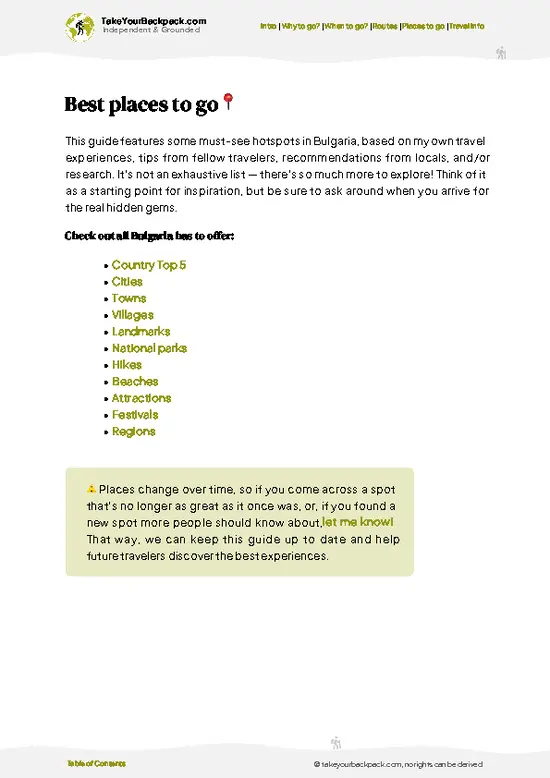
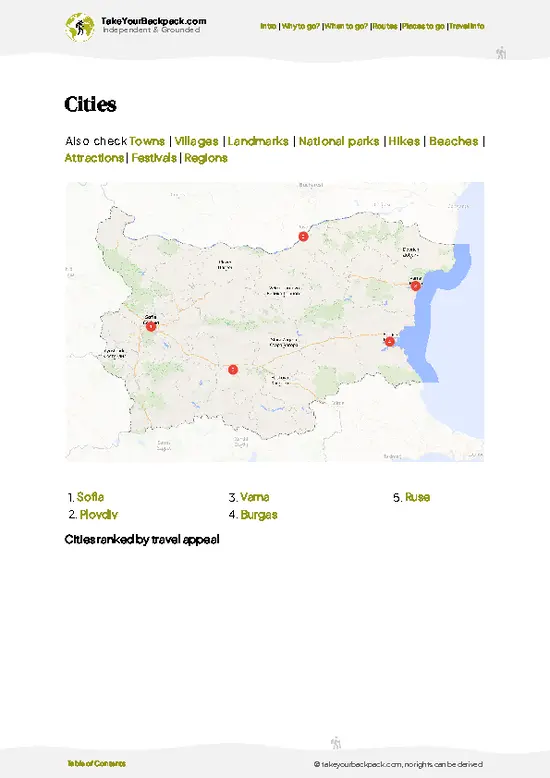
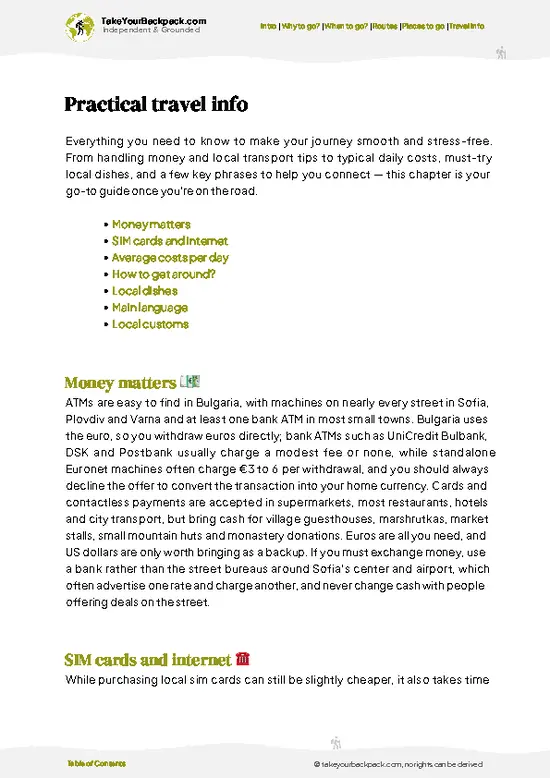
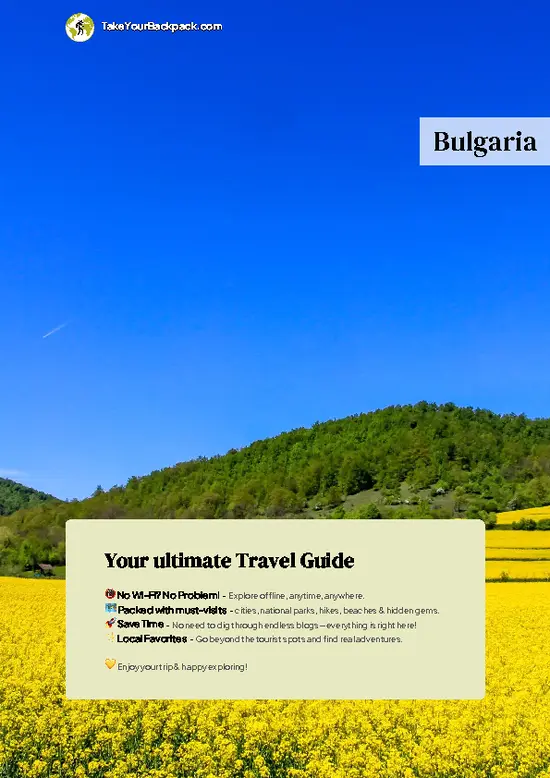
example page 0 from our offline Travel Guide for Bulgaria
example page 1 from our offline Travel Guide for Bulgaria
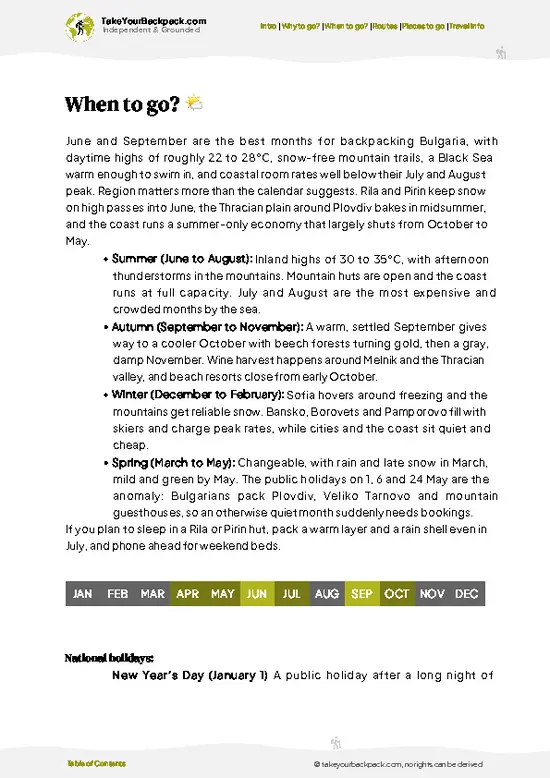
example page 2 from our offline Travel Guide for Bulgaria
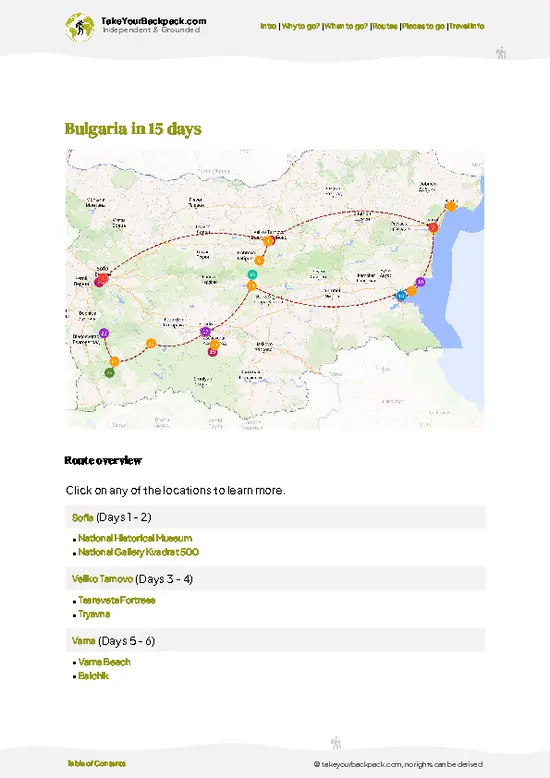
example page 3 from our offline Travel Guide for Bulgaria
example page 4 from our offline Travel Guide for Bulgaria
example page 5 from our offline Travel Guide for Bulgaria
example page 6 from our offline Travel Guide for Bulgaria
example page 7 from our offline Travel Guide for Bulgaria
The digital guide (349 pages) contains:
✅ 92 highlights, ranked by travel appeal
✅ Optimized 5, 10 & 15-day travel routes
✅ Cities, national parks, landmarks, beaches
✅ How to get around
✅ Offline-friendly for travel without Wi-Fi
👉 Click to see all 30+ guide features

📅 Plan smarter in minutes, not weeks
✅ Month by month travel advice
✅ Festivals & national holidays
✅ Budget expectations

🗺️ Go to the right places, skip the overrated ones
✅ Honest pros & cons of destinations
✅ Top hikes, parks & viewpoints
✅ Lesser-known places most travelers miss
✅ Clear “worth it vs skip it” guidance

🛏️ Travel smoothly without rookie mistakes
✅ Best areas to stay
✅ Transport systems explained simply
✅ Common scams & safety advice
✅ SIM cards, money & practical tips

🌍 Understand the country, not just visit it
✅ Culture & traditions
✅ 52 Essential phrases & customs
✅ Festivals worth planning around
✅ Traveler-friendly historical context
✅ Insights that make places more meaningful

📱 Built for real travel conditions
✅ Fully downloadable PDF
✅ Works completely offline
✅ Optimized for phone use
✅ Useful in remote areas & buses
✅ Everything in one place
Stop searching, start planning
Get instant access to your full guide. 30‑day money-back guarantee.
+ Add another guide for just

By proceeding you agree to our terms.
Sent to your inbox immediately after payment • 100% Secure Checkout
Best Backpacking Travel Advisor 2025 tourism awardBest Backpacking
Travel Advisor
2025
What others say about Take Your Backpack Guides:
⭐⭐⭐⭐⭐
Fantastic, amazing amount of information!
⭐⭐⭐⭐⭐
My goodness this is amazing, it's what I've been looking for hats off too you!
⭐⭐⭐⭐⭐
I think this is absolutely BRILLIANT
⭐⭐⭐⭐
Very complete and informative. It's still missing places, but I gotta to commend you
⭐⭐⭐⭐⭐
This is truly amazing, thank you, can't wait to explore it with my kids!
⭐⭐⭐⭐⭐
Awesome resource, thank you!
⭐⭐⭐⭐⭐
This is amazing! Can't wait to explore the ones I haven't seen
⭐⭐⭐⭐
I love this! Well done, great idea.
⭐⭐⭐⭐⭐
Thanks for taking the time to make this gem!
⭐⭐⭐⭐⭐
This might be the best website I've ever seen.
⭐⭐⭐⭐⭐
Congratulations, and thank you so much for your work; it's incredibly valuable.
⭐⭐⭐⭐
In all seriousness I think you did a great job pointing out the important spots
⭐⭐⭐⭐⭐
10/10 very good
⭐⭐⭐⭐⭐
As someone who's only just starting to visit regularly this is awesome, thank you.
⭐⭐⭐⭐
Thank you very much! I'm going to visit my dad, it's going to be very useful!
⭐⭐⭐⭐⭐
This is really cool! We'll be travelling for the first time and this definitely come in handy.
⭐⭐⭐⭐⭐
You are now our minister of culture, congratulations 👨‍💼
⭐⭐⭐⭐⭐
Just wanted to tell you that this is a pearl! Going to follow your recommendations.
⭐⭐⭐⭐⭐
This is so cool. I'll definitely be using the resource for my travels soon.
⭐⭐⭐⭐⭐
This is very impressive! Good work.
⭐⭐⭐⭐⭐
This is an amazing and informative site. Very well done!

🛏️ Where to stay?Where to Stay: Bulgaria Edition

Bulgaria has plenty of hostels and budget guesthouses, with dorm beds typically running €10 to 20 a night and private doubles from about €30 to 50. In Sofia, the streets around Vitosha Boulevard and Serdika put you within walking distance of the main sights, metro lines and bars, though weekend nights get loud, while Plovdiv splits between the cobbled Old Town (quiet, atmospheric, hilly) and the Kapana district (craft beer, late cafés, more noise). In Veliko Tarnovo, the Old Town along Gurko and Samovodska streets gives you cliffside views and a calm, safe base, and in Varna the center near the Sea Garden keeps you close to the beach and summer nightlife, at peak-season prices.

If you enjoy meeting … read more 👉
Bulgaria has plenty of hostels and budget guesthouses, with dorm beds typically running €10 to 20 a night and private doubles from about €30 to 50. In Sofia, the streets around Vitosha Boulevard and Serdika put you within walking distance of the main sights, metro lines and bars, though weekend nights get loud, while Plovdiv splits between the cobbled Old Town (quiet, atmospheric, hilly) and the Kapana district (craft beer, late cafés, more noise). In Veliko Tarnovo, the Old Town along Gurko and Samovodska streets gives you cliffside views and a calm, safe base, and in Varna the center near the Sea Garden keeps you close to the beach and summer nightlife, at peak-season prices.

If you enjoy meeting fellow travelers, consider choosing hostels with high ratings for atmosphere. On the other hand, if you prefer having your own space, a hotel might be a better option.

BulgariaExplore Beyond This Category

👋 Meet the founderWho’s Behind Take Your Backpack?

Johan, backpacker and founder of TakeYourBackpackHi, I’m Johan (Netherlands 🇳🇱), the creator of TakeYourBackpack. Over the past 3 decades, I’ve backpacked through 90+ countries across six continents, gaining extensive experience with independent travel, long-term trips, and overland routes.

This site is built on a combination of firsthand travel experience and carefully curated insights from other backpackers. Many guides are based on places I’ve personally visited, while others bring together tips, observations, and practical advice shared by trusted travelers I’ve met along the way.

The goal is to provide realistic, experience-driven guidance — not generic itineraries — so you can explore destinations with better context, clearer expectations, and more confidence.