×

Bulgaria🇧🇬 | best national parksYour Guide to the 10 Best national parks in Bulgaria

National parks in Bulgaria come in three moods: three big mountain parks (Rila, Pirin, Central Balkan) with huts and marked trails, lowland and Black Sea parks that are mostly forest, wetland or karst, and smaller reserves where the main attraction is silence. Entry is usually free or costs a few leva, mountain huts are cheap and basic, and crowds thin out fast once you leave the lift stations. Independent travelers will find access easiest from Sofia, Plovdiv and Bansko, while remote parks reward patience with buses that run on their own mysterious logic. Bring a map. Signs get optimistic.

By Johan Kruseman 🇳🇱 | Updated October 18, 2026
Explore the best hikes in Bulgaria

Why go?Understanding Their Importance

Bulgaria packs an unreasonable amount of wild terrain into a country smaller than most American states. The Balkan range, the Rila and Pirin massifs and the Rhodopes sit within a few hours of each other, and the Black Sea coast and Danube plain add forests, wetlands and caves. Its parks protect old-growth beech and fir, glacial lakes, and a bear and wolf population that survived because large areas were simply too steep to farm.

The infrastructure is a mix of Communist-era legacy and newer EU-funded work. Mountain huts (hizhi), marked trails with color-coded stripes and local mountain rescue exist in the main ranges. Elsewhere you will find faded signposts, patchy English and trailheads that a taxi driver may doubt exist.

Before choosing Bulgaria, know that costs are low by European standards … read more 👉
Bulgaria packs an unreasonable amount of wild terrain into a country smaller than most American states. The Balkan range, the Rila and Pirin massifs and the Rhodopes sit within a few hours of each other, and the Black Sea coast and Danube plain add forests, wetlands and caves. Its parks protect old-growth beech and fir, glacial lakes, and a bear and wolf population that survived because large areas were simply too steep to farm.

The infrastructure is a mix of Communist-era legacy and newer EU-funded work. Mountain huts (hizhi), marked trails with color-coded stripes and local mountain rescue exist in the main ranges. Elsewhere you will find faded signposts, patchy English and trailheads that a taxi driver may doubt exist.

Before choosing Bulgaria, know that costs are low by European standards but trails vary wildly in upkeep, and that the leva remains the local currency, so carry cash for huts and village shops. Phone signal drops out on high ridges. Mountain weather turns quickly, and snow can linger at altitude well into early summer. Huts fill at weekends in July and August, and some close outside the main season. Go expecting rustic comfort, strong coffee in unlikely places and rakia offered as if refusing were a diplomatic incident.
How the List Was Created
The list of best national parks in Bulgaria is created based on landscapes, wildlife, adventure opportunities, facilities, and overall experience. If you feel a national park is missing in this list, please let us know.

When to go?When to Plan Your Trip

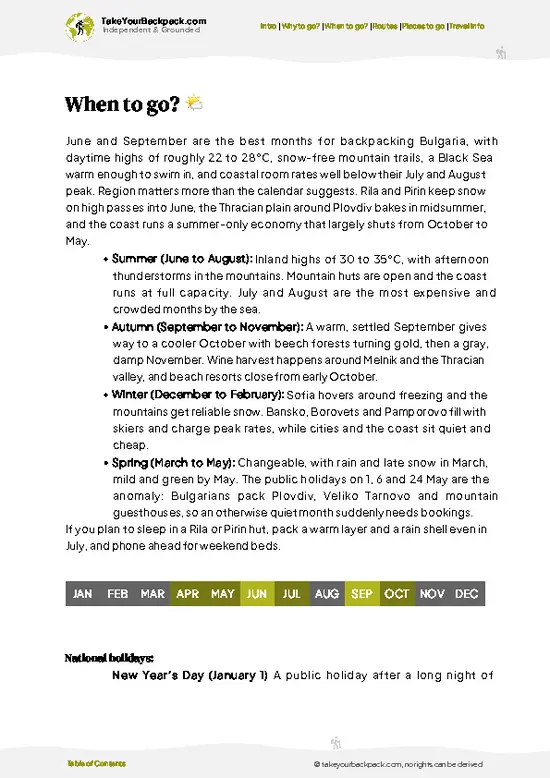
Best months and weather: June to September is the best window for Bulgaria’s national parks, because high trails in Rila, Pirin and the Balkan range are generally snow-free from about late June and huts are staffed. July and August bring daytime highs of 22 to 30°C in the lowlands and 10 to 18°C on the ridges, with afternoon thunderstorms that arrive with theatrical timing. Start early and be off the tops by 2 pm.
Shoulder seasons: May and October suit lowland, Black Sea and forest parks well, with temperatures of 12 to 22°C and far fewer people. In the mountains, May still means snowfields above roughly 2,000 meters, and October can bring early snow and closed huts. September is the sweet spot for most backpackers: stable weather, warm days, cool nights near freezing at altitude and beech … read more 👉
Best months and weather: June to September is the best window for Bulgaria’s national parks, because high trails in Rila, Pirin and the Balkan range are generally snow-free from about late June and huts are staffed. July and August bring daytime highs of 22 to 30°C in the lowlands and 10 to 18°C on the ridges, with afternoon thunderstorms that arrive with theatrical timing. Start early and be off the tops by 2 pm.
Shoulder seasons: May and October suit lowland, Black Sea and forest parks well, with temperatures of 12 to 22°C and far fewer people. In the mountains, May still means snowfields above roughly 2,000 meters, and October can bring early snow and closed huts. September is the sweet spot for most backpackers: stable weather, warm days, cool nights near freezing at altitude and beech forests turning copper.
Winter and crowds: From December to March, high-altitude parks become ski and snowshoe territory. Lift-town prices around Bansko and Borovets rise sharply over New Year and in February, with rooms often doubling compared with summer. Weekends in July and August fill popular huts, so book ahead or carry a sleeping mat. Lowland parks stay quiet and mild in winter, though frequent fog and cold rain (0 to 8°C) make for gloomy hiking.

national park hoppingTips for Visiting Multiple Destinations

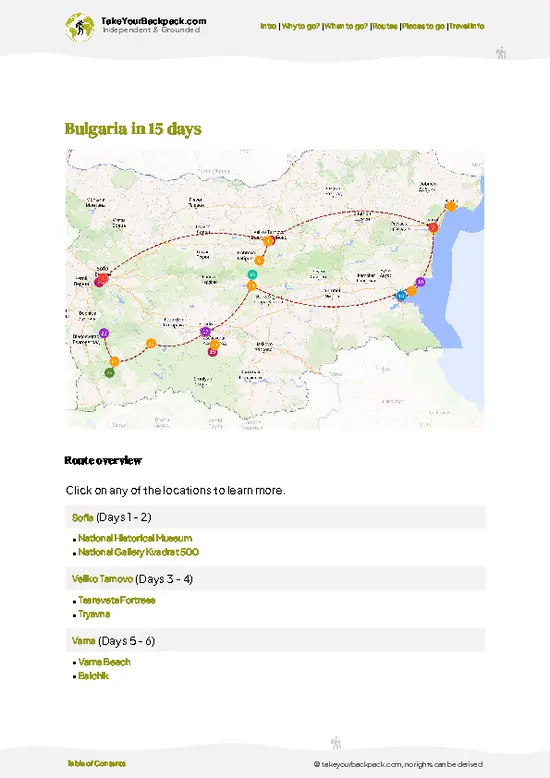
How many days to plan: A trip combining several Bulgarian national parks needs 8 to 14 days, and 10 is a comfortable middle. The country is compact, so the temptation is to squeeze everything in, which is how people spend a holiday inside buses.
Grouping regions: The southwest clusters naturally: Sofia, the Rila and Pirin massifs and the towns of Bansko, Blagoevgrad and Dupnitsa are linked by regular buses and minibuses, with transfers of 1.5 to 3 hours. The central Balkan sits separately, reached via Gabrovo, Troyan or Karlovo, and takes 3 to 4 hours from Sofia by bus or train plus a local hop. The Black Sea coast and northeast sit furthest away, 5 to 7 hours from Sofia. A sensible direction is to start in Sofia, work through the southwest, swing east and north through Plovdiv and the Balkan, … read more 👉
How many days to plan: A trip combining several Bulgarian national parks needs 8 to 14 days, and 10 is a comfortable middle. The country is compact, so the temptation is to squeeze everything in, which is how people spend a holiday inside buses.
Grouping regions: The southwest clusters naturally: Sofia, the Rila and Pirin massifs and the towns of Bansko, Blagoevgrad and Dupnitsa are linked by regular buses and minibuses, with transfers of 1.5 to 3 hours. The central Balkan sits separately, reached via Gabrovo, Troyan or Karlovo, and takes 3 to 4 hours from Sofia by bus or train plus a local hop. The Black Sea coast and northeast sit furthest away, 5 to 7 hours from Sofia. A sensible direction is to start in Sofia, work through the southwest, swing east and north through Plovdiv and the Balkan, then finish on the coast or return by train.
Time per stop and common mistakes: Allow 2 to 3 nights per mountain region and 1 to 2 for lowland parks. The usual mistake is trusting map distances: a 100 km hop can take four hours with a change at a town where the next bus leaves tomorrow. Check timetables the day before, and build a buffer day after any big hike. Another is planning hut-to-hut stages without confirming that the hut is open. Call ahead instead. Rental cars cut transfer times in half in the remote areas, which is worth considering if you are splitting costs.

The ListMust-Visit national parks in Bulgaria

1 Rila National Park

highest peak, glacial valleys, ancient spruce forests

Trek through deep valleys and dense woods, ascending to Bulgaria’s highest summit and discovering remote alpine landscapes.

bulgaria-national-park-rila-national-park
© Google |

2 Pirin National Park

granite peaks, glacial lakes, alpine tundra

Climb rugged summits and cross stony plateaus, where ancient pine forests and clear lakes reflect the wild spirit of the Pirin range.

bulgaria-national-park-pirin-national-park
© Google | Pathik Bhatt

3 Central Balkan National Park

high ridges, waterfalls, wildflower meadows

Traverse mountain passes and open meadows, encountering waterfalls and panoramic views across one of Bulgaria’s most biodiverse regions.

bulgaria-national-park-central-balkan-national-park
© Google | Svetlozar Naidenov

4 Vitosha Nature Park

stone rivers, subalpine plateaus, city skyline views

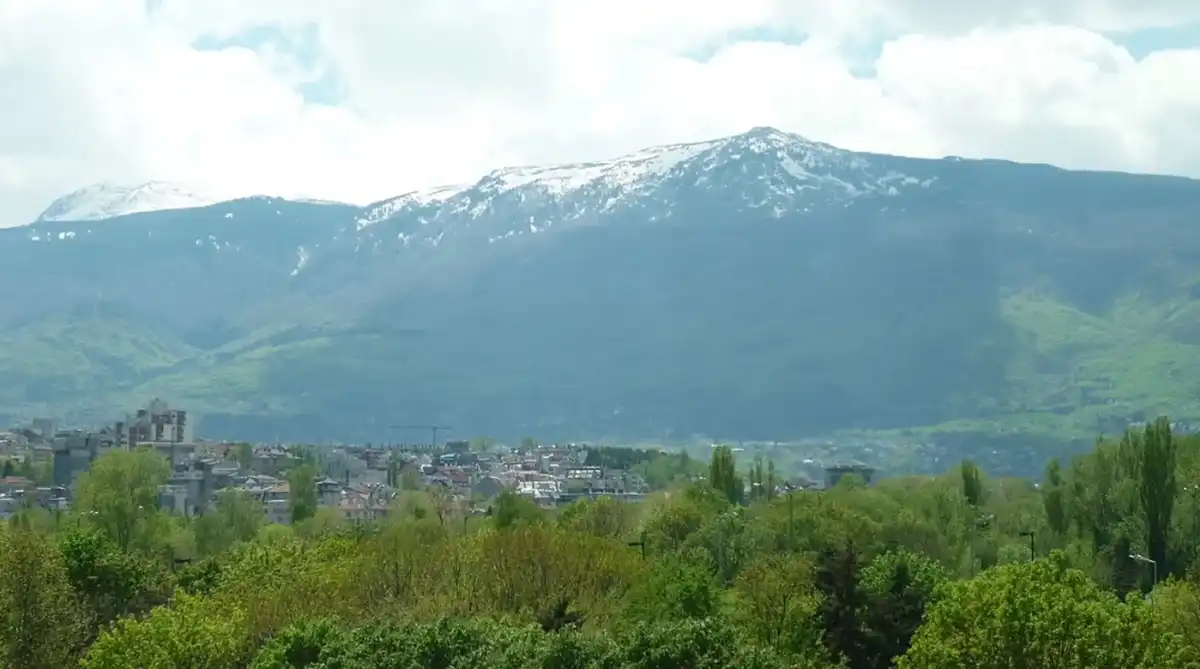
Reach open plateaus and rocky streams just above Sofia, where cool air and sweeping views contrast with the bustle below.

5 Strandzha Nature Park

oak forests, river valleys, Thracian sanctuaries

Explore winding rivers and dense woodlands, where ancient ritual sites and remote villages reveal a distinct cultural landscape.

6 Seven Rila Lakes

glacial basins, cirque lakes, panoramic trails

Ascend winding paths to a chain of crystal-clear lakes, each set in a separate basin and linked by sweeping mountain vistas.

bulgaria-national-park-seven-rila-lakes
© Google | Ivan Dontschev

7 Rila Monastery Nature Park

forest trails, monastery complex, mountain streams

Wander forested slopes and quiet riverbanks, then pause at the centuries-old monastery surrounded by alpine scenery and tranquil meadows.

bulgaria-national-park-rila-monastery-nature-park
© Google |

8 Rusenski Lom Nature Park

river canyons, rock monasteries, steppe grasslands

Follow river bends beneath limestone cliffs, where centuries-old cave churches and open grasslands shape a varied landscape.

9 Srebarna Nature Reserve

lakeside wetlands, pelican colonies, reed beds

Observe migrating birds and nesting pelicans in a lakeside reserve, where reed beds and open water create a haven for wildlife.

bulgaria-national-park-srebarna-nature-reserve
© Google | Penka Andonova

10 Belasitsa Nature Park

chestnut groves, border ridge, Balkan panoramas

Walk along a border ridge with views into three countries, passing through chestnut forests and meadows rich in wildflowers.

11 Bulgarka Nature Park

beech forests, mountain passes, ethnographic villages

Travel through wooded slopes and over historic passes, visiting traditional villages that preserve crafts and rural customs.

12 Sinite Kamani Nature Park

blue rock formations, beech woods, open ridges

Roam over open ridges and through ancient forests, where blue-hued cliffs rise above the valley and offer far-reaching views.

bulgaria-national-park-sinite-kamani-nature-park
© Google | Daniel Ivanov

13 Vrachanski Balkan Nature Park

limestone cliffs, deep caves, karst plateaus

Hike through dramatic rock formations and discover a network of caves, where rare plants and birds thrive in sheltered valleys.

14 Zlatni Pyasatsi Nature Park

coastal forest, Black Sea views, mineral springs

Stroll shaded woodland paths above the coast, where mineral springs and sea breezes shape a unique blend of flora and fauna.

15 Shumen Plateau Nature Park

limestone plateau, fortress ruins, forested gullies

Wander a high plateau dotted with ancient ruins and deep gullies, where forest trails lead to panoramic viewpoints and quiet clearings.

16 Kamchia Biosphere Reserve

floodplain forest, river delta, sand dunes

Experience a shifting landscape where dense alluvial woods meet river channels and sand dunes, supporting diverse plant and animal life.

17 Iskar-Panega Geopark

limestone canyons, turquoise river, rock arches

Follow winding trails along a turquoise river, passing through narrow gorges and natural rock bridges carved by water over millennia.

Think you know Bulgaria?

Prove you’re a true local — uncover 7 lesser-known national parks in Bulgaria that locals tend to keep to themselves.
Loading the map 🌍

Expert viewInsights from Locals and Experts

How many parks are worth your time: Two. Bulgaria has only three national parks, which sounds like an easy box to tick, but each one is a high-mountain area where a single proper hike eats a full day and the weather decides the rest. Two parks give you enough time to walk long routes, sleep in a hut and still have a spare day for rain. Cramming in all three means more hours on buses than on trails, and you pay for that in time and comfort without gaining much. If you only have a week, one park done well beats three done badly. The eleven nature parks outside this list are the cheap, quiet filler if you want more trail without more planning.
Choosing between the kinds: The parks split into two types. The first is high alpine terrain: granite ridges, glacial lakes, scree and ridgelines above … read more 👉
How many parks are worth your time: Two. Bulgaria has only three national parks, which sounds like an easy box to tick, but each one is a high-mountain area where a single proper hike eats a full day and the weather decides the rest. Two parks give you enough time to walk long routes, sleep in a hut and still have a spare day for rain. Cramming in all three means more hours on buses than on trails, and you pay for that in time and comfort without gaining much. If you only have a week, one park done well beats three done badly. The eleven nature parks outside this list are the cheap, quiet filler if you want more trail without more planning.
Choosing between the kinds: The parks split into two types. The first is high alpine terrain: granite ridges, glacial lakes, scree and ridgelines above 2,500 meters, with short, spectacular day hikes and plenty of other walkers in July and August. The second is a long, forested ridge with a multi-day trail, lower foot traffic and a more solitary feel. For a first-timer or a short trip, alpine day hikes cost the least in time and give the most views per hour, though you share the path with school groups and selfie sticks. For a confident walker with five or more days, the long-ridge type offers the best value: fewer people, cheaper huts and a feeling of having earned the view. If you love lakes and photographs, choose alpine. If you love silence and sore calves, choose the ridge.
What it costs: Entry to the parks is free. The money goes on everything around them. Expect €30 to 50 a day on a hut-based trip: a bed in a mountain hut runs about €10 to 20, a hearty dinner of bean soup or grilled meat €6 to 10, and breakfast €3 to 5. Local buses to trailheads cost €2 to 8, while a shared taxi or ride from a town to a high trailhead can reach €20 to 40 for the car. Chairlifts to popular trailheads run roughly €10 to 15 return, and they save two hours of climbing, which is excellent value if your knees have opinions. A licensed mountain guide costs around €100 to 200 a day for a group, which only makes sense for winter routes or glacier-free but exposed ridges in poor visibility. A full visit of three days therefore lands at €90 to 160 including transport. Bring cash, because many huts do not take cards.
Safety and local manners: Weather is the main hazard. Afternoon thunderstorms build fast above the treeline in summer, so start walking by 7 or 8 a.m. and be below the ridges by early afternoon. Snow can linger on north-facing slopes into June, and fog turns marked paths into guesswork. Shepherd dogs guard flocks and they are serious animals, so stop, stay calm and give them a wide detour. Brown bears exist but rarely trouble hikers who make noise and store food properly. Check for ticks and watch for vipers in warm, rocky grass. The emergency number is 112, and the Mountain Rescue Service responds in the parks, so tell your hut keeper your route each evening. Wild camping is banned inside the parks, and rangers do fine people, so book huts or use the designated campsites. Greet hut staff with a friendly “dobar den,” take your rubbish out and stay on the marked, color-coded trail signs. Bulgarians take hut etiquette seriously, including boots off at the door and quiet after 10 p.m.

✈️ The backpacker research shortcutBulgaria Travel Guide

An offline-friendly backpacking guide with optimized travel routes, ranked highlights, transport advice, and the best areas to stay.
example page 0 from our offline Travel Guide for Bulgaria
example page 1 from our offline Travel Guide for Bulgaria
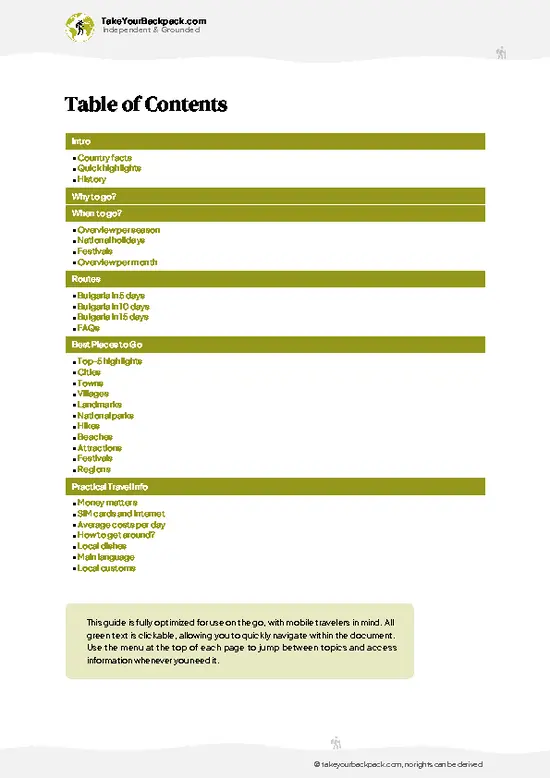
example page 2 from our offline Travel Guide for Bulgaria
example page 3 from our offline Travel Guide for Bulgaria
example page 4 from our offline Travel Guide for Bulgaria
example page 5 from our offline Travel Guide for Bulgaria
example page 6 from our offline Travel Guide for Bulgaria
example page 7 from our offline Travel Guide for Bulgaria
The digital guide (349 pages) contains:
✅ 92 highlights, ranked by travel appeal
✅ Optimized 5, 10 & 15-day travel routes
✅ Cities, national parks, landmarks, beaches
✅ How to get around
✅ Offline-friendly for travel without Wi-Fi
👉 Click to see all 30+ guide features

📅 Plan smarter in minutes, not weeks
✅ Month by month travel advice
✅ Festivals & national holidays
✅ Budget expectations

🗺️ Go to the right places, skip the overrated ones
✅ Honest pros & cons of destinations
✅ Top hikes, parks & viewpoints
✅ Lesser-known places most travelers miss
✅ Clear “worth it vs skip it” guidance

🛏️ Travel smoothly without rookie mistakes
✅ Best areas to stay
✅ Transport systems explained simply
✅ Common scams & safety advice
✅ SIM cards, money & practical tips

🌍 Understand the country, not just visit it
✅ Culture & traditions
✅ 52 Essential phrases & customs
✅ Festivals worth planning around
✅ Traveler-friendly historical context
✅ Insights that make places more meaningful

📱 Built for real travel conditions
✅ Fully downloadable PDF
✅ Works completely offline
✅ Optimized for phone use
✅ Useful in remote areas & buses
✅ Everything in one place
Stop searching, start planning
Get instant access to your full guide. 30‑day money-back guarantee.
+ Add another guide for just

By proceeding you agree to our terms.
Sent to your inbox immediately after payment • 100% Secure Checkout
Best Backpacking Travel Advisor 2025 tourism awardBest Backpacking
Travel Advisor
2025
What others say about Take Your Backpack Guides:
⭐⭐⭐⭐⭐
Fantastic, amazing amount of information!
⭐⭐⭐⭐⭐
My goodness this is amazing, it's what I've been looking for hats off too you!
⭐⭐⭐⭐⭐
I think this is absolutely BRILLIANT
⭐⭐⭐⭐
Very complete and informative. It's still missing places, but I gotta to commend you
⭐⭐⭐⭐⭐
This is truly amazing, thank you, can't wait to explore it with my kids!
⭐⭐⭐⭐⭐
Awesome resource, thank you!
⭐⭐⭐⭐⭐
This is amazing! Can't wait to explore the ones I haven't seen
⭐⭐⭐⭐
I love this! Well done, great idea.
⭐⭐⭐⭐⭐
Thanks for taking the time to make this gem!
⭐⭐⭐⭐⭐
This might be the best website I've ever seen.
⭐⭐⭐⭐⭐
Congratulations, and thank you so much for your work; it's incredibly valuable.
⭐⭐⭐⭐
In all seriousness I think you did a great job pointing out the important spots
⭐⭐⭐⭐⭐
10/10 very good
⭐⭐⭐⭐⭐
As someone who's only just starting to visit regularly this is awesome, thank you.
⭐⭐⭐⭐
Thank you very much! I'm going to visit my dad, it's going to be very useful!
⭐⭐⭐⭐⭐
This is really cool! We'll be travelling for the first time and this definitely come in handy.
⭐⭐⭐⭐⭐
You are now our minister of culture, congratulations 👨‍💼
⭐⭐⭐⭐⭐
Just wanted to tell you that this is a pearl! Going to follow your recommendations.
⭐⭐⭐⭐⭐
This is so cool. I'll definitely be using the resource for my travels soon.
⭐⭐⭐⭐⭐
This is very impressive! Good work.
⭐⭐⭐⭐⭐
This is an amazing and informative site. Very well done!

🛏️ Where to stay?Top Places to Consider Staying

Bulgaria has plenty of hostels and budget guesthouses, with dorm beds typically running €10 to 20 a night and private doubles from about €30 to 50. In Sofia, the streets around Vitosha Boulevard and Serdika put you within walking distance of the main sights, metro lines and bars, though weekend nights get loud, while Plovdiv splits between the cobbled Old Town (quiet, atmospheric, hilly) and the Kapana district (craft beer, late cafés, more noise). In Veliko Tarnovo, the Old Town along Gurko and Samovodska streets gives you cliffside views and a calm, safe base, and in Varna the center near the Sea Garden keeps you close to the beach and summer nightlife, at peak-season prices.

If you enjoy meeting … read more 👉
Bulgaria has plenty of hostels and budget guesthouses, with dorm beds typically running €10 to 20 a night and private doubles from about €30 to 50. In Sofia, the streets around Vitosha Boulevard and Serdika put you within walking distance of the main sights, metro lines and bars, though weekend nights get loud, while Plovdiv splits between the cobbled Old Town (quiet, atmospheric, hilly) and the Kapana district (craft beer, late cafés, more noise). In Veliko Tarnovo, the Old Town along Gurko and Samovodska streets gives you cliffside views and a calm, safe base, and in Varna the center near the Sea Garden keeps you close to the beach and summer nightlife, at peak-season prices.

If you enjoy meeting fellow travelers, consider choosing hostels with high ratings for atmosphere. On the other hand, if you prefer having your own space, a hotel might be a better option.

BulgariaMore Places Across Bulgaria

👋 Meet the founderWho’s Behind Take Your Backpack?

Johan, backpacker and founder of TakeYourBackpackHi, I’m Johan (Netherlands 🇳🇱), the creator of TakeYourBackpack. Over the past 3 decades, I’ve backpacked through 90+ countries across six continents, gaining extensive experience with independent travel, long-term trips, and overland routes.

This site is built on a combination of firsthand travel experience and carefully curated insights from other backpackers. Many guides are based on places I’ve personally visited, while others bring together tips, observations, and practical advice shared by trusted travelers I’ve met along the way.

The goal is to provide realistic, experience-driven guidance — not generic itineraries — so you can explore destinations with better context, clearer expectations, and more confidence.