×

Bulgaria🇧🇬 | best attractionsYour Guide to the 12 Best attractions in Bulgaria

Bulgaria packs Orthodox monasteries, Thracian tombs, Roman ruins, Black Sea resorts and ski towns into a country smaller than Ohio, and almost none of it is crowded. Entry fees mostly run a few euros, which makes independent travel here pleasantly absurd for anyone used to Western European ticket windows. The Rila and Pirin mountains in the southwest mean altitude and early closures. The Black Sea coast means summer sun, sunbed rows and prices that jump in July. The central Balkan towns sit in between: quiet, cobbled and reached by buses that keep their own schedule.

By Johan Kruseman 🇳🇱 | Updated October 18, 2026
Explore the best festivals in Bulgaria

Why go?Understanding Their Importance

Bulgaria sits on top of several empires at once. Thracians, Greeks, Romans, Byzantines and Ottomans each left something here, and the country never had the tourism machine to fence it all off, so ancient layers often sit in a field or under a modern city center with a modest ticket booth. The result is a concentrated history that costs far less than its equivalent in Greece, Italy or Turkey.

Geography does the rest. Mountains, a long coastline and river valleys all fit in a few hours of driving, so a traveler can swap a ski lift for a beach without a flight. The Orthodox tradition is also alive rather than preserved. Monasteries are working communities, and dress and behavior expectations follow from that.

Know before choosing Bulgaria that infrastructure is uneven. Trains are slow, rural … read more 👉
Bulgaria sits on top of several empires at once. Thracians, Greeks, Romans, Byzantines and Ottomans each left something here, and the country never had the tourism machine to fence it all off, so ancient layers often sit in a field or under a modern city center with a modest ticket booth. The result is a concentrated history that costs far less than its equivalent in Greece, Italy or Turkey.

Geography does the rest. Mountains, a long coastline and river valleys all fit in a few hours of driving, so a traveler can swap a ski lift for a beach without a flight. The Orthodox tradition is also alive rather than preserved. Monasteries are working communities, and dress and behavior expectations follow from that.

Know before choosing Bulgaria that infrastructure is uneven. Trains are slow, rural buses are sparse, and signage in English drops off outside major sites. Opening hours shift by season, and some places simply close for lunch or on Mondays. Payment is often cash only in small towns. None of this is a flaw so much as a reminder that the country is still run for locals first, which is a large part of why it feels real.
Behind the Scenes of Selection
The list of best attractions in Bulgaria is created based on cultural significance or entertainment value. If you feel a attraction is missing in this list, please let us know.

When to go?When to Plan Your Trip

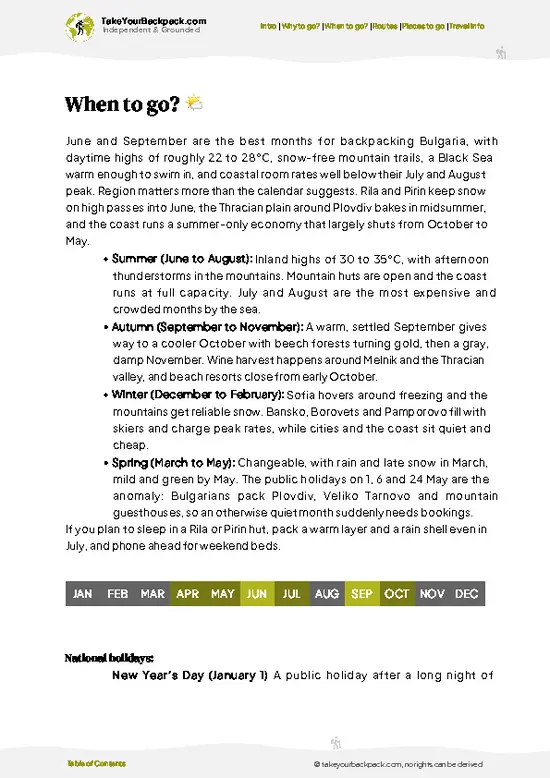
Best months: May, June, September and early October are the best months for attractions in Bulgaria, with daytime highs of roughly 20 to 28°C, open sites and mountain trails clear of snow. July and August push inland cities like Plovdiv past 32°C, and the Black Sea coast fills up, with hotel rates often 40 to 70 percent above shoulder-season levels.

Shoulder and low seasons: April and late October are cooler, around 10 to 18°C, with more rain (April and May are the wettest months, roughly 50 to 70 mm in Sofia). Prices are low and queues nonexistent, but some mountain huts and coastal sites keep reduced hours. Many Black Sea hotels and restaurants close entirely from October to May, so the coast in winter is mostly gulls and shuttered kiosks.

Winter: December to March suits the Rila, Pirin … read more 👉
Best months: May, June, September and early October are the best months for attractions in Bulgaria, with daytime highs of roughly 20 to 28°C, open sites and mountain trails clear of snow. July and August push inland cities like Plovdiv past 32°C, and the Black Sea coast fills up, with hotel rates often 40 to 70 percent above shoulder-season levels.

Shoulder and low seasons: April and late October are cooler, around 10 to 18°C, with more rain (April and May are the wettest months, roughly 50 to 70 mm in Sofia). Prices are low and queues nonexistent, but some mountain huts and coastal sites keep reduced hours. Many Black Sea hotels and restaurants close entirely from October to May, so the coast in winter is mostly gulls and shuttered kiosks.

Winter: December to March suits the Rila, Pirin and Rhodope mountains for skiing, with Bansko and Borovets busiest at New Year and in February school holidays. Sofia and the central towns hover around 0°C, often with snow, and cold hands at open-air ruins are the price of empty sites. High mountain monasteries and roads can be hard to reach after heavy snow.

attraction hoppingTips for Visiting Multiple Destinations

Time needed: A trip combining several attractions in Bulgaria works best in 7 to 14 days, because distances are short but public transport is slow. The country divides sensibly into the southwest (Sofia and the Rila and Pirin mountains), the center (Plovdiv, the Rose Valley and the Balkan towns around Veliko Tarnovo) and the east (Varna and Burgas on the Black Sea).

Direction and pacing: Flying into Sofia and finishing on the coast, or the reverse, avoids backtracking. Sofia to Plovdiv takes about 2 hours by bus or train, Plovdiv to Veliko Tarnovo roughly 3.5 to 4 hours with a change, and Veliko Tarnovo to Varna about 3.5 to 4 hours. Sofia to Varna directly takes 6 to 7 hours by bus. Allow a full day for a monastery or mountain stop, half a day for a ruin or museum, and two days for a town … read more 👉
Time needed: A trip combining several attractions in Bulgaria works best in 7 to 14 days, because distances are short but public transport is slow. The country divides sensibly into the southwest (Sofia and the Rila and Pirin mountains), the center (Plovdiv, the Rose Valley and the Balkan towns around Veliko Tarnovo) and the east (Varna and Burgas on the Black Sea).

Direction and pacing: Flying into Sofia and finishing on the coast, or the reverse, avoids backtracking. Sofia to Plovdiv takes about 2 hours by bus or train, Plovdiv to Veliko Tarnovo roughly 3.5 to 4 hours with a change, and Veliko Tarnovo to Varna about 3.5 to 4 hours. Sofia to Varna directly takes 6 to 7 hours by bus. Allow a full day for a monastery or mountain stop, half a day for a ruin or museum, and two days for a town with several sites.

Common mistakes: The classic error is trusting a map. Bulgaria looks small, but a 150 km hop can eat four hours of mountain roads and a bus that leaves when full. Another is cramming Sofia, Rila and the coast into a long weekend. Choose two regions per week, travel mornings, and keep one flexible day for the bus that doesn’t show.

The ListMust-Visit attractions in Bulgaria

1 Rila Monastery Museum

Mountain trails, monastic artifacts, natural history

Combine hiking with visits to museum halls displaying manuscripts, icons, and exhibits on the park’s flora and fauna.

bulgaria-attraction-rila-monastery-museum
© Google |

2 Alexander Nevsky Cathedral

Neo-Byzantine architecture, gold domes, Orthodox icons

Admire intricate mosaics and religious art while experiencing the scale and acoustics of Bulgaria’s most recognized Orthodox cathedral.

bulgaria-attraction-alexander-nevsky-cathedral
© Google |

3 Tsarevets Fortress

Hilltop ruins, medieval walls, panoramic ramparts

Walk fortified paths and climb towers to survey the remains of Bulgaria’s medieval capital, with sweeping vistas of Veliko Tarnovo.

bulgaria-attraction-tsarevets-fortress
© Google |

4 Roman Theatre of Plovdiv

Ancient amphitheater, marble seating, city views

Sit among original stone seats and imagine Roman spectacles, or attend a modern performance with panoramic views over Plovdiv.

bulgaria-attraction-roman-theatre-of-plovdiv
© Google |

5 Bachkovo Monastery

Frescoed chapels, mountain setting, medieval relics

Wander through centuries-old courtyards and richly painted interiors surrounded by forested hills and the sound of running water.

bulgaria-attraction-bachkovo-monastery
© Google |

6 Ivan Vazov National Theatre

Neoclassical façade, marble columns, cultural performances

Experience live drama or ballet in Bulgaria’s oldest theatre, known for its ornate interiors and prominent city garden setting.

bulgaria-attraction-ivan-vazov-national-theatre
© Google |

7 National Palace of Culture

Event halls, Brutalist architecture, city landmark

Attend concerts or exhibitions in a vast multi-purpose complex, notable for its geometric design and central location in Sofia.

bulgaria-attraction-national-palace-of-culture
© Google |

8 Regional Historical Museum Plovdiv

Urban exhibits, Ottoman-era artifacts, city development

Discover how Plovdiv evolved through displays of everyday objects, period costumes, and documents housed in restored townhouses.

bulgaria-attraction-regional-historical-museum-plovdiv
© Google |

9 National Historical Museum

Thracian treasures, royal regalia, archaeological finds

Trace Bulgaria’s story from prehistory to the 20th century through gold artifacts, ancient tools, and royal possessions displayed in chronological order.

bulgaria-attraction-national-historical-museum
© Google |

10 National Museum of Military History

Weaponry displays, armored vehicles, military uniforms

Examine tanks, aircraft, and uniforms in indoor and outdoor exhibits that detail Bulgaria’s military past and technological changes.

11 Regional History Museum – Sofia

Bathhouse building, local heritage, rotating exhibits

Explore Sofia’s transformation through archaeological finds, period rooms, and temporary exhibitions inside a former mineral bath.

Loading the map 🌍

Expert viewInsights from Locals and Experts

How many attractions: Plan on one major attraction per day and no more than four or five a week. Bulgaria’s sites are spread across hills, valleys and long bus rides, so a second stop on the same day usually costs more in time than it gives back. Two or three well-chosen sites per region leave energy for the cafés and street life, which are half the point.

What to prioritize: Travelers who want history get the most from Thracian and Roman sites and the old towns, which offer far more depth per euro than the coast. Hikers should spend their days in the mountains, where the main cost is a hut bed rather than a ticket. Beach seekers can have the Black Sea, but outside June to September the choice thins out fast. Monasteries sit in between: cheap, quiet and slow to reach, so they suit anyone … read more 👉
How many attractions: Plan on one major attraction per day and no more than four or five a week. Bulgaria’s sites are spread across hills, valleys and long bus rides, so a second stop on the same day usually costs more in time than it gives back. Two or three well-chosen sites per region leave energy for the cafés and street life, which are half the point.

What to prioritize: Travelers who want history get the most from Thracian and Roman sites and the old towns, which offer far more depth per euro than the coast. Hikers should spend their days in the mountains, where the main cost is a hut bed rather than a ticket. Beach seekers can have the Black Sea, but outside June to September the choice thins out fast. Monasteries sit in between: cheap, quiet and slow to reach, so they suit anyone with time rather than anyone in a hurry. If time is tight, pick history first, since it is the cheapest and least crowded option.

Budget: A backpacker can manage on roughly €30 to 50 a day, including a hostel bed (€10 to 18), meals (€10 to 15) and local transport. Most museums, ruins and monasteries charge about €2 to 8, though a few larger sites cost more, and monasteries are often free with a small donation. Guides for a site run around €10 to 30 per group, and audio guides, where they exist, are a better value for solo travelers. Mountain lifts and ski passes are the big spends, at roughly €30 to 60 a day. Intercity buses cost about €5 to 15 per leg, so frequent hopping adds up faster than entry fees.

Safety and etiquette: Sites are generally safe, but pickpockets work crowded transport and the Sofia center, so keep valuables zipped. Carry cash, because small ticket offices often refuse cards. Monasteries expect covered shoulders and knees, and photography is often banned inside churches, so look for signs before raising a camera. Bulgaria nods for no and shakes the head for yes, which turns ticket-window conversations into an unplanned comedy routine, so say the word aloud. Mountain weather turns quickly, and trails above 2,000 meters can keep snow into June, so check conditions and carry layers. Stray dogs near rural ruins are usually harmless, but give them space.

✈️ The backpacker research shortcutBulgaria Travel Guide

An offline-friendly backpacking guide with optimized travel routes, ranked highlights, transport advice, and the best areas to stay.
example page 0 from our offline Travel Guide for Bulgaria
example page 1 from our offline Travel Guide for Bulgaria
example page 2 from our offline Travel Guide for Bulgaria
example page 3 from our offline Travel Guide for Bulgaria
example page 4 from our offline Travel Guide for Bulgaria
example page 5 from our offline Travel Guide for Bulgaria
example page 6 from our offline Travel Guide for Bulgaria
example page 7 from our offline Travel Guide for Bulgaria
The digital guide (349 pages) contains:
✅ 92 highlights, ranked by travel appeal
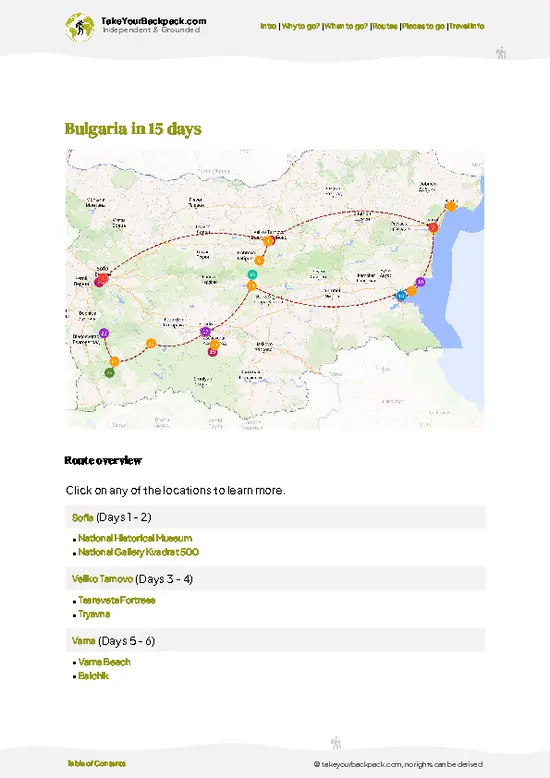
✅ Optimized 5, 10 & 15-day travel routes
✅ Cities, national parks, landmarks, beaches
✅ How to get around
✅ Offline-friendly for travel without Wi-Fi
👉 Click to see all 30+ guide features

📅 Plan smarter in minutes, not weeks
✅ Month by month travel advice
✅ Festivals & national holidays
✅ Budget expectations

🗺️ Go to the right places, skip the overrated ones
✅ Honest pros & cons of destinations
✅ Top hikes, parks & viewpoints
✅ Lesser-known places most travelers miss
✅ Clear “worth it vs skip it” guidance

🛏️ Travel smoothly without rookie mistakes
✅ Best areas to stay
✅ Transport systems explained simply
✅ Common scams & safety advice
✅ SIM cards, money & practical tips

🌍 Understand the country, not just visit it
✅ Culture & traditions
✅ 52 Essential phrases & customs
✅ Festivals worth planning around
✅ Traveler-friendly historical context
✅ Insights that make places more meaningful

📱 Built for real travel conditions
✅ Fully downloadable PDF
✅ Works completely offline
✅ Optimized for phone use
✅ Useful in remote areas & buses
✅ Everything in one place
Stop searching, start planning
Get instant access to your full guide. 30‑day money-back guarantee.
+ Add another guide for just

By proceeding you agree to our terms.
Sent to your inbox immediately after payment • 100% Secure Checkout
Best Backpacking Travel Advisor 2025 tourism awardBest Backpacking
Travel Advisor
2025
What others say about Take Your Backpack Guides:
⭐⭐⭐⭐⭐
Fantastic, amazing amount of information!
⭐⭐⭐⭐⭐
My goodness this is amazing, it's what I've been looking for hats off too you!
⭐⭐⭐⭐⭐
I think this is absolutely BRILLIANT
⭐⭐⭐⭐
Very complete and informative. It's still missing places, but I gotta to commend you
⭐⭐⭐⭐⭐
This is truly amazing, thank you, can't wait to explore it with my kids!
⭐⭐⭐⭐⭐
Awesome resource, thank you!
⭐⭐⭐⭐⭐
This is amazing! Can't wait to explore the ones I haven't seen
⭐⭐⭐⭐
I love this! Well done, great idea.
⭐⭐⭐⭐⭐
Thanks for taking the time to make this gem!
⭐⭐⭐⭐⭐
This might be the best website I've ever seen.
⭐⭐⭐⭐⭐
Congratulations, and thank you so much for your work; it's incredibly valuable.
⭐⭐⭐⭐
In all seriousness I think you did a great job pointing out the important spots
⭐⭐⭐⭐⭐
10/10 very good
⭐⭐⭐⭐⭐
As someone who's only just starting to visit regularly this is awesome, thank you.
⭐⭐⭐⭐
Thank you very much! I'm going to visit my dad, it's going to be very useful!
⭐⭐⭐⭐⭐
This is really cool! We'll be travelling for the first time and this definitely come in handy.
⭐⭐⭐⭐⭐
You are now our minister of culture, congratulations 👨‍💼
⭐⭐⭐⭐⭐
Just wanted to tell you that this is a pearl! Going to follow your recommendations.
⭐⭐⭐⭐⭐
This is so cool. I'll definitely be using the resource for my travels soon.
⭐⭐⭐⭐⭐
This is very impressive! Good work.
⭐⭐⭐⭐⭐
This is an amazing and informative site. Very well done!

🛏️ Where to stay?Best Places to Stay in Bulgaria

Bulgaria has plenty of hostels and budget guesthouses, with dorm beds typically running €10 to 20 a night and private doubles from about €30 to 50. In Sofia, the streets around Vitosha Boulevard and Serdika put you within walking distance of the main sights, metro lines and bars, though weekend nights get loud, while Plovdiv splits between the cobbled Old Town (quiet, atmospheric, hilly) and the Kapana district (craft beer, late cafés, more noise). In Veliko Tarnovo, the Old Town along Gurko and Samovodska streets gives you cliffside views and a calm, safe base, and in Varna the center near the Sea Garden keeps you close to the beach and summer nightlife, at peak-season prices.

If you enjoy meeting … read more 👉
Bulgaria has plenty of hostels and budget guesthouses, with dorm beds typically running €10 to 20 a night and private doubles from about €30 to 50. In Sofia, the streets around Vitosha Boulevard and Serdika put you within walking distance of the main sights, metro lines and bars, though weekend nights get loud, while Plovdiv splits between the cobbled Old Town (quiet, atmospheric, hilly) and the Kapana district (craft beer, late cafés, more noise). In Veliko Tarnovo, the Old Town along Gurko and Samovodska streets gives you cliffside views and a calm, safe base, and in Varna the center near the Sea Garden keeps you close to the beach and summer nightlife, at peak-season prices.

If you enjoy meeting fellow travelers, consider choosing hostels with high ratings for atmosphere. On the other hand, if you prefer having your own space, a hotel might be a better option.

BulgariaExplore Bulgaria

👋 Meet the founderWho’s Behind Take Your Backpack?

Johan, backpacker and founder of TakeYourBackpackHi, I’m Johan (Netherlands 🇳🇱), the creator of TakeYourBackpack. Over the past 3 decades, I’ve backpacked through 90+ countries across six continents, gaining extensive experience with independent travel, long-term trips, and overland routes.

This site is built on a combination of firsthand travel experience and carefully curated insights from other backpackers. Many guides are based on places I’ve personally visited, while others bring together tips, observations, and practical advice shared by trusted travelers I’ve met along the way.

The goal is to provide realistic, experience-driven guidance — not generic itineraries — so you can explore destinations with better context, clearer expectations, and more confidence.