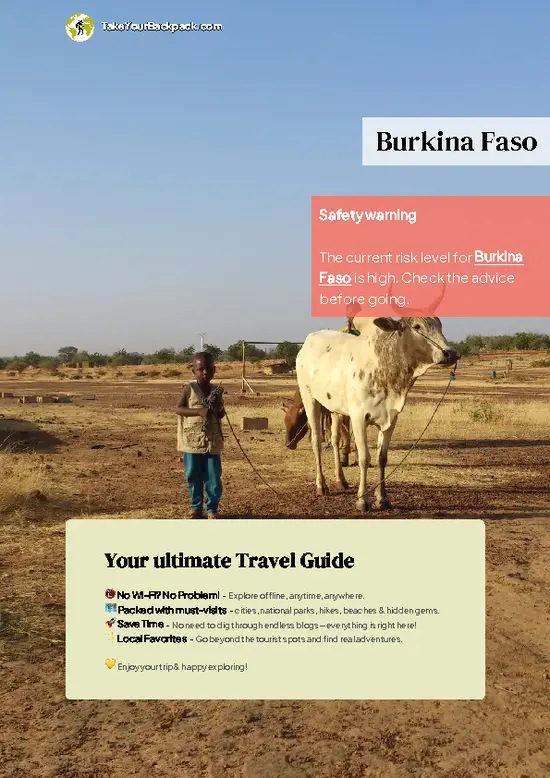
Backpacking Burkina Faso independently is doable in the center and southwest, where buses run on time and people are quick to help, but the north and east are currently off-limits because of armed conflict.
Stick to the
Ouagadougou to
Bobo-Dioulasso to
Banfora corridor and you can travel without a tour: the capital to Bobo takes 5 to 6 hours by bus for roughly 7,500 to 9,000 CFA francs (US$12 to 15), and Bobo to Banfora is about 1.5 hours. Guesthouses cost 8,000 to 20,000 CFA francs (US$13 to 33) a night. French is the working language, so a few phrases go a long way, and hiring local guides at sites like Sindou is normal and cheap.
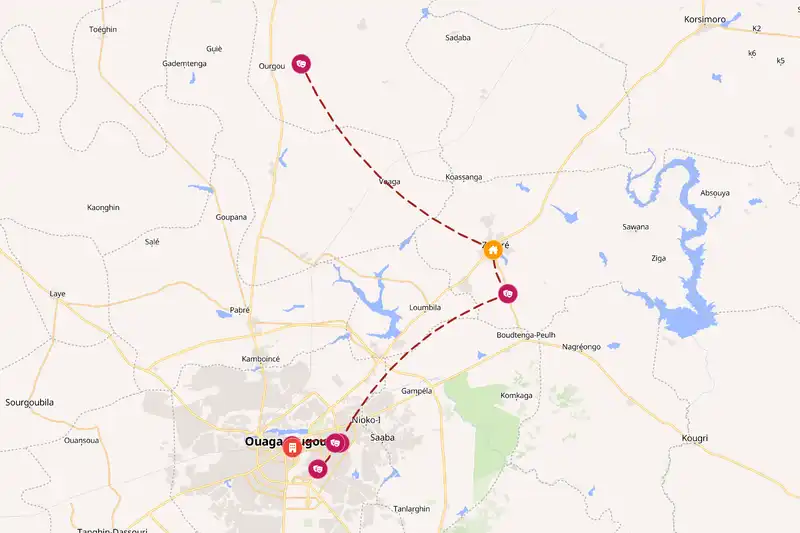
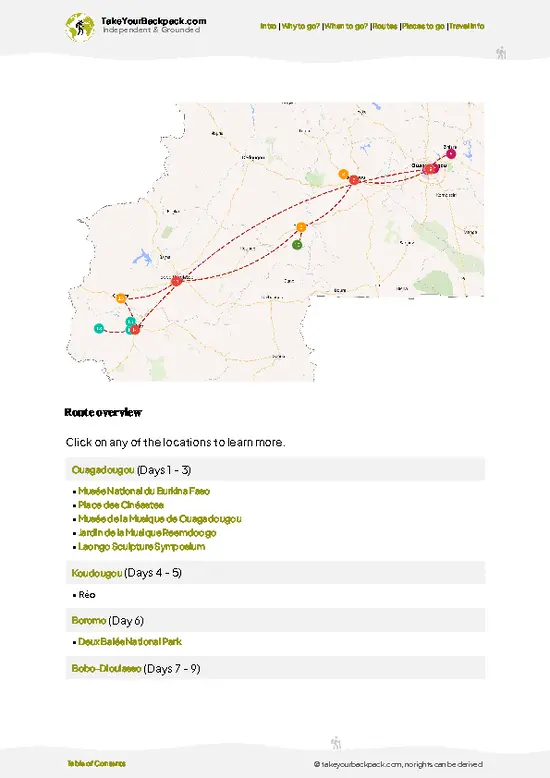
Ten days is the right amount of time for Burkina Faso on a first trip, enough for the capital and the southwest without rushing.
With 5 days, base yourself in
Bobo-Dioulasso for 2 nights and
Banfora for 2, covering the Karfiguéla falls and the Sindou Peaks. Ten days adds 3 nights in
Ouagadougou with a day trip to the Laongo granite sculptures, plus the hippo lake north of Bobo. Two weeks or more lets you add the painted compounds of
Tiébélé near Pô (2.5 to 3 hours from the capital) and Lobi country around
Gaoua. Plan one rest day after every long ride, since the heat from March to May drains you fast.
You can get around Burkina Faso without a car using intercity buses, bush taxis and motorbike taxis, and that is how most locals travel.
Air-conditioned coaches link
Ouagadougou and
Bobo-Dioulasso several times a day in 5 to 6 hours for about 7,500 to 9,000 CFA francs (US$12 to 15). Bobo to
Banfora takes around 1.5 hours for 2,000 to 2,500 CFA francs. For sites like the Sindou Peaks or the Karfiguéla falls, hire a motorbike with driver for 10,000 to 15,000 CFA francs (US$17 to 25) a day. The one place a car with driver makes sense is
Nazinga Ranch, where sandy tracks defeat motorbikes.
The must-visits in Burkina Faso are Ouagadougou’s museums and craft village, the city of Bobo-Dioulasso, and the waterfalls and rock formations around Banfora.
In
Ouagadougou, give 2 to 3 days to the Musée National and the Village Artisanal, plus a half-day at the
Laongo granite sculptures 35 km east.
Bobo-Dioulasso, 5 to 6 hours west by bus, is the place for live balafon music and the old mud-built quarter. From
Banfora, the Cascades de Karfiguéla sit 12 km out and the
Sindou Peaks about 50 km west, with an entry fee of 1,000 to 2,000 CFA francs plus a village guide. If you have extra days, the painted houses of
Tiébélé are the most photogenic village in the country.
If you are short on time in Burkina Faso, skip the northern and eastern towns and parks entirely, since security makes them unreachable for now, and cut the far-flung southern detours.
That rules out
Gorom-Gorom,
Dori,
Djibo and the
W and
Arly national parks. Next to go are
Gaoua and the Loropéni ruins, which cost 2 days and 4 to 5 hours of bus travel each way from Bobo. In the capital, the cultural centers and the Place des Cinéastes monument can wait. Spend the saved time in
Banfora: 2 to 3 nights there covers the falls, the Fabedougou domes and the Sindou Peaks at a relaxed pace.
Yes, our itinerary-planner does exactly that. Set your trip length in days, give your interests and travel style, optionally give start- and end location and/or some mandatory stops you would like to include and the itinerary planner creates your personalized routes for Burkina Faso in seconds. Try it out!
Try the itinerary plannerv2.webp)
 Best Backpacking