×

Burkina Faso🇧🇫 | best townsDiscover the 10 Best towns Across Burkina Faso

Towns in Burkina Faso are low-rise, dusty, and run on mopeds, which makes them cheap and easy to read, but the country is split in two for independent travel. The southwest and the capital corridor have working bus lines, guesthouses at 10,000 to 20,000 CFA francs (US$17 to 33) and almost no tourist crowds. The north, east and Sahel are not worth planning around, because security there is poor and access is restricted. Pick towns by what you want: green, relaxed, music-heavy places in the southwest, or the busier, noisier center. Backpackers get the most from the southwest.

By Johan Kruseman 🇳🇱 | Updated October 23, 2026
Explore the best villages in Burkina Faso

Why go?Why Travelers Love These Spots

Burkina Faso suits towns because its culture lives at street level. Markets, maquis (open-air bars and restaurants), workshops and cinema culture sit in the center of settlements, not in sights behind ticket booths. Several ethnic groups, including the Mossi, Bobo, Gurunsi and Lobi, shape distinct architecture, festivals and crafts, so towns differ more than the flat Sahelian landscape suggests. The country is landlocked and mostly savanna, so climate and geography split it clearly: the south and southwest are greener and wetter, the north is arid.

Know before you choose it: security is the deciding factor. Several regions, especially in the north, east and along borders, face armed-group activity, and many governments advise against travel to large parts of the country. Check your government’s … read more 👉
Burkina Faso suits towns because its culture lives at street level. Markets, maquis (open-air bars and restaurants), workshops and cinema culture sit in the center of settlements, not in sights behind ticket booths. Several ethnic groups, including the Mossi, Bobo, Gurunsi and Lobi, shape distinct architecture, festivals and crafts, so towns differ more than the flat Sahelian landscape suggests. The country is landlocked and mostly savanna, so climate and geography split it clearly: the south and southwest are greener and wetter, the north is arid.

Know before you choose it: security is the deciding factor. Several regions, especially in the north, east and along borders, face armed-group activity, and many governments advise against travel to large parts of the country. Check your government’s current advice and your insurance before booking. Even in safer areas, expect checkpoints, curfews in some places, and limited tolerance for photographing soldiers or officials.

Infrastructure is basic. Paved roads link the main hubs, but smaller towns can mean long waits for transport and patchy power. Cash in West African CFA francs is essential, as ATMs are scarce outside the largest cities. French is the working language. If you want polished heritage towns with guaranteed comforts, look elsewhere in West Africa.
How the List Was Created
The list of best towns in Burkina Faso is created based on charm, local culture, atmosphere, hidden gems, and visitor appeal. If you feel a town is missing in this list, please let us know.

When to go?Seasonal Guide to Visiting

Best months: November to February: November to February is the best window because the rains have ended and temperatures are tolerable, roughly 15 to 32°C at night and by day in most of the country. This is the dry, Harmattan season. Expect dusty haze from December to February that dulls views and can irritate throats, but roads are passable and nights are cool enough to sleep well.Shoulder and hot season: March to May is the hottest stretch, with daytime highs of 38 to 45°C, especially in the north and center. Walking around towns in the afternoon is pointless then. Plan errands for early morning and evening, and pay a little extra for a room with a working fan or air conditioning, usually adding 5,000 to 10,000 CFA francs (US$8 to 17).Rainy season: June to September is the wettest period. … read more 👉
Best months: November to February: November to February is the best window because the rains have ended and temperatures are tolerable, roughly 15 to 32°C at night and by day in most of the country. This is the dry, Harmattan season. Expect dusty haze from December to February that dulls views and can irritate throats, but roads are passable and nights are cool enough to sleep well.Shoulder and hot season: March to May is the hottest stretch, with daytime highs of 38 to 45°C, especially in the north and center. Walking around towns in the afternoon is pointless then. Plan errands for early morning and evening, and pay a little extra for a room with a working fan or air conditioning, usually adding 5,000 to 10,000 CFA francs (US$8 to 17).Rainy season: June to September is the wettest period. The southwest gets the heaviest rain, often 1,000 mm or more a year, with storms starting in May and lingering into October. The Sahel in the north sees roughly 300 to 500 mm. Dirt roads turn to mud, and some rural tracks become impassable, though everything is greener and cheaper to book.Events and prices: Prices barely change by season, so events matter more. The FESPACO film festival, held in odd-numbered years around late February and early March, fills Ouagadougou rooms and raises rates, so book weeks ahead.

town hoppingSuggested Travel Strategies

How long to allow: A trip linking several towns in Burkina Faso needs 7 to 14 days, and anything shorter than a week turns into a bus-seat marathon. The workable shape is a single arc through the safer western half: enter or leave through Ouagadougou, then run southwest toward Bobo-Dioulasso and the Banfora area. Skip the north and east entirely, since they are not worth the risk or the permits.Direction and timing: Going west from the capital works best because the Ouagadougou to Bobo-Dioulasso road is the country’s best, with buses taking about 5 to 6 hours for roughly 360 km. From Bobo to the Banfora region is about 1.5 hours by minibus or shared taxi. Give each stop 2 to 3 nights, and keep a spare day near the end for delays or a missed bus.Planning mistakes: The most common error is packing … read more 👉
How long to allow: A trip linking several towns in Burkina Faso needs 7 to 14 days, and anything shorter than a week turns into a bus-seat marathon. The workable shape is a single arc through the safer western half: enter or leave through Ouagadougou, then run southwest toward Bobo-Dioulasso and the Banfora area. Skip the north and east entirely, since they are not worth the risk or the permits.Direction and timing: Going west from the capital works best because the Ouagadougou to Bobo-Dioulasso road is the country’s best, with buses taking about 5 to 6 hours for roughly 360 km. From Bobo to the Banfora region is about 1.5 hours by minibus or shared taxi. Give each stop 2 to 3 nights, and keep a spare day near the end for delays or a missed bus.Planning mistakes: The most common error is packing in too many towns. Four stops in a week means four half-days lost to waiting for buses to fill. Pick two or three bases and use day trips by moped or hired bike. Another mistake is traveling after dark. Buses depart early, usually between 5 and 8 a.m., so leave in the morning and arrive by mid-afternoon. Finally, many travelers trust old routes: check current road and security status in each town before leaving, and drop any leg that locals or your guesthouse say is unsafe.

The ListThe Best towns of Burkina Faso

1 Fada N’gourma

Gulmu royal court, Grand Marché, eastern crossroads, tea corners

Greet the traditional ruler’s court through an intermediary, work through the market lanes, then eat grilled mutton among drivers and students.

2 Gorom-Gorom

Thursday market, Tuareg silver, Bella leather, Oudalan dunes

Time your arrival for the weekly market, watch silversmiths hammer crosses and rings, and walk out to the orange dunes.

3 Gaoua

Lobi museum, clay houses, carved figurines, dolo stalls

Visit the Poni museum for masks and divination objects, then tour fortified Lobi compounds with a guide and watch carvers at work.

4 Dori

Sahel capital, livestock pens, Mare de Dori, Tuareg crafts

Join herders at dawn livestock sales, watch egrets at the seasonal pond, and climb the dunes with a local guide.

burkina-faso-city-dori
© Google |

5 Diapaga

Tapoa capital, Gourmantché market, artisan workshops, park gateway

Browse pottery, baskets and leatherwork in small workshops, eat charcoal-grilled guinea fowl at dusk, and stroll sandy lanes as cattle come home.

6 Boromo

Forest reserve, elephant guides, Mouhoun riverbank, highway grills

Book a forest guide to track elephants, baboons and birds, then watch fishermen on the Mouhoun and finish with grilled guinea fowl.

7 Orodara

Orchard rides, mango season, fruit juice stalls, Kénédougou belt

Cycle through mango and citrus groves, press fresh tamarind and orange juice at stalls, and eat grilled fish at an evening maquis.

8 Djibo

Fulani emirate, camel trade, reservoir gardens, Sahel dust

Watch camels, cattle and goats traded, learn how the emir’s court shapes local life, and end at the reservoir where gardeners work.

9 Ziniaré

Laongo granite carvings, potters, Naba tradition, art day trip

Climb among granite outcrops carved by artists from many countries, then watch women potters shape and fire clay vessels in the neighborhoods.

10 Koupéla

Highway junction, maquis strip, tailor stalls, mission grounds

Order wax-print shirts from tailors who finish within days, then share grilled chicken at roadside bars with truckers and students.

11 Kongoussi

Lake Bam, pirogue rides, pelicans, onion gardens

Paddle out in a fisherman’s pirogue to herons and ibis, then follow lakeside garden plots where onions grow to the water.

12 Tenkodogo

Tenkodogo Naba, Mossi royal line, dolo courtyards, plantain grills

Pay a courtesy visit to the royal compound, then follow mud-walled lanes to calabash beer courtyards and charcoal grills after dark.

burkina-faso-city-tenkodogo
© Google |

13 Pô

Naba Kango, Kasena murals, Nazinga drives, border grills

Visit the Kasena chief’s palace, photograph painted compound walls with permission, and arrange early game drives for elephants at Nazinga.

14 Léo

Gurunsi compounds, border road, cattle trade, Sunday Mass

Look for painted geometric walls on edge-of-town compounds, watch herders and trucks head toward Ghana, and stay in a simple guesthouse.

15 Houndé

RN1 stopover, cotton trucks, Hauts-Bassins, evening lanes

Break the Ouagadougou to Bobo journey with grilled guinea fowl, a morning market, and dusk strolls past cooking fires and football games.

16 Yako

Mossi plateau, cathedral area, northern highway, clay compounds

Move through the morning market, pause at the Catholic mission, and walk quiet lanes of clay-walled Mossi family compounds.

17 Tougan

Sourou valley, Samo farmers, onion gardens, plain mosque

Watch Samo and Mossi traders at the early market, then walk irrigated plots where farmers hand-water rows of onions and tomatoes.

18 Nouna

Cotton town, ginning district, Kossi province, old quarter

See where cotton shapes the economy, from ginning warehouses to market traders, then wander goat-lined lanes of the old quarter.

19 Bogandé

Monday market, Gulmu compounds, Sahel herders, roadside tea

Arrive for the Monday market, then wander mud-brick Gourmantché compounds and share sweet green tea at evening stalls with traders and herders.

20 Boulsa

Namentenga seat, Fulani herders, Naaba court, millet beer

Time your stop for the Monday market, greet the local Naaba with a small gift, and end the day at open-air maquis.

21 Boussé

Naba court, Mossi farmland, onion stalls, baobab lanes

Call on the local Naba with a small gift, browse the farmers’ market, then follow baobab-lined paths through millet fields.

22 Dano

Dagara country, dolo cabarets, balafon evenings, Sunday mass

Sip millet beer from calabashes, listen for balafon players at evening gatherings, and hear choir and drums at Sunday mass.

23 Garango

Highway market, weaving corners, shea butter, Boulgou province

Pick through grain and cloth at the morning market, watch weavers and dyers, and wander shaded mud-brick courtyards by late afternoon.

24 Gourcy

Onion market, irrigated gardens, Mossi chief, kola nuts

Walk irrigated vegetable plots where farmers carry water, buy from market stalls, and pay a courtesy call on the chief.

25 Kombissiri

Dolo stalls, calabash beer, village lanes, Catholic mission

Sit under shade trees with a calabash of sour millet beer, then walk lanes of mud-brick compounds and granaries behind the market.

26 Manga

Nahouri market, Catholic mission, shea-tree quarters, brochette stalls

Loop through the produce market, hear Sunday services at the cathedral, and finish with brochettes at roadside grills after dusk.

27 Pama

Arly park access, Pendjari reserves, elephants, savanna market

Arrange guides and entry for Arly’s elephants, hippos and antelope, then browse the village market and stroll seasonal streams for birds.

28 Réo

Lyela country, grand market, mission church, main-road dolo

Eat cheaply among market stalls, visit the calm mission compound, and finish at grilled meat stands where motorbikes crowd the main road.

29 Sapouy

Ziro province, Gourounsi paintings, weekly market, sorghum beer

Walk among mud houses with geometric patterns painted by women, then settle at an open-air bar over sorghum beer and grilled chicken.

30 Sebba

Yagha capital, Fulani herds, Gourmantché community, far northeast

Watch cattle and goat deals at the edge of town, browse the market under tin roofs, and stroll mud-brick streets past the mosque.

31 Solenzo

Cashew orchards, Banwa seat, cotton depot, red-dirt streets

Taste seasonal fruit on orchard tracks, watch cotton trucks pile up at harvest, and meet farmers over grilled meat at the maquis.

32 Titao

Loroum capital, Fulani livestock, reservoir plots, mosque quarter

Watch Fulani herders haggle at dawn, then walk to the reservoir where irrigated plots keep farmers working through the dry months.

33 Zabré

Bissa quarters, border region, mango-lined tracks, bissap

Walk Bissa quarters where women pound millet beside granaries, then sit at simple maquis tables for grilled chicken and local dolo.

34 Zorgho

Ganzourgou market, Mossi compounds, Brakina beer, eastern road

Break the eastbound drive with a morning market, a loop through shea-shaded compounds, and brochettes with tô at a roadside maquis.

35 Kourouma

Mango groves, cotton fields, Kénédougou lanes, no hostel

Follow shaded tracks through fruit groves and cotton fields, then walk old quarters where shea trees stand beside mud-brick courtyards.

Think you know Burkina Faso?

Prove you’re a true local — uncover 25 lesser-known towns in Burkina Faso that locals tend to keep to themselves.
Loading the map 🌍

Expert viewExpert Commentary on towns

How many towns to visit: Two to four towns is the sensible number. Transport is slow, buses leave when full, and each move eats most of a day. Fewer stops mean more time actually spent wandering markets, listening to live music and talking to people. Beyond four, you are mostly watching the road.Which kind suits you: The southwest towns suit most backpackers: greener, cooler, with walking, cycling and craft traditions. The larger central towns suit those who want nightlife, cinemas, galleries and the best food. Skip anything in the north, east or near borders. Reaching these places is hard, and they offer nothing that justifies the security risk.What it costs: Budget 15,000 to 30,000 CFA francs (US$25 to 50) a day in the smaller towns. A basic guesthouse room runs 8,000 to 15,000 CFA francs … read more 👉
How many towns to visit: Two to four towns is the sensible number. Transport is slow, buses leave when full, and each move eats most of a day. Fewer stops mean more time actually spent wandering markets, listening to live music and talking to people. Beyond four, you are mostly watching the road.Which kind suits you: The southwest towns suit most backpackers: greener, cooler, with walking, cycling and craft traditions. The larger central towns suit those who want nightlife, cinemas, galleries and the best food. Skip anything in the north, east or near borders. Reaching these places is hard, and they offer nothing that justifies the security risk.What it costs: Budget 15,000 to 30,000 CFA francs (US$25 to 50) a day in the smaller towns. A basic guesthouse room runs 8,000 to 15,000 CFA francs (US$13 to 25), street meals cost 500 to 1,500 CFA francs (under US$3), and a restaurant meal 2,500 to 5,000 CFA francs (US$4 to 8). A longer bus between hubs costs about 6,000 to 10,000 CFA francs (US$10 to 17). A local guide for a day runs 10,000 to 25,000 CFA francs (US$17 to 42), and museum or site entries are typically 1,000 to 5,000 CFA francs (US$2 to 8). Cash is vital. ATMs fail often, so carry reserves and withdraw in larger towns whenever you pass one.Costs and delays that catch you out: Buses leave only when full, so arriving at the station at dawn avoids a wait of several hours. Moped taxi drivers quote tourist rates, so agree a price before getting on. Photography permits or informal fees sometimes apply at cultural sites, so ask the guesthouse first. Power cuts are common, so carry a power bank and a headlamp.Safety and culture: Before booking, read your government’s current travel advice and confirm your insurance covers Burkina Faso, since many policies exclude areas under a do-not-travel advisory. Stay out of regions flagged as high risk, avoid night driving, and expect checkpoints where you should carry your passport and visa copies and stay polite. Never photograph soldiers, police, bridges or government buildings. Dress modestly, especially in Muslim-majority areas, with covered shoulders and knees. Greet people before asking anything, a handshake and a few words of French go a long way. Ask permission before photographing individuals, and expect to pay for it at some markets. Drink bottled or treated water, and take malaria prophylaxis.

Register with your embassy if it offers it, keep a local SIM, and share your plans with the guesthouse. A guide who knows the local situation is worth the fee when roads change.

✈️ The backpacker research shortcutBurkina Faso Travel Guide

An offline-friendly backpacking guide with optimized travel routes, ranked highlights, transport advice, and the best areas to stay.
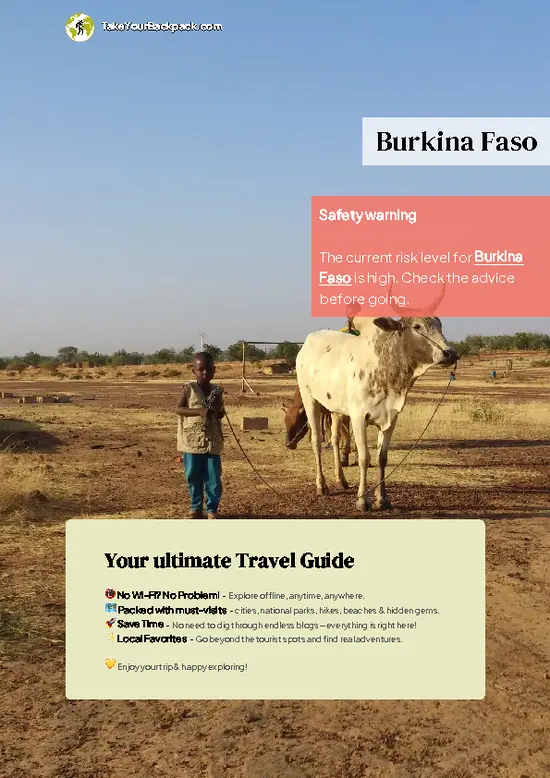
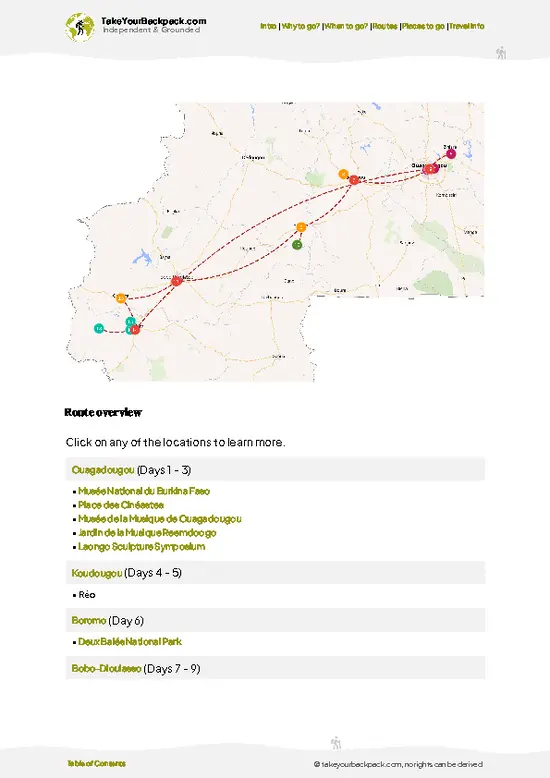
example page 0 from our offline Travel Guide for Burkina Faso
example page 1 from our offline Travel Guide for Burkina Faso
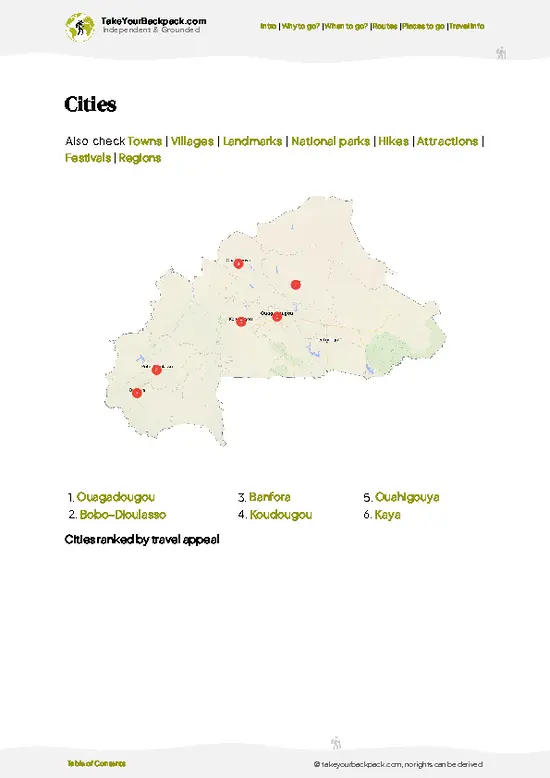
example page 2 from our offline Travel Guide for Burkina Faso
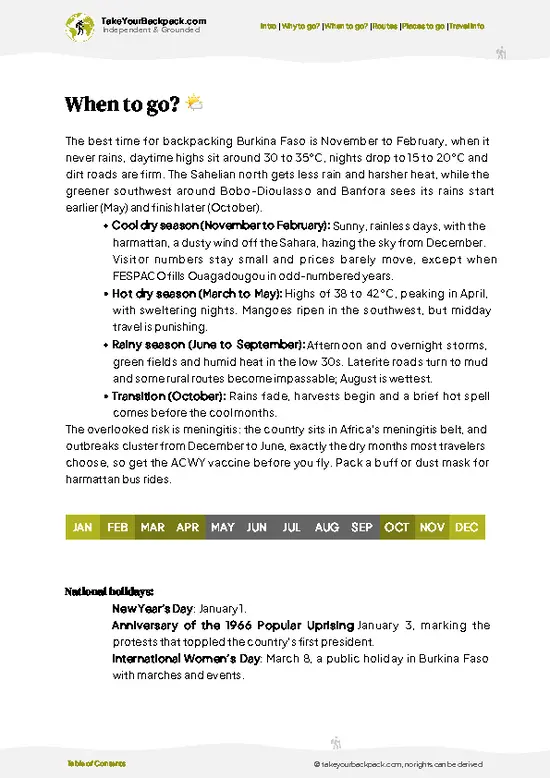
example page 3 from our offline Travel Guide for Burkina Faso
example page 4 from our offline Travel Guide for Burkina Faso
example page 5 from our offline Travel Guide for Burkina Faso
example page 6 from our offline Travel Guide for Burkina Faso
example page 7 from our offline Travel Guide for Burkina Faso
The digital guide (273 pages) contains:
✅ 63 highlights, ranked by travel appeal
✅ Optimized 5, 10 & 15-day travel routes
✅ Cities, national parks, landmarks, beaches
✅ How to get around
✅ Offline-friendly for travel without Wi-Fi
👉 Click to see all 30+ guide features

📅 Plan smarter in minutes, not weeks
✅ Month by month travel advice
✅ Festivals & national holidays
✅ Budget expectations

🗺️ Go to the right places, skip the overrated ones
✅ Honest pros & cons of destinations
✅ Top hikes, parks & viewpoints
✅ Lesser-known places most travelers miss
✅ Clear “worth it vs skip it” guidance

🛏️ Travel smoothly without rookie mistakes
✅ Best areas to stay
✅ Transport systems explained simply
✅ Common scams & safety advice
✅ SIM cards, money & practical tips

🌍 Understand the country, not just visit it
✅ Culture & traditions
✅ 52 Essential phrases & customs
✅ Festivals worth planning around
✅ Traveler-friendly historical context
✅ Insights that make places more meaningful

📱 Built for real travel conditions
✅ Fully downloadable PDF
✅ Works completely offline
✅ Optimized for phone use
✅ Useful in remote areas & buses
✅ Everything in one place
Stop searching, start planning
Get instant access to your full guide. 30‑day money-back guarantee.
+ Add another guide for just

By proceeding you agree to our terms.
Sent to your inbox immediately after payment • 100% Secure Checkout
Best Backpacking Travel Advisor 2025 tourism awardBest Backpacking
Travel Advisor
2025
What others say about Take Your Backpack Guides:
⭐⭐⭐⭐⭐
Fantastic, amazing amount of information!
⭐⭐⭐⭐⭐
My goodness this is amazing, it's what I've been looking for hats off too you!
⭐⭐⭐⭐⭐
I think this is absolutely BRILLIANT
⭐⭐⭐⭐
Very complete and informative. It's still missing places, but I gotta to commend you
⭐⭐⭐⭐⭐
This is truly amazing, thank you, can't wait to explore it with my kids!
⭐⭐⭐⭐⭐
Awesome resource, thank you!
⭐⭐⭐⭐⭐
This is amazing! Can't wait to explore the ones I haven't seen
⭐⭐⭐⭐
I love this! Well done, great idea.
⭐⭐⭐⭐⭐
Thanks for taking the time to make this gem!
⭐⭐⭐⭐⭐
This might be the best website I've ever seen.
⭐⭐⭐⭐⭐
Congratulations, and thank you so much for your work; it's incredibly valuable.
⭐⭐⭐⭐
In all seriousness I think you did a great job pointing out the important spots
⭐⭐⭐⭐⭐
10/10 very good
⭐⭐⭐⭐⭐
As someone who's only just starting to visit regularly this is awesome, thank you.
⭐⭐⭐⭐
Thank you very much! I'm going to visit my dad, it's going to be very useful!
⭐⭐⭐⭐⭐
This is really cool! We'll be travelling for the first time and this definitely come in handy.
⭐⭐⭐⭐⭐
You are now our minister of culture, congratulations 👨‍💼
⭐⭐⭐⭐⭐
Just wanted to tell you that this is a pearl! Going to follow your recommendations.
⭐⭐⭐⭐⭐
This is so cool. I'll definitely be using the resource for my travels soon.
⭐⭐⭐⭐⭐
This is very impressive! Good work.
⭐⭐⭐⭐⭐
This is an amazing and informative site. Very well done!

🛏️ Where to stay?Best Stay Options in Burkina Faso

Backpacker hostels with dorms barely exist in Burkina Faso, so budget travel here means simple auberges, church-run mission guesthouses and basic hotels at roughly 8,000 to 20,000 CFA (US$13 to 33) a night, almost all of them in the two cities still realistic for visitors. In Ouagadougou, the city center around the cathedral and the big avenues puts you near markets, maquis bars and live music but is noisy and dusty. Zone du Bois and Ouaga 2000 are quieter, greener and better guarded, at the cost of higher prices and a taxi ride for everything, while in Bobo-Dioulasso the cheap rooms cluster near the Grand Marché and the train station, walkable to the old Kibidwé quarter and the evening music … read more 👉
Backpacker hostels with dorms barely exist in Burkina Faso, so budget travel here means simple auberges, church-run mission guesthouses and basic hotels at roughly 8,000 to 20,000 CFA (US$13 to 33) a night, almost all of them in the two cities still realistic for visitors. In Ouagadougou, the city center around the cathedral and the big avenues puts you near markets, maquis bars and live music but is noisy and dusty. Zone du Bois and Ouaga 2000 are quieter, greener and better guarded, at the cost of higher prices and a taxi ride for everything, while in Bobo-Dioulasso the cheap rooms cluster near the Grand Marché and the train station, walkable to the old Kibidwé quarter and the evening music scene.

If you enjoy meeting fellow travelers, consider choosing hostels with high ratings for atmosphere. On the other hand, if you prefer having your own space, a hotel might be a better option.

Burkina FasoWhere to Go Next

👋 Meet the founderWho’s Behind Take Your Backpack?

Johan, backpacker and founder of TakeYourBackpackHi, I’m Johan (Netherlands 🇳🇱), the creator of TakeYourBackpack. Over the past 3 decades, I’ve backpacked through 90+ countries across six continents, gaining extensive experience with independent travel, long-term trips, and overland routes.

This site is built on a combination of firsthand travel experience and carefully curated insights from other backpackers. Many guides are based on places I’ve personally visited, while others bring together tips, observations, and practical advice shared by trusted travelers I’ve met along the way.

The goal is to provide realistic, experience-driven guidance — not generic itineraries — so you can explore destinations with better context, clearer expectations, and more confidence.