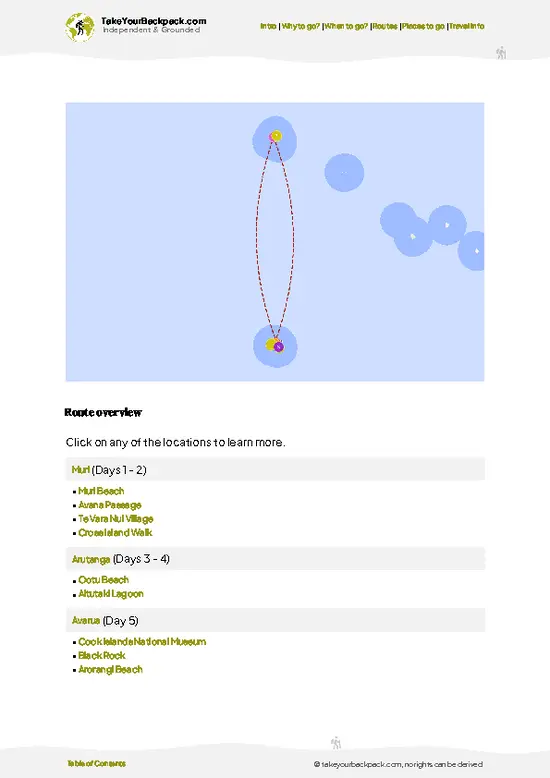
This five-day route suits travelers who want both of the Cook Islands’ big draws, Rarotonga’s mountains and Aitutaki’s lagoon, without spending the trip in transit. The pace is relaxed, with one demanding hike and one flight in each direction. You need the Rarotonga round-island buses and a return Air Rarotonga flight to Aitutaki (about 50 minutes each way), plus a bicycle or scooter on Aitutaki, where public transport barely exists.
Days 1-2: Muri and the Southeast Coast
Start in
Muri, on Rarotonga’s calm eastern side. The lagoon at
Muri Beach is shallow, sheltered by four small motu, and easy to kayak or paddleboard across in 15 to 20 minutes, a gentle way to shake off a long-haul flight. Walk a few minutes north to
Avana Passage at Ngatangiia, the harbor from which, by tradition, the great voyaging canoes set out for New Zealand. It looks modest, a channel through the reef with a few memorial stones on shore, and that is part of its weight. Spend the first evening at
Te Vara Nui Village, …
read more 👉This five-day route suits travelers who want both of the Cook Islands’ big draws, Rarotonga’s mountains and Aitutaki’s lagoon, without spending the trip in transit. The pace is relaxed, with one demanding hike and one flight in each direction. You need the Rarotonga round-island buses and a return Air Rarotonga flight to Aitutaki (about 50 minutes each way), plus a bicycle or scooter on Aitutaki, where public transport barely exists.
Days 1-2: Muri and the Southeast Coast
Start in Muri, on Rarotonga’s calm eastern side. The lagoon at Muri Beach is shallow, sheltered by four small motu, and easy to kayak or paddleboard across in 15 to 20 minutes, a gentle way to shake off a long-haul flight. Walk a few minutes north to Avana Passage at Ngatangiia, the harbor from which, by tradition, the great voyaging canoes set out for New Zealand. It looks modest, a channel through the reef with a few memorial stones on shore, and that is part of its weight. Spend the first evening at Te Vara Nui Village, where the dance show on an over-water stage and the buffet of island food make the most polished cultural night on the island. Book a day or two ahead.
Day two belongs to the Cross Island Walk. Take the bus to the Avatiu valley road behind Avarua early, climb the root-laced trail to the base of Te Rua Manga, then descend through wet forest to the south coast in 3 to 4 hours. Pick up the bus back to Muri for a lazy swim. Skip it after heavy rain, when the clay turns slick.Days 3-4: Aitutaki
Fly to Aitutaki on a morning flight and settle near Arutanga, the island’s main village, where the coral-lime Cook Islands Christian Church dates to the 1820s and is usually cited as the oldest in the country. Rent a bicycle and spend the afternoon at Ootu Beach, a sandy point on the eastern side where the water is waist-deep and turquoise far out from shore.
Give a full day to the Aitutaki Lagoon on a cruise (roughly NZ$130 to 200, about US$75 to 115, with lunch). Most boats stop to snorkel among giant clams and land at One Foot Island, where the tiny post office stamps your passport. Two nights here means you are never racing the return flight.Day 5: Avarua and the West Coast
Fly back to Rarotonga and drop your bags in Avarua. The Cook Islands National Museum is small, with carved staff gods, canoe models and tools, and takes under an hour, good context after the cultural show. If it is Saturday, the morning Punanga Nui Market comes first. In the afternoon, ride the bus west to Black Rock, the volcanic outcrop where tradition says spirits departed for the ancestral homeland; snorkeling is best near high tide. Finish with sunset on Arorangi Beach, the western shore that catches the last light while Muri sits in shadow.
With an extra two days, fly to Atiu to explore Anatakitaki Cave, where the tiny kopeka swiftlets navigate the darkness by clicking.

 Best Backpacking


