×

Costa Rica🇨🇷 | best festivalsWhere to Find the 9 Best festivals in Costa Rica

Festivals in Costa Rica run on a small-town rhythm: a plaza ringed with plastic chairs, the thump of a marimba or a brass band, smoke from grills selling chicharrones and tamales, and a sky that can turn from blazing to downpour in twenty minutes. The Pacific northwest leans toward cowboy culture, with dusty bullrings and horse parades. The Caribbean coast brings reggae, calypso and humid, sweaty nights. The Central Valley is the easiest to reach, with frequent buses from San José. Entry is usually free or cheap, and crowds are mostly local families, which suits backpackers and independent travelers who want company without tour groups.

By Johan Kruseman 🇳🇱 | Updated October 23, 2026
Explore the best regions in Costa Rica

Why go?Why Travelers Love These Spots

Costa Rica is well suited to festivals because community life still centers on the town plaza, the parish church and the local salón comunal. Most celebrations grew from Catholic calendar days, then picked up Afro-Caribbean, indigenous and Guanacaste cattle-ranching traditions, so the sound and taste change sharply within a few hours of driving. The country is small, and its paved main roads and frequent buses mean you can reach very different events without internal flights.

Climate shapes everything. The green season brings afternoon downpours, muddy streets and the smell of wet earth and frying dough, and outdoor stages and parades are sometimes delayed or moved. The dry season is dusty, hot and hard on the feet, especially in the northwest. Dates also matter: many events follow religious … read more 👉
Costa Rica is well suited to festivals because community life still centers on the town plaza, the parish church and the local salón comunal. Most celebrations grew from Catholic calendar days, then picked up Afro-Caribbean, indigenous and Guanacaste cattle-ranching traditions, so the sound and taste change sharply within a few hours of driving. The country is small, and its paved main roads and frequent buses mean you can reach very different events without internal flights.

Climate shapes everything. The green season brings afternoon downpours, muddy streets and the smell of wet earth and frying dough, and outdoor stages and parades are sometimes delayed or moved. The dry season is dusty, hot and hard on the feet, especially in the northwest. Dates also matter: many events follow religious or civic dates, so they cluster around certain weeks, and accommodation in small towns can fill fast.

Before choosing Costa Rica for festivals, know that it is not a country of giant spectacles. Events are local, modest and often loosely scheduled, with details posted on municipal Facebook pages rather than glossy sites. Programs shift, and the best moments often happen at the edges: a bomba, a street dance, a bar spilling onto the sidewalk. Bring patience and small cash, and treat the events as a way into everyday Tico life, not as a polished show.
Our Approach to Ranking
The list of best festivals in Costa Rica is created based on energy, traditions, crowd experience, activities, and overall excitement. If you feel a festival is missing in this list, please let us know.

When to go?When to Plan Your Trip

Best months for festivals in Costa Rica: The best months are December to April, the dry season, when days are sunny at 28 to 34°C (82 to 93°F) in Guanacaste and the Pacific coast, roads are dry and outdoor stages run on time. Rainfall is minimal, often under 50 mm a month in the northwest, and the air smells of dust and dry grass.
Green season and shoulder months: From May to November, afternoon rain is the rule, with the Pacific side and mountains getting the heaviest downpours, often 300 to 500 mm a month in September and October. Mornings are usually clear, so plan outdoor events for early in the day. May, June and November work as shoulder months, with fewer visitors and lower prices, though dirt roads can be slick and some rural buses run less often.
Regional differences and peak periods: … read more 👉
Best months for festivals in Costa Rica: The best months are December to April, the dry season, when days are sunny at 28 to 34°C (82 to 93°F) in Guanacaste and the Pacific coast, roads are dry and outdoor stages run on time. Rainfall is minimal, often under 50 mm a month in the northwest, and the air smells of dust and dry grass.
Green season and shoulder months: From May to November, afternoon rain is the rule, with the Pacific side and mountains getting the heaviest downpours, often 300 to 500 mm a month in September and October. Mornings are usually clear, so plan outdoor events for early in the day. May, June and November work as shoulder months, with fewer visitors and lower prices, though dirt roads can be slick and some rural buses run less often.
Regional differences and peak periods: The Caribbean coast follows its own pattern. It is humid year-round, with 25 to 30°C (77 to 86°F) and rain possible in any month. September and October are often drier there than on the Pacific side. The Central Valley stays milder at 20 to 26°C (68 to 79°F), cooler at night.
Prices and crowds: Christmas, New Year and Semana Santa are the peak weeks, when coastal rooms can cost 30 to 60 percent more and need booking weeks ahead. Outside these periods, dorm beds typically run US$10 to 20, and small-town guesthouses US$25 to 50 a night.

festival hoppingOptimizing Your Multi-Stop Itinerary

How many days to combine festivals: A trip linking several festivals in Costa Rica needs 10 to 14 days, since distances are short but roads are slow, winding and often wet. Plan around San José, the main transport hub, which has buses to nearly every region.
Grouping regions and direction: The Central Valley (Cartago, Heredia, Alajuela) clusters well because towns are 30 to 90 minutes apart by bus. The Guanacaste region in the northwest pairs with the Pacific coast, with Liberia as the gateway, about 4 to 5 hours from San José. The Caribbean side, via Limón or Puerto Viejo, takes 4 to 5 hours from the capital and works best as a separate loop. A sensible direction is Central Valley first, then the northwest, then back through San José to the Caribbean, which avoids doubling back over the same … read more 👉
How many days to combine festivals: A trip linking several festivals in Costa Rica needs 10 to 14 days, since distances are short but roads are slow, winding and often wet. Plan around San José, the main transport hub, which has buses to nearly every region.
Grouping regions and direction: The Central Valley (Cartago, Heredia, Alajuela) clusters well because towns are 30 to 90 minutes apart by bus. The Guanacaste region in the northwest pairs with the Pacific coast, with Liberia as the gateway, about 4 to 5 hours from San José. The Caribbean side, via Limón or Puerto Viejo, takes 4 to 5 hours from the capital and works best as a separate loop. A sensible direction is Central Valley first, then the northwest, then back through San José to the Caribbean, which avoids doubling back over the same mountain roads.
Time per stop and common mistakes: Allow 2 to 3 days per stop so you can settle in, find local rooms and catch the day-of buildup, when streets fill and stalls open by mid-morning. Typical transfers take 3 to 6 hours, and rural buses are rarely on a strict timetable.

The usual mistakes are packing a festival into the day you arrive after a long bus, trusting a single posted date without checking locally, and booking tight connections. Leave a buffer day between regions, book rooms early for small towns, and expect landslides or flooded roads in the rainy months to add hours.

The ListMust-Visit festivals in Costa Rica

1 Envision

Week-long jungle camp, yoga and breathwork, rainforest stages, Uvita mud

Spend seven days near Uvita moving between morning yoga in open pavilions, art-lined jungle paths, bass-heavy rainforest stages, and river pools for cooling off.

2 Fiestas de Palmares

Two-week January run, redondel, Saturday horse tope, dance tents

Squeeze into a Costa Rican crowd for the big horse parade, amateur bullring chaos, sugarcane juice and salsa tents that run well past midnight.

3 Limón Carnival

Calypso parade, Parque Vargas, rondón, Caribbean comparsas

Stake out a curb for the Saturday parade of costumed comparsas, then eat coconut-milk rondón and dance to calypso and soca along the Caribbean seafront.

4 Festival de la Luz

Lantern floats, Paseo Colón, light switch-on, night fireworks

Watch community-built floats and marching bands roll down Paseo Colón as the downtown Christmas lights flick on, then stay for the fireworks over the capital.

5 Festival Internacional de las Artes

Ten days in March, La Sabana stages, Teatro Nacional, free street shows

Follow the drums through La Sabana park and downtown San José, catching dance, circus and folk music from Costa Rica and abroad, mostly without a ticket.

6 Fiestas Típicas Nacionales de Santa Cruz

Tope horses, bomba verses, Guanacaste folk dance, wooden redondel

Sit on plain benches at a town rodeo where riders parade, amateurs face bulls and the crowd answers rhymed bomba verses in unison.

7 Fiestas Cívicas de Liberia

Tope de toros, Calle Real, Camilo Reyes ring, marimba nights

Line the Calle Real as riders drive cattle toward the ring, then eat tamales and chicharrones standing up before dancing to live bands after dark.

8 Desfile Nacional de Boyeros

Boyeros, Sarchí-painted carretas, creaking wheels, last Sunday of November

Watch about 150 to 200 ox teams haul painted carts across La Sabana park, close enough to study the geometric patterns and hear the yokes clatter.

9 Fiesta de los Diablitos

Boruca devils, balsa masks, burlap costumes, bull battle

Follow masked dancers in burlap through Boruca territory as they fight a wooden bull over hours, with conch blasts, chicha and weavers selling their work.

Loading the map 🌍

Expert viewWhat You Should Know

How many festivals to visit: I advise two or three festivals in a single trip. Costa Rica is compact, but buses are slow, rains interrupt plans, and festivals are usually more rewarding when you spend a full day letting the town warm up, with the first fried food at noon and the real crowd at dusk. Beyond three, you spend more time in transit than in plazas.
Choosing the kind that fits you: If you like music and dancing, favor the Caribbean side, where sound systems, drumming and humid late nights are the point. If you want cowboy and rural culture, choose Guanacaste, with its dusty arenas, horses and tamale stands. If this is your first trip, or time is short, the Central Valley is the best value: it is easy to reach, cooler, and parades and religious processions are walkable from a cheap … read more 👉
How many festivals to visit: I advise two or three festivals in a single trip. Costa Rica is compact, but buses are slow, rains interrupt plans, and festivals are usually more rewarding when you spend a full day letting the town warm up, with the first fried food at noon and the real crowd at dusk. Beyond three, you spend more time in transit than in plazas.
Choosing the kind that fits you: If you like music and dancing, favor the Caribbean side, where sound systems, drumming and humid late nights are the point. If you want cowboy and rural culture, choose Guanacaste, with its dusty arenas, horses and tamale stands. If this is your first trip, or time is short, the Central Valley is the best value: it is easy to reach, cooler, and parades and religious processions are walkable from a cheap hostel. Skip anything sold mainly through resort packages, since the atmosphere is thin and prices are double.
What it costs: A backpacker spending US$35 to 60 a day covers a dorm bed or simple room (US$10 to 25), local meals at sodas (US$5 to 9), and buses. Most community events are free; ticketed concerts or bullring seats typically cost US$5 to 30. Intercity buses cost US$3 to 12, and taxis from a bus stop to a fairground US$3 to 10. Budget US$20 to 40 extra for a festival day with food, drinks and a late ride home. Guided add-ons are rarely needed.
Safety and cultural considerations: Crowds are friendly, but pickpocketing and phone theft happen in dense plazas and on packed buses, so carry a cross-body bag and leave your passport copy, not the original, in your pocket. Drinks are cheap and strong; guard your glass and avoid unlicensed late taxis, using a hotel-called driver or a ride app instead. Dress for the weather, carry a light rain jacket, and wear closed shoes, since streets can be muddy, littered with broken glass and busy with horses in some regions.

Ticos are warm and curious, so a greeting, a “pura vida” and a few Spanish phrases go a long way. Ask before photographing religious processions, and stand back from bull and horse events, where accidents do occur.

✈️ The backpacker research shortcutCosta Rica Travel Guide

An offline-friendly backpacking guide with optimized travel routes, ranked highlights, transport advice, and the best areas to stay.
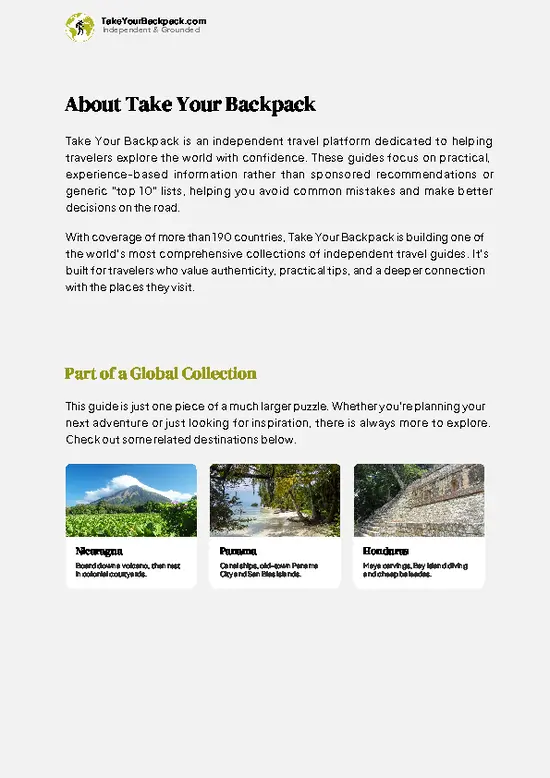
example page 0 from our offline Travel Guide for Costa Rica
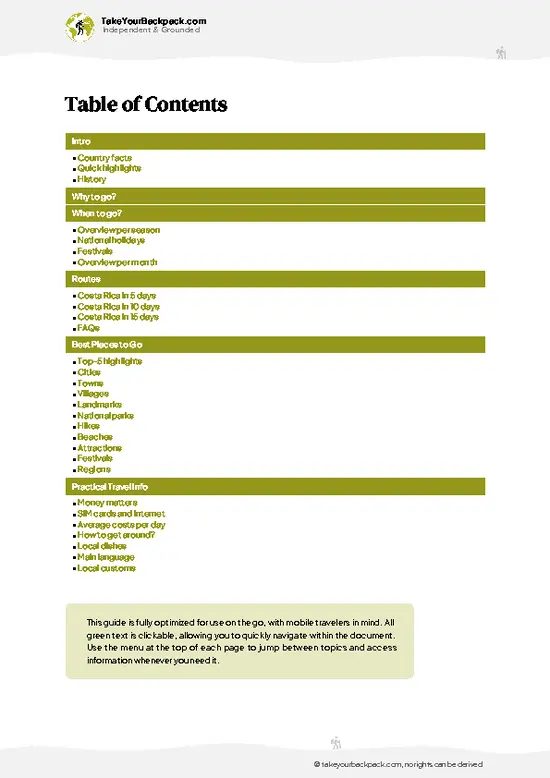
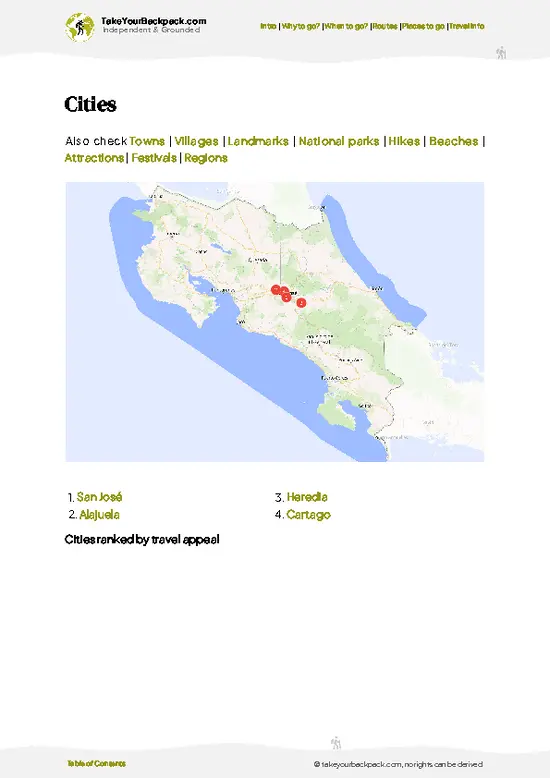
example page 1 from our offline Travel Guide for Costa Rica
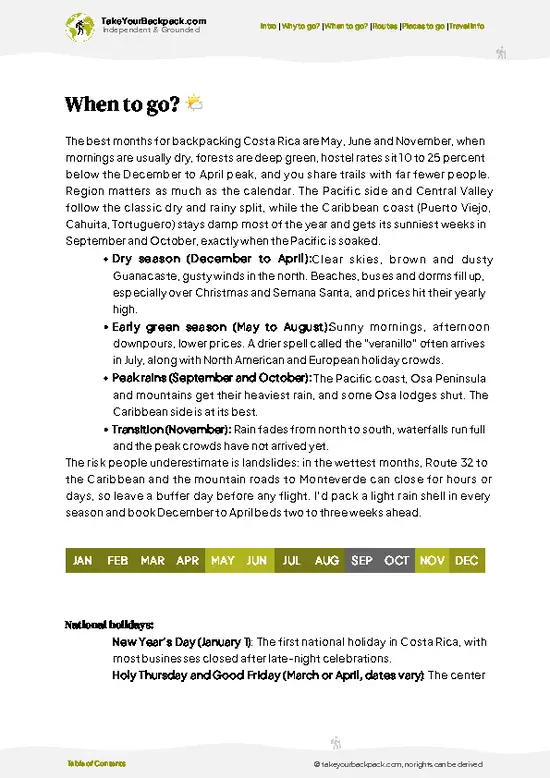
example page 2 from our offline Travel Guide for Costa Rica
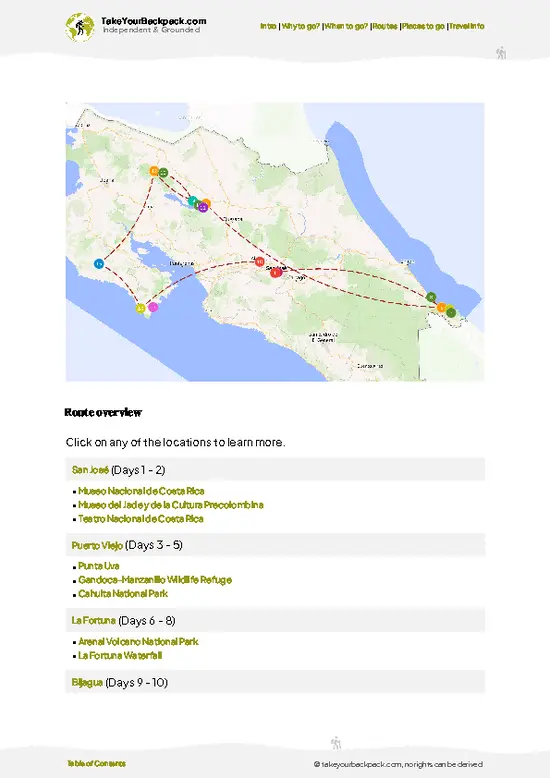
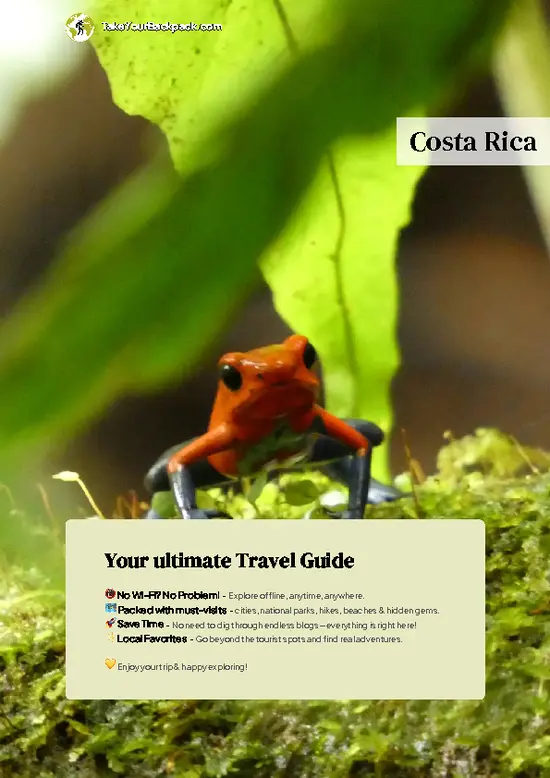
example page 3 from our offline Travel Guide for Costa Rica
example page 4 from our offline Travel Guide for Costa Rica
example page 5 from our offline Travel Guide for Costa Rica
example page 6 from our offline Travel Guide for Costa Rica
example page 7 from our offline Travel Guide for Costa Rica
The digital guide (287 pages) contains:
✅ 90 highlights, ranked by travel appeal
✅ Optimized 5, 10 & 15-day travel routes
✅ Cities, national parks, landmarks, beaches
✅ How to get around
✅ Offline-friendly for travel without Wi-Fi
👉 Click to see all 30+ guide features

📅 Plan smarter in minutes, not weeks
✅ Month by month travel advice
✅ Festivals & national holidays
✅ Budget expectations

🗺️ Go to the right places, skip the overrated ones
✅ Honest pros & cons of destinations
✅ Top hikes, parks & viewpoints
✅ Lesser-known places most travelers miss
✅ Clear “worth it vs skip it” guidance

🛏️ Travel smoothly without rookie mistakes
✅ Best areas to stay
✅ Transport systems explained simply
✅ Common scams & safety advice
✅ SIM cards, money & practical tips

🌍 Understand the country, not just visit it
✅ Culture & traditions
✅ 52 Essential phrases & customs
✅ Festivals worth planning around
✅ Traveler-friendly historical context
✅ Insights that make places more meaningful

📱 Built for real travel conditions
✅ Fully downloadable PDF
✅ Works completely offline
✅ Optimized for phone use
✅ Useful in remote areas & buses
✅ Everything in one place
Stop searching, start planning
Get instant access to your full guide. 30‑day money-back guarantee.
+ Add another guide for just

By proceeding you agree to our terms.
Sent to your inbox immediately after payment • 100% Secure Checkout
Best Backpacking Travel Advisor 2025 tourism awardBest Backpacking
Travel Advisor
2025
What others say about Take Your Backpack Guides:
⭐⭐⭐⭐⭐
Fantastic, amazing amount of information!
⭐⭐⭐⭐⭐
My goodness this is amazing, it's what I've been looking for hats off too you!
⭐⭐⭐⭐⭐
I think this is absolutely BRILLIANT
⭐⭐⭐⭐
Very complete and informative. It's still missing places, but I gotta to commend you
⭐⭐⭐⭐⭐
This is truly amazing, thank you, can't wait to explore it with my kids!
⭐⭐⭐⭐⭐
Awesome resource, thank you!
⭐⭐⭐⭐⭐
This is amazing! Can't wait to explore the ones I haven't seen
⭐⭐⭐⭐
I love this! Well done, great idea.
⭐⭐⭐⭐⭐
Thanks for taking the time to make this gem!
⭐⭐⭐⭐⭐
This might be the best website I've ever seen.
⭐⭐⭐⭐⭐
Congratulations, and thank you so much for your work; it's incredibly valuable.
⭐⭐⭐⭐
In all seriousness I think you did a great job pointing out the important spots
⭐⭐⭐⭐⭐
10/10 very good
⭐⭐⭐⭐⭐
As someone who's only just starting to visit regularly this is awesome, thank you.
⭐⭐⭐⭐
Thank you very much! I'm going to visit my dad, it's going to be very useful!
⭐⭐⭐⭐⭐
This is really cool! We'll be travelling for the first time and this definitely come in handy.
⭐⭐⭐⭐⭐
You are now our minister of culture, congratulations 👨‍💼
⭐⭐⭐⭐⭐
Just wanted to tell you that this is a pearl! Going to follow your recommendations.
⭐⭐⭐⭐⭐
This is so cool. I'll definitely be using the resource for my travels soon.
⭐⭐⭐⭐⭐
This is very impressive! Good work.
⭐⭐⭐⭐⭐
This is an amazing and informative site. Very well done!

🛏️ Where to stay?Best Places to Stay in Costa Rica

Costa Rica has a dense hostel network, with dorm beds typically running ₡8,000 to 16,000 (about US$15 to 30) a night and private doubles in small guesthouses from roughly US$35 to 60. In the capital, San José, Barrio Escalante is the pick for its restaurants, craft beer bars and safer streets, while Barrio Amón puts you within walking distance of the museums but gets sketchy after dark. Outside the city, La Fortuna sits right by Arenal Volcano and goes quiet by 10 pm, Santa Elena in Monteverde is cool, calm and close to the cloud forest reserves, Puerto Viejo de Talamanca on the Caribbean side has the liveliest reggae and bar scene with more petty theft, and the surf towns of Tamarindo and Santa … read more 👉
Costa Rica has a dense hostel network, with dorm beds typically running ₡8,000 to 16,000 (about US$15 to 30) a night and private doubles in small guesthouses from roughly US$35 to 60. In the capital, San José, Barrio Escalante is the pick for its restaurants, craft beer bars and safer streets, while Barrio Amón puts you within walking distance of the museums but gets sketchy after dark. Outside the city, La Fortuna sits right by Arenal Volcano and goes quiet by 10 pm, Santa Elena in Monteverde is cool, calm and close to the cloud forest reserves, Puerto Viejo de Talamanca on the Caribbean side has the liveliest reggae and bar scene with more petty theft, and the surf towns of Tamarindo and Santa Teresa trade higher prices for beach access and late nights.

If you enjoy meeting fellow travelers, consider choosing hostels with high ratings for atmosphere. On the other hand, if you prefer having your own space, a hotel might be a better option.

Costa RicaExplore Costa Rica

👋 Meet the founderWho’s Behind Take Your Backpack?

Johan, backpacker and founder of TakeYourBackpackHi, I’m Johan (Netherlands 🇳🇱), the creator of TakeYourBackpack. Over the past 3 decades, I’ve backpacked through 90+ countries across six continents, gaining extensive experience with independent travel, long-term trips, and overland routes.

This site is built on a combination of firsthand travel experience and carefully curated insights from other backpackers. Many guides are based on places I’ve personally visited, while others bring together tips, observations, and practical advice shared by trusted travelers I’ve met along the way.

The goal is to provide realistic, experience-driven guidance — not generic itineraries — so you can explore destinations with better context, clearer expectations, and more confidence.