×

Costa Rica🇨🇷 | best regionsWhere to Find the 3 Best regions in Costa Rica

Costa Rica packs two coastlines, volcanic highlands and rainforest into a country smaller than West Virginia, yet each region runs on its own rhythm. Mist-soaked cloud forest smells of wet moss and coffee pulp. Pacific beach towns hum with surf shops and roasting afternoon heat. The Caribbean side tastes of coconut rice and rings with reggae. Costs climb where tour buses gather and drop in villages the shuttle vans skip. Public buses reach most hubs, but dirt roads turn to red mud in the rains. For backpacking and independent travel, the question is which texture of Costa Rica you want to wake up in.

By Johan Kruseman 🇳🇱 | Updated October 23, 2026
Explore the best cities in Costa Rica

Why go?Why Travelers Love These Spots

Costa Rica suits regional travel because geography does the work. A spine of volcanic and cordillera mountains splits the country between a wetter Caribbean slope and a drier Pacific one, so within a few hours by road the air changes from sticky and salt-heavy to thin, cool and smelling of wet earth. Elevation stacks climates the way layers stack in a cake: hot lowlands, temperate valleys, cold windy summits.

The country abolished its army in 1948 and put money into national parks and protected land, which now cover roughly a quarter of its territory. That means wilderness sits close to towns, with ranger stations, marked trails and entry fees rather than anarchic access. It also means prices run higher than in neighboring Central American countries, and the tourism infrastructure is well … read more 👉
Costa Rica suits regional travel because geography does the work. A spine of volcanic and cordillera mountains splits the country between a wetter Caribbean slope and a drier Pacific one, so within a few hours by road the air changes from sticky and salt-heavy to thin, cool and smelling of wet earth. Elevation stacks climates the way layers stack in a cake: hot lowlands, temperate valleys, cold windy summits.

The country abolished its army in 1948 and put money into national parks and protected land, which now cover roughly a quarter of its territory. That means wilderness sits close to towns, with ranger stations, marked trails and entry fees rather than anarchic access. It also means prices run higher than in neighboring Central American countries, and the tourism infrastructure is well developed, with shuttle vans, hostels and tour desks nearly everywhere popular.

Before choosing, know that distances look short on a map but travel times stretch. Roads are narrow, winding and often potholed, and landslides in the wet months can close routes. Public buses are cheap and reliable but slow, and many remote areas need a 4x4 or a boat. Wildlife is abundant, though the heat, humidity and sudden downpours are part of the deal. Pack for rain even in the dry season on the Caribbean side.
Behind the Scenes of Selection
The list of best regions in Costa Rica is created based on landscapes, local culture, attractions, vibes, and overall appeal. If you feel a region is missing in this list, please let us know.

When to go?When to Plan Your Trip

Best months: The best months for exploring Costa Rica's regions are December to April, when the Pacific side and the central highlands are dry, skies are a hard blue and trails are firm underfoot. Daytime highs reach 30 to 35°C in the Pacific lowlands, around 22 to 26°C in the Central Valley, and noticeably cooler in the mountains, where nights can fall below 10°C.

Shoulder and green season: May to November is the green season. Mornings are often clear, then clouds build and heavy rain arrives most afternoons, with September and October the wettest months on the Pacific side. Some parts of the south and the Pacific can see well over 3,000 mm a year. Roads get muddy, rivers rise and a few remote lodges or boat services reduce operations. In return, forests turn electric green, crowds thin, … read more 👉
Best months: The best months for exploring Costa Rica's regions are December to April, when the Pacific side and the central highlands are dry, skies are a hard blue and trails are firm underfoot. Daytime highs reach 30 to 35°C in the Pacific lowlands, around 22 to 26°C in the Central Valley, and noticeably cooler in the mountains, where nights can fall below 10°C.

Shoulder and green season: May to November is the green season. Mornings are often clear, then clouds build and heavy rain arrives most afternoons, with September and October the wettest months on the Pacific side. Some parts of the south and the Pacific can see well over 3,000 mm a year. Roads get muddy, rivers rise and a few remote lodges or boat services reduce operations. In return, forests turn electric green, crowds thin, and room prices can drop by 20 to 40 percent compared to peak.

Caribbean exceptions: The Caribbean slope ignores the national pattern. It gets rain year-round, but September and October are often drier there, and March and April are also decent. December to January can be soaked on that coast.

Peak periods: Christmas through New Year and the week before Easter are the busiest times. Beach towns fill, buses sell out and rates rise noticeably, so book beds and long-distance rides ahead.

region hoppingOptimizing Your Multi-Stop Itinerary

How long you need: A trip linking several regions in Costa Rica needs 10 to 21 days, with two weeks being the realistic minimum for three or four stops without constant packing. The country is small, but road speeds average well under 50 km/h, so a 150 km hop often eats four to five hours.

Direction and grouping: Fly into San José (SJO) and work in a loop rather than a line. Regions that sit close along the same road network pair easily, such as the northern volcano and cloud forest highlands with the northern Pacific coast, or the southern Pacific with the central highlands. The Caribbean side links best with San José by a direct bus of roughly four hours, so treat it as a separate out-and-back leg or a one-way end of the trip. Moving counterclockwise or clockwise matters less than ending … read more 👉
How long you need: A trip linking several regions in Costa Rica needs 10 to 21 days, with two weeks being the realistic minimum for three or four stops without constant packing. The country is small, but road speeds average well under 50 km/h, so a 150 km hop often eats four to five hours.

Direction and grouping: Fly into San José (SJO) and work in a loop rather than a line. Regions that sit close along the same road network pair easily, such as the northern volcano and cloud forest highlands with the northern Pacific coast, or the southern Pacific with the central highlands. The Caribbean side links best with San José by a direct bus of roughly four hours, so treat it as a separate out-and-back leg or a one-way end of the trip. Moving counterclockwise or clockwise matters less than ending near the airport for your flight.

Time per stop: Plan 3 to 5 nights in each main area. Two nights barely covers an early-morning wildlife walk and a day of recovery, while longer suits beach or surf time. Typical transfers run 3 to 6 hours by shuttle or public bus, and some need a ferry or boat.

Planning mistakes: The classic error is cramming one region per day because distances look tiny on the map. Another is booking late-afternoon departures; roads grow dark by 5:30 pm year-round and rain turns them treacherous. Travel in the morning, keep one buffer day, and cut a stop rather than rush.

The ListMust-Visit regions in Costa Rica

1 Nicoya Peninsula

Surf breaks, dirt roads, turtle beaches, dry forest caves

Pick one or two bases, then ride Pacific waves, hike to empty beaches and descend into limestone caves with a guide.

2 Bajos del Toro

Crater waterfall, turquoise pools, cloud forest, trout farms, dairy lanes

Descend wet stairs into an extinct crater beneath a 90-meter waterfall, then wander fern-draped lanes, cold streams and farm stops on Poás’s damp northern slope.

costa-rica-region-bajos-del-toro
© Google | Mainorp Dbennett

3 Orosi Valley

Coffee slopes, colonial adobe, thermal pools, Tapantí waterfalls

Ride local buses around a loop road past an 18th-century church, steaming springs and coffee farms, then hike river trails in cloud forest.

Loading the map 🌍

Expert viewWhat You Should Know

How many regions: I advise three regions for two weeks, four at most for three weeks. Costa Rica's roads are slow, and every extra stop costs half a day on a bus with luggage on your knees. Three lets you spend real time under the canopy at dawn, when howler monkeys roar and the air is still cool, rather than staring at a window.

Which kinds to prioritize: Mix one highland or forest region, one coast, and one wild card. Wildlife and hiking travelers should put cloud forest and rainforest first, because the animals are most active in early morning and the best trails are the ones with guides. Surfers and beach people should lean to the Pacific coast and skip volcano-heavy circuits, where the cone is often hidden in cloud by 10 am. Culture seekers get more from the Caribbean side and small … read more 👉
How many regions: I advise three regions for two weeks, four at most for three weeks. Costa Rica's roads are slow, and every extra stop costs half a day on a bus with luggage on your knees. Three lets you spend real time under the canopy at dawn, when howler monkeys roar and the air is still cool, rather than staring at a window.

Which kinds to prioritize: Mix one highland or forest region, one coast, and one wild card. Wildlife and hiking travelers should put cloud forest and rainforest first, because the animals are most active in early morning and the best trails are the ones with guides. Surfers and beach people should lean to the Pacific coast and skip volcano-heavy circuits, where the cone is often hidden in cloud by 10 am. Culture seekers get more from the Caribbean side and small mountain towns than from the busiest resort strips. Adventure add-ons such as zip-lines, canopy bridges and hot springs are fun but pricey; one is plenty. Skip the packaged hot spring day with buffet lunch unless you want it for comfort, as it costs far more than a local-run pool.

What it costs: Budget US$45 to 75 a day for a backpacker: dorm beds US$12 to 25, simple casado lunches US$5 to 9, local buses US$2 to 10 per leg. Shuttle vans cost US$40 to 65 for longer hops. National park entry runs about US$10 to 20 for foreigners, and some, such as Corcovado, require a licensed guide at roughly US$50 to 90 a day. Guided night walks cost US$25 to 45. A realistic per-region spend, with a park fee, a guide and transport, is US$100 to 200.

Safety and etiquette: The main risk is petty theft: bags left in rental cars at trailheads and beaches, and phones taken from tables. Never leave valuables visible in a parked car. Rip currents are a real danger on many Pacific beaches, so swim only where lifeguards or locals do. In rivers, flash floods can arrive from rain upstream. Respect park rules: no feeding wildlife, stay on trails and keep to ranger directions. Locals, called ticos, appreciate a greeting and a little Spanish, and pura vida is a daily phrase rather than a slogan. Carry cash for small towns and a rain jacket in every season.

✈️ The backpacker research shortcutCosta Rica Travel Guide

An offline-friendly backpacking guide with optimized travel routes, ranked highlights, transport advice, and the best areas to stay.
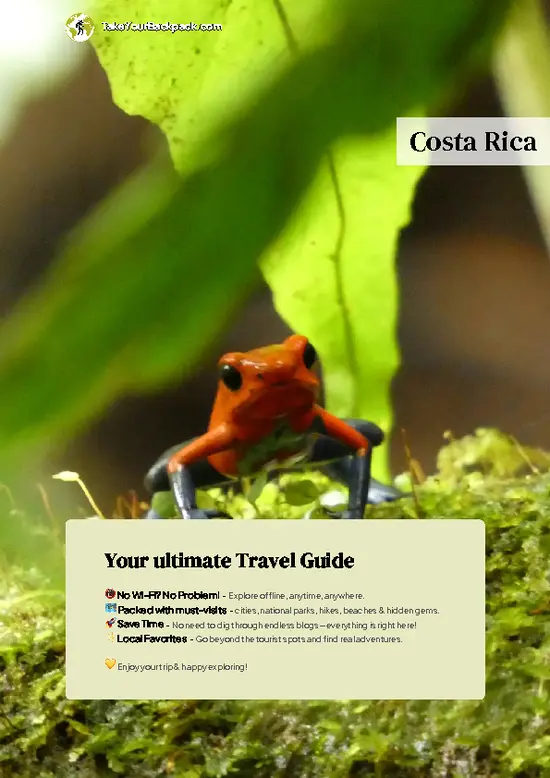
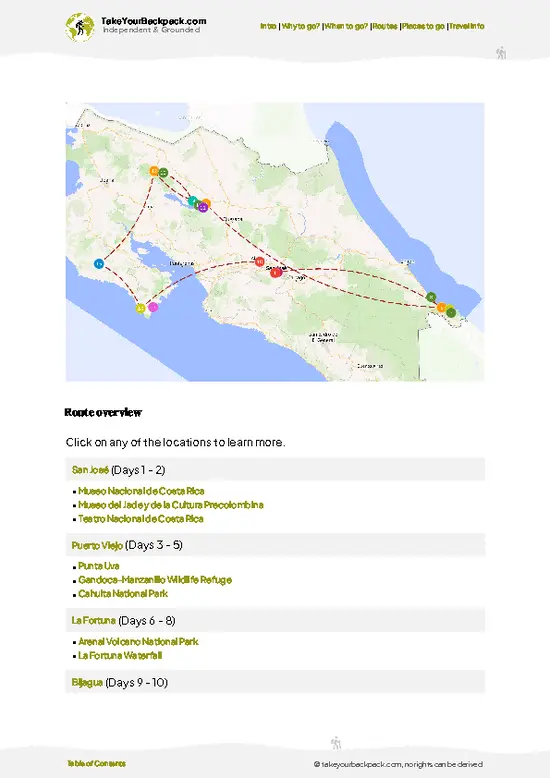
example page 0 from our offline Travel Guide for Costa Rica
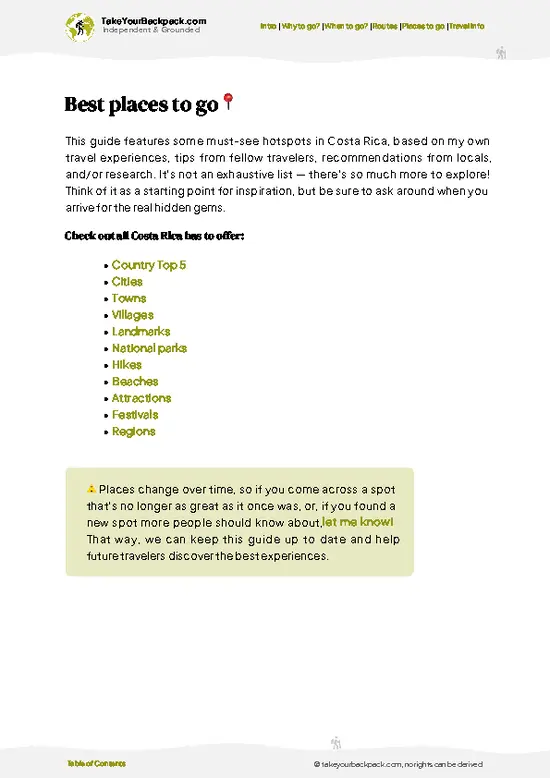
example page 1 from our offline Travel Guide for Costa Rica
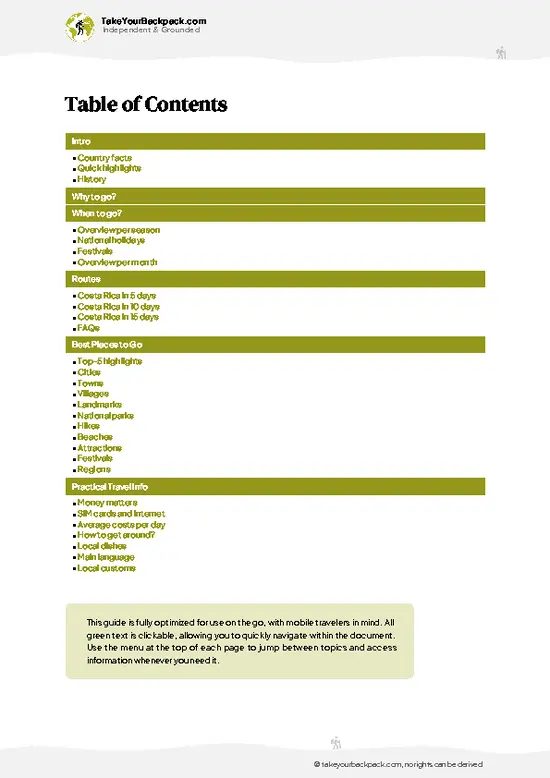
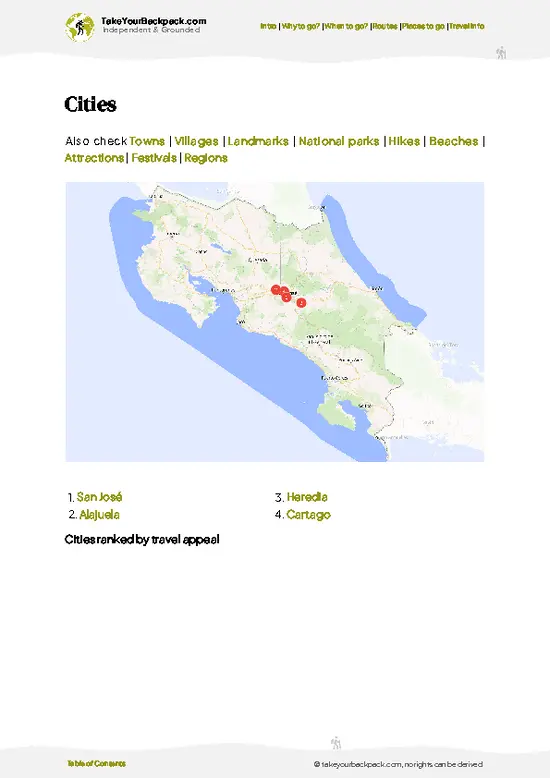
example page 2 from our offline Travel Guide for Costa Rica
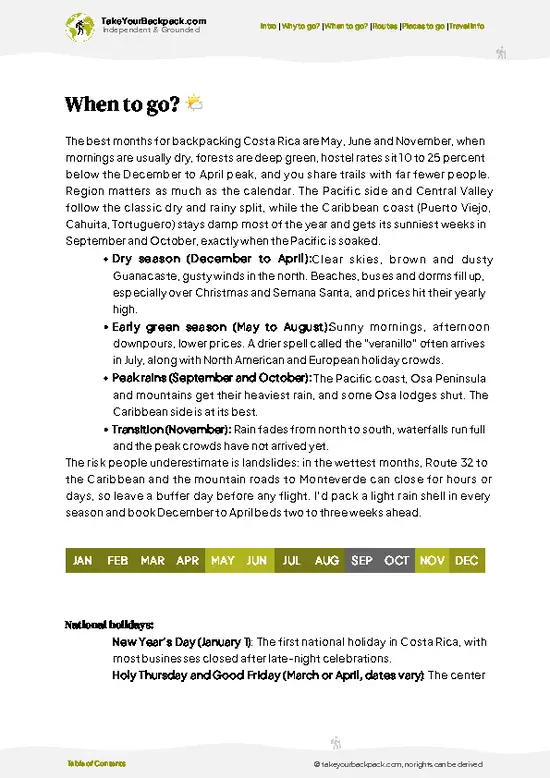
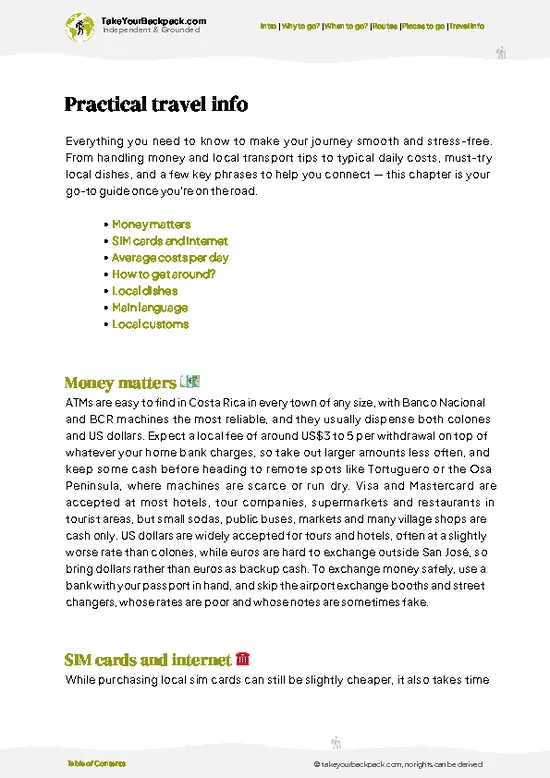
example page 3 from our offline Travel Guide for Costa Rica
example page 4 from our offline Travel Guide for Costa Rica
example page 5 from our offline Travel Guide for Costa Rica
example page 6 from our offline Travel Guide for Costa Rica
example page 7 from our offline Travel Guide for Costa Rica
The digital guide (287 pages) contains:
✅ 90 highlights, ranked by travel appeal
✅ Optimized 5, 10 & 15-day travel routes
✅ Cities, national parks, landmarks, beaches
✅ How to get around
✅ Offline-friendly for travel without Wi-Fi
👉 Click to see all 30+ guide features

📅 Plan smarter in minutes, not weeks
✅ Month by month travel advice
✅ Festivals & national holidays
✅ Budget expectations

🗺️ Go to the right places, skip the overrated ones
✅ Honest pros & cons of destinations
✅ Top hikes, parks & viewpoints
✅ Lesser-known places most travelers miss
✅ Clear “worth it vs skip it” guidance

🛏️ Travel smoothly without rookie mistakes
✅ Best areas to stay
✅ Transport systems explained simply
✅ Common scams & safety advice
✅ SIM cards, money & practical tips

🌍 Understand the country, not just visit it
✅ Culture & traditions
✅ 52 Essential phrases & customs
✅ Festivals worth planning around
✅ Traveler-friendly historical context
✅ Insights that make places more meaningful

📱 Built for real travel conditions
✅ Fully downloadable PDF
✅ Works completely offline
✅ Optimized for phone use
✅ Useful in remote areas & buses
✅ Everything in one place
Stop searching, start planning
Get instant access to your full guide. 30‑day money-back guarantee.
+ Add another guide for just

By proceeding you agree to our terms.
Sent to your inbox immediately after payment • 100% Secure Checkout
Best Backpacking Travel Advisor 2025 tourism awardBest Backpacking
Travel Advisor
2025
What others say about Take Your Backpack Guides:
⭐⭐⭐⭐⭐
Fantastic, amazing amount of information!
⭐⭐⭐⭐⭐
My goodness this is amazing, it's what I've been looking for hats off too you!
⭐⭐⭐⭐⭐
I think this is absolutely BRILLIANT
⭐⭐⭐⭐
Very complete and informative. It's still missing places, but I gotta to commend you
⭐⭐⭐⭐⭐
This is truly amazing, thank you, can't wait to explore it with my kids!
⭐⭐⭐⭐⭐
Awesome resource, thank you!
⭐⭐⭐⭐⭐
This is amazing! Can't wait to explore the ones I haven't seen
⭐⭐⭐⭐
I love this! Well done, great idea.
⭐⭐⭐⭐⭐
Thanks for taking the time to make this gem!
⭐⭐⭐⭐⭐
This might be the best website I've ever seen.
⭐⭐⭐⭐⭐
Congratulations, and thank you so much for your work; it's incredibly valuable.
⭐⭐⭐⭐
In all seriousness I think you did a great job pointing out the important spots
⭐⭐⭐⭐⭐
10/10 very good
⭐⭐⭐⭐⭐
As someone who's only just starting to visit regularly this is awesome, thank you.
⭐⭐⭐⭐
Thank you very much! I'm going to visit my dad, it's going to be very useful!
⭐⭐⭐⭐⭐
This is really cool! We'll be travelling for the first time and this definitely come in handy.
⭐⭐⭐⭐⭐
You are now our minister of culture, congratulations 👨‍💼
⭐⭐⭐⭐⭐
Just wanted to tell you that this is a pearl! Going to follow your recommendations.
⭐⭐⭐⭐⭐
This is so cool. I'll definitely be using the resource for my travels soon.
⭐⭐⭐⭐⭐
This is very impressive! Good work.
⭐⭐⭐⭐⭐
This is an amazing and informative site. Very well done!

🛏️ Where to stay?Where to Stay in Costa Rica

Costa Rica has a dense hostel network, with dorm beds typically running ₡8,000 to 16,000 (about US$15 to 30) a night and private doubles in small guesthouses from roughly US$35 to 60. In the capital, San José, Barrio Escalante is the pick for its restaurants, craft beer bars and safer streets, while Barrio Amón puts you within walking distance of the museums but gets sketchy after dark. Outside the city, La Fortuna sits right by Arenal Volcano and goes quiet by 10 pm, Santa Elena in Monteverde is cool, calm and close to the cloud forest reserves, Puerto Viejo de Talamanca on the Caribbean side has the liveliest reggae and bar scene with more petty theft, and the surf towns of Tamarindo and Santa … read more 👉
Costa Rica has a dense hostel network, with dorm beds typically running ₡8,000 to 16,000 (about US$15 to 30) a night and private doubles in small guesthouses from roughly US$35 to 60. In the capital, San José, Barrio Escalante is the pick for its restaurants, craft beer bars and safer streets, while Barrio Amón puts you within walking distance of the museums but gets sketchy after dark. Outside the city, La Fortuna sits right by Arenal Volcano and goes quiet by 10 pm, Santa Elena in Monteverde is cool, calm and close to the cloud forest reserves, Puerto Viejo de Talamanca on the Caribbean side has the liveliest reggae and bar scene with more petty theft, and the surf towns of Tamarindo and Santa Teresa trade higher prices for beach access and late nights.

If you enjoy meeting fellow travelers, consider choosing hostels with high ratings for atmosphere. On the other hand, if you prefer having your own space, a hotel might be a better option.

Costa RicaMore of Costa Rica

👋 Meet the founderWho’s Behind Take Your Backpack?

Johan, backpacker and founder of TakeYourBackpackHi, I’m Johan (Netherlands 🇳🇱), the creator of TakeYourBackpack. Over the past 3 decades, I’ve backpacked through 90+ countries across six continents, gaining extensive experience with independent travel, long-term trips, and overland routes.

This site is built on a combination of firsthand travel experience and carefully curated insights from other backpackers. Many guides are based on places I’ve personally visited, while others bring together tips, observations, and practical advice shared by trusted travelers I’ve met along the way.

The goal is to provide realistic, experience-driven guidance — not generic itineraries — so you can explore destinations with better context, clearer expectations, and more confidence.