×

Costa Rica🇨🇷 | best landmarksWhere to Find the 3 Best landmarks in Costa Rica

Landmarks in Costa Rica are mostly natural, and that shapes everything about visiting them. Volcano craters smell of sulfur and wet stone, cloud forest drips under mossy branches, and Pacific beaches hum with howler monkeys at dawn. Man-made sights are few, so you plan around terrain and weather. The Central Valley and the north are easy, with paved roads, shuttles and busy car parks. The Caribbean coast is slower, humid and cheaper. The Osa Peninsula demands rough roads, guides and patience. For backpacking or independent travel, pick the region that matches your budget and tolerance for mud.

By Johan Kruseman 🇳🇱 | Updated October 23, 2026
Explore the best national parks in Costa Rica

Why go?Why Travelers Love These Spots

Costa Rica packs an unusual range of terrain into a country about the size of West Virginia. A volcanic spine runs from the northwest to the center, with both Pacific and Caribbean slopes within a few hours of each other. That means steaming craters, dripping cloud forest and dry-forest coastline can sit in one trip, each with its own sounds and smells: sulfur vents, wet soil, cicadas at midday, frogs after dark.

The country abolished its army in 1948 and channeled money into national parks, and roughly a quarter of the land is protected. Parks have ranger stations, marked trails and set entry fees, so independent visits are easy. The tradeoff is that there are few historic monuments. Pre-Columbian sites exist but are modest, and colonial architecture is thin because of earthquakes and a … read more 👉
Costa Rica packs an unusual range of terrain into a country about the size of West Virginia. A volcanic spine runs from the northwest to the center, with both Pacific and Caribbean slopes within a few hours of each other. That means steaming craters, dripping cloud forest and dry-forest coastline can sit in one trip, each with its own sounds and smells: sulfur vents, wet soil, cicadas at midday, frogs after dark.

The country abolished its army in 1948 and channeled money into national parks, and roughly a quarter of the land is protected. Parks have ranger stations, marked trails and set entry fees, so independent visits are easy. The tradeoff is that there are few historic monuments. Pre-Columbian sites exist but are modest, and colonial architecture is thin because of earthquakes and a poor colonial economy.

Before choosing Costa Rica, know that weather controls access. Afternoon rain turns trails to slick red clay, and clouds often hide crater views by late morning. Many parks cap daily visitors or require advance tickets and, in places, a licensed guide. Costs run higher than elsewhere in Central America, so budget with that in mind.
How the List Was Created
The list of best unique sites in Costa Rica is created based on history or culture, wow factor, atmosphere, quirks, and memorability. If you feel a unique site is missing in this list, please let us know.

When to go?When to Plan Your Trip

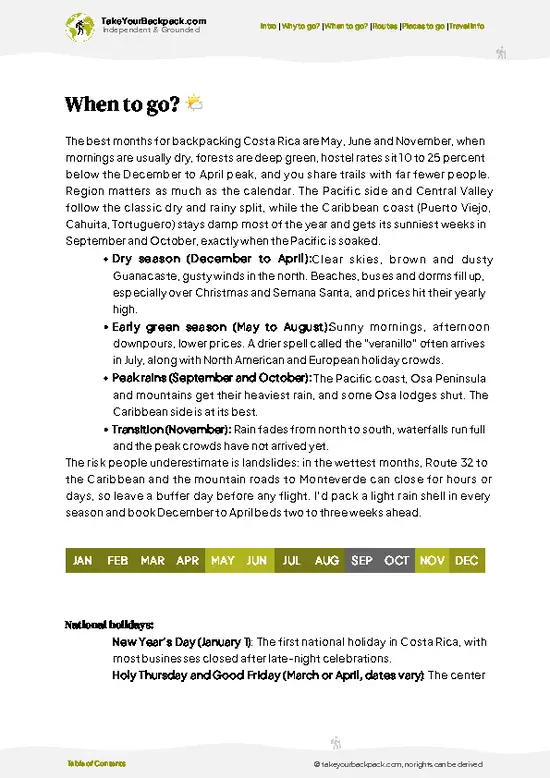
Best months: The best months for landmarks are December to April, when the Pacific side is dry, skies are clear in the morning and trails are firm underfoot. Temperatures sit around 28 to 33°C (82 to 91°F) on the lowlands and 15 to 22°C (59 to 72°F) in the highlands, where nights turn properly cold at volcano elevations.

Shoulder and green season: May to June and November are the shoulder months. Mornings are usually bright, with downpours arriving between 1 and 4 p.m., and lodging is often 20 to 40 percent cheaper than in peak season. From August to October the Pacific and highlands get the heaviest rain, often 250 to 400 mm a month, and some dirt roads and river crossings become unreliable, especially around the Osa Peninsula. Crowds thin out, but views can disappear into cloud.

Regional … read more 👉
Best months: The best months for landmarks are December to April, when the Pacific side is dry, skies are clear in the morning and trails are firm underfoot. Temperatures sit around 28 to 33°C (82 to 91°F) on the lowlands and 15 to 22°C (59 to 72°F) in the highlands, where nights turn properly cold at volcano elevations.

Shoulder and green season: May to June and November are the shoulder months. Mornings are usually bright, with downpours arriving between 1 and 4 p.m., and lodging is often 20 to 40 percent cheaper than in peak season. From August to October the Pacific and highlands get the heaviest rain, often 250 to 400 mm a month, and some dirt roads and river crossings become unreliable, especially around the Osa Peninsula. Crowds thin out, but views can disappear into cloud.

Regional differences: The Caribbean coast runs on its own calendar. Its driest spells are February to April and September to October, while December and January can be soaked. Northwest Guanacaste is the driest region, hot and dusty by March. Peak weeks around Christmas, New Year and Easter fill popular parks, so reserve tickets and beds well ahead.

unique site hoppingOptimizing Your Multi-Stop Itinerary

How many days: A trip combining several landmarks in Costa Rica needs 10 to 14 days, because distances look short on a map but roads are slow, winding and often wet.

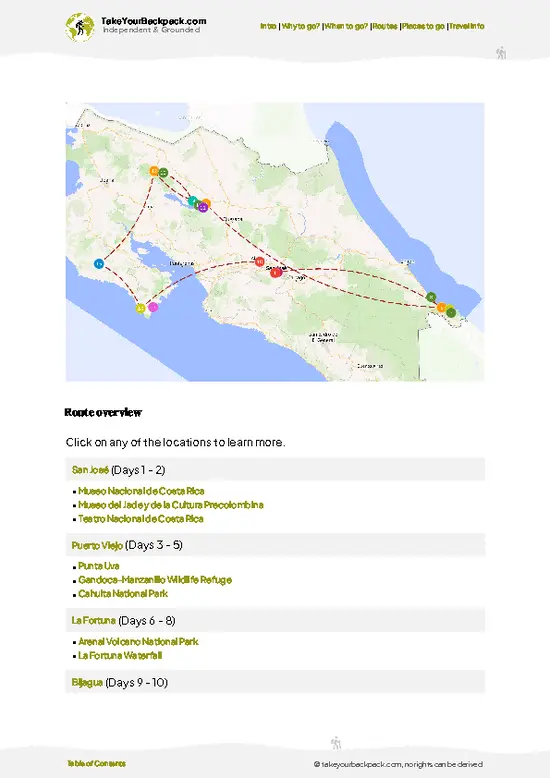
Regions and direction: Start in San José, the transport hub, and group stops by region: Central Valley and the north (La Fortuna, Monteverde), then the Pacific coast, then the south or Osa. Moving in one loop avoids doubling back. Going north first, then down the Pacific, suits most itineraries, finishing with the Caribbean only if you have a full extra week, since it sits on a separate road corridor.

Allow 1 to 2 days per stop. Volcano and cloud forest visits are best done early, before cloud closes in, so an overnight nearby beats a day trip. Typical transfers run 3 to 5 hours between major regions, with San José to the Osa … read more 👉
How many days: A trip combining several landmarks in Costa Rica needs 10 to 14 days, because distances look short on a map but roads are slow, winding and often wet.

Regions and direction: Start in San José, the transport hub, and group stops by region: Central Valley and the north (La Fortuna, Monteverde), then the Pacific coast, then the south or Osa. Moving in one loop avoids doubling back. Going north first, then down the Pacific, suits most itineraries, finishing with the Caribbean only if you have a full extra week, since it sits on a separate road corridor.

Allow 1 to 2 days per stop. Volcano and cloud forest visits are best done early, before cloud closes in, so an overnight nearby beats a day trip. Typical transfers run 3 to 5 hours between major regions, with San José to the Osa gateway closer to 7 to 8 hours on the road, and San José to Puerto Viejo on the Caribbean about 4.5 to 5.5 hours. Shared shuttles and public buses cover the main routes.

Planning mistakes: The classic error is cramming three regions into a week. Mountain roads slow to 30 to 40 km/h, rain washes out sections, and afternoon downpours erase any time cushion. Instead, cut one region, travel in the morning and keep a spare day near the end.

The ListMust-Visit landmarks in Costa Rica

1 La Fortuna Waterfall

500 steps, 70-meter drop, spray-soaked base, Arenal backdrop

Descend the forest stairway to the foot of a roaring plume, then swim the calm edge of its cool basin.

costa-rica-unique-site-la-fortuna-waterfall
© Google | T Khan

2 Cerro de la Muerte

Pan-American high point, páramo, dwarf bamboo, quetzal valley

Pull over at about 3,335 meters to walk spongy highland ground, then drop toward cloud forest where quetzals feed on wild avocados.

costa-rica-unique-site-cerro-de-la-muerte
© Google | Ana Lau Fdz

3 Bijagual Waterfall

180-meter plunge, mossy basalt wall, muddy forest trail, Turrubares hills

Follow a muddy trail across shallow fords to a tall cascade, then wade the cool green pool beneath its mist-soaked wall.

Loading the map 🌍

Expert viewWhat You Should Know

How many to visit: Plan on four to six landmarks in a two-week trip. Fewer leaves unused time, while more means spending your days in vans instead of on trails. Each major park needs a full morning at minimum, and the heat, humidity and slick clay wear you down faster than the mileage suggests.

Which kind to prioritize: Costa Rica rewards natural landmarks far more than built ones, so spend most of your time and money there. First-timers with limited days should pick one volcano, one cloud forest and one coastal park. Budget travelers can skip the paid add-ons around the famous crater areas, such as hot spring resorts charging US$40 to 90, and use free public river spots or modest local pools at US$5 to 15 instead. Wildlife-focused travelers should put a remote rainforest park first, because … read more 👉
How many to visit: Plan on four to six landmarks in a two-week trip. Fewer leaves unused time, while more means spending your days in vans instead of on trails. Each major park needs a full morning at minimum, and the heat, humidity and slick clay wear you down faster than the mileage suggests.

Which kind to prioritize: Costa Rica rewards natural landmarks far more than built ones, so spend most of your time and money there. First-timers with limited days should pick one volcano, one cloud forest and one coastal park. Budget travelers can skip the paid add-ons around the famous crater areas, such as hot spring resorts charging US$40 to 90, and use free public river spots or modest local pools at US$5 to 15 instead. Wildlife-focused travelers should put a remote rainforest park first, because dense forest hides animals and a guide spots what your eyes miss. Anyone interested in history should treat the pre-Columbian sites as short, inexpensive stops of an hour or two, and not a reason to cross the country.

What it costs: Expect US$50 to 90 a day for a backpacker doing a landmark-heavy itinerary, covering a hostel dorm at US$12 to 25, meals at local sodas for US$5 to 10 and transport. Entry to national parks is usually US$10 to 20 for foreigners, with premium sites such as Corcovado around US$30 plus a required guide. Guides run US$30 to 80 per person on group tours. A shuttle between regions costs US$40 to 60, while public buses are far cheaper at US$3 to 12 but slower. Book ranger-controlled parks online before arrival, as daily caps sell out in high season.

Safety and etiquette: Hazards here are mostly natural. Rip currents kill more visitors than anything else, so swim only where lifeguards or locals do. Stay on marked trails near crater rims, where gas and sudden collapses are real risks, and obey closures when ranger flags go up. Wet trails are slick, so wear shoes with grip. Never feed or touch wildlife, and keep distance from snakes and crocodiles near river mouths. Petty theft from parked rental cars at trailheads is common, so leave nothing visible and use attended lots, which usually cost US$3 to 5. Carry some colones for small park cafes and rural entry booths, and greet staff with a friendly “pura vida,” which goes a long way.

✈️ The backpacker research shortcutCosta Rica Travel Guide

An offline-friendly backpacking guide with optimized travel routes, ranked highlights, transport advice, and the best areas to stay.
example page 0 from our offline Travel Guide for Costa Rica
example page 1 from our offline Travel Guide for Costa Rica
example page 2 from our offline Travel Guide for Costa Rica
example page 3 from our offline Travel Guide for Costa Rica
example page 4 from our offline Travel Guide for Costa Rica
example page 5 from our offline Travel Guide for Costa Rica
example page 6 from our offline Travel Guide for Costa Rica
example page 7 from our offline Travel Guide for Costa Rica
The digital guide (287 pages) contains:
✅ 90 highlights, ranked by travel appeal
✅ Optimized 5, 10 & 15-day travel routes
✅ Cities, national parks, landmarks, beaches
✅ How to get around
✅ Offline-friendly for travel without Wi-Fi
👉 Click to see all 30+ guide features

📅 Plan smarter in minutes, not weeks
✅ Month by month travel advice
✅ Festivals & national holidays
✅ Budget expectations

🗺️ Go to the right places, skip the overrated ones
✅ Honest pros & cons of destinations
✅ Top hikes, parks & viewpoints
✅ Lesser-known places most travelers miss
✅ Clear “worth it vs skip it” guidance

🛏️ Travel smoothly without rookie mistakes
✅ Best areas to stay
✅ Transport systems explained simply
✅ Common scams & safety advice
✅ SIM cards, money & practical tips

🌍 Understand the country, not just visit it
✅ Culture & traditions
✅ 52 Essential phrases & customs
✅ Festivals worth planning around
✅ Traveler-friendly historical context
✅ Insights that make places more meaningful

📱 Built for real travel conditions
✅ Fully downloadable PDF
✅ Works completely offline
✅ Optimized for phone use
✅ Useful in remote areas & buses
✅ Everything in one place
Stop searching, start planning
Get instant access to your full guide. 30‑day money-back guarantee.
+ Add another guide for just

By proceeding you agree to our terms.
Sent to your inbox immediately after payment • 100% Secure Checkout
Best Backpacking Travel Advisor 2025 tourism awardBest Backpacking
Travel Advisor
2025
What others say about Take Your Backpack Guides:
⭐⭐⭐⭐⭐
Fantastic, amazing amount of information!
⭐⭐⭐⭐⭐
My goodness this is amazing, it's what I've been looking for hats off too you!
⭐⭐⭐⭐⭐
I think this is absolutely BRILLIANT
⭐⭐⭐⭐
Very complete and informative. It's still missing places, but I gotta to commend you
⭐⭐⭐⭐⭐
This is truly amazing, thank you, can't wait to explore it with my kids!
⭐⭐⭐⭐⭐
Awesome resource, thank you!
⭐⭐⭐⭐⭐
This is amazing! Can't wait to explore the ones I haven't seen
⭐⭐⭐⭐
I love this! Well done, great idea.
⭐⭐⭐⭐⭐
Thanks for taking the time to make this gem!
⭐⭐⭐⭐⭐
This might be the best website I've ever seen.
⭐⭐⭐⭐⭐
Congratulations, and thank you so much for your work; it's incredibly valuable.
⭐⭐⭐⭐
In all seriousness I think you did a great job pointing out the important spots
⭐⭐⭐⭐⭐
10/10 very good
⭐⭐⭐⭐⭐
As someone who's only just starting to visit regularly this is awesome, thank you.
⭐⭐⭐⭐
Thank you very much! I'm going to visit my dad, it's going to be very useful!
⭐⭐⭐⭐⭐
This is really cool! We'll be travelling for the first time and this definitely come in handy.
⭐⭐⭐⭐⭐
You are now our minister of culture, congratulations 👨‍💼
⭐⭐⭐⭐⭐
Just wanted to tell you that this is a pearl! Going to follow your recommendations.
⭐⭐⭐⭐⭐
This is so cool. I'll definitely be using the resource for my travels soon.
⭐⭐⭐⭐⭐
This is very impressive! Good work.
⭐⭐⭐⭐⭐
This is an amazing and informative site. Very well done!

🛏️ Where to stay?Accommodation Highlights

Costa Rica has a dense hostel network, with dorm beds typically running ₡8,000 to 16,000 (about US$15 to 30) a night and private doubles in small guesthouses from roughly US$35 to 60. In the capital, San José, Barrio Escalante is the pick for its restaurants, craft beer bars and safer streets, while Barrio Amón puts you within walking distance of the museums but gets sketchy after dark. Outside the city, La Fortuna sits right by Arenal Volcano and goes quiet by 10 pm, Santa Elena in Monteverde is cool, calm and close to the cloud forest reserves, Puerto Viejo de Talamanca on the Caribbean side has the liveliest reggae and bar scene with more petty theft, and the surf towns of Tamarindo and Santa … read more 👉
Costa Rica has a dense hostel network, with dorm beds typically running ₡8,000 to 16,000 (about US$15 to 30) a night and private doubles in small guesthouses from roughly US$35 to 60. In the capital, San José, Barrio Escalante is the pick for its restaurants, craft beer bars and safer streets, while Barrio Amón puts you within walking distance of the museums but gets sketchy after dark. Outside the city, La Fortuna sits right by Arenal Volcano and goes quiet by 10 pm, Santa Elena in Monteverde is cool, calm and close to the cloud forest reserves, Puerto Viejo de Talamanca on the Caribbean side has the liveliest reggae and bar scene with more petty theft, and the surf towns of Tamarindo and Santa Teresa trade higher prices for beach access and late nights.

If you enjoy meeting fellow travelers, consider choosing hostels with high ratings for atmosphere. On the other hand, if you prefer having your own space, a hotel might be a better option.

Costa RicaSee More of Costa Rica

👋 Meet the founderWho’s Behind Take Your Backpack?

Johan, backpacker and founder of TakeYourBackpackHi, I’m Johan (Netherlands 🇳🇱), the creator of TakeYourBackpack. Over the past 3 decades, I’ve backpacked through 90+ countries across six continents, gaining extensive experience with independent travel, long-term trips, and overland routes.

This site is built on a combination of firsthand travel experience and carefully curated insights from other backpackers. Many guides are based on places I’ve personally visited, while others bring together tips, observations, and practical advice shared by trusted travelers I’ve met along the way.

The goal is to provide realistic, experience-driven guidance — not generic itineraries — so you can explore destinations with better context, clearer expectations, and more confidence.