×

Costa Rica🇨🇷 | best citiesWhere to Find the 4 Best cities in Costa Rica

Costa Rica’s cities are working towns more than showpieces: corrugated roofs drumming under afternoon downpours, bus exhaust, fried plantain and coffee smells drifting from sodas (small family diners). The Central Valley sits at 900 to 1,200 meters, so mornings are cool, traffic is thick and prices run higher. The Caribbean coast is humid, slower and rhythmed by reggae and rain. The Pacific side and Guanacaste are hot, dusty in the dry season and tourist-priced. For backpacking or independent travel, the choice comes down to whether you want easy bus connections, beach heat, or a rawer, quieter feel.

By Johan Kruseman 🇳🇱 | Updated October 23, 2026
Explore the best towns in Costa Rica

Why go?Why Travelers Love These Spots

Costa Rica has no single great urban center in the way Mexico or Peru do. It abolished its army in 1948 and put money into schools, clinics and roads, so towns are compact, safe by regional standards and easy to read, but they grew from coffee and banana wealth rather than colonial grandeur. Earthquakes and volcanic ash flattened much of the old adobe, which is why concrete, tin and low rooflines dominate and few historic façades survive.

Geography drives everything. Mountain ranges split the country into distinct climate zones within a few hours of each other: cool highland valleys, steamy Caribbean lowlands, and a hot, seasonally parched Pacific northwest. Most of the population lives in the Central Valley, so that is where you find markets, museums, universities and real nightlife. Elsewhere, … read more 👉
Costa Rica has no single great urban center in the way Mexico or Peru do. It abolished its army in 1948 and put money into schools, clinics and roads, so towns are compact, safe by regional standards and easy to read, but they grew from coffee and banana wealth rather than colonial grandeur. Earthquakes and volcanic ash flattened much of the old adobe, which is why concrete, tin and low rooflines dominate and few historic façades survive.

Geography drives everything. Mountain ranges split the country into distinct climate zones within a few hours of each other: cool highland valleys, steamy Caribbean lowlands, and a hot, seasonally parched Pacific northwest. Most of the population lives in the Central Valley, so that is where you find markets, museums, universities and real nightlife. Elsewhere, towns serve as bus hubs, supply stops and gateways to cloud forest, volcanoes and beaches.

Before choosing Costa Rica for its cities, know that prices are the highest in Central America, often close to US levels for tours and food outside sodas. Sidewalks are narrow and broken, street addresses use landmarks instead of numbers, and the rain can turn a walk into a wade. Come for the rhythm of daily life, not for monuments.
Our Approach to Ranking
The list of best cities in Costa Rica is created based on culture, vibe, attractions, transport ease, and local charm. If you feel a city is missing in this list, please let us know.

When to go?When to Plan Your Trip

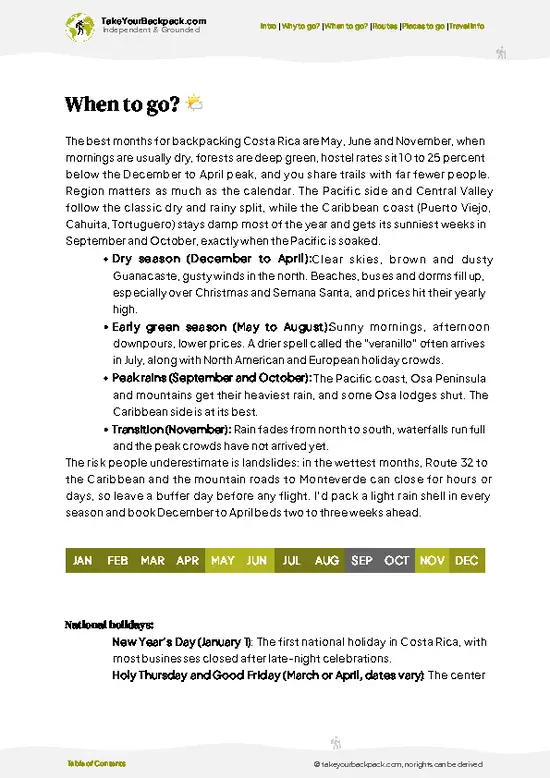
Best months and the dry season: The best months for cities in Costa Rica are December to April, when the Pacific side and the Central Valley get little or no rain, skies are clear and blue by 6 a.m., and streets stay dry enough for long walks. Valley days reach 24 to 28°C with cool nights around 15 to 17°C, while Guanacaste and the Pacific coast climb to 32 to 35°C with dust on the roads.
Green season and shoulder months: From May to November, afternoon storms arrive almost daily, typically from 1 to 3 p.m., with the heaviest rain in September and October. Mornings are often bright, so plan sightseeing early and keep the afternoon for museums and cafes. Rainfall in the Central Valley runs roughly 1,800 to 2,500 mm a year, mostly in this season. May, June and November are good shoulder months, … read more 👉
Best months and the dry season: The best months for cities in Costa Rica are December to April, when the Pacific side and the Central Valley get little or no rain, skies are clear and blue by 6 a.m., and streets stay dry enough for long walks. Valley days reach 24 to 28°C with cool nights around 15 to 17°C, while Guanacaste and the Pacific coast climb to 32 to 35°C with dust on the roads.
Green season and shoulder months: From May to November, afternoon storms arrive almost daily, typically from 1 to 3 p.m., with the heaviest rain in September and October. Mornings are often bright, so plan sightseeing early and keep the afternoon for museums and cafes. Rainfall in the Central Valley runs roughly 1,800 to 2,500 mm a year, mostly in this season. May, June and November are good shoulder months, with fewer visitors and hotel prices often 20 to 40 percent below peak.
Caribbean side and peak periods: The Caribbean coast follows its own calendar. It is wet nearly year-round, but February to April and September to October tend to be drier. Peak crowding and top prices fall over Christmas, New Year and Semana Santa (Holy Week), when locals fill buses and beach towns, and rooms need booking weeks ahead.

city hoppingOptimizing Your Multi-Stop Itinerary

How long a multi-city trip takes: A trip linking several cities in Costa Rica needs 10 to 14 days, and 7 days is the practical minimum for two regions. Distances look short on a map but roads are winding, single-lane in places and slowed by trucks, landslides in the wet season and one-hour jams around the capital.
Regions and direction: Start in the Central Valley, where San José is the main bus and airport hub, then fan out in one loop instead of zigzagging. A sensible direction runs from the valley to the Caribbean (3 to 4 hours by bus), back through the valley, then northwest to Guanacaste or southwest to the Pacific coast (4 to 6 hours by bus). Allow 2 to 3 nights per stop. Fewer than two nights means you spend the whole time on a bus seat that smells of diesel and damp backpacks.
Planning … read more 👉
How long a multi-city trip takes: A trip linking several cities in Costa Rica needs 10 to 14 days, and 7 days is the practical minimum for two regions. Distances look short on a map but roads are winding, single-lane in places and slowed by trucks, landslides in the wet season and one-hour jams around the capital.
Regions and direction: Start in the Central Valley, where San José is the main bus and airport hub, then fan out in one loop instead of zigzagging. A sensible direction runs from the valley to the Caribbean (3 to 4 hours by bus), back through the valley, then northwest to Guanacaste or southwest to the Pacific coast (4 to 6 hours by bus). Allow 2 to 3 nights per stop. Fewer than two nights means you spend the whole time on a bus seat that smells of diesel and damp backpacks.
Planning mistakes: The classic error is cramming three regions into five days. Do fewer and go deeper. Another is relying on afternoon buses, when rain slows the roads and the light fades by 5:30 p.m. all year, since Costa Rica sits near the equator. Take morning departures. Finally, travelers skip booking the popular shuttle and bus seats during Holy Week and Christmas. Reserve ahead, or use the public buses from the main terminals and arrive early.

The ListMust-Visit cities in Costa Rica

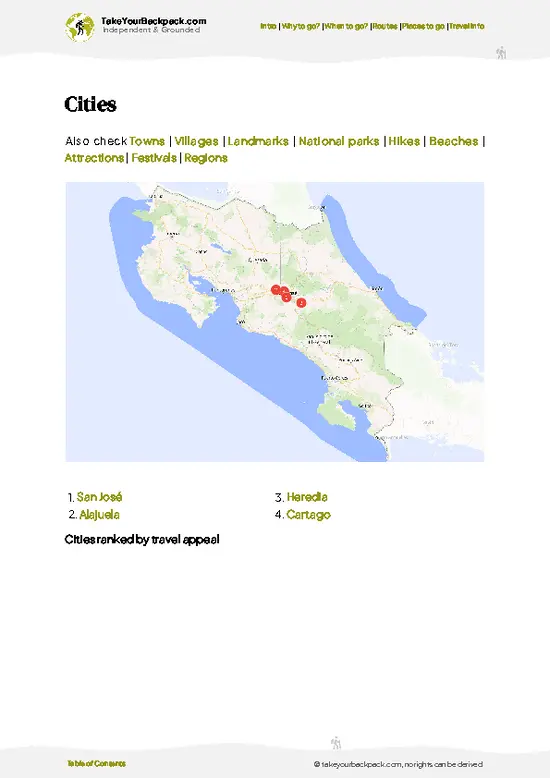
1 San José

Gold and jade museums, opera house, Barrio Escalante, market casados

Pack in museums, a marble-lobbied theater and a central market lunch, then finish with craft beer and coffee in Escalante.

costa-rica-city-san-jose
© Google | David Phipps

2 Alajuela

Airport-adjacent, mango-tree plaza, Saturday farmers’ market, early-closing nights

Spend an easy first or last night beside a red-domed cathedral, with market breakfasts, cheap sodas and a plaza that empties after dark.

costa-rica-city-alajuela
© Google |

3 Heredia

Stone Fortín tower, coffee-scented plaza, university crowd, calm grid

Wander a shaded plaza between an 1797 basilica and a squat stone tower, then eat a casado at the central market.

costa-rica-city-heredia
© Google |

4 Cartago

Pilgrimage basilica, roofless church ruins, La Negrita spring, drizzly highlands

Stop for a half day to walk through a carved-wood basilica, an unfinished stone church turned garden and a market lunch.

costa-rica-city-cartago
© Google |
Loading the map 🌍

Expert viewWhat You Should Know

How many cities to visit: Three to four is the right number for a trip of two weeks, and two is plenty for a week. Costa Rican cities are not packed with sights, so the pleasure comes from slowing down: market stalls with mango and cheese, coffee at a counter, the sound of motorbikes and church bells at dusk. Rushing through six places leaves you with six bus terminals and little else.
Which kind to prioritize: If you want culture and nightlife, give your time to the Central Valley, where museums, markets and universities sit within a short bus ride. If you want beach life with a town feel, pick one Pacific or Guanacaste base and stay put. If you want something rougher and more local, one Caribbean stop is worth the long ride and the humidity. Skip trying to see all three regions in a single … read more 👉
How many cities to visit: Three to four is the right number for a trip of two weeks, and two is plenty for a week. Costa Rican cities are not packed with sights, so the pleasure comes from slowing down: market stalls with mango and cheese, coffee at a counter, the sound of motorbikes and church bells at dusk. Rushing through six places leaves you with six bus terminals and little else.
Which kind to prioritize: If you want culture and nightlife, give your time to the Central Valley, where museums, markets and universities sit within a short bus ride. If you want beach life with a town feel, pick one Pacific or Guanacaste base and stay put. If you want something rougher and more local, one Caribbean stop is worth the long ride and the humidity. Skip trying to see all three regions in a single week. Worth your time are a central market, a free walk through a town park, and a day at a coffee farm. Not worth it are paying for tours in the capital itself when a bus to the nearest volcano or farm costs a fraction.
What it costs: Budget US$45 to 70 a day as a backpacker: a dorm bed at US$12 to 20, a casado (rice, beans, meat, salad) at a soda for US$5 to 8, local buses at US$1 to 12 per leg depending on distance. Private rooms run US$35 to 60. Museum entry usually costs US$5 to 12, a guided coffee tour US$35 to 50, and a good half-day city walking tour US$20 to 40. Shuttles cost US$45 to 70 between regions. Eating at sodas instead of tourist restaurants can cut daily costs by a third.
Safety and culture: Costa Rica is relatively safe, but petty theft is the real issue. Phones and bags vanish on crowded buses, in markets and on the beach. Keep valuables in a front pocket, leave nothing visible in a parked car, and take licensed red taxis or ride apps after dark in larger cities. Streets in some capital districts feel rough after sunset, so walk with purpose and stay in lit areas. Locals greet with “Pura vida” and expect politeness, a “buenos días” when entering a shop, and patience with slow service. Dress modestly in churches. Carry a photocopy of your passport, a rain jacket and small bills, since vendors often cannot break US$50 or 20,000 colón notes.

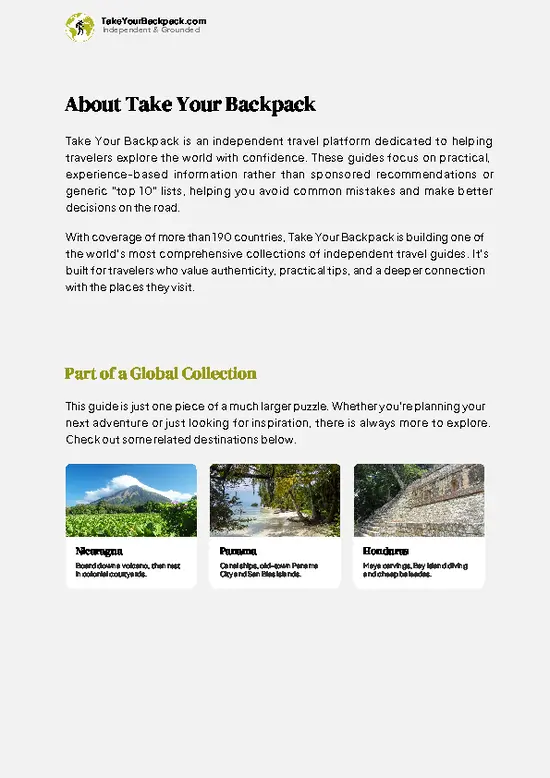
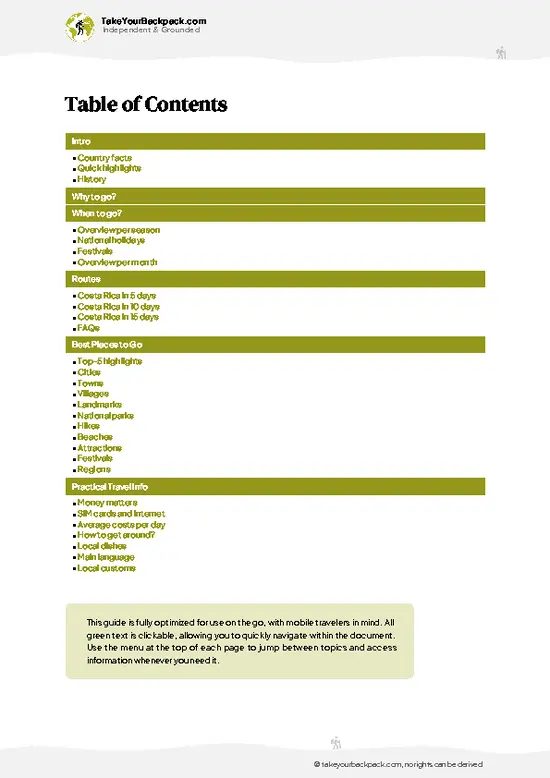
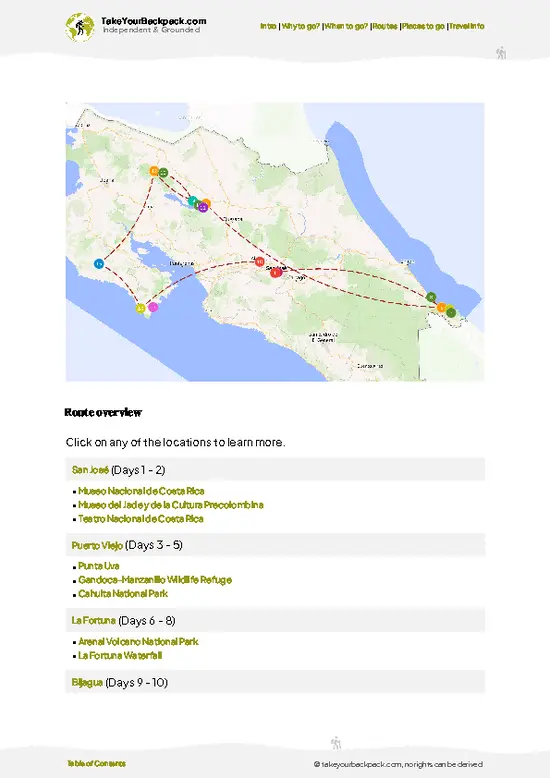
✈️ The backpacker research shortcutCosta Rica Travel Guide

An offline-friendly backpacking guide with optimized travel routes, ranked highlights, transport advice, and the best areas to stay.
example page 0 from our offline Travel Guide for Costa Rica
example page 1 from our offline Travel Guide for Costa Rica
example page 2 from our offline Travel Guide for Costa Rica
example page 3 from our offline Travel Guide for Costa Rica
example page 4 from our offline Travel Guide for Costa Rica
example page 5 from our offline Travel Guide for Costa Rica
example page 6 from our offline Travel Guide for Costa Rica
example page 7 from our offline Travel Guide for Costa Rica
The digital guide (287 pages) contains:
✅ 90 highlights, ranked by travel appeal
✅ Optimized 5, 10 & 15-day travel routes
✅ Cities, national parks, landmarks, beaches
✅ How to get around
✅ Offline-friendly for travel without Wi-Fi
👉 Click to see all 30+ guide features

📅 Plan smarter in minutes, not weeks
✅ Month by month travel advice
✅ Festivals & national holidays
✅ Budget expectations

🗺️ Go to the right places, skip the overrated ones
✅ Honest pros & cons of destinations
✅ Top hikes, parks & viewpoints
✅ Lesser-known places most travelers miss
✅ Clear “worth it vs skip it” guidance

🛏️ Travel smoothly without rookie mistakes
✅ Best areas to stay
✅ Transport systems explained simply
✅ Common scams & safety advice
✅ SIM cards, money & practical tips

🌍 Understand the country, not just visit it
✅ Culture & traditions
✅ 52 Essential phrases & customs
✅ Festivals worth planning around
✅ Traveler-friendly historical context
✅ Insights that make places more meaningful

📱 Built for real travel conditions
✅ Fully downloadable PDF
✅ Works completely offline
✅ Optimized for phone use
✅ Useful in remote areas & buses
✅ Everything in one place
Stop searching, start planning
Get instant access to your full guide. 30‑day money-back guarantee.
+ Add another guide for just

By proceeding you agree to our terms.
Sent to your inbox immediately after payment • 100% Secure Checkout
Best Backpacking Travel Advisor 2025 tourism awardBest Backpacking
Travel Advisor
2025
What others say about Take Your Backpack Guides:
⭐⭐⭐⭐⭐
Fantastic, amazing amount of information!
⭐⭐⭐⭐⭐
My goodness this is amazing, it's what I've been looking for hats off too you!
⭐⭐⭐⭐⭐
I think this is absolutely BRILLIANT
⭐⭐⭐⭐
Very complete and informative. It's still missing places, but I gotta to commend you
⭐⭐⭐⭐⭐
This is truly amazing, thank you, can't wait to explore it with my kids!
⭐⭐⭐⭐⭐
Awesome resource, thank you!
⭐⭐⭐⭐⭐
This is amazing! Can't wait to explore the ones I haven't seen
⭐⭐⭐⭐
I love this! Well done, great idea.
⭐⭐⭐⭐⭐
Thanks for taking the time to make this gem!
⭐⭐⭐⭐⭐
This might be the best website I've ever seen.
⭐⭐⭐⭐⭐
Congratulations, and thank you so much for your work; it's incredibly valuable.
⭐⭐⭐⭐
In all seriousness I think you did a great job pointing out the important spots
⭐⭐⭐⭐⭐
10/10 very good
⭐⭐⭐⭐⭐
As someone who's only just starting to visit regularly this is awesome, thank you.
⭐⭐⭐⭐
Thank you very much! I'm going to visit my dad, it's going to be very useful!
⭐⭐⭐⭐⭐
This is really cool! We'll be travelling for the first time and this definitely come in handy.
⭐⭐⭐⭐⭐
You are now our minister of culture, congratulations 👨‍💼
⭐⭐⭐⭐⭐
Just wanted to tell you that this is a pearl! Going to follow your recommendations.
⭐⭐⭐⭐⭐
This is so cool. I'll definitely be using the resource for my travels soon.
⭐⭐⭐⭐⭐
This is very impressive! Good work.
⭐⭐⭐⭐⭐
This is an amazing and informative site. Very well done!

🛏️ Where to stay?Top Areas to Stay

Costa Rica has a dense hostel network, with dorm beds typically running ₡8,000 to 16,000 (about US$15 to 30) a night and private doubles in small guesthouses from roughly US$35 to 60. In the capital, San José, Barrio Escalante is the pick for its restaurants, craft beer bars and safer streets, while Barrio Amón puts you within walking distance of the museums but gets sketchy after dark. Outside the city, La Fortuna sits right by Arenal Volcano and goes quiet by 10 pm, Santa Elena in Monteverde is cool, calm and close to the cloud forest reserves, Puerto Viejo de Talamanca on the Caribbean side has the liveliest reggae and bar scene with more petty theft, and the surf towns of Tamarindo and Santa … read more 👉
Costa Rica has a dense hostel network, with dorm beds typically running ₡8,000 to 16,000 (about US$15 to 30) a night and private doubles in small guesthouses from roughly US$35 to 60. In the capital, San José, Barrio Escalante is the pick for its restaurants, craft beer bars and safer streets, while Barrio Amón puts you within walking distance of the museums but gets sketchy after dark. Outside the city, La Fortuna sits right by Arenal Volcano and goes quiet by 10 pm, Santa Elena in Monteverde is cool, calm and close to the cloud forest reserves, Puerto Viejo de Talamanca on the Caribbean side has the liveliest reggae and bar scene with more petty theft, and the surf towns of Tamarindo and Santa Teresa trade higher prices for beach access and late nights.

If you enjoy meeting fellow travelers, consider choosing hostels with high ratings for atmosphere. On the other hand, if you prefer having your own space, a hotel might be a better option.

Costa RicaDiscover the Country

👋 Meet the founderWho’s Behind Take Your Backpack?

Johan, backpacker and founder of TakeYourBackpackHi, I’m Johan (Netherlands 🇳🇱), the creator of TakeYourBackpack. Over the past 3 decades, I’ve backpacked through 90+ countries across six continents, gaining extensive experience with independent travel, long-term trips, and overland routes.

This site is built on a combination of firsthand travel experience and carefully curated insights from other backpackers. Many guides are based on places I’ve personally visited, while others bring together tips, observations, and practical advice shared by trusted travelers I’ve met along the way.

The goal is to provide realistic, experience-driven guidance — not generic itineraries — so you can explore destinations with better context, clearer expectations, and more confidence.