×

Costa Rica🇨🇷 | best attractionsWhere to Find the 10 Best attractions in Costa Rica

Attractions in Costa Rica are mostly outdoors, and the setting changes fast. On the Caribbean side, Afro-Caribbean cooking spice hangs over wet, steamy forest and the roads are thinner on crowds. The Pacific coast is drier, with salt air, surf and busy hostel towns. In the highlands, mist cools cloud forest to jacket weather, and volcano trails smell of sulfur. Prices run higher than elsewhere in Central America: park entry is often US$10 to 20, and many reserves want a guide. Independent travel works because public buses reach most hubs, but rough, muddy roads and afternoon downpours slow everything down.

By Johan Kruseman 🇳🇱 | Updated October 23, 2026
Explore the best festivals in Costa Rica

Why go?Why Travelers Love These Spots

Costa Rica packs an unusual range of ecosystems into a country about the size of West Virginia. A volcanic mountain spine splits the Caribbean and Pacific slopes, so within a few hours you can swap steamy lowland rainforest, with its constant insect hum, for cold, dripping cloud forest or dry tropical woodland that crackles underfoot. Roughly a quarter of the land sits under some form of protection, a result of conservation policy since the 1970s and the abolition of the army in 1948, which freed money for parks and education.

That gives travelers well-run parks, trained local guides and decent infrastructure. It also means higher costs. Costa Rica is the pricey end of Central America, and many parks require advance tickets or limit daily visitors. Wildlife is abundant but rarely obliging. … read more 👉
Costa Rica packs an unusual range of ecosystems into a country about the size of West Virginia. A volcanic mountain spine splits the Caribbean and Pacific slopes, so within a few hours you can swap steamy lowland rainforest, with its constant insect hum, for cold, dripping cloud forest or dry tropical woodland that crackles underfoot. Roughly a quarter of the land sits under some form of protection, a result of conservation policy since the 1970s and the abolition of the army in 1948, which freed money for parks and education.

That gives travelers well-run parks, trained local guides and decent infrastructure. It also means higher costs. Costa Rica is the pricey end of Central America, and many parks require advance tickets or limit daily visitors. Wildlife is abundant but rarely obliging. Animals hide in dense canopy, so a guide with a spotting scope often matters more than the trail itself. Humidity soaks shirts within minutes, mud coats boots, and heavy rain can wash out unpaved roads. Come for nature and adventure, with a budget and expectations to match, rather than for ancient ruins or colonial cities, which the country largely lacks.
How the List Was Created
The list of best attractions in Costa Rica is created based on cultural significance or entertainment value. If you feel a attraction is missing in this list, please let us know.

When to go?When to Plan Your Trip

Best months and the dry season: The best months are December to April, when the Pacific side gets little to no rain, skies are mostly clear and trails stay firm underfoot. Daytime temperatures on the Pacific lowlands reach 30 to 35°C, while highland towns hover around 15 to 22°C with cool nights. Late January to March is the driest, dustiest stretch, and dry-forest trees drop their leaves.
Green season and shoulder months: From May to November the Pacific and highlands get most of their 2,000 to 4,000 mm of rain, typically as bright mornings followed by heavy afternoon downpours drumming on tin roofs. September and October are the wettest, and some rural roads and river crossings become hard going. Lodging is often 20 to 40 percent cheaper, and parks are quieter. May and November make good … read more 👉
Best months and the dry season: The best months are December to April, when the Pacific side gets little to no rain, skies are mostly clear and trails stay firm underfoot. Daytime temperatures on the Pacific lowlands reach 30 to 35°C, while highland towns hover around 15 to 22°C with cool nights. Late January to March is the driest, dustiest stretch, and dry-forest trees drop their leaves.
Green season and shoulder months: From May to November the Pacific and highlands get most of their 2,000 to 4,000 mm of rain, typically as bright mornings followed by heavy afternoon downpours drumming on tin roofs. September and October are the wettest, and some rural roads and river crossings become hard going. Lodging is often 20 to 40 percent cheaper, and parks are quieter. May and November make good shoulder months.
Caribbean side and peak periods: The Caribbean coast follows its own rhythm. It rains year-round, but September and October are often its driest, calmest weeks, while December and January can be wet. Christmas through New Year and Holy Week are the busiest times nationwide, with prices peaking and buses filling, so book transport and beds weeks ahead.

attraction hoppingOptimizing Your Multi-Stop Itinerary

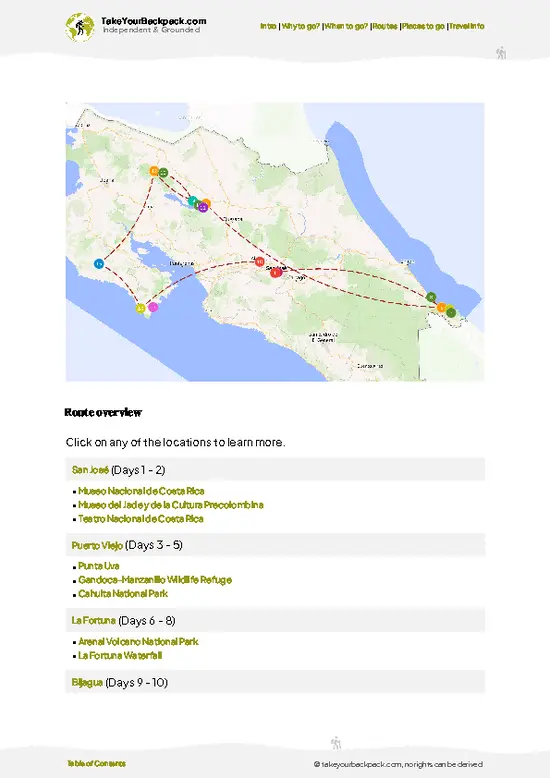
How many days to allow: A trip linking several attractions needs 10 to 14 days, and 7 days is the minimum for two regions without constant rushing. Distances look short but roads are slow: San José to the Pacific beaches takes 3 to 5 hours, and to La Fortuna roughly 3 hours. The Caribbean side takes 4 to 5 hours by bus. Mountain bends and trucks stretch every journey.
Grouping regions and direction: Start in San José or Liberia airport, then loop. The northern volcano and cloud forest zone around La Fortuna and Monteverde clusters well, though the link between them takes about 3 to 4 hours by road and boat or shared shuttle. Follow with the Pacific coast, north to south, so you finish near the Osa or Manuel Antonio. The Caribbean works best as a separate leg or short trip from San José. Plan … read more 👉
How many days to allow: A trip linking several attractions needs 10 to 14 days, and 7 days is the minimum for two regions without constant rushing. Distances look short but roads are slow: San José to the Pacific beaches takes 3 to 5 hours, and to La Fortuna roughly 3 hours. The Caribbean side takes 4 to 5 hours by bus. Mountain bends and trucks stretch every journey.
Grouping regions and direction: Start in San José or Liberia airport, then loop. The northern volcano and cloud forest zone around La Fortuna and Monteverde clusters well, though the link between them takes about 3 to 4 hours by road and boat or shared shuttle. Follow with the Pacific coast, north to south, so you finish near the Osa or Manuel Antonio. The Caribbean works best as a separate leg or short trip from San José. Plan 2 to 3 nights per stop, so you can catch early morning light and wildlife activity.
Planning mistakes: The common error is cramming a new base in every night. Heat, humidity and winding roads drain energy, and early guided starts at 5 or 6 a.m. punish tired travelers. Pick three or four bases instead, and use day trips from each. Another mistake is trusting map estimates. Add an hour to every drive in the rainy season, and avoid late afternoon travel when downpours and fog arrive. Shuttles cost more than public buses but save hours.

The ListMust-Visit attractions in Costa Rica

1 Teatro Nacional de Costa Rica

Coffee-and-banana ceiling, velvet auditorium, gilded foyer, lobby café

Climb the marble staircase beneath a painted ceiling, sit in a horseshoe hall of red velvet, and catch the national orchestra when it plays.

costa-rica-attraction-teatro-nacional-de-costa-rica
© Google |

2 Museo Nacional de Costa Rica

Bullet-scarred fortress, Diquís spheres, army abolition, tower view

Trace the 1948 civil war on shell-marked walls, stand beside mysterious granite spheres, and climb the tower for city rooftops and mountains.

costa-rica-attraction-museo-nacional-de-costa-rica
© Google |

3 Museo del Oro Precolombino

Gold frogs, underground vaults, tumbaga casting, coin museum

Descend beneath the plaza to see cast frog and eagle pendants, learn how artisans shaped them, and follow the country’s money through time.

costa-rica-attraction-museo-del-oro-precolombino
© Google |

4 Museo del Jade y de la Cultura Precolombina

Carved jade, stone metates, Plaza de la Democracia, Diquís ceramics

Compare pale green pendants, animal-headed grinding tables and painted vessels, then look out over the plaza to place the regions behind them.

costa-rica-attraction-museo-del-jade-y-de-la-cultura-precolombina
© Google |

5 Museo de Arte Costarricense

Gilded relief room, old airport terminal, Zúñiga bronzes, park sculpture lawn

Step into a former airport terminal to study gold panels of national history, rural paintings and heavy bronze figures, then finish among sculptures outside.

costa-rica-attraction-museo-de-arte-costarricense
© Google |

6 Rescate Wildlife Rescue Center

Macaw aviaries, big cats, sloth area, owl perches

Stroll fixed paths past screeching scarlet macaws, resting jaguars and slow sloths, learning why each rescued animal cannot return to the forest.

costa-rica-attraction-rescate-wildlife-rescue-center
© Google |

7 Museo de los Niños

Former penitentiary, iron cell doors, science rooms

Walk old prison corridors and tiny cells, then press buttons in hands-on science halls.

9 Finca Luna Nueva

Organic spice gardens, bean-to-bar chocolate, night walks, rainforest reserve

Taste turmeric, ginger and pepper fresh from the beds, then follow forest trails and after-dark paths where frogs call and flashlights catch eyes.

10 Finca Educativa Don Juan

Cacao pods, ox-driven cane press, farm lunch, howler monkeys

Crack open cacao pods, grind roasted nibs on a stone metate, and press sugarcane by ox power on a guided working-farm tour.

11 Recreo Verde

Thermal pools, night soaks, forest trails, canopy line, cave

Soak in graded thermal pools under the trees, walk wet forest paths between dips, and stay late while the park runs until 9 p.m.

12 Refugio Herpetológico de Costa Rica

Fer-de-lance, boa room, dart frogs, rescue talk

Follow a guide past vipers, boas and coral snakes, then crouch at eye level with red-eyed tree frogs and tiny poison dart frogs.

costa-rica-attraction-refugio-herpetologico-de-costa-rica
© Google |

13 Antigua Fábrica Nacional de Licores

Brick chimney, guaro history, free courtyard, Barrio Otoya

Wander a restored distillery where panels trace the national cane spirit, rotating exhibitions fill old halls, and early twentieth century houses line the nearby streets.

Think you know Costa Rica?

Prove you’re a true local — uncover 3 lesser-known attractions in Costa Rica that locals tend to keep to themselves.
Loading the map 🌍

Expert viewWhat You Should Know

How many attractions to visit: Aim for one major attraction per day, with a rest day after every three or four. Costa Rica rewards depth. Early mornings in a rainforest, with humidity rising and birdsong peaking before 8 a.m., beat three rushed stops. Over two weeks, 8 to 10 attractions is a sensible ceiling. More than that and you spend the trip in vans, not forests.
What to prioritize: If you have a small budget, favor free or cheap options: public beaches, village walks, waterfalls with low entry, and wildlife seen from roadsides or local trails. Pay for a guide where it counts. In dense forest, guides spot sloths, frogs and birds that you would walk past, and they are worth the money. Skip the expensive canopy and adventure packages if you are tight on cash, because several cost US$60 to … read more 👉
How many attractions to visit: Aim for one major attraction per day, with a rest day after every three or four. Costa Rica rewards depth. Early mornings in a rainforest, with humidity rising and birdsong peaking before 8 a.m., beat three rushed stops. Over two weeks, 8 to 10 attractions is a sensible ceiling. More than that and you spend the trip in vans, not forests.
What to prioritize: If you have a small budget, favor free or cheap options: public beaches, village walks, waterfalls with low entry, and wildlife seen from roadsides or local trails. Pay for a guide where it counts. In dense forest, guides spot sloths, frogs and birds that you would walk past, and they are worth the money. Skip the expensive canopy and adventure packages if you are tight on cash, because several cost US$60 to 100 for a short thrill. Choose one splurge activity and keep the others modest. Wildlife and volcano views depend on weather, so build in flexibility rather than prepaying everything.
What it costs: Plan US$50 to 90 a day as a shoestring backpacker (dorm US$12 to 25, meals at sodas US$5 to 9, local buses US$2 to 10 per leg). Add more for activities. National park entry is typically US$10 to 20 for foreigners, often cheaper for children, with fees rising at popular parks. A half-day guided walk runs US$30 to 70, a night walk around US$25 to 40, and a full-day tour US$80 to 150. Many parks sell tickets online with timed slots, so book popular ones ahead, especially in peak season. Foreigners are often charged in US dollars, though colones are the local currency.
Safety and cultural considerations: The main risks are natural. Rip currents on Pacific beaches kill swimmers every year, so swim near lifeguards and heed flag warnings. Rainy-season rivers rise quickly, and flash floods can sweep away hikers. Snakes sit on trails, so watch where you step and wear closed shoes. Petty theft is the typical crime, especially from parked cars and unattended beach bags. Never leave valuables in a rental car, even briefly. Keep to marked trails, carry water, and use reputable operators with certified guides. Respect the rules: no feeding wildlife, no touching animals, and quiet around nests and sleeping creatures. Locals, called Ticos, value politeness, a greeting before asking questions, and the phrase “pura vida”, used constantly, is a friendly way in. Dress modestly in towns, and pack out all trash.

✈️ The backpacker research shortcutCosta Rica Travel Guide

An offline-friendly backpacking guide with optimized travel routes, ranked highlights, transport advice, and the best areas to stay.
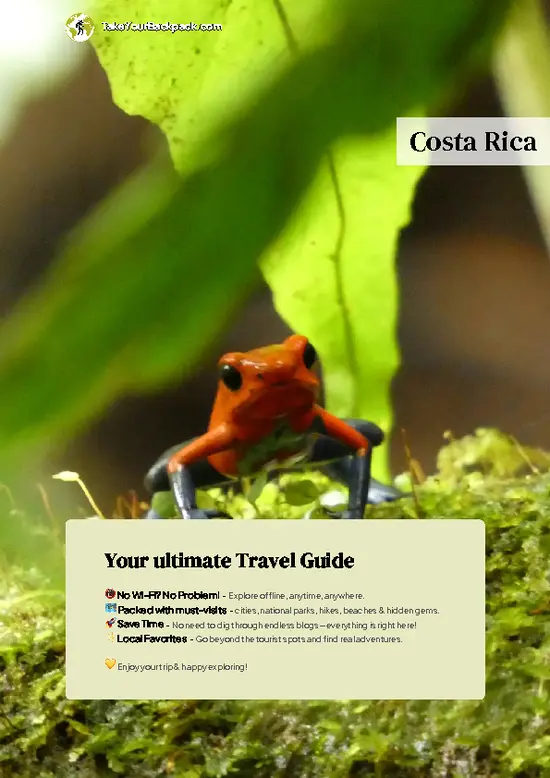
example page 0 from our offline Travel Guide for Costa Rica
example page 1 from our offline Travel Guide for Costa Rica
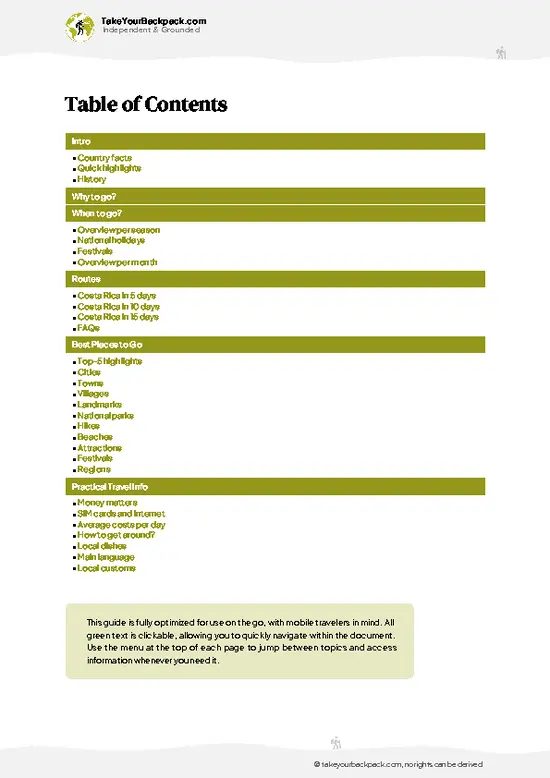
example page 2 from our offline Travel Guide for Costa Rica
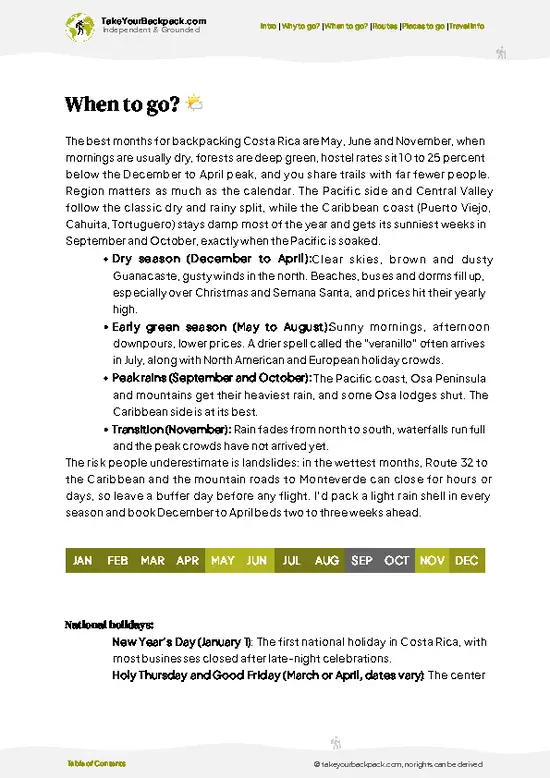
example page 3 from our offline Travel Guide for Costa Rica
example page 4 from our offline Travel Guide for Costa Rica
example page 5 from our offline Travel Guide for Costa Rica
example page 6 from our offline Travel Guide for Costa Rica
example page 7 from our offline Travel Guide for Costa Rica
The digital guide (287 pages) contains:
✅ 90 highlights, ranked by travel appeal
✅ Optimized 5, 10 & 15-day travel routes
✅ Cities, national parks, landmarks, beaches
✅ How to get around
✅ Offline-friendly for travel without Wi-Fi
👉 Click to see all 30+ guide features

📅 Plan smarter in minutes, not weeks
✅ Month by month travel advice
✅ Festivals & national holidays
✅ Budget expectations

🗺️ Go to the right places, skip the overrated ones
✅ Honest pros & cons of destinations
✅ Top hikes, parks & viewpoints
✅ Lesser-known places most travelers miss
✅ Clear “worth it vs skip it” guidance

🛏️ Travel smoothly without rookie mistakes
✅ Best areas to stay
✅ Transport systems explained simply
✅ Common scams & safety advice
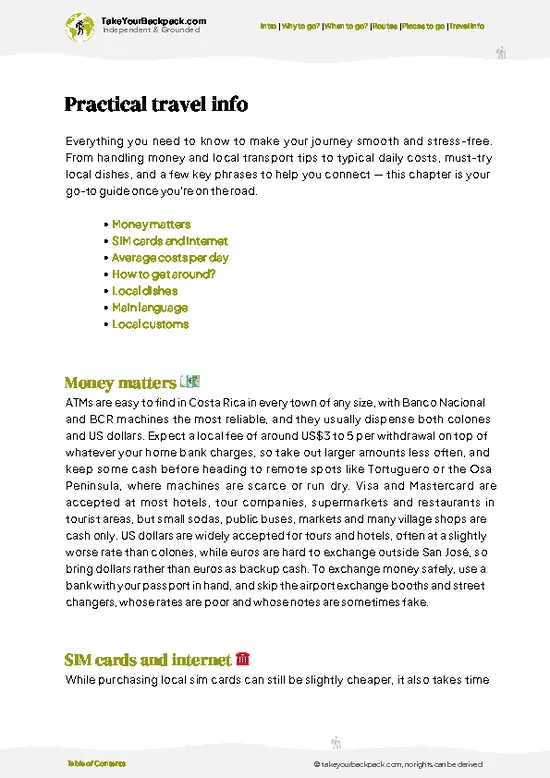
✅ SIM cards, money & practical tips

🌍 Understand the country, not just visit it
✅ Culture & traditions
✅ 52 Essential phrases & customs
✅ Festivals worth planning around
✅ Traveler-friendly historical context
✅ Insights that make places more meaningful

📱 Built for real travel conditions
✅ Fully downloadable PDF
✅ Works completely offline
✅ Optimized for phone use
✅ Useful in remote areas & buses
✅ Everything in one place
Stop searching, start planning
Get instant access to your full guide. 30‑day money-back guarantee.
+ Add another guide for just

By proceeding you agree to our terms.
Sent to your inbox immediately after payment • 100% Secure Checkout
Best Backpacking Travel Advisor 2025 tourism awardBest Backpacking
Travel Advisor
2025
What others say about Take Your Backpack Guides:
⭐⭐⭐⭐⭐
Fantastic, amazing amount of information!
⭐⭐⭐⭐⭐
My goodness this is amazing, it's what I've been looking for hats off too you!
⭐⭐⭐⭐⭐
I think this is absolutely BRILLIANT
⭐⭐⭐⭐
Very complete and informative. It's still missing places, but I gotta to commend you
⭐⭐⭐⭐⭐
This is truly amazing, thank you, can't wait to explore it with my kids!
⭐⭐⭐⭐⭐
Awesome resource, thank you!
⭐⭐⭐⭐⭐
This is amazing! Can't wait to explore the ones I haven't seen
⭐⭐⭐⭐
I love this! Well done, great idea.
⭐⭐⭐⭐⭐
Thanks for taking the time to make this gem!
⭐⭐⭐⭐⭐
This might be the best website I've ever seen.
⭐⭐⭐⭐⭐
Congratulations, and thank you so much for your work; it's incredibly valuable.
⭐⭐⭐⭐
In all seriousness I think you did a great job pointing out the important spots
⭐⭐⭐⭐⭐
10/10 very good
⭐⭐⭐⭐⭐
As someone who's only just starting to visit regularly this is awesome, thank you.
⭐⭐⭐⭐
Thank you very much! I'm going to visit my dad, it's going to be very useful!
⭐⭐⭐⭐⭐
This is really cool! We'll be travelling for the first time and this definitely come in handy.
⭐⭐⭐⭐⭐
You are now our minister of culture, congratulations 👨‍💼
⭐⭐⭐⭐⭐
Just wanted to tell you that this is a pearl! Going to follow your recommendations.
⭐⭐⭐⭐⭐
This is so cool. I'll definitely be using the resource for my travels soon.
⭐⭐⭐⭐⭐
This is very impressive! Good work.
⭐⭐⭐⭐⭐
This is an amazing and informative site. Very well done!

🛏️ Where to stay?Where to Base Yourself

Costa Rica has a dense hostel network, with dorm beds typically running ₡8,000 to 16,000 (about US$15 to 30) a night and private doubles in small guesthouses from roughly US$35 to 60. In the capital, San José, Barrio Escalante is the pick for its restaurants, craft beer bars and safer streets, while Barrio Amón puts you within walking distance of the museums but gets sketchy after dark. Outside the city, La Fortuna sits right by Arenal Volcano and goes quiet by 10 pm, Santa Elena in Monteverde is cool, calm and close to the cloud forest reserves, Puerto Viejo de Talamanca on the Caribbean side has the liveliest reggae and bar scene with more petty theft, and the surf towns of Tamarindo and Santa … read more 👉
Costa Rica has a dense hostel network, with dorm beds typically running ₡8,000 to 16,000 (about US$15 to 30) a night and private doubles in small guesthouses from roughly US$35 to 60. In the capital, San José, Barrio Escalante is the pick for its restaurants, craft beer bars and safer streets, while Barrio Amón puts you within walking distance of the museums but gets sketchy after dark. Outside the city, La Fortuna sits right by Arenal Volcano and goes quiet by 10 pm, Santa Elena in Monteverde is cool, calm and close to the cloud forest reserves, Puerto Viejo de Talamanca on the Caribbean side has the liveliest reggae and bar scene with more petty theft, and the surf towns of Tamarindo and Santa Teresa trade higher prices for beach access and late nights.

If you enjoy meeting fellow travelers, consider choosing hostels with high ratings for atmosphere. On the other hand, if you prefer having your own space, a hotel might be a better option.

Costa RicaExpand Your Journey

👋 Meet the founderWho’s Behind Take Your Backpack?

Johan, backpacker and founder of TakeYourBackpackHi, I’m Johan (Netherlands 🇳🇱), the creator of TakeYourBackpack. Over the past 3 decades, I’ve backpacked through 90+ countries across six continents, gaining extensive experience with independent travel, long-term trips, and overland routes.

This site is built on a combination of firsthand travel experience and carefully curated insights from other backpackers. Many guides are based on places I’ve personally visited, while others bring together tips, observations, and practical advice shared by trusted travelers I’ve met along the way.

The goal is to provide realistic, experience-driven guidance — not generic itineraries — so you can explore destinations with better context, clearer expectations, and more confidence.