×

Georgia🇬🇪 | best townsYour Guide to the 10 Best towns in Georgia

Towns in Georgia (the country, not the US state) are small, loud with life and rarely polished. Expect wine-country villages in Kakheti where cellar air smells of clay and fermenting grape, Black Sea resort towns with pebble beaches and humid evenings, and Greater Caucasus outposts where cold river noise and woodsmoke fill the lanes. Costs stay low, with guesthouse beds often US$15 to 35, yet access varies: lowland towns are a marshrutka ride from Tbilisi, while high-mountain settlements mean rough roads and thin services. For backpacking and independent travel, choose by terrain first, then by how much comfort you want.

By Johan Kruseman 🇳🇱 | Updated October 18, 2026
Explore the best villages in Georgia

Why go?Why Travelers Love These Spots

Georgia suits town-hopping because a tiny country packs sharp contrasts into short distances. Within a few hours you can pass from subtropical coast, where tea and citrus grow, to dry eastern valleys, to glacier-fed mountain basins. Each zone has its own architecture, food and pace: stone towers and slate roofs in the north, carved wooden balconies in older lowland streets, and Soviet-era blocks layered beside medieval churches in many regional centers.

History leaves a physical mark. Invasions, empires and the Soviet period left fortress walls, cave monasteries and cracked concrete side by side, and you will often see all three from one street corner. Hospitality is a living custom rather than a show: expect a stranger to press bread, cheese or homemade wine into your hands, and expect a … read more 👉
Georgia suits town-hopping because a tiny country packs sharp contrasts into short distances. Within a few hours you can pass from subtropical coast, where tea and citrus grow, to dry eastern valleys, to glacier-fed mountain basins. Each zone has its own architecture, food and pace: stone towers and slate roofs in the north, carved wooden balconies in older lowland streets, and Soviet-era blocks layered beside medieval churches in many regional centers.

History leaves a physical mark. Invasions, empires and the Soviet period left fortress walls, cave monasteries and cracked concrete side by side, and you will often see all three from one street corner. Hospitality is a living custom rather than a show: expect a stranger to press bread, cheese or homemade wine into your hands, and expect a toast to follow. Wine is made in clay vessels called qvevri, a method thousands of years old.

Before choosing Georgia, know that infrastructure is uneven. Minibuses called marshrutkas link nearly everywhere but leave when full, roads in the highlands can close with snow or landslides, and winter shuts some mountain villages almost completely. Smaller towns may have few ATMs, so carry lari. English is common among younger people in tourist areas and thin elsewhere, so a few Georgian or Russian phrases help.
Our Approach to Ranking
The list of best towns in Georgia is created based on charm, local culture, atmosphere, hidden gems, and visitor appeal. If you feel a town is missing in this list, please let us know.

When to go?When to Plan Your Trip

Best Months and Seasons: May, June, September and early October are the best months for towns in Georgia, with daytime temperatures of roughly 18 to 28°C, open mountain roads and the grape harvest (rtveli) filling eastern villages with the smell of crushed fruit in September. Spring brings green hillsides and blossom, though rain can fall on 8 to 12 days in May, especially in the west.

Summer, Autumn and Winter: July and August bring heat of 30 to 38°C in Tbilisi and the eastern lowlands, where midday streets go quiet and shade becomes the main plan. The Black Sea coast is humid and crowded, with beds costing 30 to 60 percent more than in May or late September. High mountain towns are the cool exception, with fresh air at 1,500 to 2,200 meters and cold nights. The west is Georgia’s wettest … read more 👉
Best Months and Seasons: May, June, September and early October are the best months for towns in Georgia, with daytime temperatures of roughly 18 to 28°C, open mountain roads and the grape harvest (rtveli) filling eastern villages with the smell of crushed fruit in September. Spring brings green hillsides and blossom, though rain can fall on 8 to 12 days in May, especially in the west.

Summer, Autumn and Winter: July and August bring heat of 30 to 38°C in Tbilisi and the eastern lowlands, where midday streets go quiet and shade becomes the main plan. The Black Sea coast is humid and crowded, with beds costing 30 to 60 percent more than in May or late September. High mountain towns are the cool exception, with fresh air at 1,500 to 2,200 meters and cold nights. The west is Georgia’s wettest region, often receiving 1,500 to 2,500 mm a year, with fog and heavy rain even in warm months.

November to March is quiet and cheap, with guesthouses often 20 to 40 percent below summer rates. Lowland towns turn gray, damp and cold, around 0 to 10°C, and wood stoves become the main source of warmth. Mountain towns can see heavy snow and road closures, though ski-oriented ones fill from late December to March. Easter and New Year can push prices up.

town hoppingSuggested Travel Strategies

Trip Length and Direction: A trip linking several towns in Georgia works best in 10 to 14 days, and 7 days is the minimum for two regions without rushing. Georgia is compact, but mountain roads are slow and bends are tight. Plan around Tbilisi as the main hub, with Kutaisi as the western gateway.

Eastern lowland wine towns cluster well together, since they sit 1.5 to 3 hours from Tbilisi by marshrutka or shared taxi. The west and the Black Sea pair naturally through Kutaisi, with 2 to 4 hours between inland and coastal towns. The high north is a separate leg: the road to Kazbegi takes about 3 hours from Tbilisi, and Svaneti typically needs 6 to 8 hours from Kutaisi or the coast on winding roads. A loop that moves east, back through Tbilisi, then west and finally north or coast avoids repeated … read more 👉
Trip Length and Direction: A trip linking several towns in Georgia works best in 10 to 14 days, and 7 days is the minimum for two regions without rushing. Georgia is compact, but mountain roads are slow and bends are tight. Plan around Tbilisi as the main hub, with Kutaisi as the western gateway.

Eastern lowland wine towns cluster well together, since they sit 1.5 to 3 hours from Tbilisi by marshrutka or shared taxi. The west and the Black Sea pair naturally through Kutaisi, with 2 to 4 hours between inland and coastal towns. The high north is a separate leg: the road to Kazbegi takes about 3 hours from Tbilisi, and Svaneti typically needs 6 to 8 hours from Kutaisi or the coast on winding roads. A loop that moves east, back through Tbilisi, then west and finally north or coast avoids repeated backtracking.

Time per Stop and Common Mistakes: Give lowland towns 1 to 2 nights and mountain towns 2 to 3, since weather and walking take time. Common mistakes include squeezing too many transfers into one day, forgetting that marshrutkas wait until full and depart mostly in the morning, and assuming a map distance of 100 km means 1 hour. Instead, allow 25 to 40 km per hour on mountain routes, start early, and keep one flexible day for rain or road closures.

The ListThe Best towns of Georgia

1 Mtskheta

UNESCO churches, river confluence, pilgrimage site

Visit ancient cathedrals, watch rivers merge below hilltop monasteries, and witness centuries-old rituals in Georgia’s spiritual center.

2 Sighnaghi

hilltop walls, Kakheti wine, cobbled lanes

Stroll narrow streets lined with pastel houses and discover local wineries, all set against sweeping views of the Alazani Valley.

3 Telavi

Wine estates, Caucasus views, market square

Sample local vintages, wander through lively produce stalls, and take in panoramic mountain scenery from the heart of Kakheti’s wine region.

georgia-city-telavi
© Google |

4 Zugdidi

Dadiani Palace, Megrelian cuisine, Abkhazia border

Tour the palace grounds, sample spicy local dishes, and experience a city shaped by its proximity to the breakaway region.

5 Kvareli

wine tunnels, lakeside views, foothill villages

Descend into cool wine tunnels, relax by a tranquil lake, and explore rural communities set against the backdrop of the Caucasus foothills.

6 Akhaltsikhe

Rabati Castle, mosque-minaret, multicultural quarters

Experience a crossroads of cultures by touring restored fortifications, admiring Ottoman architecture, and noting the blend of traditions in daily routines.

7 Martvili

Canyon, monastery, turquoise river

Paddle through limestone gorges, visit a hilltop monastery, and watch the river carve its way through lush western valleys.

8 Tskaltubo

Soviet sanatoriums, karst caves, mineral springs

Tour abandoned spa resorts, soak in mineral waters, and explore vast cave systems hidden beneath the subtropical landscape.

9 Lagodekhi

Nature reserve, forest trails, border crossing

Set out on marked hikes into primeval forest, spot wildlife in the reserve, or use the town as a gateway to Azerbaijan.

georgia-city-lagodekhi
© Google |

10 Gori

Soviet legacy, fortress hill, Stalin Museum

Trace the city’s layered identity by visiting stark monuments, exploring the medieval citadel, and observing daily life shaped by its Soviet past.

11 Ambrolauri

Racha wine, river valley, local markets

Sample unique Khvanchkara wines and browse produce stalls in a town surrounded by forested hills and the Rioni River’s gentle bends.

12 Chiatura

Cable cars, manganese mines, steep cliffs

Ride aging aerial trams over dramatic gorges, observe remnants of Soviet industry, and witness a town built into the rock.

13 Dusheti

Mountain gateway, old squares, local bakeries

Begin your journey to the Greater Caucasus, sample fresh bread, and wander through quiet lanes lined with traditional houses.

14 Akhmeta

Pankisi Valley, Kist villages, riverside parks

Meet Kist communities, stroll along the Alazani river, and use the town as a launch point for exploring the Pankisi region.

15 Dedoplistskaro

Steppe landscape, Vashlovani Park, semi-desert

Venture into arid plains, spot wildlife in protected areas, and experience the stark beauty of Georgia’s southeastern frontier.

16 Khulo

Ajarian highlands, cableway, remote villages

Ride the Soviet-era cable car, explore scattered hamlets, and take in the rugged scenery of the Upper Adjara region.

17 Keda

Wine cellars, Adjarian valley, stone bridges

Taste regional wines in family cellars, cross arched bridges, and follow the river through a lush, little-visited valley.

18 Khashuri

Rail junction, market stalls, transit town

Pass through a key crossroads, stock up at local markets, and observe the rhythms of a town shaped by the railway.

19 Oni

Mountain valley, synagogue, quiet streets

Absorb the tranquil pace of a remote Racha town, visit the historic synagogue, and enjoy the surrounding alpine landscape.

20 Ninotsminda

Armenian culture, volcanic lakes, high plateau

Travel across windswept plains, visit lakes formed by ancient eruptions, and observe Armenian traditions in daily life.

21 Tianeti

Forest hills, reservoir, rural market

Drive through rolling hills, stop at small-town markets, and enjoy the calm of a lakeside setting away from main routes.

22 Tsnori

Wine cellars, Alazani plain, archaeological sites

Explore local wineries, walk through fertile vineyards, and discover archaeological finds that reveal the region’s deep history.

Think you know Georgia?

Prove you’re a true local — uncover 12 lesser-known towns in Georgia that locals tend to keep to themselves.
Loading the map 🌍

Expert viewTips and Advice from Travelers

How Many Towns to Visit: Visit four to six towns on a 10 to 14 day trip. That count leaves a full day at each stop for slow breakfasts, cellar tastings or walks, instead of spending the trip staring at a marshrutka window. Georgia’s roads are twisty and a short map distance can become a long, sweaty ride, so fewer stops buy you more time in the moment: the cheese bread still warm, the evening light on a stone wall.

Choosing by Travel Style: For food and wine, prioritize eastern wine-country towns, where family cellars pour amber and red wine from clay jars. For hiking, pick one high-mountain base such as those in Svaneti or Kazbegi, where trails go through cold, thin air and wildflower meadows. For rest and cheap comfort, add a Black Sea or spa-style lowland town. Mixing one of each gives … read more 👉
How Many Towns to Visit: Visit four to six towns on a 10 to 14 day trip. That count leaves a full day at each stop for slow breakfasts, cellar tastings or walks, instead of spending the trip staring at a marshrutka window. Georgia’s roads are twisty and a short map distance can become a long, sweaty ride, so fewer stops buy you more time in the moment: the cheese bread still warm, the evening light on a stone wall.

Choosing by Travel Style: For food and wine, prioritize eastern wine-country towns, where family cellars pour amber and red wine from clay jars. For hiking, pick one high-mountain base such as those in Svaneti or Kazbegi, where trails go through cold, thin air and wildflower meadows. For rest and cheap comfort, add a Black Sea or spa-style lowland town. Mixing one of each gives the best range, while stacking only mountain stops can strand you if weather closes a pass.

What It Costs: Budget US$30 to 50 a day on a backpacker plan: dorm or guesthouse US$12 to 30, home-cooked or bakery meals US$6 to 15, and local transport US$2 to 10. Mid-range travel with private rooms runs about US$60 to 100. Marshrutka rides between towns cost roughly 5 to 30 lari (US$2 to 11). Church and fortress entry is often free, museums often cost 5 to 15 lari, and private guides in the mountains run about US$40 to 100 a day. Cellar tastings generally cost 20 to 60 lari (US$7 to 22) per person, and a full home supper (supra) with wine can cost 40 to 80 lari.

Safety and Culture: Georgia is generally safe for solo travelers, including women, but stray dogs, fast drivers and unmarked roads are the real hazards. Cover shoulders and knees, and wear a headscarf or hat as locals do, when entering active churches. Accept toasts with grace: a toast is a ritual, and drinking a few sips is better than refusing outright. Do not photograph military sites near the occupied breakaway regions, and avoid the administrative boundary lines with Abkhazia and South Ossetia. Mountain weather turns quickly, so carry a rain shell, cash in lari and a downloaded offline map. Many small towns have few ATMs and shops close early on Sundays.

✈️ The backpacker research shortcutGeorgia Travel Guide

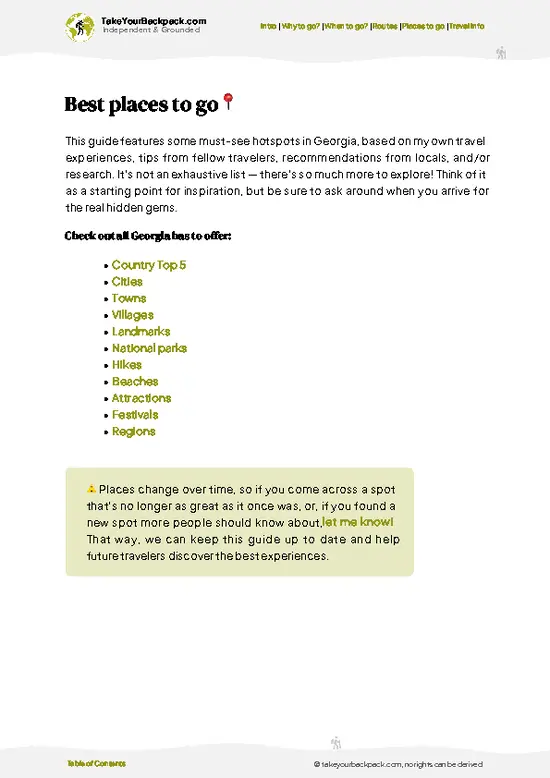
An offline-friendly backpacking guide with optimized travel routes, ranked highlights, transport advice, and the best areas to stay.
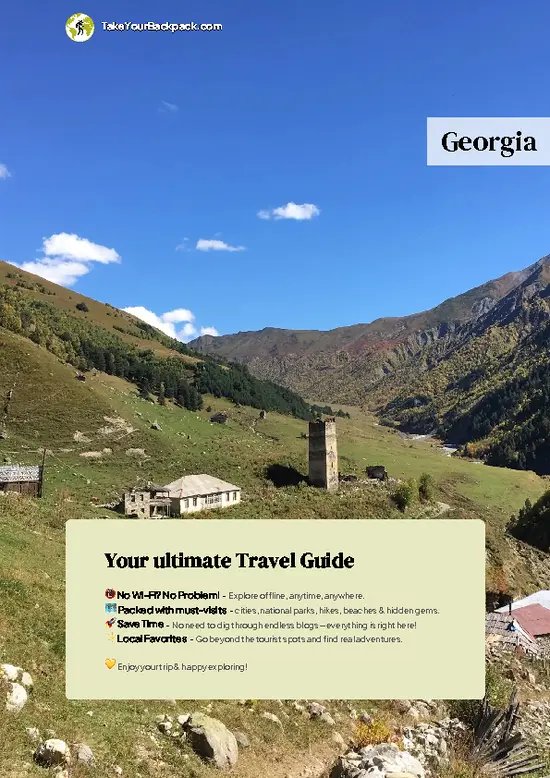
example page 0 from our offline Travel Guide for Georgia
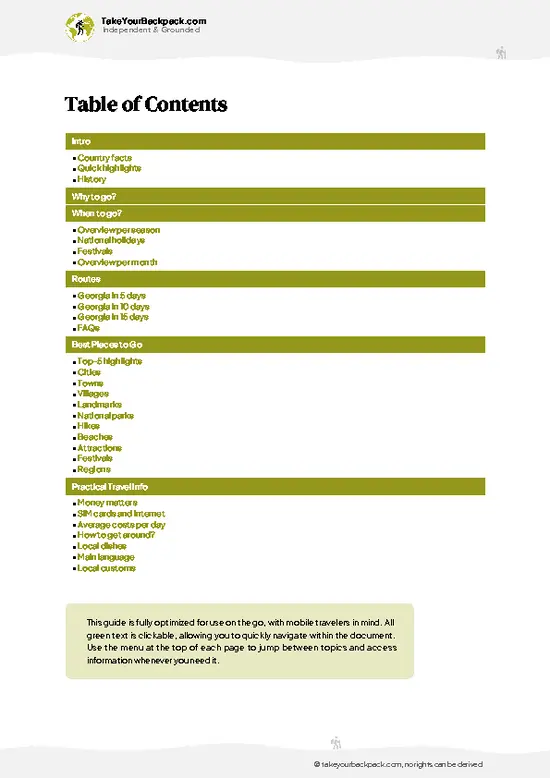
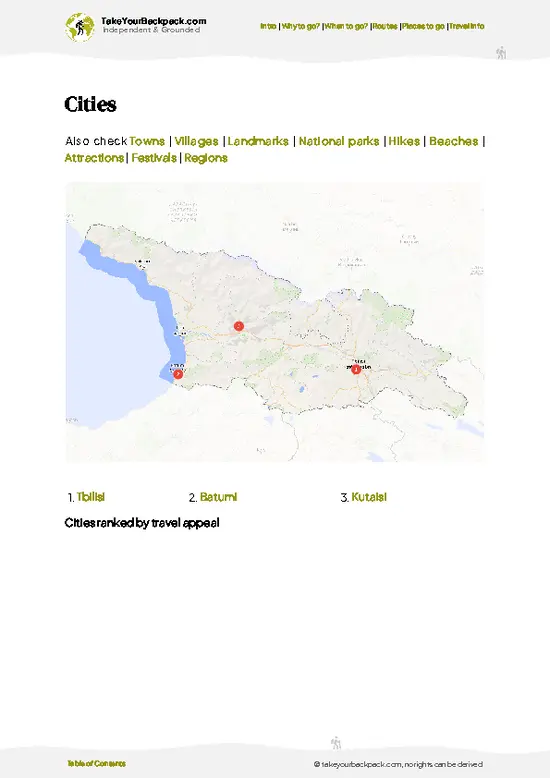
example page 1 from our offline Travel Guide for Georgia
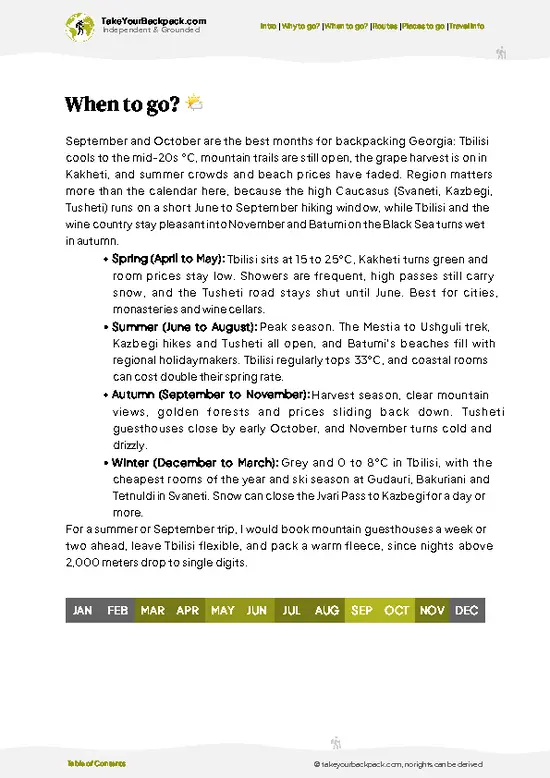
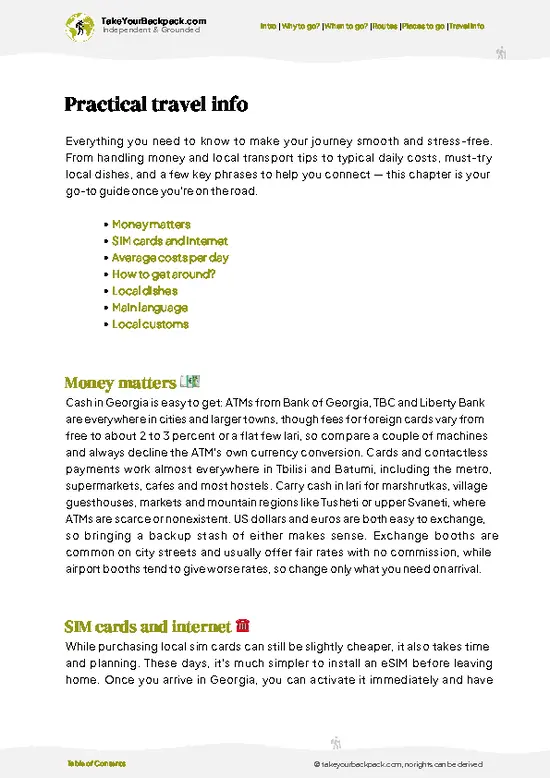
example page 2 from our offline Travel Guide for Georgia
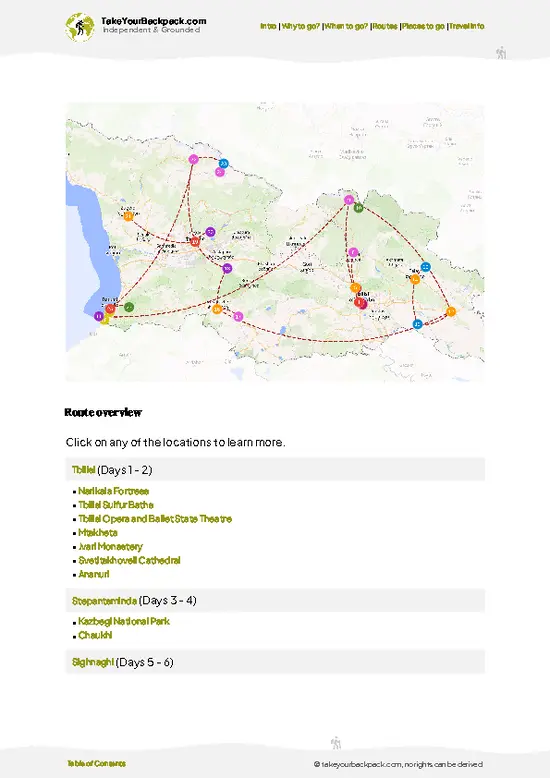
example page 3 from our offline Travel Guide for Georgia
example page 4 from our offline Travel Guide for Georgia
example page 5 from our offline Travel Guide for Georgia
example page 6 from our offline Travel Guide for Georgia
example page 7 from our offline Travel Guide for Georgia
The digital guide (350 pages) contains:
✅ 89 highlights, ranked by travel appeal
✅ Optimized 5, 10 & 15-day travel routes
✅ Cities, national parks, landmarks, beaches
✅ How to get around
✅ Offline-friendly for travel without Wi-Fi
👉 Click to see all 30+ guide features

📅 Plan smarter in minutes, not weeks
✅ Month by month travel advice
✅ Festivals & national holidays
✅ Budget expectations

🗺️ Go to the right places, skip the overrated ones
✅ Honest pros & cons of destinations
✅ Top hikes, parks & viewpoints
✅ Lesser-known places most travelers miss
✅ Clear “worth it vs skip it” guidance

🛏️ Travel smoothly without rookie mistakes
✅ Best areas to stay
✅ Transport systems explained simply
✅ Common scams & safety advice
✅ SIM cards, money & practical tips

🌍 Understand the country, not just visit it
✅ Culture & traditions
✅ 52 Essential phrases & customs
✅ Festivals worth planning around
✅ Traveler-friendly historical context
✅ Insights that make places more meaningful

📱 Built for real travel conditions
✅ Fully downloadable PDF
✅ Works completely offline
✅ Optimized for phone use
✅ Useful in remote areas & buses
✅ Everything in one place
Stop searching, start planning
Get instant access to your full guide. 30‑day money-back guarantee.
+ Add another guide for just

By proceeding you agree to our terms.
Sent to your inbox immediately after payment • 100% Secure Checkout
Best Backpacking Travel Advisor 2025 tourism awardBest Backpacking
Travel Advisor
2025
What others say about Take Your Backpack Guides:
⭐⭐⭐⭐⭐
Fantastic, amazing amount of information!
⭐⭐⭐⭐⭐
My goodness this is amazing, it's what I've been looking for hats off too you!
⭐⭐⭐⭐⭐
I think this is absolutely BRILLIANT
⭐⭐⭐⭐
Very complete and informative. It's still missing places, but I gotta to commend you
⭐⭐⭐⭐⭐
This is truly amazing, thank you, can't wait to explore it with my kids!
⭐⭐⭐⭐⭐
Awesome resource, thank you!
⭐⭐⭐⭐⭐
This is amazing! Can't wait to explore the ones I haven't seen
⭐⭐⭐⭐
I love this! Well done, great idea.
⭐⭐⭐⭐⭐
Thanks for taking the time to make this gem!
⭐⭐⭐⭐⭐
This might be the best website I've ever seen.
⭐⭐⭐⭐⭐
Congratulations, and thank you so much for your work; it's incredibly valuable.
⭐⭐⭐⭐
In all seriousness I think you did a great job pointing out the important spots
⭐⭐⭐⭐⭐
10/10 very good
⭐⭐⭐⭐⭐
As someone who's only just starting to visit regularly this is awesome, thank you.
⭐⭐⭐⭐
Thank you very much! I'm going to visit my dad, it's going to be very useful!
⭐⭐⭐⭐⭐
This is really cool! We'll be travelling for the first time and this definitely come in handy.
⭐⭐⭐⭐⭐
You are now our minister of culture, congratulations 👨‍💼
⭐⭐⭐⭐⭐
Just wanted to tell you that this is a pearl! Going to follow your recommendations.
⭐⭐⭐⭐⭐
This is so cool. I'll definitely be using the resource for my travels soon.
⭐⭐⭐⭐⭐
This is very impressive! Good work.
⭐⭐⭐⭐⭐
This is an amazing and informative site. Very well done!

🛏️ Where to stay?Best Places to Stay in Georgia

Georgia has plenty of hostels and guesthouses, with dorm beds typically 25 to 40 GEL (about US$9 to 15) and private guesthouse rooms from around 70 GEL (US$26). In Tbilisi, Sololaki and the Old Town put you within walking distance of the sulfur baths and the best wine bars but come with steep cobbled streets and late-night noise, while Marjanishvili and Chughureti on the left bank are cheaper, well connected by metro and home to the city’s liveliest hostel and bar scene. On the coast, Batumi’s Old Town keeps you close to the boulevard and beach, and in Kutaisi the streets around the center are quiet, safe and handy for early marshrutka departures to the mountains.

If you enjoy meeting fellow … read more 👉
Georgia has plenty of hostels and guesthouses, with dorm beds typically 25 to 40 GEL (about US$9 to 15) and private guesthouse rooms from around 70 GEL (US$26). In Tbilisi, Sololaki and the Old Town put you within walking distance of the sulfur baths and the best wine bars but come with steep cobbled streets and late-night noise, while Marjanishvili and Chughureti on the left bank are cheaper, well connected by metro and home to the city’s liveliest hostel and bar scene. On the coast, Batumi’s Old Town keeps you close to the boulevard and beach, and in Kutaisi the streets around the center are quiet, safe and handy for early marshrutka departures to the mountains.

If you enjoy meeting fellow travelers, consider choosing hostels with high ratings for atmosphere. On the other hand, if you prefer having your own space, a hotel might be a better option.

GeorgiaExplore Georgia

👋 Meet the founderWho’s Behind Take Your Backpack?

Johan, backpacker and founder of TakeYourBackpackHi, I’m Johan (Netherlands 🇳🇱), the creator of TakeYourBackpack. Over the past 3 decades, I’ve backpacked through 90+ countries across six continents, gaining extensive experience with independent travel, long-term trips, and overland routes.

This site is built on a combination of firsthand travel experience and carefully curated insights from other backpackers. Many guides are based on places I’ve personally visited, while others bring together tips, observations, and practical advice shared by trusted travelers I’ve met along the way.

The goal is to provide realistic, experience-driven guidance — not generic itineraries — so you can explore destinations with better context, clearer expectations, and more confidence.