×
Iceland🇮🇸 | 5 days itinerary

Backpacking Iceland: A 5-Day Guide

By Johan Kruseman 🇳🇱 | Updated May 8, 2026
This 5-day South Coast sprint is for first-time Iceland travelers who want maximum drama with minimum driving, using a rental car as your main tool and keeping the pace energetic but not frantic. You’ll base yourself between Reykjavik and the South Coast, chasing waterfalls, black-sand beaches, and one big glacier day instead of trying to lap the whole island.

Days 1-2: Reykjavik & Blue Lagoon

Start in Reykjavik so you can land, grab your car, and ease into Iceland rather than white-knuckling straight into long drives. Spend your first afternoon wandering the compact center, then duck into Aurora Reykjavík - The Northern Lights Center to get a crash course on aurora science and photography so you’re not guessing later when the sky actually performs. On day two, keep things close and indulgent: head to the nearby fishing town of Grindavík as a low-key coastal detour, then soak away jet lag at the geothermal spa of the Blue Lagoon, timing it for late afternoon or evening when the light softens … read more 👉
This 5-day South Coast sprint is for first-time Iceland travelers who want maximum drama with minimum driving, using a rental car as your main tool and keeping the pace energetic but not frantic. You’ll base yourself between Reykjavik and the South Coast, chasing waterfalls, black-sand beaches, and one big glacier day instead of trying to lap the whole island.

Days 1-2: Reykjavik & Blue Lagoon

Start in Reykjavik so you can land, grab your car, and ease into Iceland rather than white-knuckling straight into long drives. Spend your first afternoon wandering the compact center, then duck into Aurora Reykjavík - The Northern Lights Center to get a crash course on aurora science and photography so you’re not guessing later when the sky actually performs. On day two, keep things close and indulgent: head to the nearby fishing town of Grindavík as a low-key coastal detour, then soak away jet lag at the geothermal spa of the Blue Lagoon, timing it for late afternoon or evening when the light softens and the steam feels extra otherworldly.

Days 3-4: South Coast Waterfalls & Vik

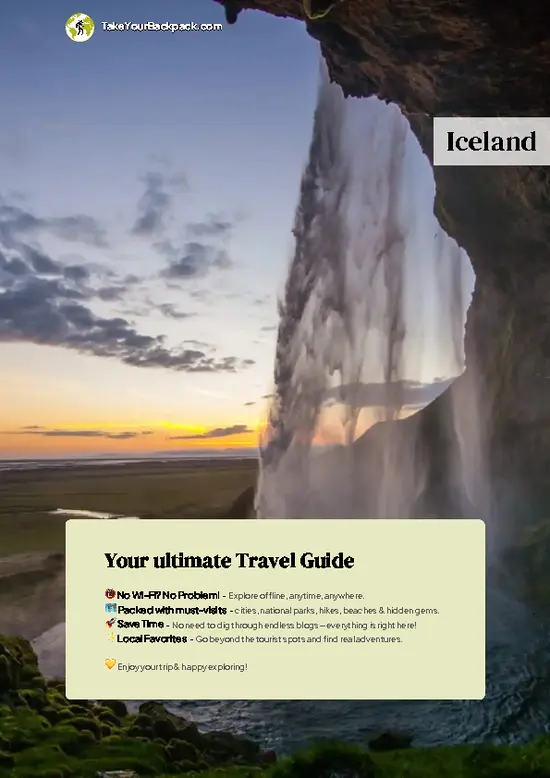
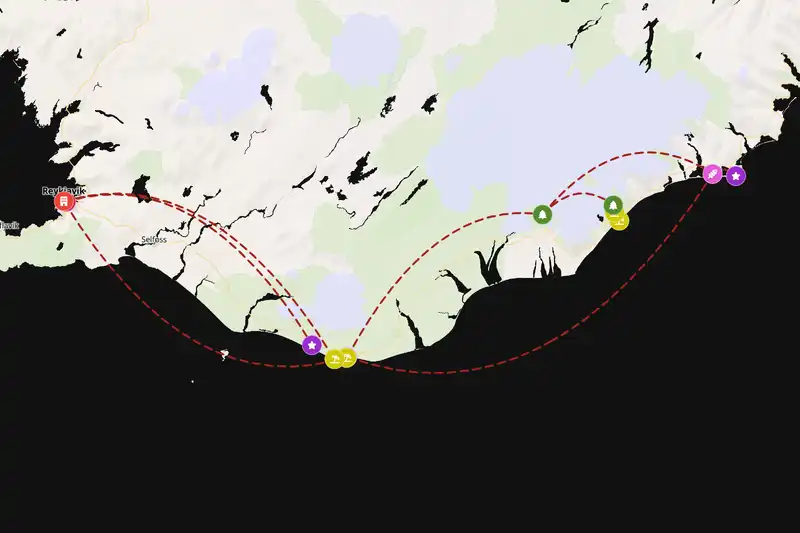
Now you point the car east along the Ring Road and lean into the South Coast greatest hits without rushing. Break up the drive with a long stop at Seljalandsfoss, where you can walk behind the curtain of water, then continue to the small village of Vik, your base for two nights so you’re not packing and unpacking every day. From Vik, spend one day exploring Reynisfjara with its basalt columns and roaring surf plus the gentler Vik Beach, and another day looping to Dyrhólaey for cliff views and birdlife; by staying put, you can time each spot for quieter hours instead of racing between them.

Day 5: Golden Circle Dash & Return to Reykjavik

On your final day, drive back toward Reykjavik via a compact Golden Circle sampler so you end on a high note without a brutal haul. The key stop is Þingvellir, where you can literally walk between tectonic plates and stand in the birthplace of Iceland’s parliament, then swing by the powerhouse waterfall Gullfoss to feel the spray and scale that made this one of the country’s classic sights before rolling back into Reykjavik for a last evening in the city.
My favorite moment on this route is standing on Reynisfjara late in the day, when the crowds thin and the Atlantic feels like it’s breathing right in front of you.
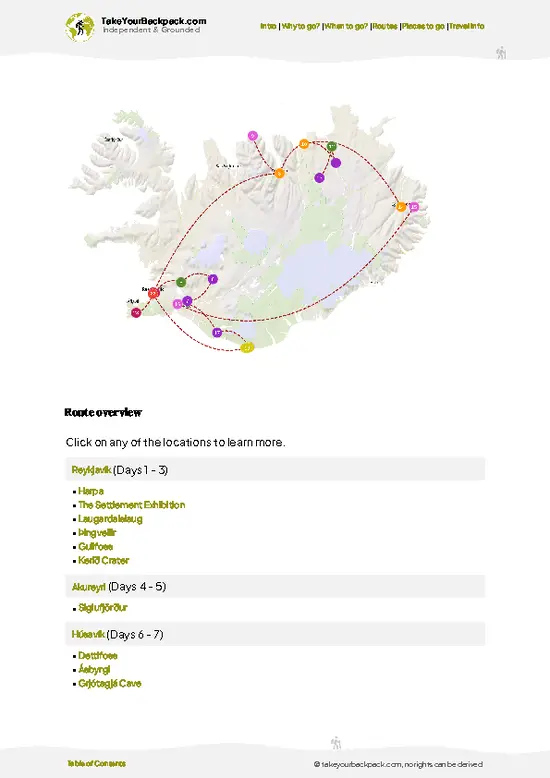
Loading the map 🌍
film
0
0
0a
Reykjavik
Pixabay
film
1
1
1a
Aurora Reykjavík – The Northern Lights Center
film
2
2
2a
Grindavík
film
3
3
3a
Blue Lagoon
film
4
4
4a
Vik
Francisco Aguilar
film
5
5
5a
Seljalandsfoss
film
6
6
6a
Reynisfjara
Christophe Deneuchatel
film
7
7
7a
Vik Beach
film
8
8
8a
Dyrhólaey
film
9
9
9a
Þingvellir
Katerina Kucharova
film
10
10
10a
Gullfoss

🛏️ Where to stay?Your Route at a Glance

✈️ The backpacker research shortcutIceland Travel Guide

An offline-friendly backpacking guide with optimized travel routes, ranked highlights, transport advice, and the best areas to stay.
example page 0 from our offline Travel Guide for Icelandexample page 1 from our offline Travel Guide for Icelandexample page 2 from our offline Travel Guide for Icelandexample page 3 from our offline Travel Guide for Icelandexample page 4 from our offline Travel Guide for Icelandexample page 5 from our offline Travel Guide for Iceland
The digital guide (219 pages) contains:
64 highlights, ranked by travel appeal
Optimized 5, 10 & 15-day travel routes
Best neighborhoods to stay
How to get around
Offline-friendly for travel without Wi-Fi
👉 See all 30+ guide features

📅 Plan smarter in minutes, not weeks
Month by month travel advice
Festivals & national holidays
Budget expectations

🗺️ Go to the right places, skip the overrated ones
Honest pros & cons of destinations
Top hikes, parks & viewpoints
Lesser-known places most travelers miss
Clear “worth it vs skip it” guidance

🛏️ Travel smoothly without rookie mistakes
Best areas to stay
Transport systems explained simply
Common scams & safety advice
SIM cards, money & practical tips

🌍 Understand the country, not just visit it
Culture & traditions
52 Essential phrases & customs
Festivals worth planning around
Traveler-friendly historical context
Insights that make places more meaningful

📱 Built for real travel conditions
Fully downloadable PDF
Works completely offline
Optimized for phone use
Useful in remote areas & buses
Everything in one place
Save weeks of stressful planning
Get instant access to the full guide directly. 30-day money-back guarantee.


Sent to your inbox immediately after payment • 100% Secure Checkout
Best Backpacking Travel Advisor 2025 tourism awardBest Backpacking
Travel Advisor
2025
What others say about Take Your Backpack Guides:
⭐⭐⭐⭐⭐
Fantastic, amazing amount of information!
⭐⭐⭐⭐⭐
My goodness this is amazing, it's what I've been looking for hats off too you!
⭐⭐⭐⭐⭐
I think this is absolutely BRILLIANT
⭐⭐⭐⭐
Very complete and informative. It's still missing places, but I gotta to commend you
⭐⭐⭐⭐⭐
This is truly amazing, thank you, can't wait to explore it with my kids!
⭐⭐⭐⭐⭐
Awesome resource, thank you!
⭐⭐⭐⭐⭐
This is amazing! Can't wait to explore the ones I haven't seen
⭐⭐⭐⭐
I love this! Well done, great idea.
⭐⭐⭐⭐⭐
Thanks for taking the time to make this gem!
⭐⭐⭐⭐⭐
This might be the best website I've ever seen.
⭐⭐⭐⭐⭐
Congratulations, and thank you so much for your work; it's incredibly valuable.
⭐⭐⭐⭐
In all seriousness I think you did a great job pointing out the important spots
⭐⭐⭐⭐⭐
10/10 very good
⭐⭐⭐⭐⭐
As someone who's only just starting to visit regularly this is awesome, thank you.
⭐⭐⭐⭐
Thank you very much! I'm going to visit my dad, it's going to be very useful!
⭐⭐⭐⭐⭐
This is really cool! We'll be travelling for the first time and this definitely come in handy.
⭐⭐⭐⭐⭐
You are now our minister of culture, congratulations 👨‍💼
⭐⭐⭐⭐⭐
Just wanted to tell you that this is a pearl! Going to follow your recommendations.
⭐⭐⭐⭐⭐
This is so cool. I'll definitely be using the resource for my travels soon.
⭐⭐⭐⭐⭐
This is very impressive! Good work.
⭐⭐⭐⭐⭐
This is an amazing and informative site. Very well done!

🧭 RouteAlternative Routes

Travel Iceland your way — from a quick highlights trip to a slow-paced adventure.

🙋 FAQBackpacking FAQ

Short answer: yes, Iceland is very easy to backpack independently, as long as you respect the weather and your budget. English is widely spoken, roads are well-marked, and hiking trails in popular areas are clear and usually well-signed. The main challenges are cost, weather, and distances.

For budget travelers, the key is planning: book hostels, campsites, and buses early in high season (June–August). Wild camping is heavily restricted now; assume you’ll be in official campsites or hostels most nights. Campsites are cheaper than beds and often have kitchens, which is huge for saving money on food.

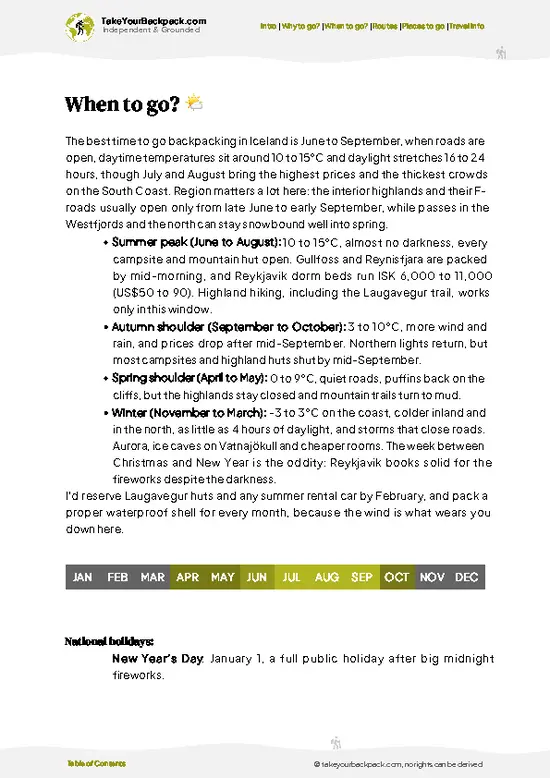
Weather is the real boss. Even in summer, you need layers, waterproofs, and a flexible mindset. In shoulder seasons (May, September–October), some highland roads, huts, and bus routes shut down, so stick to the Ring Road and lowland hikes. In winter, independent backpacking is possible but only if you’re comfortable with snow, short daylight, and road closures; otherwise, mix in day tours for safety.

Navigation is straightforward on the Ring Road and in popular trekking areas like the Laugavegur trail. You don’t need a guide for most classic hikes in good conditions, but you do need to check daily weather and road conditions, tell someone your plan, and be ready to turn back. If you’re used to backpacking in Europe or North America, Iceland feels logistically simple but physically serious: easy to organize, unforgiving if you ignore conditions.
For a tight-budget backpacker, think in three tiers:

3–5 days (quick hit): Base yourself in Reykjavík or Keflavík area and focus on day trips. Prioritize: Golden Circle, South Coast waterfalls and black sand beaches, maybe a cheap(er) geothermal pool instead of the Blue Lagoon. This is enough to get a taste, not enough to see the country.

7–10 days (solid first trip): This is the sweet spot for most backpackers. You can:
- Spend 2–3 days around Reykjavík + Golden Circle.
- Spend 3–5 days along the South Coast (Vík, Skaftafell, Jökulsárlón area).
- Or, if it’s summer and you’re into trekking, use 4–6 days for the Laugavegur/Fimmvörðuháls hike plus a couple of buffer days.
You’ll still be skipping big chunks of the country, but you’ll feel like you actually traveled, not just sampled.

12–16 days (Ring Road level): This is where a full or near-full loop of the Ring Road becomes realistic without rushing every day. You can hit the South Coast, Eastfjords, Mývatn area, North (Akureyri, maybe Húsavík), and the Snæfellsnes Peninsula. With 2+ weeks, you can build in rest days, bad-weather days, and a multi-day trek.

If you’re truly short on time, it’s better to go for fewer regions in depth than to sprint around the Ring Road. Iceland rewards slow travel: weather delays, long daylight in summer, and lots of roadside stops mean everything takes longer than it looks on a map.
You can get around Iceland without a car, but it takes more planning and flexibility, especially on a budget.

In and around Reykjavík: Super easy. You can walk most of the center, use city buses, and join day tours for the Golden Circle, South Coast, and some glacier/volcano activities. For a short trip, this is the simplest and often cheapest approach.

Intercity travel: In summer, there are scheduled buses along the Ring Road and to popular hiking areas like Landmannalaugar and Þórsmörk. These buses are reliable but not cheap, and they may run only once or twice a day. For backpackers, this works if you:
- Pre-book key legs in high season.
- Build in buffer days in case of weather or full buses.
- Are okay with less spontaneity than a road trip.

Hitchhiking: Common and generally considered safe, especially in summer along the Ring Road and to/from trailheads. It’s not guaranteed, and you should never rely on it for tight connections (like flights). It works best if you’re in pairs, look approachable, and are patient. Always have warm layers and food in case you’re waiting longer than expected.

Guided day tours: For solo travelers, tours can be cheaper than renting a car alone, especially in winter when 4x4 and insurance costs spike. Use them for hard-to-reach spots (glaciers, ice caves, highlands) and then walk or bus the rest.

If your goal is maximum freedom and you’re traveling with 1–3 friends, a rental car still wins on flexibility and often on cost per person. But if you’re solo and willing to adapt your route to bus schedules and tours, you absolutely can see a lot of Iceland without driving.
For a budget backpacker, “must-visit” means high impact per krona and easy to reach. These are the places that consistently feel worth the effort:

1. South Coast (Reykjavík to Jökulsárlón)
If you only do one region, make it this. You get waterfalls (Seljalandsfoss, Skógafoss), black sand beaches near Vík, glacier views, and, if you go far enough, the Jökulsárlón glacier lagoon and Diamond Beach. Campsites and hostels are spread along the route, and there are plenty of short hikes that don’t require guiding.

2. Golden Circle (Þingvellir, Geysir, Gullfoss)
Yes, it’s busy, but it’s close to Reykjavík and packs in a lot: tectonic rift valley, geothermal activity, and a powerful waterfall. It’s a good first-day or last-day loop, especially if you’re car-free and using a day tour.

3. Laugavegur Trail (and Fimmvörðuháls extension, in season)
If you like multi-day trekking and you’re there in summer, this is Iceland’s classic backpacking route: colorful rhyolite mountains, geothermal valleys, black sand deserts, and river crossings. It’s not cheap (huts or camping fees plus buses), but the experience-to-cost ratio is high for hikers.

4. Skaftafell area (Vatnajökull National Park)
Great day hikes with glacier views, peaks, and waterfalls, plus a big campsite with facilities. You can do everything from short walks to full-day hikes without a guide, and then add a budget-friendly glacier walk if you want to splurge on one activity.

5. Snæfellsnes Peninsula
Often called “Iceland in miniature” for a reason: cliffs, beaches, lava fields, small fishing towns, and the Snæfellsjökull glacier looming in the background. It’s a strong alternative if you don’t have time for the full Ring Road but want more than just the South Coast.

6. Mývatn and North Iceland (if you have time for the Ring Road)
Geothermal areas, pseudo-craters, lava formations, and good chances for whale watching from places like Húsavík or Akureyri. It’s more spread out, so it shines if you have a car or are doing a full loop, but it’s a worthy target if you’re going beyond the southwest.
If you’re short on time or money, skip anything that eats a full day for a relatively narrow payoff, or that duplicates experiences you’re already getting elsewhere. A few things to deprioritize:

1. Full Ring Road in under 7–8 days
Trying to drive the whole island in 4–5 days means you’ll spend most of your time in the car, racing past places you’d rather explore. If your trip is a week or less, focus on Reykjavík + Golden Circle + South Coast or Snæfellsnes instead of a rushed loop.

2. Expensive, crowded spas if you’re on a tight budget
The Blue Lagoon and similar high-end lagoons are cool, but they’re pricey and time-consuming. If money is tight, use local geothermal pools and cheaper hot springs instead; you still get that Icelandic hot-water culture without burning a day’s budget.

3. Deep highland driving if you’re not trekking
Renting a 4x4 just to “see the highlands” from the road is expensive and often stressful for new off-road drivers. If you’re not doing a specific trek like Laugavegur, you can skip long F-road missions and put that money into extra days on the South Coast or Snæfellsnes.

4. Too many paid tours that repeat the same scenery
You don’t need a guided tour for every waterfall and viewpoint. Save tours for things you truly can’t do alone (glacier walks, ice caves, certain winter activities) and do the rest independently. If two tours show you similar coastlines and waterfalls, pick one and free up time for hiking.

5. Long detours to remote peninsulas if your schedule is tight
Places like the Westfjords are incredible but far. If you only have 5–7 days, the travel time there and back can eat days you could spend actually hiking and exploring closer regions. Save the far corners for a second trip when you can give them the time they deserve.

🇮🇸 IcelandMore of Iceland

Ready to build a truly unique trip? Predefined routes are perfect for first-time visitors, but there is so much more to discover. Whether you are chasing a city trip, pristine national parks, local food scenes, or quiet beaches, pick a category to design your own path.