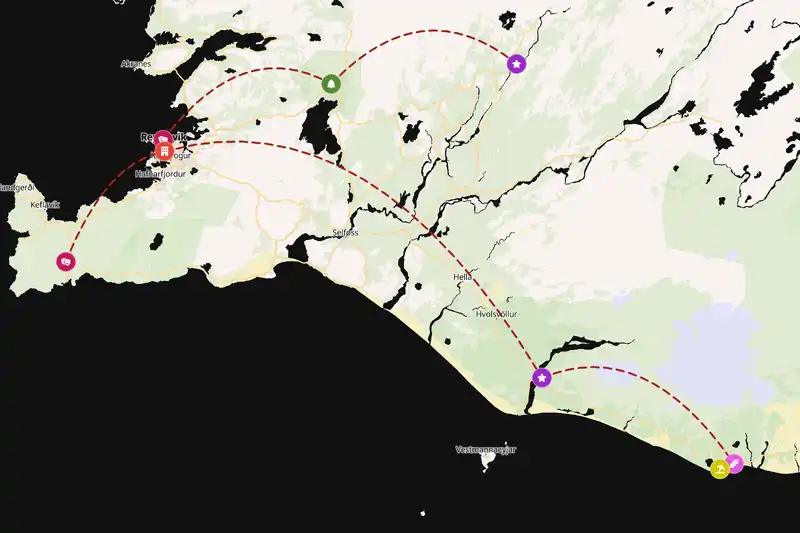
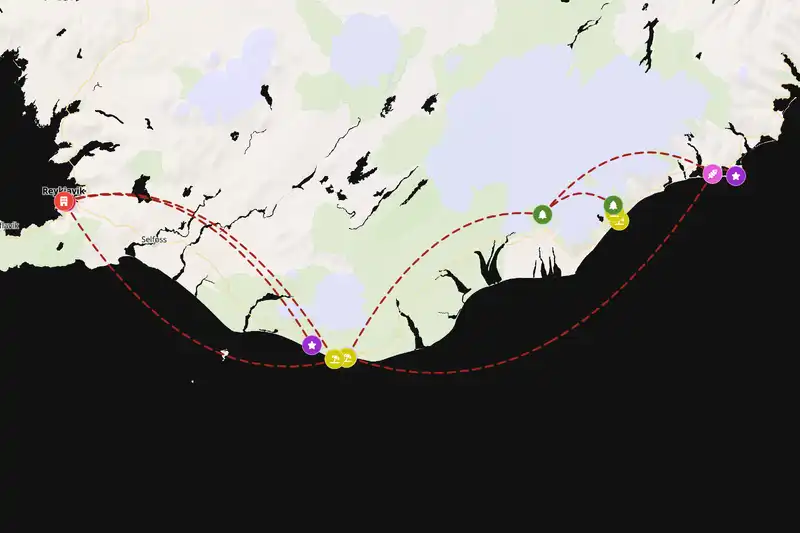
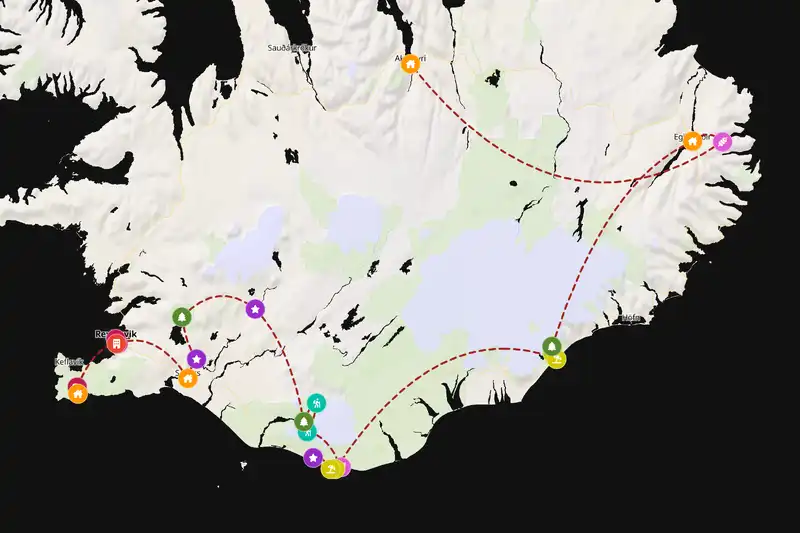
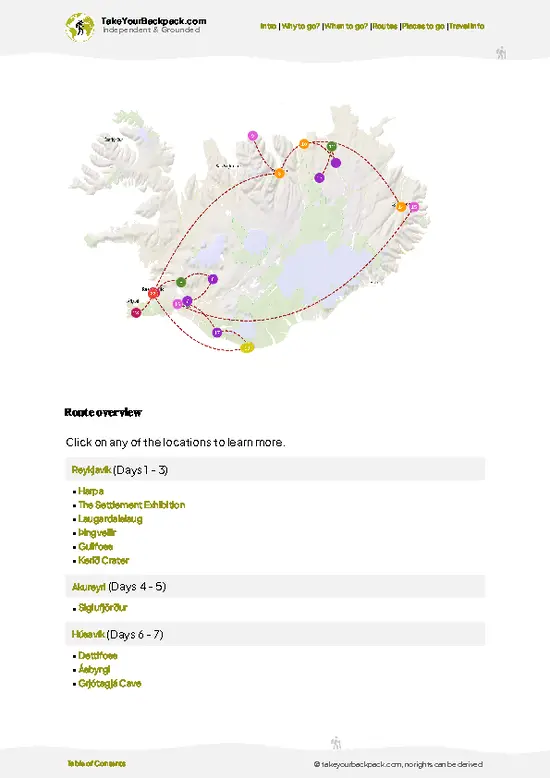
This fifteen-day loop is for travelers who want both ends of Iceland, the fjord towns of the north and east as well as the waterfall-and-black-sand south, without renting a car. The pace is relaxed, with two or three nights in most bases and only one long bus day. You’ll use Strætó long-distance buses, one domestic flight from Egilsstaðir to Reykjavík, and a few day tours where the bus network stops short.
Days 1-3: Reykjavik and the Golden Circle
Start slow in
Reykjavik, because jet lag and Icelandic prices both take a day to absorb. Walk the harbor to
Harpa Concert Hall and Conference Centre, whose glass facade throws colored light onto the floor inside, then go underground at
The Settlement Exhibition, where the excavated walls of a Viking-age longhouse sit beneath Aðalstræti, a few meters from where they were found. Spend an evening like a local at
Laugardalslaug Geothermal Pool, the city’s biggest pool, with hot tubs at different temperatures for about ISK 1,300 to 1,600 (US$10 to 12). …
read more 👉This fifteen-day loop is for travelers who want both ends of Iceland, the fjord towns of the north and east as well as the waterfall-and-black-sand south, without renting a car. The pace is relaxed, with two or three nights in most bases and only one long bus day. You’ll use Strætó long-distance buses, one domestic flight from Egilsstaðir to Reykjavík, and a few day tours where the bus network stops short.
Days 1-3: Reykjavik and the Golden Circle
Start slow in Reykjavik, because jet lag and Icelandic prices both take a day to absorb. Walk the harbor to Harpa Concert Hall and Conference Centre, whose glass facade throws colored light onto the floor inside, then go underground at The Settlement Exhibition, where the excavated walls of a Viking-age longhouse sit beneath Aðalstræti, a few meters from where they were found. Spend an evening like a local at Laugardalslaug Geothermal Pool, the city’s biggest pool, with hot tubs at different temperatures for about ISK 1,300 to 1,600 (US$10 to 12).
On Day 3 join a Golden Circle minibus tour, since no regular public bus covers it. Þingvellir is where you walk the Almannagjá rift between two tectonic plates, Gullfoss drops in two steps into a narrow canyon, and many tours add Kerid Crater, a red-gravel volcanic bowl with a blue-green lake at the bottom and a small entry fee.Days 4-5: Akureyri and Siglufjörður
Take Strætó route 57 north, about 6.5 hours via Borgarnes and Blönduós, and budget roughly ISK 11,000 to 14,000 (US$80 to 100). Akureyri is small enough to cover on foot, with a botanical garden that seems unlikely this close to the Arctic Circle and a pedestrian street of bakeries and bookshops. On Day 5, ride the local bus through the Tröllaskagi tunnels to Siglufjörður, a former herring capital where the Herring Era Museum explains how this fishing village once salted barrels for half of Europe.Days 6-7: Husavik and the Diamond Circle
Route 79 reaches Husavik in about 1 hour 15 minutes. This is the whale-watching town of the north, and the old oak boats leaving the harbor charge around ISK 11,000 to 14,000 (US$80 to 100) for three hours on Skjálfandi Bay, with humpbacks most summers. Use Day 7 for a Diamond Circle tour: Dettifoss is one of the most powerful waterfalls in Europe, Ásbyrgi is a horseshoe-shaped canyon with 100-meter cliffs and birch woods on its floor, and the stop at Mývatn usually includes Grjótagjá Cave, a lava fissure with a steaming blue pool inside (look, but bathing is off-limits).Days 8-10: Egilsstaðir and Seyðisfjörður
Day 8 is the long one. Bus back to Akureyri, then take route 56 east across the lava plateau; check the timetable, because departures thin out outside summer. Sleep one night in Egilsstaðir, the practical hub of the east, beside the long glacial lake Lagarfljót. Next morning a local bus climbs the Fjarðarheiði pass to Seyðisfjörður in about 30 minutes. Two nights here gives you time for the painted street leading to the pale-blue church, the craft shops and the waterfalls tumbling down both sides of the fjord.Days 11-14: Hveragerði, Vik and the South Coast
Fly from Egilsstaðir to Reykjavík (about 1 hour, usually ISK 15,000 to 30,000 or US$110 to 220), then catch the bus 45 minutes east to Hveragerði, a greenhouse town sitting on a geothermal field. The hot-river walk up the valley behind town takes about an hour each way, so it fits the afternoon. On Day 12 continue by bus toward Vik, stopping at Seljalandsfoss, the 60-meter falls with a path that loops behind the water (bring a rain jacket even on a sunny day).
Two nights in Vik let you see the coast at different tides and lights. Reynisfjara has basalt columns and the Reynisdrangar sea stacks, and its sneaker waves have killed visitors, so stay well back from the waterline. Dyrhólaey is the arch and headland to the west, where puffins nest roughly from May to August. Neither has a bus stop, so arrange a taxi or a local tour, and use Vik Beach below the village for a free evening walk. Return to Reykjavik on Day 14 for a final night.Day 15: Blue Lagoon
Save the Blue Lagoon for departure day. It sits about 20 minutes from Keflavík Airport, transfers link it with both the city and the terminal, and there is luggage storage, so your last memory of the country is milky-blue water instead of a check-in queue. Book ahead; entry starts around ISK 11,000 (US$80).
If a friend asked me for one extra day on this route, I’d tell them to take a tour from Egilsstaðir to Stuðlagil canyon, where hexagonal basalt columns line a glacial river so turquoise it looks edited, and to bring proper boots for the steep path down to the water.
 Best Backpacking