×
India🇮🇳 | 21 days itinerary

How to Spend 21 Days in India

By Johan Kruseman 🇳🇱 | Updated May 11, 2026
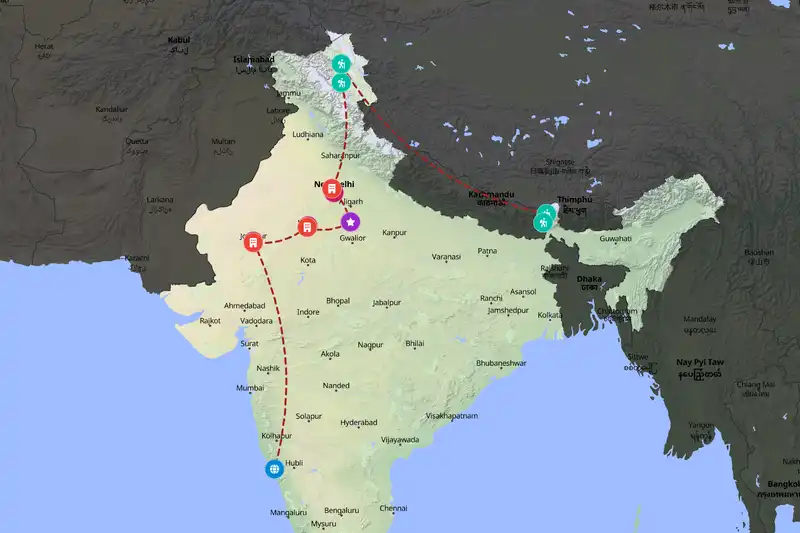
This 21-day itinerary is for travelers who want a fuller sweep of India’s north and west: classic monuments, desert forts, and a quick hit of the Himalaya, moving at a medium pace with a mix of trains, one or two domestic flights, and a couple of longer car transfers. You’ll cover more ground than the 14-day route but still have breathing room in each stop, so it feels like a journey rather than a checklist.

Days 1-3: Delhi - capital crash course

Start in Delhi for three nights to get your bearings and dive into the layers of empire that set up the rest of the trip. Split your time between the Mughal core around the Red Fort and the leafy avenues of New Delhi, then head out to the Qutub Minar Complex to see how early Delhi Sultanate architecture set the tone for everything you’ll see later. Use the metro to hop between neighborhoods, and keep one evening for either the Lotus Temple or Akshardham Temple if you want a more modern spiritual counterpoint to the old mosques and forts.

Days 4-6:

read more 👉
This 21-day itinerary is for travelers who want a fuller sweep of India’s north and west: classic monuments, desert forts, and a quick hit of the Himalaya, moving at a medium pace with a mix of trains, one or two domestic flights, and a couple of longer car transfers. You’ll cover more ground than the 14-day route but still have breathing room in each stop, so it feels like a journey rather than a checklist.

Days 1-3: Delhi - capital crash course

Start in Delhi for three nights to get your bearings and dive into the layers of empire that set up the rest of the trip. Split your time between the Mughal core around the Red Fort and the leafy avenues of New Delhi, then head out to the Qutub Minar Complex to see how early Delhi Sultanate architecture set the tone for everything you’ll see later. Use the metro to hop between neighborhoods, and keep one evening for either the Lotus Temple or Akshardham Temple if you want a more modern spiritual counterpoint to the old mosques and forts.

Days 4-6: Agra - the Taj and beyond

A short train ride drops you into Agra, where two nights is enough to soak up the Mughal hits without lingering too long. Sunrise at the Taj Mahal is non-negotiable, but pairing it with the hulking walls and river views of Agra Fort gives you the political backdrop to all that marble romance. With your extra time, head out to Fatehpur Sikri, wandering through its red sandstone courtyards and empty halls that feel like the empire just walked out yesterday, then return to Agra for one last view of the Taj from a rooftop before heading into Rajasthan proper.

Days 7-10: Jaipur - palaces, bazaars, and desert light

From Agra, travel overland to Jaipur and settle in for four nights to really let the Pink City breathe. Dedicate a full day to Amer Fort, exploring its layered defenses and mirrored halls, then spend another drifting between the City Palace, the astronomical instruments nearby, and the latticed façade of Hawa Mahal. Use your remaining time to dive into the bazaars, sample street snacks, and maybe take a side trip to Ajmer for a day (0 nights) to visit its famous dargah and see a different, more devotional side of Rajasthan before returning to your Jaipur base each evening.

Days 11-14: Jodhpur and Mehrangarh - the Blue City

A day’s train or car ride brings you to Jodhpur, where three nights gives you time to balance fort, city, and a bit of desert edge. The star here is Mehrangarh Fort, a massive cliff-top stronghold that makes almost every other fort in India feel like a warm-up; spend a full day wandering its ramparts, museums, and viewpoints over the blue-washed old town. Use your other days to explore Jodhpur’s stepwells and markets, and if you’re keen, take a short countryside excursion before you move on deeper into the desert.

Days 15-18: Jaisalmer - golden fort and desert horizons

Continue west to Jaisalmer for three nights, trading blue cityscapes for honey-colored stone and big skies. Base yourself in or just outside the living Jaisalmer Fort, where narrow lanes, rooftop cafes, and old havelis make it easy to slow down between sightseeing bursts. One day should be reserved for exploring the fort and its Jain temples, another for a desert excursion out into the dunes, and your final day for simply wandering the town and watching the light change on the sandstone walls before you loop back toward the plains.

Days 19-21: Rishikesh - Ganges, yoga, and foothills

From Jaisalmer, connect via Delhi to reach Rishikesh, swapping desert heat for Himalayan foothill air for your last three nights. Here the focus shifts from forts to river life: walk the pedestrian bridges, sit in on an ashram yoga class, and watch the evening aarti on the Ganges as the hills darken around you. Use your final full day for short hikes in the surrounding hills or a quick visit into the edge of Rajaji National Park on a day trip (0 nights) if you want a low-key wildlife taster, then wrap up your journey with one last riverside chai before heading back toward Delhi and home.

The moment that always sticks with me on this route is standing on Mehrangarh’s ramparts at sunset, watching Jodhpur’s blue houses fade into the desert haze while the evening call to prayer rolls across the city.
Loading the map 🌍
film
0
0
0a
Delhi
Pixabay
film
1
1
1a
Taj Mahal
film
2
2
2a
Jaisalmer

🛏️ Where to stay?21 Days of Adventure

✈️ The backpacker research shortcutIndia Travel Guide

An offline-friendly backpacking guide with optimized travel routes, ranked highlights, transport advice, and the best areas to stay.
example page 0 from our offline Travel Guide for Indiaexample page 1 from our offline Travel Guide for Indiaexample page 2 from our offline Travel Guide for Indiaexample page 3 from our offline Travel Guide for Indiaexample page 4 from our offline Travel Guide for Indiaexample page 5 from our offline Travel Guide for India
The digital guide (442 pages) contains:
164 highlights, ranked by travel appeal
Optimized 14, 21 & 30-day travel routes
Best neighborhoods to stay
How to get around
Offline-friendly for travel without Wi-Fi
👉 See all 30+ guide features

📅 Plan smarter in minutes, not weeks
Month by month travel advice
Festivals & national holidays
Budget expectations

🗺️ Go to the right places, skip the overrated ones
Honest pros & cons of destinations
Top hikes, parks & viewpoints
Lesser-known places most travelers miss
Clear “worth it vs skip it” guidance

🛏️ Travel smoothly without rookie mistakes
Best areas to stay
Transport systems explained simply
Common scams & safety advice
SIM cards, money & practical tips

🌍 Understand the country, not just visit it
Culture & traditions
52 Essential phrases & customs
Festivals worth planning around
Traveler-friendly historical context
Insights that make places more meaningful

📱 Built for real travel conditions
Fully downloadable PDF
Works completely offline
Optimized for phone use
Useful in remote areas & buses
Everything in one place
Save weeks of stressful planning
Get instant access to the full guide directly. 30-day money-back guarantee.


Sent to your inbox immediately after payment • 100% Secure Checkout
Best Backpacking Travel Advisor 2025 tourism awardBest Backpacking
Travel Advisor
2025
What others say about Take Your Backpack Guides:
⭐⭐⭐⭐⭐
Fantastic, amazing amount of information!
⭐⭐⭐⭐⭐
My goodness this is amazing, it's what I've been looking for hats off too you!
⭐⭐⭐⭐⭐
I think this is absolutely BRILLIANT
⭐⭐⭐⭐
Very complete and informative. It's still missing places, but I gotta to commend you
⭐⭐⭐⭐⭐
This is truly amazing, thank you, can't wait to explore it with my kids!
⭐⭐⭐⭐⭐
Awesome resource, thank you!
⭐⭐⭐⭐⭐
This is amazing! Can't wait to explore the ones I haven't seen
⭐⭐⭐⭐
I love this! Well done, great idea.
⭐⭐⭐⭐⭐
Thanks for taking the time to make this gem!
⭐⭐⭐⭐⭐
This might be the best website I've ever seen.
⭐⭐⭐⭐⭐
Congratulations, and thank you so much for your work; it's incredibly valuable.
⭐⭐⭐⭐
In all seriousness I think you did a great job pointing out the important spots
⭐⭐⭐⭐⭐
10/10 very good
⭐⭐⭐⭐⭐
As someone who's only just starting to visit regularly this is awesome, thank you.
⭐⭐⭐⭐
Thank you very much! I'm going to visit my dad, it's going to be very useful!
⭐⭐⭐⭐⭐
This is really cool! We'll be travelling for the first time and this definitely come in handy.
⭐⭐⭐⭐⭐
You are now our minister of culture, congratulations 👨‍💼
⭐⭐⭐⭐⭐
Just wanted to tell you that this is a pearl! Going to follow your recommendations.
⭐⭐⭐⭐⭐
This is so cool. I'll definitely be using the resource for my travels soon.
⭐⭐⭐⭐⭐
This is very impressive! Good work.
⭐⭐⭐⭐⭐
This is an amazing and informative site. Very well done!

🧭 RouteMore Ways to Explore

Travel India your way — from a quick highlights trip to a slow-paced adventure.

🙋 FAQGood to Know

Short version: yes, India is absolutely backpackable on your own, as long as you’re flexible and a bit stubborn in a good way.

India is easy in the sense that:
- There’s a huge budget-travel ecosystem: hostels, cheap guesthouses, backpacker cafés, sleeper trains, overnight buses.
- English is widely understood in most cities and travel hubs, and signs at stations/airports are usually bilingual.
- You can almost always find a room and a meal within a few minutes’ walk of any major bus or train station.
- Locals are used to travelers and will often help you find platforms, buses, and food.

India is hard in the sense that:
- Crowds, noise, and chaos can be intense, especially in big cities and train stations.
- Trains and buses can be delayed, and last‑minute tickets sometimes sell out.
- Scams and pushy touts exist around major sights and transport hubs; you need to say “no” firmly and keep walking.
- Hygiene standards vary; you have to be picky about water and street food.

For a first‑timer, the easiest way to backpack India:
- Start with “soft landing” cities: Rishikesh, McLeod Ganj, Jaipur, Udaipur, Goa, Hampi, Varkala, Pondicherry. They’re used to foreigners and have plenty of hostels.
- Book your first 2–3 nights and your first long train/bus in advance so you’re not hunting for beds while jet‑lagged.
- Travel slower than you think: fewer cities, more days in each. India rewards depth, not checklists.
- Use backpacker hostels (Zostel/Moustache/Hosteller‑type places) for instant travel buddies and shared tips.

If you’ve handled places like Southeast Asia, Morocco, or Latin America, you can handle India. It’s not “effortless,” but it’s very doable and very worth the learning curve.
If you want a number: 3–4 weeks is the sweet spot for a first backpacking trip to India. You can do less, but you’ll be rushing.

Rough time guidelines:
- 1 week: Pick ONE region only. Example: just Rajasthan (Jaipur + Udaipur/Jodhpur), or just Goa, or just Rishikesh + nearby.
- 2 weeks: Two regions max. Example: Delhi–Agra–Rajasthan, or Mumbai–Goa–Hampi, or Kerala + a short inland detour (Munnar/Wayanad).
- 3–4 weeks: A classic first‑timer loop. Example: Delhi–Agra–Rajasthan–Rishikesh, or Mumbai–Goa–Hampi–Kerala, or a North India combo (Rajasthan + Rishikesh + Amritsar).
- 6–8 weeks: You can do a north–south combo without pure chaos: Rajasthan + North (Rishikesh/Dharamshala) + Goa/Hampi + Kerala.
- 3 months+: You can start adding the Himalaya (Ladakh, Spiti, Uttarakhand treks) or the Northeast.

Why you need more time than you think:
- Distances are huge; even fast trains and flights eat half‑days.
- You’ll lose time to train delays, heat, and the occasional stomach issue.
- The culture shock is real; you’ll want slow days to just sit in a café and process.

If you’re truly short on time (under 2 weeks), it’s better to do a tight, well‑chosen route than to “see all of India.” Think in clusters, not in dots on a map.
You can travel the entire country without ever renting or driving a car, and most backpackers do exactly that.

Main ways to get around:
- Trains: The backbone of budget travel. Overnight sleepers are cheap, social, and time‑efficient. Aim for 2A/3A/SL classes depending on comfort and budget. Book popular routes in advance when possible.
- Buses: Fill the gaps where trains don’t go or schedules don’t work. You’ll find everything from basic government buses to AC sleeper coaches. Overnight buses are common on routes like Goa–Hampi, Jaipur–Jodhpur, Bangalore–Gokarna.
- Domestic flights: Useful for long jumps (e.g., Delhi–Goa, Mumbai–Kochi, Kolkata–Guwahati). Not the cheapest per kilometer, but they save days.
- Local transport: Auto‑rickshaws, cycle‑rickshaws, metro systems (Delhi, Mumbai, Bangalore, etc.), city buses, and app taxis (where available). These cover the “last mile” from station to hostel.

How to keep it smooth without a car:
- Build your route around train lines and major bus corridors instead of drawing straight lines on a map.
- Travel overnight for long distances to save on accommodation and maximize days.
- In cities, use metro where it exists; it’s cheap, fast, and less stressful than haggling with rickshaws.
- For remote areas (Himalayan valleys, rural villages), use shared jeeps and local buses; they’re slow but cheap and part of the adventure.

Driving yourself is usually more stress than freedom in India. Public transport plus the occasional taxi or shared jeep is the standard backpacker combo and works very well.
For a budget backpacker, “must‑visit” means places that give you a strong sense of India’s character without draining your wallet or your sanity. These are the ones that consistently deliver:

1. Rajasthan (Jaipur, Udaipur, Jodhpur, Jaisalmer)
- Why: Forts, palaces, blue and golden cities, desert landscapes, and a ton of cheap guesthouses and hostels.
- Best for: First‑timers who want that classic “India” feel with decent infrastructure.
- Don’t try to do all four cities in a week; pick 2–3 and linger.

2. Agra (Taj Mahal – short, focused stop)
- Why: The Taj really is worth seeing once in your life, especially at sunrise.
- Best for: A 1–2 night detour from Delhi or Jaipur. See the Taj, maybe Agra Fort, then move on.

3. Rishikesh (and nearby Himalaya gateways)
- Why: Ganga river, yoga, cafés, hostels, and an easy first taste of the mountains.
- Best for: Slower days, meeting other travelers, and recovering from big‑city overload.

4. Himachal/Uttarakhand hill towns (McLeod Ganj, Dharamkot, Manali, Kasol, etc.)
- Why: Cooler air, mountain views, chill backpacker scenes, and good value stays.
- Best for: Long stays on a budget, short treks, and café‑hopping with a view.

5. Goa (especially if you like beaches and social hostels)
- Why: Easygoing, lots of budget stays, scooter‑friendly, and a good place to pause and reset.
- Best for: Beach time, parties if you want them, or quiet villages if you don’t.

6. Hampi (Karnataka)
- Why: Surreal boulder landscapes, ruins you can explore by bicycle or scooter, and a laid‑back village vibe.
- Best for: Budget travelers who like scenery and history without big‑city chaos.

7. Kerala (Kochi, Alleppey backwaters, Varkala, Munnar/Wayanad)
- Why: Slower pace, palm trees, backwaters, and good food. Easy to travel without much stress.
- Best for: First‑timers who want a gentler introduction to India.

8. Amritsar (Golden Temple)
- Why: The Golden Temple complex is one of the most powerful and welcoming places you can visit, with free community meals and lodging options.
- Best for: Cultural immersion and seeing community service in action.

If you have more time or a second trip, add Ladakh/Spiti (high Himalaya), the Northeast (Meghalaya, Nagaland, Arunachal), and big cities like Mumbai or Kolkata for a deeper dive.
If you’re short on time, skip anything that eats days without giving you a strong, unique experience in return. That usually means:

1. Extra‑large city marathons
- You don’t need to deeply “do” every big city. If time is tight, limit yourself to 1–2 major cities (e.g., Delhi + Mumbai or just Delhi) instead of trying to squeeze in Delhi, Mumbai, Kolkata, Chennai, and Bangalore.
- In Delhi, focus on 2–3 key areas (Old Delhi, a couple of monuments, maybe one market) instead of racing across the entire metro map.

2. Overlapping forts and palaces
- In Rajasthan, every city has a fort, palace, and old town. They’re great, but after 3–4, they blur together.
- If you’re rushing, pick a couple of standouts (e.g., Amber Fort in Jaipur, Mehrangarh in Jodhpur, city palace + lake in Udaipur) and skip the rest of the minor forts and museums.

3. Long detours just for bragging rights
- Avoid huge side trips that require 2–3 days of buses/trains just to tick one sight, especially if it’s similar to something you’re already seeing.
- Examples: Going all the way to Wagah Border ceremony if you’re not already in Amritsar; crossing the country just to add one extra beach when you already have Goa or Kerala.

4. Rushed Himalaya or Ladakh if you don’t have time to acclimatize
- High‑altitude regions like Ladakh and Spiti need time for acclimatization and weather windows.
- If you have under 3 weeks total and are already doing a north–south route, save these for another trip instead of a frantic 4–5 day dash.

5. Generic malls and modern nightlife districts
- If you’re backpacking on a budget, skip Western‑style malls, high‑end bars, and imported‑alcohol nights unless that’s genuinely your priority; they burn cash fast and don’t tell you much about India.

6. Over‑touristed, high‑stress areas when you’re already burnt out
- If you’re exhausted, it’s okay to skip one more crowded temple or market and spend that day in a quieter town or café instead.

When in doubt, cut one city and add two days to somewhere that already feels good. India rewards depth: fewer places, more time in each, and more actual experiences instead of train windows.

🇮🇳 IndiaDiscover the Country

Ready to build a truly unique trip? Predefined routes are perfect for first-time visitors, but there is so much more to discover. Whether you are chasing a city trip, pristine national parks, local food scenes, or quiet beaches, pick a category to design your own path.