×

Italy🇮🇹 | best landmarksWhere to Find the 12 Best landmarks in Italy

Landmarks in Italy are not one product. In Rome, Florence and Venice they are ticketed, timed and crowded, with queues that punish anyone who turns up unbooked. In the south and Sicily, ancient temples, Greek theaters and hilltop towns cost far less (many sites charge €5 to 15), draw thinner crowds and take more effort to reach by slow regional trains and buses. The north adds lakes, Alpine villages and Renaissance cities with efficient rail and higher prices. Rome is worth the money and the planning. Venice is worth a day, not a week, because beds cost double what they do elsewhere. Skip any landmark that requires a tour-bus transfer when a €10 regional train does the same job. For backpackers and other independent travelers, the smartest approach is to mix one or two headline sites with lesser-known small-town landmarks, where entry is often free and the atmosphere is local rather than staged.

By Johan Kruseman 🇳🇱 | Updated October 18, 2026
Explore the best national parks in Italy

Why go?Why These unique site Stand Out

Italy has more UNESCO World Heritage sites than any other country, with roughly 60 listed, and the reason is layered history. Etruscans, Greeks, Romans, medieval city-states, Renaissance patrons and the Papacy all built in the same compact peninsula, often on top of each other. A traveler can move between 2,500 years of architecture within a few hours by train. Rivalry between independent city-states also left each region with its own style, dialect and food, so landmarks feel regionally distinct rather than repetitive.

The infrastructure is a real advantage. High-speed trains link Turin, Milan, Venice, Florence, Rome and Naples, and regional trains reach most mid-sized towns for a few euros. The mild Mediterranean climate keeps most open-air sites accessible for much of the year.

Before … read more 👉
Italy has more UNESCO World Heritage sites than any other country, with roughly 60 listed, and the reason is layered history. Etruscans, Greeks, Romans, medieval city-states, Renaissance patrons and the Papacy all built in the same compact peninsula, often on top of each other. A traveler can move between 2,500 years of architecture within a few hours by train. Rivalry between independent city-states also left each region with its own style, dialect and food, so landmarks feel regionally distinct rather than repetitive.

The infrastructure is a real advantage. High-speed trains link Turin, Milan, Venice, Florence, Rome and Naples, and regional trains reach most mid-sized towns for a few euros. The mild Mediterranean climate keeps most open-air sites accessible for much of the year.

Before choosing Italy, know the downsides. The big names are heavily visited, and the most popular sites sell out days or weeks ahead in high season, so spontaneous plans fail there. Many sites close on Mondays, close for a long lunch in smaller towns, or restrict entry by dress code. Summer heat in the south and in Rome makes midday sightseeing miserable. Many landmarks are also churches, so they stay active places of worship with limited hours during services.

The south has fewer trains, and strikes (scioperi) occasionally halt rail travel for a day. Italy pays off for people who book the top sites early and leave room for the quieter, cheaper ones.
Behind the Scenes of Selection
The list of best unique sites in Italy is created based on history or culture, wow factor, atmosphere, quirks, and memorability. If you feel a unique site is missing in this list, please let us know.

When to go?Best Time to Visit Italy for landmarks

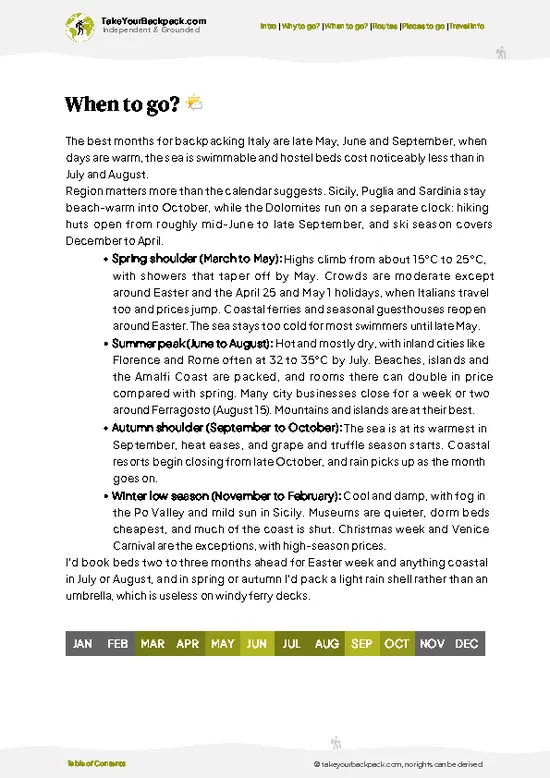
Best months for landmarks in Italy: April to early June and September to October are the best months: daytime temperatures sit around 15 to 26°C, sites are comfortable to walk, and crowds stay manageable compared with summer. Rain is most likely in autumn and spring, with October and November often the wettest, so a light waterproof is worth carrying.

Peak season and what it costs: July and August are the weak point. Rome, Florence and the south regularly reach 32 to 38°C, and the heat makes midday visits unpleasant. Ticket queues lengthen, and dorm beds and hotels can cost 30 to 60 percent more than in shoulder months. Easter week and the long weekends around 25 April and 1 May also fill hotels and sell out timed entries. Mid-August (Ferragosto) is the most awkward stretch: many small family-run … read more 👉
Best months for landmarks in Italy: April to early June and September to October are the best months: daytime temperatures sit around 15 to 26°C, sites are comfortable to walk, and crowds stay manageable compared with summer. Rain is most likely in autumn and spring, with October and November often the wettest, so a light waterproof is worth carrying.

Peak season and what it costs: July and August are the weak point. Rome, Florence and the south regularly reach 32 to 38°C, and the heat makes midday visits unpleasant. Ticket queues lengthen, and dorm beds and hotels can cost 30 to 60 percent more than in shoulder months. Easter week and the long weekends around 25 April and 1 May also fill hotels and sell out timed entries. Mid-August (Ferragosto) is the most awkward stretch: many small family-run businesses in cities close, though major landmarks stay open.

Winter and regional differences: November to March is cheap and quiet, and it suits Rome, Naples, Sicily and Puglia, where winter days still reach 10 to 16°C. It is a poor choice for the Alps, the Dolomites and the northern lakes, where some ferries, villages and viewpoints reduce service or close from November. Venice floods occasionally in autumn and winter, and Milan and Turin can be foggy and cold, often near 0 to 8°C.

In the south and Sicily, spring comes early, and March and April are already pleasant. Shoulder season gives the best balance of weather, price and opening hours, while late June and early September can still work if you start early and rest in the afternoon.

unique site hoppingPlanning Your Route Efficiently

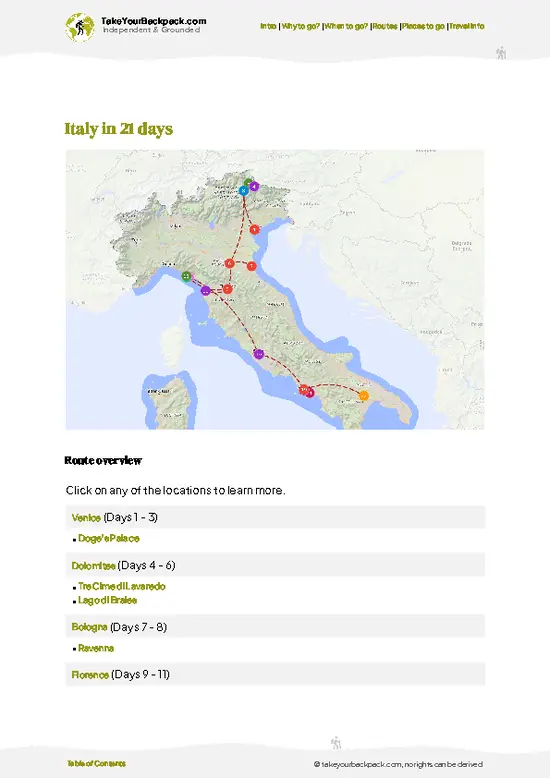
How many days to plan: A trip combining several landmarks in Italy needs 10 to 14 days; anything shorter pushes you into a rushed transit-heavy schedule. The country is long and narrow, so a north to south direction (Milan or Venice, then Florence, Rome, Naples) works well because the fast trains run on that spine, and you can end in the cheaper, slower south.

Which regions group well: Veneto, Tuscany and Lazio form a natural chain linked by high-speed rail. Venice to Florence takes about 2 hours, Florence to Rome about 1.5 hours and Rome to Naples about 1 hour 10 minutes. Campania connects easily to Puglia or Sicily, but those stretches add 4 to 8 hours by rail, bus or ferry, so treat them as a separate leg rather than a day trip.

Time per stop: Rome needs 3 to 4 days, Florence 2, Venice … read more 👉
How many days to plan: A trip combining several landmarks in Italy needs 10 to 14 days; anything shorter pushes you into a rushed transit-heavy schedule. The country is long and narrow, so a north to south direction (Milan or Venice, then Florence, Rome, Naples) works well because the fast trains run on that spine, and you can end in the cheaper, slower south.

Which regions group well: Veneto, Tuscany and Lazio form a natural chain linked by high-speed rail. Venice to Florence takes about 2 hours, Florence to Rome about 1.5 hours and Rome to Naples about 1 hour 10 minutes. Campania connects easily to Puglia or Sicily, but those stretches add 4 to 8 hours by rail, bus or ferry, so treat them as a separate leg rather than a day trip.

Time per stop: Rome needs 3 to 4 days, Florence 2, Venice 1 to 2 and Naples 2. Smaller towns need half a day to a day. Cramming a city into a single afternoon wastes the transit time you paid for.

Planning mistakes to avoid: The most common error is treating Italy as a quick checklist of 8 cities in 8 days, which means you spend a large share of your trip on station platforms. Pick 3 to 5 bases and use day trips instead. A second mistake is booking the high-speed Frecciarossa or Italo at the last minute, when fares can run to €50 to 90 for a trip that costs €15 to 30 when booked weeks ahead. Regional trains have fixed, low prices and do not need booking, so use them for short hops. Travelers also forget Monday closures and arrive in a city on its day off. Check opening days before locking in the order of stops. Finally, leaving the south for an extra day or two is smarter than adding another northern city, because buses there are slower and less frequent.

The ListMust-Visit landmarks in Italy

1 Colosseum

Amphitheater, Roman engineering, gladiator arena

Stand beneath towering arches and imagine the roar of crowds, as the scale and design of ancient Rome’s arena come into sharp focus.

Italy - Colosseum

2 Piazza dei Miracoli

Leaning tower, marble baptistery, medieval square

Experience a cluster of monumental buildings set on green lawns, where architectural experiments and medieval ambition are on full display.

italy-unique-site-piazza-dei-miracoli
© Google | Maximilian Richard

3 Tre Cime di Lavaredo

Dolomite peaks, alpine trails, rugged cliffs

Hike beneath sheer rock faces and across high meadows, with changing light and weather revealing new perspectives at every turn.

Italy - Tre Cime di Lavaredo

4 Mount Etna

Active volcano, lava fields, summit craters

Ascend shifting volcanic slopes and feel the ground’s warmth, with panoramic views shaped by eruptions and changing weather.

italy-unique-site-mount-etna
© Google | Doppy (winnie)

5 Trulli of Alberobello

Conical roofs, limestone dwellings, Apulian village

Navigate narrow lanes lined with clustered stone houses, where unique construction methods reflect local materials and centuries of adaptation.

italy-unique-site-trulli-of-alberobello
© Google | Alexey Slavko

6 Villa Adriana

Imperial retreat, reflecting pools, mosaic floors

Explore sprawling grounds dotted with ruins, where water features and hidden chambers reveal the private world of a Roman emperor.

7 Valley of the Temples

Greek temples, ancient ruins, Sicilian landscape

Walk among monumental stone columns and olive groves, tracing the outlines of a city that shaped Mediterranean civilization for centuries.

italy-unique-site-valley-of-the-temples
© Google | Paul Neighbour

8 Royal Palace of Caserta

Grand palace, formal gardens, monumental fountains

Wander through vast halls and along tree-lined canals, where royal ambition shaped both architecture and the surrounding landscape.

italy-unique-site-royal-palace-of-caserta
© Google | Around The World

9 Modena Cathedral

Romanesque architecture, sculpted façade, bell tower

Admire intricate stonework and climb the medieval tower for views that reveal how faith and artistry merged in Modena’s urban heart.

italy-unique-site-modena-cathedral
© Google | Damiana Facchin

10 Prosecco Hills

Vineyard hills, rural villages, wine terraces

Travel winding lanes between steep vineyards, where small producers and centuries-old traditions define the rhythm of local life.

italy-unique-site-prosecco-hills
© Google | Ngo Hai Anh

11 Appian Way

Ancient road, basalt paving, Roman milestones

Follow a straight path through open countryside and ruined tombs, tracing the original route that once connected Rome to the south.

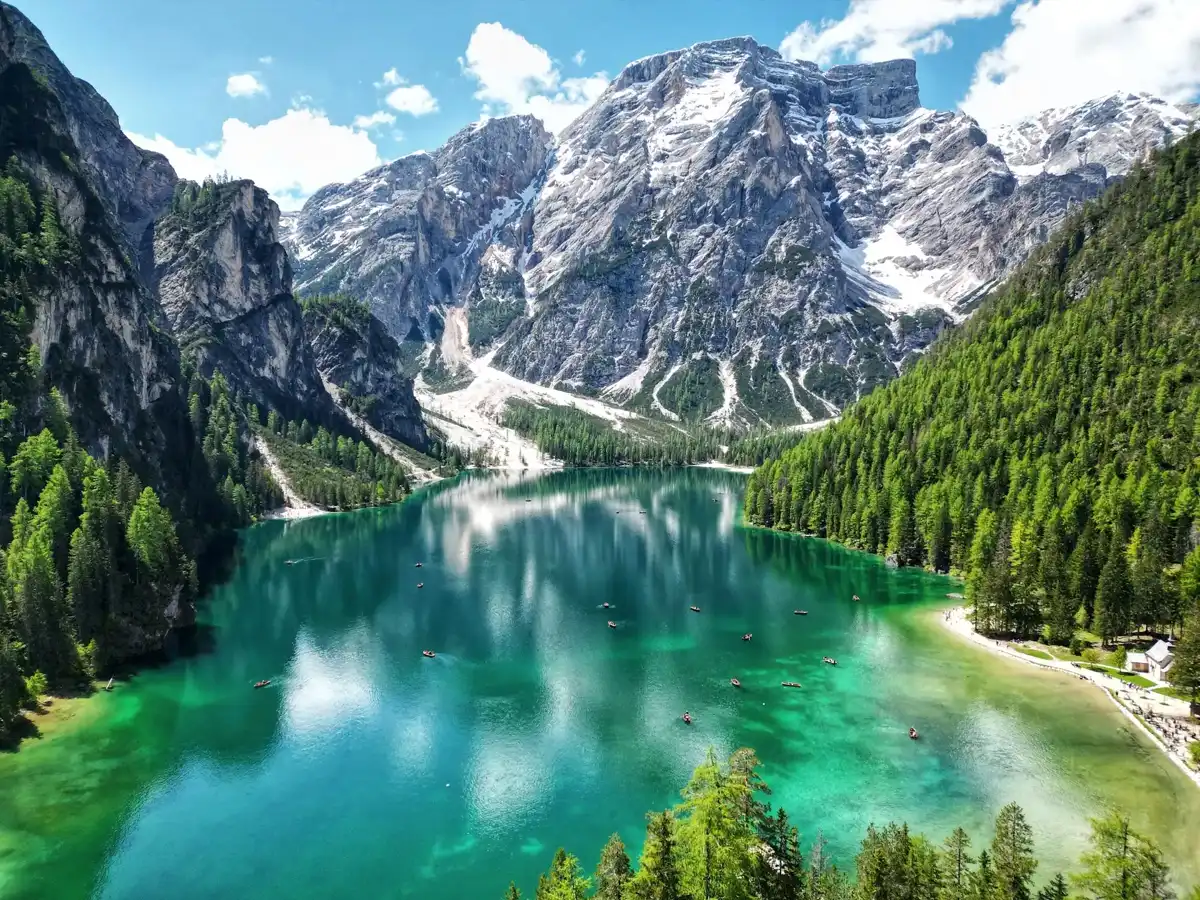
12 Lago di Braies

emerald lake, Dolomite backdrop, wooden boats

Paddle or walk around a striking alpine lake, framed by dramatic cliffs and forests in the northern Dolomites.

Loading the map 🌍

Expert viewTips and Advice from Travelers

How many landmarks to visit: Plan on one major paid landmark per day, with a second smaller one at most. Italy’s big sites take 2 to 4 hours each when you include security lines, and the third visit in a day is usually the one you half-remember. A 10 to 14 day trip supports roughly 8 to 12 landmarks done well. Beyond that, your attention drops and your budget starts to feel the strain.

Which kind to prioritize: For first-timers, the Roman and Renaissance headliners are worth the booking effort because nothing else matches their scale and artistic density. History readers should favor archaeological sites in the south and Sicily, where entry is cheaper and the crowds are smaller. Architecture and art fans should spend time in Florence, but skip multi-museum passes unless you will really use … read more 👉
How many landmarks to visit: Plan on one major paid landmark per day, with a second smaller one at most. Italy’s big sites take 2 to 4 hours each when you include security lines, and the third visit in a day is usually the one you half-remember. A 10 to 14 day trip supports roughly 8 to 12 landmarks done well. Beyond that, your attention drops and your budget starts to feel the strain.

Which kind to prioritize: For first-timers, the Roman and Renaissance headliners are worth the booking effort because nothing else matches their scale and artistic density. History readers should favor archaeological sites in the south and Sicily, where entry is cheaper and the crowds are smaller. Architecture and art fans should spend time in Florence, but skip multi-museum passes unless you will really use four or five sites in the validity window. Hikers and outdoor travelers get more from Alpine and lake landmarks than from a fourth cathedral. Churches are the best-value category in Italy: many are free, and the best ones hold major artwork. Skip any tower or dome climb that costs €15 to 20 if the view is one you can get from a free hilltop.

What it costs: A budget backpacker can cover food, a dorm bed and local transport for US$60 to 90 a day in the north and Rome, and US$45 to 70 in the south. Add landmark spending on top: major sites usually cost €12 to 25 each, smaller ones €5 to 12, and many churches are free or ask for a €2 to 5 donation. A realistic sightseeing budget is €15 to 30 a day. Audio guides cost €5 to 8 and are usually better value than live guides at €15 to 40 a person on group tours. Local transport adds €1.50 to 2 per city bus or metro ride, and regional trains €5 to 20.

Skip the skip-the-line resellers who charge €40 to 70 for what costs €20 to 25 on the official site. Book tickets directly on official websites and avoid sellers at the gates.

Safety and cultural considerations: Pickpocketing is the main risk around major landmarks, crowded buses, and train stations in Rome, Naples, Florence and Milan. Carry your phone and wallet in a front pocket or zipped bag. Violent crime is rare in tourist areas. Be wary of friendship-bracelet sellers, petition clipboards and people offering to help you with ticket machines, because these are standard scam approaches.

Many landmarks are active churches, and staff enforce dress codes: shoulders and knees covered, for both men and women. A light scarf or sarong in your daypack solves the problem and avoids turned-away entry. Large backpacks are often banned from museums and churches, so store luggage at a station (about €6 to 12 a day) before sightseeing. Photography rules vary, so check signs, since some chapels ban photos entirely and flash is forbidden almost everywhere.

Strict rules also apply to behavior. Sitting on monument steps, eating on historic steps and wading in fountains can bring fines of €50 to 500 in Rome, Florence and Venice. In Venice, a day-tripper entry fee has applied on selected peak days, so check the current calendar before arriving. Plan around Monday closures, and note that in the south some sites close by 1 or 2 pm in winter. Carry a refillable bottle: Italian cities have free drinking fountains that save you a few euros each day.

✈️ The backpacker research shortcutItaly Travel Guide

An offline-friendly backpacking guide with optimized travel routes, ranked highlights, transport advice, and the best areas to stay.
example page 0 from our offline Travel Guide for Italy
example page 1 from our offline Travel Guide for Italy
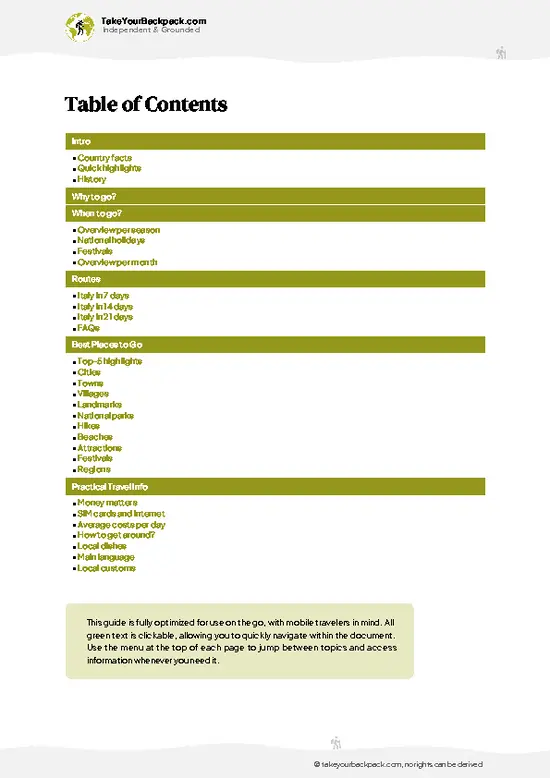
example page 2 from our offline Travel Guide for Italy
example page 3 from our offline Travel Guide for Italy
example page 4 from our offline Travel Guide for Italy
example page 5 from our offline Travel Guide for Italy
example page 6 from our offline Travel Guide for Italy
example page 7 from our offline Travel Guide for Italy
The digital guide (523 pages) contains:
✅ 142 highlights, ranked by travel appeal
✅ Optimized 7, 14 & 21-day travel routes
✅ Cities, national parks, landmarks, beaches
✅ How to get around
✅ Offline-friendly for travel without Wi-Fi
👉 Click to see all 30+ guide features

📅 Plan smarter in minutes, not weeks
✅ Month by month travel advice
✅ Festivals & national holidays
✅ Budget expectations

🗺️ Go to the right places, skip the overrated ones
✅ Honest pros & cons of destinations
✅ Top hikes, parks & viewpoints
✅ Lesser-known places most travelers miss
✅ Clear “worth it vs skip it” guidance

🛏️ Travel smoothly without rookie mistakes
✅ Best areas to stay
✅ Transport systems explained simply
✅ Common scams & safety advice
✅ SIM cards, money & practical tips

🌍 Understand the country, not just visit it
✅ Culture & traditions
✅ 52 Essential phrases & customs
✅ Festivals worth planning around
✅ Traveler-friendly historical context
✅ Insights that make places more meaningful

📱 Built for real travel conditions
✅ Fully downloadable PDF
✅ Works completely offline
✅ Optimized for phone use
✅ Useful in remote areas & buses
✅ Everything in one place
Stop searching, start planning
Get instant access to your full guide. 30‑day money-back guarantee.
+ Add another guide for just

By proceeding you agree to our terms.
Sent to your inbox immediately after payment • 100% Secure Checkout
Best Backpacking Travel Advisor 2025 tourism awardBest Backpacking
Travel Advisor
2025
What others say about Take Your Backpack Guides:
⭐⭐⭐⭐⭐
Fantastic, amazing amount of information!
⭐⭐⭐⭐⭐
My goodness this is amazing, it's what I've been looking for hats off too you!
⭐⭐⭐⭐⭐
I think this is absolutely BRILLIANT
⭐⭐⭐⭐
Very complete and informative. It's still missing places, but I gotta to commend you
⭐⭐⭐⭐⭐
This is truly amazing, thank you, can't wait to explore it with my kids!
⭐⭐⭐⭐⭐
Awesome resource, thank you!
⭐⭐⭐⭐⭐
This is amazing! Can't wait to explore the ones I haven't seen
⭐⭐⭐⭐
I love this! Well done, great idea.
⭐⭐⭐⭐⭐
Thanks for taking the time to make this gem!
⭐⭐⭐⭐⭐
This might be the best website I've ever seen.
⭐⭐⭐⭐⭐
Congratulations, and thank you so much for your work; it's incredibly valuable.
⭐⭐⭐⭐
In all seriousness I think you did a great job pointing out the important spots
⭐⭐⭐⭐⭐
10/10 very good
⭐⭐⭐⭐⭐
As someone who's only just starting to visit regularly this is awesome, thank you.
⭐⭐⭐⭐
Thank you very much! I'm going to visit my dad, it's going to be very useful!
⭐⭐⭐⭐⭐
This is really cool! We'll be travelling for the first time and this definitely come in handy.
⭐⭐⭐⭐⭐
You are now our minister of culture, congratulations 👨‍💼
⭐⭐⭐⭐⭐
Just wanted to tell you that this is a pearl! Going to follow your recommendations.
⭐⭐⭐⭐⭐
This is so cool. I'll definitely be using the resource for my travels soon.
⭐⭐⭐⭐⭐
This is very impressive! Good work.
⭐⭐⭐⭐⭐
This is an amazing and informative site. Very well done!

🛏️ Where to stay?Accommodation Highlights

Italy has hostels and budget guesthouses in every major city, with dorm beds running roughly €25 to €50 a night and spiking in summer and around big events. In Rome, Esquilino near Termini station has the most cheap beds and the best transport links but feels scruffy after dark, while Trastevere puts you among the best nightlife at higher prices and with late-night noise. In Florence, San Lorenzo and Santa Maria Novella keep you within a 15-minute walk of the Duomo, and in Venice, staying on the mainland in Mestre roughly halves the price but means a 10 to 15 minute train or bus ride into the historic center.

If you enjoy meeting fellow travelers, consider choosing hostels with high ratings for … read more 👉
Italy has hostels and budget guesthouses in every major city, with dorm beds running roughly €25 to €50 a night and spiking in summer and around big events. In Rome, Esquilino near Termini station has the most cheap beds and the best transport links but feels scruffy after dark, while Trastevere puts you among the best nightlife at higher prices and with late-night noise. In Florence, San Lorenzo and Santa Maria Novella keep you within a 15-minute walk of the Duomo, and in Venice, staying on the mainland in Mestre roughly halves the price but means a 10 to 15 minute train or bus ride into the historic center.

If you enjoy meeting fellow travelers, consider choosing hostels with high ratings for atmosphere. On the other hand, if you prefer having your own space, a hotel might be a better option.

ItalySee More of Italy

👋 Meet the founderWho’s Behind Take Your Backpack?

Johan, backpacker and founder of TakeYourBackpackHi, I’m Johan (Netherlands 🇳🇱), the creator of TakeYourBackpack. Over the past 3 decades, I’ve backpacked through 90+ countries across six continents, gaining extensive experience with independent travel, long-term trips, and overland routes.

This site is built on a combination of firsthand travel experience and carefully curated insights from other backpackers. Many guides are based on places I’ve personally visited, while others bring together tips, observations, and practical advice shared by trusted travelers I’ve met along the way.

The goal is to provide realistic, experience-driven guidance — not generic itineraries — so you can explore destinations with better context, clearer expectations, and more confidence.