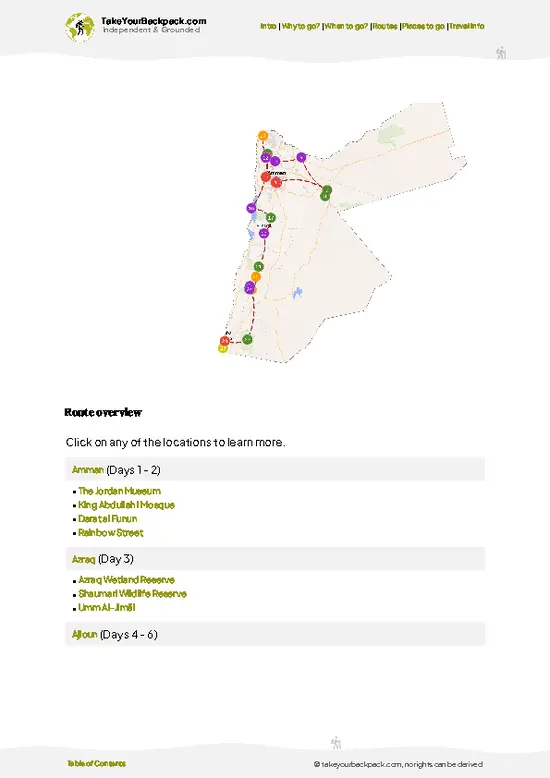
This fifteen-day loop is for travelers who want the whole of Jordan: the Roman north, the basalt and fresco ruins of the eastern desert, the Crusader castles of the King’s Highway, and the big southern three of Dana, Petra and Wadi Rum, with a Red Sea finish. The pace is relaxed. Most days involve two to three hours of moving, and the long hauls never fall back-to-back. JETT buses cover Amman to Wadi Musa and Aqaba, and local minibuses run the northern towns. The eastern desert, the Dead Sea and the King’s Highway have patchy public transport, so plan on a private driver or a rental car for those stretches. A Bedouin camp pickup handles Wadi Rum.
Days 1-3: Amman
Start in
Amman with two nights. That gives you a gentle first day to sort a SIM card, cash and jet lag. The first full day goes to the city’s modern face. Begin at
The Jordan Museum, where a few of the Dead Sea Scrolls and the 9,000-year-old plaster statues from Ain Ghazal give you the long view of everything you’re about to see. …
read more 👉This fifteen-day loop is for travelers who want the whole of Jordan: the Roman north, the basalt and fresco ruins of the eastern desert, the Crusader castles of the King’s Highway, and the big southern three of Dana, Petra and Wadi Rum, with a Red Sea finish. The pace is relaxed. Most days involve two to three hours of moving, and the long hauls never fall back-to-back. JETT buses cover Amman to Wadi Musa and Aqaba, and local minibuses run the northern towns. The eastern desert, the Dead Sea and the King’s Highway have patchy public transport, so plan on a private driver or a rental car for those stretches. A Bedouin camp pickup handles Wadi Rum.
Days 1-3: Amman
Start in Amman with two nights. That gives you a gentle first day to sort a SIM card, cash and jet lag. The first full day goes to the city’s modern face. Begin at The Jordan Museum, where a few of the Dead Sea Scrolls and the 9,000-year-old plaster statues from Ain Ghazal give you the long view of everything you’re about to see. Next comes the blue-tiled dome of King Abdullah I Mosque, one of the few mosques in the capital that welcomes non-Muslim visitors (abayas are provided at the door).
In the late afternoon, walk up to Darat al Funun art complex in Jabal al-Weibdeh. Its contemporary Arab art hangs in restored 1920s villas set around the excavated ruins of a Byzantine church, and the garden is the calmest spot in the city. From there it’s a short taxi hop to the Rainbow Street nightlife area. Falafel stands, rooftop cafés and shisha terraces stay busy until well after midnight.
Days 3-4: The Eastern Desert and Azraq
On day three, head east with a driver. The loop through the Desert Castles takes in Qasr Kharana, a square two-story fortress with no clear purpose even today, and Qasr Amra. Amra is a small Umayyad bathhouse whose ceilings are covered in 8th-century frescoes of hunters, musicians and bathers. Qasr Azraq, the black basalt fort where T.E. Lawrence wintered during the Arab Revolt, sits right in town.
Overnight in Azraq. The town is an oasis crossroads full of truck stops and Druze and Chechen families, and it’s the only practical base out here. Spend the afternoon on the boardwalk of Azraq Wetland Reserve, a pocket of reeds and water buffalo in the middle of the gravel desert. Then drive ten minutes to Shaumari Wildlife Reserve, where Arabian oryx were bred back from local extinction.
Days 4-7: Ajloun and the Green North
Day four is the one long drive of this stretch, roughly two and a half to three hours. Break it at Umm Al-Jimāl, a whole town of dark basalt houses, churches and cisterns near the Syrian border, where you’ll often be the only visitor. Then climb into the oak and pine hills to Ajloun for three nights.
Three nights here turns the north into easy day trips. Walk the trails of Ajloun Forest Reserve, where the RSCN lodge runs guided routes through strawberry trees and wild orchids in spring. Save a morning for Ajloun Castle, built in the 1180s by one of Saladin’s generals to watch over the Jordan Valley. Another full day belongs to Jersash, about 40 minutes away. Its oval plaza and colonnaded street make it one of the most complete Roman cities in the Middle East, and you need four or five hours to see it properly. Make the last day a run to Umm Qais, ancient Gadara. Its black basalt theater looks across the Yarmouk gorge to the Golan Heights and the Sea of Galilee.
Days 7-9: Al-Salt, the Dead Sea and Al-Karak
Roll south on day seven via Al-Salt. Its honey-colored Ottoman-era merchant houses and stepped alleys earned UNESCO status, and you can walk it in two hours before dropping 1,000-plus meters to the Dead Sea. Spend the night at the shore, roughly 430 meters below sea level. A resort day pass runs about 25 to 50 JOD (US$35 to 70), but staying overnight lets you float at sunrise before the heat builds.
On day eight, drive down the shore road to Wadi Mujib. From roughly April to October, the Siq Trail has you wading and scrambling up a sandstone canyon against the current. Then climb inland to Al-Karak for the night. Karak Castle is the main event: a 12th-century Crusader fortress with long vaulted passages that run deep into the hill. Bring a flashlight.
Days 9-11: Dana
The King’s Highway brings you to Dana by midday, a half-restored village of stone houses on the lip of a huge escarpment. Stay two nights. That buys you a full day in Dana Biosphere Reserve, where trails drop through red sandstone, granite and white limestone zones toward the copper-mining country of Wadi Feynan. Ibex sightings are common at dusk.
Days 11-13: Shobak and Petra
On the way south, stop at Shobak, a hilltop Crusader castle that sees a fraction of Karak’s visitors. Then continue to Wadi Musa for two nights. Give your one full day entirely to Petra. Walk the Siq at opening time to beat the tour groups to the Treasury, work through the Street of Facades and the Royal Tombs, then tackle the Petra Monastery Trail. Its roughly 800 rock-cut steps reach Ad-Deir, which is larger than the Treasury and far quieter by late afternoon. On your departure morning, visit Little Petra, a compact Nabataean canyon about 15 minutes north with a rare painted ceiling, before heading to the desert.
Days 13-15: Wadi Rum and Aqaba
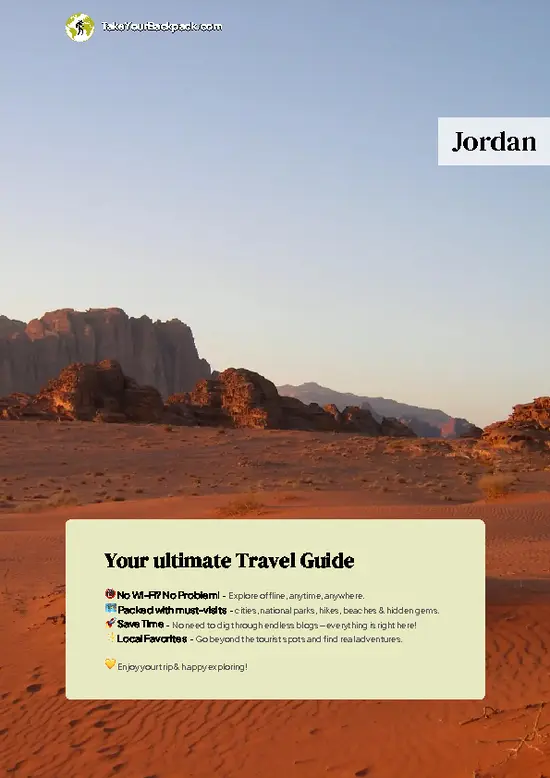
Spend one night in a Bedouin camp in Wadi Rum. A half-day jeep tour covers the dunes, rock bridges and Nabataean inscriptions. After that, the silence and the star field are the reason you came. On day fourteen, ride an hour south to Aqaba for your last night. Before your flight or bus, snorkel the coral reefs at South Beach, where parrotfish and lionfish sit a few meters off the sand.
I’d send a friend to walk the 14-kilometer trail from Dana down to Feynan Ecolodge, a candlelit desert lodge, and to book a night there before the trek so the downhill finish ends in a hot dinner instead of a haggle for transport.
 Best Backpacking


