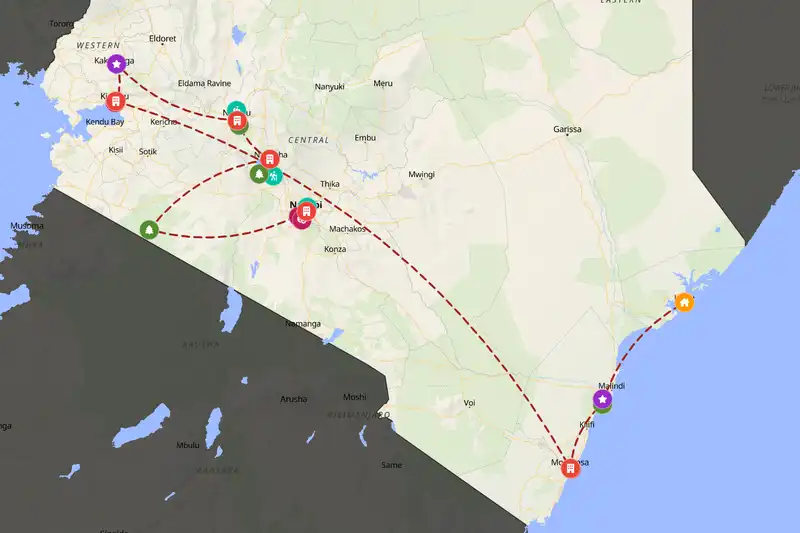
Yes, Kenya is one of the easier East African countries to backpack on your own, with cheap matatus, a reliable Nairobi to Mombasa train, M-Pesa mobile money and English spoken almost everywhere. The exception is safari: most parks require a vehicle, so you join a shared tour for those days.
Dorm beds in
Nairobi,
Naivasha and
Diani Beach run KES 1,500 to 2,500 (US$12 to 20), and matatu fares of KES 300 to 800 (US$2 to 6) cover runs like Nairobi to Naivasha (2 hours) or Nakuru (3 hours). A shared camping safari in the
Masai Mara costs roughly US$450 to 1,000 depending on length and season. Buy a local SIM with M-Pesa on arrival, since it pays for nearly everything.
Two weeks is the right length for a first trip to Kenya: enough for one safari region, the Rift Valley lakes and several days on the coast. One week covers Nairobi, Naivasha and the Masai Mara, while three weeks adds the western rainforest and Lamu.
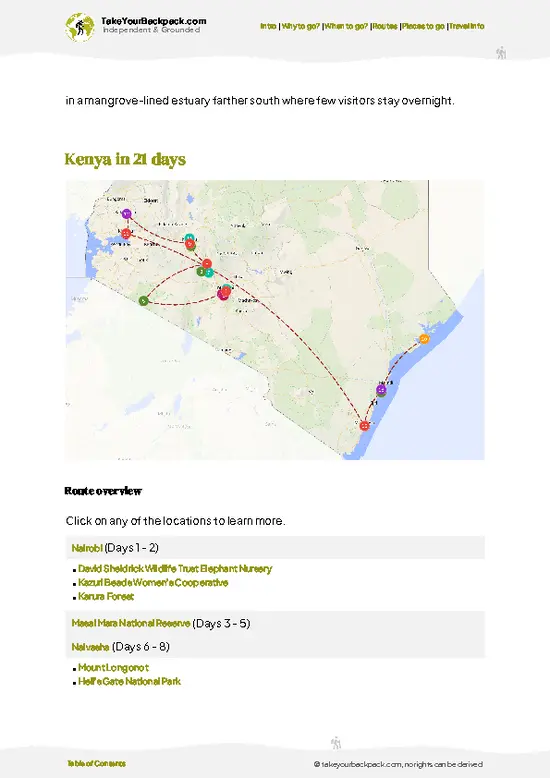
A typical two-week split is 2 nights in
Nairobi, 2 to 3 in
Naivasha for Hell’s Gate and Mount Longonot, 2 to 3 in the
Masai Mara, then the train to Mombasa (5 to 6 hours) and 4 nights at
Diani Beach. With 21 days, add Lake Nakuru, Kakamega Forest, Kisumu and 3 nights in
Lamu Old Town. Climbing Mount Kenya needs another 4 to 5 days on its own.
Yes, you can travel Kenya without a car using matatus, long-distance buses, the Madaraka Express train and cheap domestic flights; the only gap is inside the safari parks, where you need a tour or a hired vehicle with driver.
The
Nairobi to
Mombasa train takes 5 to 6 hours and costs KES 1,500 (about US$12) in economy. Matatus link Nairobi with Naivasha (2 hours), Nakuru (3 hours) and Nanyuki (3 to 4 hours) for KES 300 to 800 (US$2 to 6). Flights save days on longer legs: Kisumu to Mombasa takes about 1.5 hours, Malindi to Lamu around 30 minutes. For the
Masai Mara or
Samburu, book a shared safari that includes transport from town.
For a first trip to Kenya, the must-visits are the
Masai Mara National Reserve for big cats, the Rift Valley around
Naivasha,
Lamu Old Town on the north coast and
Diani Beach for sea time.
Give the Mara 2 to 3 nights; foreign visitors pay US$100 a day in park fees from January to June and US$200 from July to December, when the migration usually arrives. Naivasha, 2 hours from Nairobi by matatu, combines cycling in Hell’s Gate with the Mount Longonot rim hike. In Nairobi, the
David Sheldrick Wildlife Trust Elephant Nursery opens for one hour from 11am. Lamu deserves 3 nights and a flight from Malindi or Nairobi, and Mombasa’s
Fort Jesus Museum fills a good morning on the way.
If you’re short on time in Kenya, cut the remote north and far west first, since Lake Turkana, Marsabit and Lodwar each take a full day or more of travel in each direction.
Choose one southern park rather than stacking them:
Amboseli or
Tsavo makes sense mainly if you skip the Masai Mara. Lake Nakuru is worth it chiefly for rhinos, which
Ol Pejeta also covers. In Nairobi, Bomas of Kenya and the Railway Museum can go, and on the coast Mamba Village Crocodile Farm and Nyali Beach are easy cuts, because
Diani Beach, 1.5 to 2 hours south of Mombasa, has better sand and snorkeling. Leave Kitale, Mount Elgon and Kakamega Forest for a second trip.
Yes, our itinerary-planner does exactly that. Set your trip length in days, give your interests and travel style, optionally give start- and end location and/or some mandatory stops you would like to include and the itinerary planner creates your personalized routes for Kenya in seconds. Try it out!
Try the itinerary planner
 Best Backpacking