×
Kenya🇰🇪 | 21 days itinerary

Backpacking Kenya: A 21-Day Guide

By Johan Kruseman 🇳🇱 | Updated May 9, 2026
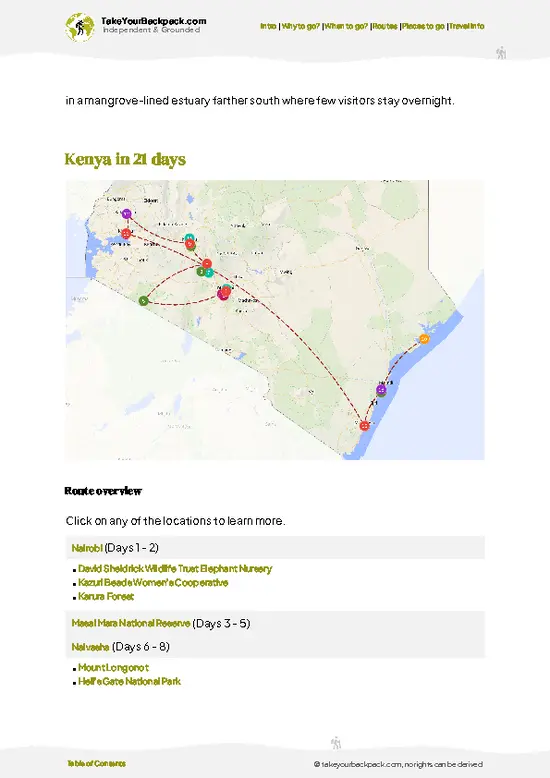
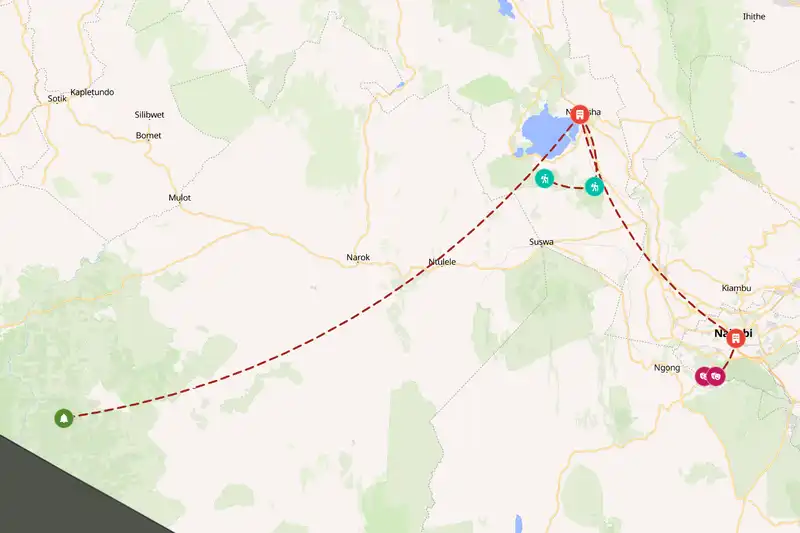
This 21-day route is for travelers who want to really dig into Kenya: multiple safari ecosystems, serious hiking, Rift Valley lakes, and both historic and laid-back stretches of the coast, with enough time to breathe in each stop. You’ll move at a moderate pace using a mix of overland transfers by private vehicle or shared shuttles, plus one or two internal hops between inland hubs and the coast to avoid back-to-back marathon drives.

Days 1-4: Nairobi & Highlands - City, culture, and foothill forests

Settle into Nairobi for a few nights to front-load the essentials and adjust before heading deeper into the country. Use a day for Nairobi National Park, the David Sheldrick Wildlife Trust Elephant Nursery, and the Giraffe Centre, which together give you wildlife, conservation, and that “I’m in Africa” feeling without leaving the city limits. Add time at the Nairobi National Museum and a visit to the Kazuri Beads Women’s Cooperative to ground yourself in Kenya’s history and contemporary craft … read more 👉
This 21-day route is for travelers who want to really dig into Kenya: multiple safari ecosystems, serious hiking, Rift Valley lakes, and both historic and laid-back stretches of the coast, with enough time to breathe in each stop. You’ll move at a moderate pace using a mix of overland transfers by private vehicle or shared shuttles, plus one or two internal hops between inland hubs and the coast to avoid back-to-back marathon drives.

Days 1-4: Nairobi & Highlands - City, culture, and foothill forests

Settle into Nairobi for a few nights to front-load the essentials and adjust before heading deeper into the country. Use a day for Nairobi National Park, the David Sheldrick Wildlife Trust Elephant Nursery, and the Giraffe Centre, which together give you wildlife, conservation, and that “I’m in Africa” feeling without leaving the city limits. Add time at the Nairobi National Museum and a visit to the Kazuri Beads Women’s Cooperative to ground yourself in Kenya’s history and contemporary craft scene, then spend a half-day walking shaded trails in Karura Forest to reset your body clock in green instead of concrete. When you’re ready to leave the city, head out to the Ngong Hills for a day hike along the ridge, catching big views back toward Nairobi and the Rift, which sets the tone for the landscapes to come.

Days 5-7: Mount Kenya & Aberdares - High-altitude drama

Travel north to Nanyuki, your launchpad for the central highlands. Dedicate a full day to Mount Kenya National Park and the lower slopes of Mount Kenya, where you can do a demanding day hike or short overnight trek without committing to a full summit expedition, still getting those giant lobelias, moorland views, and crisp mountain air. Then swing across to the Aberdare National Park and the surrounding Aberdare Range, where dense forest, waterfalls, and cooler temperatures give you a completely different feel from the open savannah, and where you can mix game viewing with hikes along forest trails.

Days 8-10: Samburu & Laikipia - Northern wildlife and dry-country culture

Continue north into Samburu National Reserve, where the landscape shifts to arid hills, doum palms, and the Ewaso Nyiro River cutting through the dry country. Spend a couple of days here looking for the so-called “Samburu Special Five” and watching elephants come down to drink at the river, which gives you a strong contrast to the southern parks. On your way back toward the central highlands, add another night around Nanyuki or nearby ranchland to break the journey and enjoy the Laikipia plateau’s big skies without rushing straight into the next region.

Days 11-13: Rift Valley lakes - Naivasha, Hell’s Gate, and Nakuru

Drop down into the Rift Valley and base yourself first in Naivasha, where you can spend a day in Hell’s Gate National Park and Hell’s Gate Gorge cycling and hiking among wildlife instead of sitting in a vehicle. Use another day to climb Mount Longonot, circling part of the crater rim for sweeping views over the Rift and the lake, which gives you a satisfying physical challenge mid-trip. Then move on to Nakuru for a couple of nights, using your time to explore Lake Nakuru and the broader Kenya Lake System in the Great Rift Valley, where you can look for rhinos, big cats, and dense birdlife along the soda lakes while still having time to enjoy town life in the evenings.

Days 14-16: Masai Mara via Narok - Classic savannah and big cats

Head overland via Narok into the Masai Mara National Reserve, giving yourself at least three nights so you can see the reserve in different lights and moods. Split your time between the main reserve and the Mara Triangle if your camp or operator offers access, focusing on early-morning and late-afternoon drives when predators are most active and the light is at its best. With this much time, you’re not just chasing sightings; you can linger with lion prides, watch cheetahs scan the plains, and follow elephant herds as they move between the river and the open grasslands.

Days 17-18: Tsavo & Voi - Red elephants and wide horizons

Make your way southeast toward Voi, the main gateway town for Tsavo, breaking the journey with a night in transit if needed so you’re not stuck in a vehicle all day. Base yourself near Voi and spend your time exploring the vast red-earth landscapes of Tsavo, where elephants dust themselves in the ochre soil and the sense of space is on a completely different scale from the Mara. The slower pace here lets you appreciate the long views, scattered rock kopjes, and the feeling of being in a truly big, wild park rather than a compact reserve.

Days 19-21: Coast time - Mombasa, Diani, and Swahili history

Finish by heading to the coast, stopping in Mombasa for at least a night to wander the old town streets and visit the Fort Jesus Museum, where centuries of trade and conflict along the Swahili coast are written into the coral-stone walls. Then continue down to Diani Beach for a couple of nights of pure downtime, trading game drives for warm Indian Ocean swims, dhow trips, and long walks on the sand. If you still have energy for one more green escape, add a day trip into Shimba Hills for cooler air, forested slopes, and a last look at wildlife before you fly out.

When you’re ready to go even deeper on another trip, pencil in a future detour to the remote Matthews Range, where forested mountains and Samburu communities make the journey feel like a true expedition.
Loading the map 🌍
film
0
0
0a
David Sheldrick Wildlife Trust Elephant Nursery
film
1
1
1a
Giraffe Centre
film
2
2
2a
Nairobi National Museum
film
3
3
3a
Karura Forest
film
4
4
4a
Ngong Hills
film
5
5
5a
Naivasha
film
6
6
6a
Hell’s Gate
film
7
7
7a
Hell’s Gate Gorge
film
8
8
8a
Lake Nakuru
film
9
9
9a
Kenya Lake System in the Great Rift Valley
film
10
10
10a
Narok
film
11
11
11a
Masai Mara National Reserve
Pixabay
film
12
12
12a
Mara Triangle
film
13
13
13a
Fort Jesus Museum
film
14
14
14a
Diani Beach
film
15
15
15a
Shimba Hills

✈️ The backpacker research shortcutKenya Travel Guide

An offline-friendly backpacking guide with optimized travel routes, ranked highlights, transport advice, and the best areas to stay.
example page 0 from our offline Travel Guide for Kenyaexample page 1 from our offline Travel Guide for Kenyaexample page 2 from our offline Travel Guide for Kenyaexample page 3 from our offline Travel Guide for Kenyaexample page 4 from our offline Travel Guide for Kenyaexample page 5 from our offline Travel Guide for Kenya
The digital guide (370 pages) contains:
114 highlights, ranked by travel appeal
Optimized 7, 14 & 21-day travel routes
Best neighborhoods to stay
How to get around
Offline-friendly for travel without Wi-Fi
👉 See all 30+ guide features

📅 Plan smarter in minutes, not weeks
Month by month travel advice
Festivals & national holidays
Budget expectations

🗺️ Go to the right places, skip the overrated ones
Honest pros & cons of destinations
Top hikes, parks & viewpoints
Lesser-known places most travelers miss
Clear “worth it vs skip it” guidance

🛏️ Travel smoothly without rookie mistakes
Best areas to stay
Transport systems explained simply
Common scams & safety advice
SIM cards, money & practical tips

🌍 Understand the country, not just visit it
Culture & traditions
52 Essential phrases & customs
Festivals worth planning around
Traveler-friendly historical context
Insights that make places more meaningful

📱 Built for real travel conditions
Fully downloadable PDF
Works completely offline
Optimized for phone use
Useful in remote areas & buses
Everything in one place
Save weeks of stressful planning
Get instant access to the full guide directly. 30-day money-back guarantee.


Sent to your inbox immediately after payment • 100% Secure Checkout
Best Backpacking Travel Advisor 2025 tourism awardBest Backpacking
Travel Advisor
2025
What others say about Take Your Backpack Guides:
⭐⭐⭐⭐⭐
Fantastic, amazing amount of information!
⭐⭐⭐⭐⭐
My goodness this is amazing, it's what I've been looking for hats off too you!
⭐⭐⭐⭐⭐
I think this is absolutely BRILLIANT
⭐⭐⭐⭐
Very complete and informative. It's still missing places, but I gotta to commend you
⭐⭐⭐⭐⭐
This is truly amazing, thank you, can't wait to explore it with my kids!
⭐⭐⭐⭐⭐
Awesome resource, thank you!
⭐⭐⭐⭐⭐
This is amazing! Can't wait to explore the ones I haven't seen
⭐⭐⭐⭐
I love this! Well done, great idea.
⭐⭐⭐⭐⭐
Thanks for taking the time to make this gem!
⭐⭐⭐⭐⭐
This might be the best website I've ever seen.
⭐⭐⭐⭐⭐
Congratulations, and thank you so much for your work; it's incredibly valuable.
⭐⭐⭐⭐
In all seriousness I think you did a great job pointing out the important spots
⭐⭐⭐⭐⭐
10/10 very good
⭐⭐⭐⭐⭐
As someone who's only just starting to visit regularly this is awesome, thank you.
⭐⭐⭐⭐
Thank you very much! I'm going to visit my dad, it's going to be very useful!
⭐⭐⭐⭐⭐
This is really cool! We'll be travelling for the first time and this definitely come in handy.
⭐⭐⭐⭐⭐
You are now our minister of culture, congratulations 👨‍💼
⭐⭐⭐⭐⭐
Just wanted to tell you that this is a pearl! Going to follow your recommendations.
⭐⭐⭐⭐⭐
This is so cool. I'll definitely be using the resource for my travels soon.
⭐⭐⭐⭐⭐
This is very impressive! Good work.
⭐⭐⭐⭐⭐
This is an amazing and informative site. Very well done!

🧭 RouteOther Route Options

Travel Kenya your way — from a quick highlights trip to a slow-paced adventure.

🙋 FAQFAQ: Backpacking Kenya

Short version: yes, Kenya is absolutely doable as an independent backpacker if you’re comfortable with a bit of chaos and basic planning.

Kenya is one of East Africa’s more backpacker-friendly countries. English and Swahili are widely spoken, people are used to travelers, and there’s a solid network of guesthouses, hostels, and simple hotels in most towns. You’ll find dorms and cheap privates in Nairobi, Mombasa, Diani, Lamu, and around the main safari hubs.

The main learning curve is transport and safety awareness, not bureaucracy. Visas are straightforward for many nationalities, ATMs are common in cities and bigger towns, and mobile money (M-Pesa) makes paying for small things easy once you set it up. You don’t need a tour company to move around the country, but you do need to be realistic about time and comfort.

Where independent backpacking feels easy:
- Coast (Mombasa, Diani, Kilifi, Watamu, Lamu): clear backpacker trail, cheap matatus, tuk-tuks, and plenty of budget beds.
- Nairobi: big city with hostels, Uber/Bolt, and day trips you can join last-minute.
- Popular parks like Maasai Mara and Amboseli: you can base yourself in a town and join group safaris.

Where it gets trickier:
- Very remote parks (Turkana, far north, some parts of Tsavo): logistics, safety, and costs jump up fast; better with a group or organized trip.
- Night travel: roads, driving standards, and occasional banditry make overnight buses and late matatus a risk you don’t need to take.

If you’ve backpacked Southeast Asia or Latin America, Kenya will feel a bit more intense and less polished, but still very doable. If this is your first big trip, it’s still manageable as long as you:
- Arrive with your first 2–3 nights booked.
- Avoid walking around big cities after dark.
- Keep valuables out of sight and use a money belt or neck pouch on long rides.
- Accept that schedules are “approximate” and build in buffer time.

Independent backpacking in Kenya rewards patience: you trade some comfort and predictability for lower costs and a lot more real-life interaction.
If you want a number: 2 weeks is a sweet spot for a first-time, budget-conscious Kenya trip. You can do less, but you’ll feel rushed; you can easily do more, but that’s the minimum where the long distances and park fees start to feel worth it.

Rough guidelines:
- 7–10 days: Good if you’re combining Kenya with Tanzania or Uganda.
Example: 2–3 days Nairobi + 3 days Maasai Mara group safari + 2–3 days on the coast (Diani or Lamu) if you fly one way.
Trade-off: you’ll be moving fast and probably need at least one domestic flight to avoid losing days on buses.

- 14 days: Ideal starter Kenya itinerary.
Example: 2 days Nairobi (city + day trip), 3 days Maasai Mara, 2–3 days Naivasha/Nakuru or Amboseli, 4–5 days coast (Diani, Kilifi, or Lamu).
This lets you mix safari, lakes, and beach without feeling like you’re living on buses.

- 3–4 weeks: For slow travelers and tight budgets.
You can:
- Take buses instead of flights between Nairobi and the coast.
- Add extra parks (Tsavo, Samburu) or more time in Naivasha/Nakuru.
- Sit still in one coastal town for a week and let your budget breathe.

Time vs. money trade-offs:
- Less time, more money: you’ll likely use domestic flights and pay for quick, organized safaris.
- More time, less money: you can hunt for group safari deals, use public transport, and stay longer in cheaper towns.

If you only have a week and you’re on a budget, it’s still worth going, but focus hard: pick either safari + Nairobi or coast + one short safari, not “everything.”
You can absolutely get around Kenya without renting a car, and for budget travelers it’s usually the smarter move.

Main options:
- Matatus (minibuses): The backbone of local transport. Cheap, frequent, and chaotic. Great for short to medium hops between towns and within regions. Expect tight seating, loud music, and variable safety standards. Sit near the front if you can.

- Long-distance buses: Best for big jumps like Nairobi–Mombasa, Nairobi–Kisumu, or Nairobi–Eldoret. More comfortable and safer than matatus, but still avoid overnight rides when possible. Book a reputable company, aim for daytime departures, and keep valuables on you, not in the hold.

- Shared taxis and tuk-tuks: Common in and around towns and on the coast. Good for short hops, beach runs, and late-afternoon returns when matatus thin out. Always agree on the price before you get in.

- Boda-bodas (motorbike taxis): Very handy in rural areas and small towns. Cheap and fast, but higher risk. Wear a helmet if one is offered and avoid them at night or on highways.

- Trains: The Nairobi–Mombasa SGR train is a game-changer for backpackers. It’s safer and more comfortable than the bus, with fixed schedules and reasonable prices. It does sell out, so book ahead when you can.

- Domestic flights: Not “budget” in the backpacker sense, but sometimes worth it to save days of travel, especially between Nairobi and the coast or remote safari airstrips. If your time is short, one strategic flight can actually save money on extra nights and transfers.

For safaris without a car:
- Join group tours from Nairobi or from gateway towns (like Narok for Maasai Mara, or towns near Amboseli). These usually include transport, park fees, and camping or basic lodges.
- Public transport rarely goes inside parks; it just gets you to the nearest town or gate. From there, you’ll need a local operator or lodge vehicle.

You don’t need to drive yourself in Kenya. Between matatus, buses, trains, and group safaris, you can cover the main highlights cheaply. The key is to travel by day, keep your plans a bit flexible, and accept that “3 hours” on paper might be 5 in real life.
For a first-time, budget-minded trip, these are the places that give you the best payoff for your time and money.

1. Maasai Mara (on a group safari)
If you do one big safari, make it this. The wildlife density is wild: lions, elephants, giraffes, big herds of herbivores, and a real chance at the full “Big Five” if you’re lucky. You don’t need a luxury lodge; budget group safaris with camping are common from Nairobi and give you the same animals for a fraction of the price.

2. Nairobi (1–2 days, not just a transit stop)
Nairobi is intense but worth a short stay. You get a feel for modern Kenyan life, good food, and some easy day trips. Backpacker-friendly highlights include:
- Karen Blixen Museum and nearby cafes if you like history and chill afternoons.
- Giraffe Centre and the elephant orphanage (book ahead) for ethical-ish wildlife encounters outside a full safari.
- Local markets and simple nyama choma (grilled meat) joints for cheap, filling meals.

3. Lake Naivasha and Hell’s Gate
This is the budget traveler’s “active safari.” You can:
- Rent a bike and ride through Hell’s Gate National Park among zebras and giraffes.
- Take a cheap boat trip on Lake Naivasha to see hippos and birds.
- Stay in simple lakeside camps or guesthouses.
It’s close to Nairobi and easy to slot into a short itinerary.

4. The Coast: Diani, Kilifi, or Lamu
You don’t need to hit every beach; pick one and stay a while.
- Diani: Classic palm-fringed beach with a social backpacker scene, cheap guesthouses, and easy access from Mombasa.
- Kilifi: More laid-back, with a strong backpacker community and good value hostels.
- Lamu: Atmospheric old town, narrow alleys, Swahili culture, and slower pace. Great if you like culture and wandering more than partying.

5. Lake Nakuru (if you want a shorter, cheaper safari add-on)
Smaller and more contained than the Mara, with good chances of seeing rhinos and plenty of birdlife. It’s often cheaper and easier to combine with Naivasha as a 2–3 day loop from Nairobi.

If you have extra time and budget, Samburu or Amboseli are strong second-tier picks, but for a first trip on a budget, the combo of Mara + Naivasha/Hell’s Gate + one coastal base gives you a very complete Kenya experience.
When time and money are tight, you have to be ruthless. These are the things I’d skip or downgrade if you’re on a backpacker budget and short on days.

1. Multiple big safaris in different parks
Doing Maasai Mara, Amboseli, Tsavo, and Samburu all in one short trip sounds epic, but park fees and transport will eat your budget. Pick one flagship park (usually Maasai Mara) and, if you want more, add a cheaper, shorter option like Lake Nakuru instead of a whole second multi-day safari.

2. Overlanding huge distances by bus just to “collect” towns
Nairobi–Mombasa–Kisumu–Eldoret–Nakuru in 10 days is a blur of bus stations and not much else. Focus on one main loop: either Nairobi + Mara + Naivasha/Nakuru or Nairobi + coast. You can always come back for the western side.

3. Expensive luxury lodges if you’re mainly there for wildlife
The animals don’t care how fancy your bed is. If your budget is tight, go for camping or basic tented camps on group safaris and spend the savings on extra days in the park or more time on the coast.

4. Rushing the entire coast
Trying to do Diani, Tiwi, Kilifi, Watamu, Malindi, and Lamu in a week means you’ll mostly see bus windows. Pick one or two spots:
- If you want social and easy logistics: Diani or Kilifi.
- If you want culture and slower pace: Lamu.
Skip the rest this time.

5. Long, complicated detours to very remote regions
Places like Lake Turkana and the far north are fascinating but logistically heavy and not cheap once you factor in guides, security considerations, and transport. If you only have 1–2 weeks and a backpacker budget, save these for a dedicated future trip.

6. Big-city nightlife as a “must-do” experience
Nairobi and Mombasa nightlife can be fun, but it’s easy to burn cash and increase your risk of petty crime in one night out. If you’re short on time and money, keep city nights low-key and put your energy into days on safari or at the beach.

If you have to choose, always prioritize: one good safari, one active inland stop (like Naivasha/Hell’s Gate), and one coastal base. Everything else is optional seasoning.

🇰🇪 KenyaExpand Your Journey

Ready to build a truly unique trip? Predefined routes are perfect for first-time visitors, but there is so much more to discover. Whether you are chasing a city trip, pristine national parks, local food scenes, or quiet beaches, pick a category to design your own path.