×

Kenya🇰🇪 | best townsEssential 5 towns to Explore in Kenya

Kenya’s towns run on matatu horns, market stalls and the rhythm of whatever landscape surrounds them. Highland towns along the Rift Valley and around Mount Kenya are cool, busy and cheap, with produce markets and frequent minibus links. Coastal towns swap that for heat, humidity, Swahili stonework, dhows and hotel prices that climb sharply in December. Western and lakeside towns move slower, sit greener and see far fewer foreigners, though roads thin out and journeys stretch. Up north, arid frontier towns demand more time, more money and more planning. For backpackers, independent travel here is refreshingly simple: matatus reach almost every town, M-Pesa handles most payments, and a dorm bed costs a sliver of a safari lodge rate. Choose your region first, then go hunting for the town that fits its pace.

By Johan Kruseman 🇳🇱 | Updated October 18, 2026
Explore the best landmarks in Kenya

Why go?Why Travelers Love These Spots

Kenya is a country where towns formed around movement. The Uganda Railway, built in the 1890s and early 1900s, created hubs like the ones strung along the Rift Valley, while Swahili trading ports on the Indian Ocean have worked monsoon routes for well over a thousand years. The result is a layered urban map: old coastal settlements with coral-stone lanes, railway and colonial-era farm towns in the highlands, and fast-growing market towns that serve rural communities from dozens of ethnic groups, including Kikuyu, Luo, Luhya, Kalenjin, Maasai and Swahili.


Geography does the sorting. The Great Rift Valley splits the country, altitude keeps the central and western highlands pleasantly cool even on the equator, and the coast stays hot and wet. That means you can change climate, food and language … read more 👉
Kenya is a country where towns formed around movement. The Uganda Railway, built in the 1890s and early 1900s, created hubs like the ones strung along the Rift Valley, while Swahili trading ports on the Indian Ocean have worked monsoon routes for well over a thousand years. The result is a layered urban map: old coastal settlements with coral-stone lanes, railway and colonial-era farm towns in the highlands, and fast-growing market towns that serve rural communities from dozens of ethnic groups, including Kikuyu, Luo, Luhya, Kalenjin, Maasai and Swahili.


Geography does the sorting. The Great Rift Valley splits the country, altitude keeps the central and western highlands pleasantly cool even on the equator, and the coast stays hot and wet. That means you can change climate, food and language in a single day, from nyama choma grills and cold nights to coconut curries and sticky heat.


Infrastructure is the other draw. Matatus link nearly every settlement, the Madaraka Express train connects Nairobi and Mombasa, domestic flights fill the gaps, and mobile money means you rarely need a stack of cash. English and Swahili are both official languages, so basic communication is easy.


Know before you choose Kenya for towns: this is not a walkable, compact-cobblestone country. Many towns are working commercial centers first and sightseeing stops second, with traffic, dust and noise to match. Distances are big and roads can be slow, so a few well-chosen stops beat a long checklist. Many visitors also treat towns as launchpads for national parks, which raises prices in gateway areas. Go with curiosity for markets, music and conversation, and Kenya returns the favor generously.
Behind the Scenes of Selection
The list of best towns in Kenya is created based on charm, local culture, atmosphere, hidden gems, and visitor appeal. If you feel a town is missing in this list, please let us know.

When to go?When to Plan Your Trip

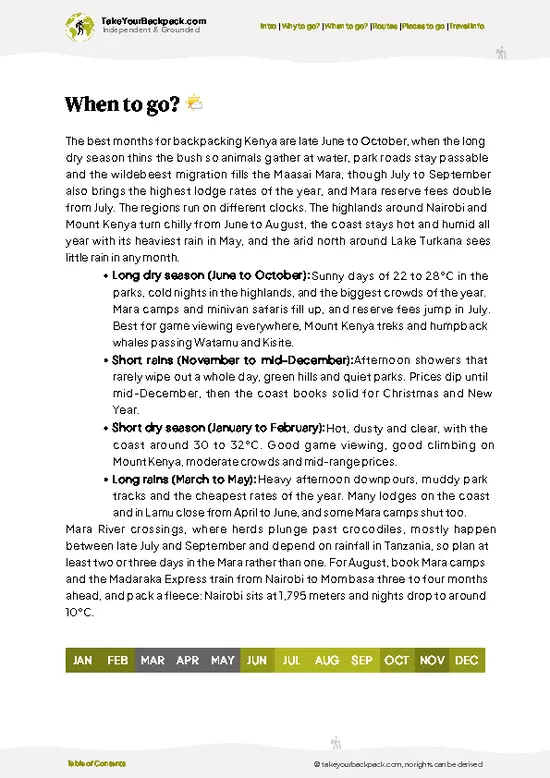
Best months for Kenya’s towns: The best months are January to February and June to October, when the main dry spells keep roads passable, skies clear and humidity manageable. Daytime highs in the highlands sit around 22 to 27°C, so walking a town center is comfortable, while the coast runs hotter at roughly 29 to 33°C.


Rainy seasons and shoulder months: The long rains arrive from March to May and are heaviest in April and May, turning dirt roads to mud and slowing matatu journeys. The short rains fall from October to December, usually as brief afternoon downpours that clear quickly. November is often a fine shoulder month, with greener hills and thinner crowds. Western Kenya around Lake Victoria sees rain across much of the year, typically as afternoon thunderstorms, so mornings are the time … read more 👉
Best months for Kenya’s towns: The best months are January to February and June to October, when the main dry spells keep roads passable, skies clear and humidity manageable. Daytime highs in the highlands sit around 22 to 27°C, so walking a town center is comfortable, while the coast runs hotter at roughly 29 to 33°C.


Rainy seasons and shoulder months: The long rains arrive from March to May and are heaviest in April and May, turning dirt roads to mud and slowing matatu journeys. The short rains fall from October to December, usually as brief afternoon downpours that clear quickly. November is often a fine shoulder month, with greener hills and thinner crowds. Western Kenya around Lake Victoria sees rain across much of the year, typically as afternoon thunderstorms, so mornings are the time for exploring. The coast takes the worst of the wet in April to June, with heavy, humid days, though that is also when hotel rates can drop by 30 to 50 percent.


Altitude and cold nights: Highland towns around Mount Kenya and the Rift Valley can drop to 8 to 12°C at night, especially in June and July. A fleece earns its place in the pack. The far north is the opposite: hot and dry, often 32 to 38°C by day, and best visited in the cooler months of June to September.


Peak periods and prices: Prices spike twice. Late December to early January is the busiest time at the coast, when beach-town rooms cost noticeably more and book out. July to October brings migration-season visitors to the south-west, which lifts rates in gateway towns near the Maasai Mara. Kenyan school holidays in April, August and December also fill buses on popular routes. Book transport a day ahead in these windows and arrive early for matatus.

town hoppingSuggested Travel Strategies

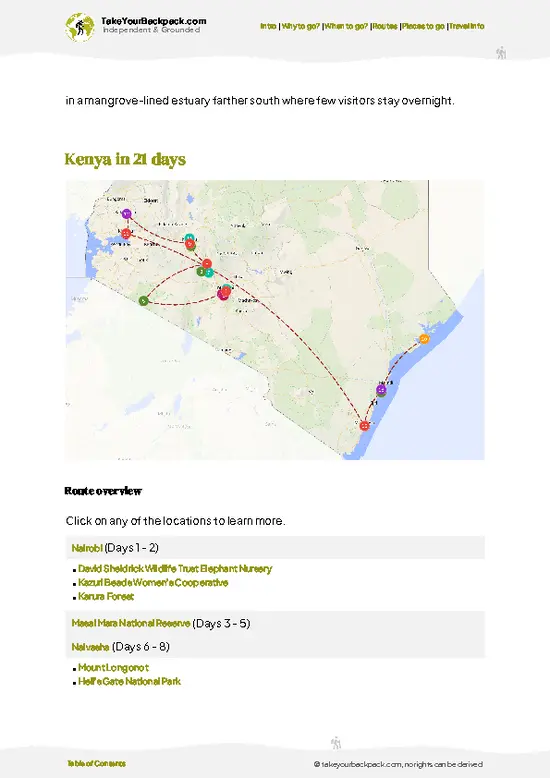
How many days to plan: A trip linking several towns in Kenya needs 10 to 21 days, because journeys eat far more time than the map suggests. Two weeks suits most backpackers well, while ten days only works if you stick to a single loop.


Which regions group well: Cluster by region, not by wish list. Nairobi is the main hub, with the central highlands and Rift Valley within 2 to 4 hours by matatu, western Kenya and Lake Victoria around 6 to 8 hours by road or about an hour by plane, and the coast 4.5 to 5 hours away on the Madaraka Express. A sensible direction is a loop: head out from Nairobi through the highlands, push west, swing back through the Rift Valley, then finish at the coast by train. That puts the slowest, hottest, most relaxed stops at the end, when your legs need them. Reaching … read more 👉
How many days to plan: A trip linking several towns in Kenya needs 10 to 21 days, because journeys eat far more time than the map suggests. Two weeks suits most backpackers well, while ten days only works if you stick to a single loop.


Which regions group well: Cluster by region, not by wish list. Nairobi is the main hub, with the central highlands and Rift Valley within 2 to 4 hours by matatu, western Kenya and Lake Victoria around 6 to 8 hours by road or about an hour by plane, and the coast 4.5 to 5 hours away on the Madaraka Express. A sensible direction is a loop: head out from Nairobi through the highlands, push west, swing back through the Rift Valley, then finish at the coast by train. That puts the slowest, hottest, most relaxed stops at the end, when your legs need them. Reaching the far northern coast adds a further 5 to 6 hours by road and boat from Mombasa, or a short flight.


Time per stop: Allow 2 to 3 nights in a town that has things to see and 1 night in a simple transit stop. Anything less than 2 nights in a coastal base wastes the long journey to get there.


Planning mistakes to dodge: The most common error is doubling back across the country, which burns whole days on the Nairobi corridor. Another is trusting a quoted journey time: matatus wait until they fill, and Nairobi traffic can add an hour or more to any departure. Plan one major transfer a day, never two. Avoid traveling after dark on intercity roads, and instead leave early, when buses run cleanest. Finally, skip tight connections around the rainy months, since flooded roads can cancel plans. Keep one spare day in the schedule, and the route stays flexible and fun.

The ListHighly Recommended towns of Kenya

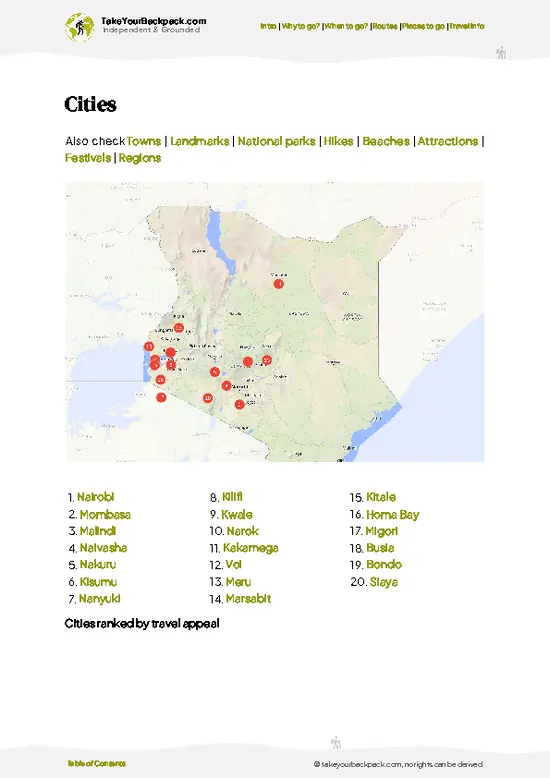
1 Lamu Old Town

Swahili architecture, dhow harbor, narrow alleys

Wander through centuries-old streets, discover intricate woodwork, and watch dhows glide past in Kenya’s best-preserved coastal settlement.

kenya-city-lamu-old-town
© Google |

2 Embu

coffee farms, Embu market, eastern highlands

Sample fresh produce in a highland town known for its coffee, and use it as a launch point for eastern Kenya’s rural landscapes.

kenya-city-embu
© Google |

3 Maralal

Samburu culture, camel safaris, forested hills

Join camel caravans or meet Samburu herders in a highland town that serves as a launch point for remote northern adventures.

4 Lodwar

Turkana heartland, desert climate, Lake Turkana access

Venture into Kenya’s northwest for a taste of Turkana culture, stark desert scenery, and the gateway to the Jade Sea’s southern shores.

kenya-city-lodwar
© Google |

5 Karatina

Open-air market, Aberdare foothills, agricultural hub

Browse one of Kenya’s largest markets and explore the fertile slopes that supply produce to much of the central region.

Loading the map 🌍

Expert viewPro Tips for Exploring the Best

How many towns to visit: Four to five towns is the number I advise for a trip of two to three weeks. That gives you two or three nights in each place, enough time to find the good food stalls, learn the matatu stages and talk to locals rather than just tick a box. Six or more turns the trip into a series of bus stations. Fewer than four means you miss the contrast that makes Kenya worth the flight: cool highland air, Lake Victoria humidity and salty coastal heat in one journey. Going deeper in fewer places costs less in transport, saves you energy and gives the most for a backpacker.


Choosing between kinds of towns: Match the kind of town to your travel style. Highland and Rift Valley towns suit anyone on a tight budget who wants markets, easy transport and cool sleeping weather. Lakeside and … read more 👉
How many towns to visit: Four to five towns is the number I advise for a trip of two to three weeks. That gives you two or three nights in each place, enough time to find the good food stalls, learn the matatu stages and talk to locals rather than just tick a box. Six or more turns the trip into a series of bus stations. Fewer than four means you miss the contrast that makes Kenya worth the flight: cool highland air, Lake Victoria humidity and salty coastal heat in one journey. Going deeper in fewer places costs less in transport, saves you energy and gives the most for a backpacker.


Choosing between kinds of towns: Match the kind of town to your travel style. Highland and Rift Valley towns suit anyone on a tight budget who wants markets, easy transport and cool sleeping weather. Lakeside and western towns suit slow travelers who value quiet, local company and few other foreigners, though the trade-off is longer, less polished transport. Coastal towns cost more but give you history, boat trips and a place to rest, so they suit trips that need a recovery phase. Northern frontier towns reward experienced travelers with more time and a bigger budget, since distances and costs rise quickly. For a first visit, I would build the trip around one highland, one western and one coastal stop, and add a fourth only if time allows.


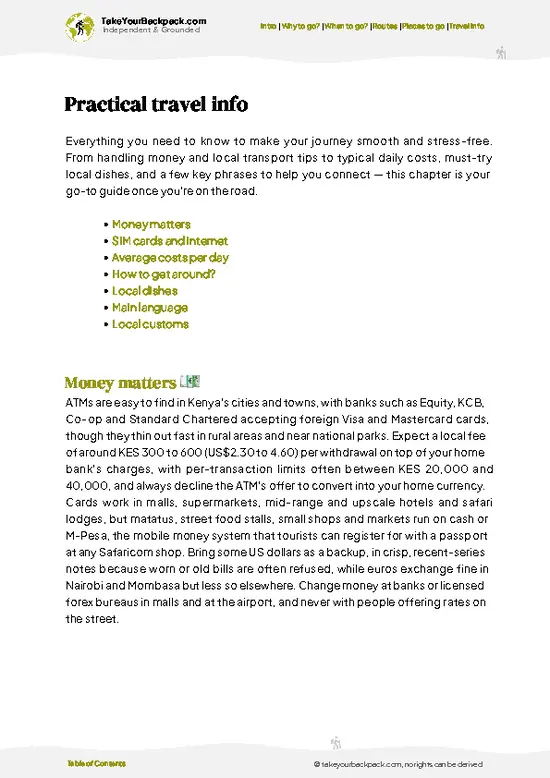
What it costs: A realistic backpacker budget is US$30 to 50 a day (about KSh 3,900 to 6,500). Dorm beds or basic guesthouse rooms run KSh 1,000 to 2,500 (US$8 to 19) in most towns, with coastal rooms at the higher end in peak season. Local meals at a hotelio or street grill cost KSh 250 to 700 (US$2 to 5), and a sit-down meal with a drink might reach KSh 1,200 to 1,800. Intercity matatus cost around KSh 500 to 1,500 (US$4 to 12) per leg, the Madaraka Express economy seat is roughly KSh 1,000 and first class costs about three times that, and boda bodas around town are KSh 50 to 300. Per visit, plan US$10 to 25 on top for entry fees to museums and forts (often KSh 500 to 1,500 for non-residents), a local guide for a walking tour (KSh 1,500 to 3,000) and the occasional boat or bike hire. Spend on guides in places with real history, since the stories behind buildings and markets are what you cannot read from a plaque. Save by skipping hotel taxis and using boda bodas and shared matatus, which cost the least and teach the most.


Safety and local etiquette: Kenyan towns are mostly friendly and relaxed, but petty theft is real, especially phone snatching in crowded bus stations and city centers. Keep valuables out of sight, carry a small day wallet and avoid walking after dark. Use a registered taxi app or a trusted driver at night. Pay with M-Pesa where you can, and keep small bills handy for matatus. Check your government’s current travel advice, as certain border regions in the north-east and parts of the coast near Somalia are treated with caution. Dress modestly in Muslim-majority coastal communities, with covered shoulders and knees for both men and women, and ask before photographing people, especially Maasai and Samburu community members, who may expect payment or simply say no. A handshake and a warm Swahili greeting such as “Jambo” or “Habari” open doors fast. Bargain politely at markets, never aggressively. Do that, and Kenyan towns will repay you with some of the best conversations on the continent.

✈️ The backpacker research shortcutKenya Travel Guide

An offline-friendly backpacking guide with optimized travel routes, ranked highlights, transport advice, and the best areas to stay.
example page 0 from our offline Travel Guide for Kenya
example page 1 from our offline Travel Guide for Kenya
example page 2 from our offline Travel Guide for Kenya
example page 3 from our offline Travel Guide for Kenya
example page 4 from our offline Travel Guide for Kenya
example page 5 from our offline Travel Guide for Kenya
example page 6 from our offline Travel Guide for Kenya
example page 7 from our offline Travel Guide for Kenya
The digital guide (365 pages) contains:
✅ 96 highlights, ranked by travel appeal
✅ Optimized 7, 14 & 21-day travel routes
✅ Cities, national parks, landmarks, beaches
✅ How to get around
✅ Offline-friendly for travel without Wi-Fi
👉 Click to see all 30+ guide features

📅 Plan smarter in minutes, not weeks
✅ Month by month travel advice
✅ Festivals & national holidays
✅ Budget expectations

🗺️ Go to the right places, skip the overrated ones
✅ Honest pros & cons of destinations
✅ Top hikes, parks & viewpoints
✅ Lesser-known places most travelers miss
✅ Clear “worth it vs skip it” guidance

🛏️ Travel smoothly without rookie mistakes
✅ Best areas to stay
✅ Transport systems explained simply
✅ Common scams & safety advice
✅ SIM cards, money & practical tips

🌍 Understand the country, not just visit it
✅ Culture & traditions
✅ 52 Essential phrases & customs
✅ Festivals worth planning around
✅ Traveler-friendly historical context
✅ Insights that make places more meaningful

📱 Built for real travel conditions
✅ Fully downloadable PDF
✅ Works completely offline
✅ Optimized for phone use
✅ Useful in remote areas & buses
✅ Everything in one place
Stop searching, start planning
Get instant access to your full guide. 30‑day money-back guarantee.
+ Add another guide for just

By proceeding you agree to our terms.
Sent to your inbox immediately after payment • 100% Secure Checkout
Best Backpacking Travel Advisor 2025 tourism awardBest Backpacking
Travel Advisor
2025
What others say about Take Your Backpack Guides:
⭐⭐⭐⭐⭐
Fantastic, amazing amount of information!
⭐⭐⭐⭐⭐
My goodness this is amazing, it's what I've been looking for hats off too you!
⭐⭐⭐⭐⭐
I think this is absolutely BRILLIANT
⭐⭐⭐⭐
Very complete and informative. It's still missing places, but I gotta to commend you
⭐⭐⭐⭐⭐
This is truly amazing, thank you, can't wait to explore it with my kids!
⭐⭐⭐⭐⭐
Awesome resource, thank you!
⭐⭐⭐⭐⭐
This is amazing! Can't wait to explore the ones I haven't seen
⭐⭐⭐⭐
I love this! Well done, great idea.
⭐⭐⭐⭐⭐
Thanks for taking the time to make this gem!
⭐⭐⭐⭐⭐
This might be the best website I've ever seen.
⭐⭐⭐⭐⭐
Congratulations, and thank you so much for your work; it's incredibly valuable.
⭐⭐⭐⭐
In all seriousness I think you did a great job pointing out the important spots
⭐⭐⭐⭐⭐
10/10 very good
⭐⭐⭐⭐⭐
As someone who's only just starting to visit regularly this is awesome, thank you.
⭐⭐⭐⭐
Thank you very much! I'm going to visit my dad, it's going to be very useful!
⭐⭐⭐⭐⭐
This is really cool! We'll be travelling for the first time and this definitely come in handy.
⭐⭐⭐⭐⭐
You are now our minister of culture, congratulations 👨‍💼
⭐⭐⭐⭐⭐
Just wanted to tell you that this is a pearl! Going to follow your recommendations.
⭐⭐⭐⭐⭐
This is so cool. I'll definitely be using the resource for my travels soon.
⭐⭐⭐⭐⭐
This is very impressive! Good work.
⭐⭐⭐⭐⭐
This is an amazing and informative site. Very well done!

🛏️ Where to stay?Where to Stay: Kenya Edition

Kenya has a solid spread of hostels, backpacker guesthouses and campsites, with dorm beds typically running KSh 1,500 to 2,500 (about US$12 to 20) and campsites cheaper still. In Nairobi, Westlands has the most nightlife, restaurants and transport links but gets loud on weekends, leafy Kilimani and Kileleshwa are quieter and feel safer to walk at dusk, and Karen and Langata put you close to the national park and giraffe sanctuary at the cost of long, traffic-choked rides into town. The cheap lodgings of the CBD save money but are unpleasant after dark, while on the coast Diani and Lamu Old Town offer the best beach and old-town budget stays, and Naivasha lakeside campsites are the classic low-cost … read more 👉
Kenya has a solid spread of hostels, backpacker guesthouses and campsites, with dorm beds typically running KSh 1,500 to 2,500 (about US$12 to 20) and campsites cheaper still. In Nairobi, Westlands has the most nightlife, restaurants and transport links but gets loud on weekends, leafy Kilimani and Kileleshwa are quieter and feel safer to walk at dusk, and Karen and Langata put you close to the national park and giraffe sanctuary at the cost of long, traffic-choked rides into town. The cheap lodgings of the CBD save money but are unpleasant after dark, while on the coast Diani and Lamu Old Town offer the best beach and old-town budget stays, and Naivasha lakeside campsites are the classic low-cost base in the Rift Valley.

If you enjoy meeting fellow travelers, consider choosing hostels with high ratings for atmosphere. On the other hand, if you prefer having your own space, a hotel might be a better option.

KenyaExplore Beyond This Category

👋 Meet the founderWho’s Behind Take Your Backpack?

Johan, backpacker and founder of TakeYourBackpackHi, I’m Johan (Netherlands 🇳🇱), the creator of TakeYourBackpack. Over the past 3 decades, I’ve backpacked through 90+ countries across six continents, gaining extensive experience with independent travel, long-term trips, and overland routes.

This site is built on a combination of firsthand travel experience and carefully curated insights from other backpackers. Many guides are based on places I’ve personally visited, while others bring together tips, observations, and practical advice shared by trusted travelers I’ve met along the way.

The goal is to provide realistic, experience-driven guidance — not generic itineraries — so you can explore destinations with better context, clearer expectations, and more confidence.